biology2025

Nicole Jennings

November 21, 2025
by njenn009
0 comments

End of Term Reflection

End of Term Reflection

One thing I learned in Cell Biology is about all of the various specialized cells in the immune system. The various different types of these cells, and their functions. Such as the various types of white blood cells, or, leukocytes. And how they all work together to form a cohesive, working immune system able to fight off bacteria and viruses. While also even attacking itself in some instances. As well as how they communicate such as through the use of Cytokines. Which are proteins that chemically signal other cells in an immune response. One such leukocyte is the Macrophage, a white blood cell that engulfs and destroys pathogens and intruders through phagocytosis by essentially eating them and pulling them into its phagosome, a membrane bound vesicle. There are also other leukocytes such as B-cells that make antibodies, T-cells that help in coordination, as well as Neutrophils that act in much the same way as Macrophages. I learned how these immune cells see these threats, and the chain reaction of events that take place and cause them to fall into action. I learned how there are hundreds to thousands to millions of actions that take place at a single given event, just to achieve a single goal and response. Such as attacking a pathogen that could make one sick. This knowledge is greatly needed for my, hopefully, eventual profession in biology. As this directly relates to a field I may considering entering, such as Microbiology, and the lab work I would like to do. This course definitely opened my eyes to all of the inner workings into how the immune system responds to invaders. While also helping me grow as a student in now finally understand each cell’s part in the bigger picture of an immune response. It was a very interesting course, and one necessary to help further my education on the subject.

November 21, 2025
by njenn009
0 comments

Scientific Literacy Essay

How Pythons and Other Animals Digest Bones and Intestinal Crypt Cells in Snakes

Nicole Jennings

Biology, Old Dominion University

BIOL 293: Cell Biology

Dr. Christina Steel

10/5/2025-11/9/2025

How Pythons and Other Animals Digest Bones

While there are many carnivores in the food chain, very few can completely render their entire meal. Most eating only the flesh, fat and soft tissues. There are very few carnivores that can digest bone. However, snakes, especially large constrictors such as the Burmese python, are in fact one of those few animals that can completely digest their entire meals, including the bones. They not only digest the bones, but the bones are also a much-needed resource in their diets. One has to wonder however, just how they are able to do so when most carnivores cannot.

One reason may be their use of intestinal plasticity. Which is the ability to completely change the structure of their gut in response to their feeding. They can change both the size and function of their gut in response to eating their prey. They not only change the structure, but also the enzymes which they use to completely digest their meals (Secor, 2018). Large snakes, such as the Burmese python, can have large fasting breaks between meals as they are more ambush predators than hunters. This means that their stomach and intestines, are in a different state during a fasting period compared to when they are finally digesting a meal. While waiting for a meal, they use very little energy, and their digestive tract is significantly smaller. Having reduced their metabolic maintenance, they are able to go long periods without a meal (Wood, 2025). However, once fed, their digestive tract goes into over-drive. Their ability to increase the mass and function of their digestive tract allows for energy to be maximized in the digestion of the meal. Allowing for large amounts of enzymes and acids to be excreted (Secor, 2018). Fast tracking the digestion of their food. It is through such an endeavor that the Burmese python is then able to prioritize not just the consumption of flesh, but also the intake of calcium and phosphorous that they receive through the digestion of the prey’s bones. A necessary resource for them. As it is with many animals such as carnivores.

Thoughts arise though as to how the snakes are able to regulate the amount of phosphorous and calcium they take in from their thoroughly digested meals. While also not allowing for an overabundance of both calcium and phosphorous. It may be in part due to parathyroid hormones, an 84 amino-acid single chain polypeptide (Aurbach, 1988) as well as calcitonin that regulates these levels in vertebrates. Keeping these levels in check. The parathyroid hormone controls calcium and phosphorous intake through many means. PTH controls calcium levels through its calcium-mobilizing factors. Allowing for control of calcium synthesis and intestinal calcium absorption. As well as stimulation of osteoclast activity and controlling renal phosphate excretions. PTH, through osteoclast activity, releases calcium and phosphates into the blood stream. The kidneys then reabsorb the calcium while the phosphates are excreted through renal means. While PTH takes more of a primary role, Calcitonin is also extremely significant in that it inhibits the reabsorption of calcium. The opposite of PTH. Calcitonin increases calcium and phosphate excretions allowing for lower levels of the two through inhibiting osteoclastic activities. While working against each other in the process of in-taking or excreting the extra calcium and phosphorous, they are in fact working together to achieve a homeostasis that keeps calcium and phosphorous levels in check. This kind of homeostasis helps vertebrates, including the Burmese python, with bone growth, muscle functions and metabolism (Wendelaar, 1991). Which are necessary for their existence.

Such findings, though, had to be achieved first through the study of the snake’s intestinal wall and enterocytes. Before we could understand the roles of calcitonin and parathyroid hormones, we first had to look at the bigger picture of how the snakes could absorb calcium through their intestines. This was done using light and electron microscopy. Electron microscopy is the use of electrons in the form of a beam to enhance the resolution of the microscopic specimens being studied, such as cells, and enhance them in a way to be easily studied. What could be nanometers in length is enhanced to a resolution that can be easily distinguished and used. However, to be extremely efficient in their research, other methods alongside electron microscopy are used. Such as Energy-Dispersive X-Ray or EDX. EDX is a technique used to detect elements and their amounts in the samples that are being examined using the electron microscope. Such techniques can be used to study nanoparticles, and elements that are accumulated in tissues (Scimeca, 2018). Much like the study of the Burmese pythons, EDX can be used in detecting both calcium and phosphorous in their bones and tissues, as well as the amounts of each element. Helping us to understand how they can digest their meals whole and absorb so much phosphorous and calcium through the ingestion of bones without over accumulating them.

We may now have a greater insight of how snakes, like the Burmese python, are able to not only digest bone but in fact find it necessary to do so. Through many techniques, such as EDX and electron microscopy, we can better understand their use of intestinal plasticity and its role in how these snakes digest bone. While also getting a deeper comprehension of how parathyroid hormones and calcitonin help keep the homeostasis and balance of these amounts these snakes take in through the absorption of bone. With more studies, there will undoubtedly be a better understanding of not just how snakes but other osteophagous animals consume and digest bone. As well as why such practices are necessary for the organism’s ability to live, thrive and reproduce.

Intestinal Crypt Cells in Snakes

How snakes can completely digest their prey, bones and all, has fascinated scientists and researchers for ages. However, trying to figure out exactly how they accomplish such a feat is no easy task. As there are many components, all working together, that give snakes this amazing ability. Snakes, however, find swallowing their food whole as a necessity, and being able to completely digest bone is an essential part of their way of life. As they need bones for their calcium and phosphorous intake (Starr).

However, surely digesting large amounts of calcium and phosphorous can lead to compromising effects and become detrimental to the snake. One must wonder how these snakes avoid taking in so much calcium and phosphorus without having any disastrous effects. One possible way is through what is being considered as a possible newly discovered cell type found in the snake’s intestines. A sort of enterocyte-like cell that has microvilli of various sizes, depending on whether the snake was fed or fasting, with folds that form crypts (Lignot, Pope, Secor). These crypts appear as tiny little pouches that hold ingested particles along the snake’s intestines. These crypts, however, look quite different based on their diet. Whether it be their normal diet, lack thereof, or even during fasting. In fact, these crypts can look different even when infused with extra calcium in comparison to their normal intake. For snakes fasting, these crypts were completely empty with tiny microvilli. This would make sense as there would be no calcium or phosphorous intake with no food. For snakes fed a boneless diet, the crypts appeared to be filled with small amounts of material, however it appears that this material was in fact very tiny amounts of calcium and phosphorus, or none at all, with rather low amounts of iron. With the iron itself showing on the scans. Snakes fed boneless prey enriched with calcium supplements, or extra calcium, showed almost all crypts completely filled to the brim with calcium and phosphorous. Snakes fed their normal diet, however, showed elongated microvilli in comparison and did in fact show larger particles in their crypts. Though not nearly as full.

Different particles in the crypts appear very differently in scans based on the snake’s diet. Fasting snakes showed no particles. This occurs due to the snake not digesting any material. Particles found in crypts of snakes that were fed boneless meals appear very dark, indicating that there are indeed particles, but that it is in fact iron and not calcium. Showing that food had been digested, but only small amounts of calcium and phosphorus had been ingested as well. Which is in contrast to what calcium shows up as under EDX analysis. Here, calcium shows up as a large, bright white particle or particles that in some cases completely fill the crypts. This is most especially seen in the calcium infused boneless meals given to snakes as they show up as a beacon of light under EDX. This occurs after the snake has ingested a meal with so much calcium that it cannot make use of it all. Snakes fed a typical normal diet showed crypts not nearly as bright, but showed crypts most definitely filled with particles or solid materials of calcium. This would also be more understanding as the normal diet not only consists of calcium but also phosphorous and iron in large amounts as well. The majority of particles found in these crypts are of phosphorous, iron, small amounts of oxygen, and calcium depending on the diet given to the snake. Snakes that were given diets rich with calcium will show as such. However, in snakes given boneless meals, these crypts will generally be filled with small amounts of all particles consisting of iron and oxygen, as well as small amounts of phosphorous and sulfur. They will also typically show little to no calcium at all however.

Regardless of whether their meals have little calcium or are absolutely enriched with it, snakes must still find a way to regulate it all. They do this through the use of calcitonin and parathyroid hormone, or PTH. Calcitonin is used to help regulate calcium in the blood by inhibiting the osteoclast’s ability to break down bone and releasing calcium. Slowing down the amount that is absorbed (Kaplan). Calcitonin also helps with the removal of extra calcium by helping with excreting it through the kidneys. PTH is both used in conjunction with calcitonin and against it. This actually helps them work together when it comes to regulating calcium levels in the blood. As PTH helps excrete phosphorous through the kidneys, allowing more calcium to be absorbed (Kaplan). This back-and-forth fight between PTH’s wanting to absorb calcium, and calcitonin wanting to prevent it, allows for the snake to regulate just the right amount of calcium necessary in the blood stream. This regulation of calcium levels in the blood, however, is affectively changed based on the diet of the snake. Snakes fed a normal diet or fasting seemed to have relatively close to the same levels of calcitonin and calcium. With fasting snakes having a slightly elevated level of both. With PTH, however, snakes that were fasted had much lower levels than fed snakes. Snakes fed a boneless no calcium meal seemed to have had a decrease over each meal in calcium. This would make sense as there was little to no calcium in the meals given, thus levels will drop. Their calcitonin levels seemed to be somewhat maintained though throughout their meals, which would also come naturally. As their meals lacked calcium, there would be little to no change in the calcitonin levels needed to inhibit absorption. The PTH levels in snakes fed low or no calcium meals seem to skyrocket as expected. While these snakes received little if any calcium, they were still absorbing phosphorus. These levels are expected as the snakes, regardless of calcium levels, still needed their phosphorus levels to be maintained and regulated so that they do not overdose on it.

It is a very interesting subject, the idea that a new cell has been found in snakes that could be the answer to how snakes are able to accomplish the undertaking of digesting a meal whole, bones and all. I think more experiments need to take place before a definitive answer can be found. The number of snakes used appears too small. Without more snakes being used in the experiment, it could be said that it was a coincidence that these few snakes just happened to have this specialized new cell. There really is no true control group. It could be said that other snakes of the same species may not actually have these cells and that the snakes used were anomalies. They also only used one species of snake. Without using other species of snakes, we cannot say for certain that all snakes digest bones using these specialized cells as we don’t know if all snakes have them. Or even if other species of snakes do, we don’t know if they are used in the same fashion. There is also the idea that this is a new cell type. By new, we don’t know if they mean newly discovered, or that snakes recently developed this new specialized cell and could have been digesting the bones of their meals in another way. I believe not only that other experiments should be carried out with other species of snakes, but also other animals. Animals such as the bearded vulture also digest bones. If it is found that they too have the same specialized cells, or cells specialized in much the same way but different, then this cell would not be considered new. Perhaps though this newly discovered cell is instead a primitive version of other crypt cells. In which case, I agree it would be a new discovery. Ultimately, I think the researchers did a good job making the case that this new crypt cell could be a new cell. Though I still think more research needs to be done. New experiments done. Perhaps even with different meals other than rats, such as birds. There are far too many flaws and not enough variables to show that this is the concluding factor in how snakes digest bones and control calcium intake. However, I do think they made great progress on the subject that otherwise had not been done before. I believe that it is a very interesting, though not fully researched area that they definitely did a great job with bringing the subject to light and pioneering the research to start further studies.

References

Secor, S. M. (2008, December). Digestive physiology of the Burmese python: Broad Regulation of Integrated Performance. PubMed. https://pubmed.ncbi.nlm.nih.gov/19043049/

Wood, M. E., & Ruxton, G. D. (2025, January 15). A model of Optimal Digestive Strategy in Infrequently-Feeding Snakes. Springer Nature. https://link.springer.com/article/10.1007/s10682-024-10328-x

Wendelaar Bonga, S. E., & Pang, P. K. (1991). Control of calcium regulating hormones in the vertebrates: Parathyroid hormone, calcitonin, prolactin, and Stanniocalcin. International review of cytology. https://pubmed.ncbi.nlm.nih.gov/1917377/  https://core.ac.uk/reader/16107312?utm_source=linkout

Aurbach, G. D. (1988). Calcium-regulating hormones: Parathyroid hormone and Calcitonin. SpringerLink. https://link.springer.com/chapter/10.1007/978-1-4471-1437-6_3

Scimeca, M., Bischetti, S., Lamsira, H. K., Bonfiglio, R., & Bonanno, E. (2018, March). Energy dispersive X-ray (EDX) microanalysis: A powerful tool in biomedical research and diagnosis. European journal of histochemistry . https://pubmed.ncbi.nlm.nih.gov/29569878/

Starr, M. (2025, July 9). New cell discovered in pythons allows them to completely digest bones. ScienceAlert. https://www.sciencealert.com/new-cell-discovered-in-pythons-allows-them-to-completely-digest-bones

Lignot, J.-H., Pope, R. K., & Secor, S. M. (2025, July). Diet-dependent production of calcium- and phosphorus-rich ‘spheroids’ along the intestine of Burmese pythons: Identification of a new cell type? | journal of experimental biology | the company of Biologists. Journal of Experimental Biology. https://journals.biologists.com/jeb/article-abstract/228/14/jeb249620/368391/Diet-dependent-production-of-calcium-and?redirectedFrom=fulltext https://journals.biologists.com/jeb/article-abstract/228/14/jeb249620/368391/Diet-dependent-production-of-calcium-and?redirectedFrom=fulltext

Virata, J. (2025, July 10). Burmese python intestinal cells help Digest Bones. Reptiles Magazine. https://reptilesmagazine.com/burmese-python-intestinal-cells-help-digest-bones/?srsltid=AfmBOopO5HbTabQLBbrxmsLWkMkbzg1HjMCcEXXYYg5BOboTc4V4HdBp https://reptilesmagazine.com/burmese-python-intestinal-cells-help-digest-bones/?srsltid=AfmBOopO5HbTabQLBbrxmsLWkMkbzg1HjMCcEXXYYg5BOboTc4V4HdBp

Bassi, M. (2025, July 18). Researchers discover the trick that allows Burmese pythons to digest the bones of their prey. Smithsonian Magazine. https://www.smithsonianmag.com/smart-news/researchers-discover-the-trick-that-allows-burmese-pythons-to-digest-the-bones-of-their-prey-180987006/ https://www.smithsonianmag.com/smart-news/researchers-discover-the-trick-that-allows-burmese-pythons-to-digest-the-bones-of-their-prey-180987006/

Kaplan, M. (2014, January 1). Calcium metabolism and metabolic bone disease. Herpcare Collection. https://www.anapsid.org/mbd2.html

Lignot J., Pope R. K., & Secor S. M. (2025). Diet-dependent production of calcium- and phosphorus-rich ‘spheroids’ along the intestine of Burmese pythons: identification of a new cell type?. Journal of Experimental Biology, 228(14), Page. 10.1242/jeb.249620

November 8, 2025
by njenn009
0 comments

Scientific Literacy 2: Data Analysis

Intestinal Crypt Cells

Nicole Jennings

Biology, Old Dominion University

BIOL 293: Cell Biology

Dr. Christina Steel

11/9/2025

Intestinal Crypt Cells in Snakes

How snakes can completely digest their prey, bones and all, has fascinated scientists and researchers for ages. However, trying to figure out exactly how they accomplish such a feat is no easy task. As there are many components, all working together, that give snakes this amazing ability. Snakes, however, find swallowing their food whole as a necessity, and being able to completely digest bone is an essential part of their way of life. As they need bones for their calcium and phosphorous intake (Starr).

However, surely digesting large amounts of calcium and phosphorous can lead to compromising effects and become detrimental to the snake. One must wonder how these snakes avoid taking in so much calcium and phosphorus without having any disastrous effects. One possible way is through what is being considered as a possible newly discovered cell type found in the snake’s intestines. A sort of enterocyte-like cell that has microvilli of various sizes, depending on whether the snake was fed or fasting, with folds that form crypts (Lignot, Pope, Secor). These crypts appear as tiny little pouches that hold ingested particles along the snake’s intestines. These crypts, however, look quite different based on their diet. Whether it be their normal diet, lack thereof, or even during fasting. In fact, these crypts can look different even when infused with extra calcium in comparison to their normal intake. For snakes fasting, these crypts were completely empty with tiny microvilli. This would make sense as there would be no calcium or phosphorous intake with no food. For snakes fed a boneless diet, the crypts appeared to be filled with small amounts of material, however it appears that this material was in fact very tiny amounts of calcium and phosphorus, or none at all, with rather low amounts of iron. With the iron itself showing on the scans. Snakes fed boneless prey enriched with calcium supplements, or extra calcium, showed almost all crypts completely filled to the brim with calcium and phosphorous. Snakes fed their normal diet, however, showed elongated microvilli in comparison and did in fact show larger particles in their crypts. Though not nearly as full.

Different particles in the crypts appear very differently in scans based on the snake’s diet. Fasting snakes showed no particles. This occurs due to the snake not digesting any material. Particles found in crypts of snakes that were fed boneless meals appear very dark, indicating that there are indeed particles, but that it is in fact iron and not calcium. Showing that food had been digested, but only small amounts of calcium and phosphorus had been ingested as well. Which is in contrast to what calcium shows up as under EDX analysis. Here, calcium shows up as a large, bright white particle or particles that in some cases completely fill the crypts. This is most especially seen in the calcium infused boneless meals given to snakes as they show up as a beacon of light under EDX. This occurs after the snake has ingested a meal with so much calcium that it cannot make use of it all. Snakes fed a typical normal diet showed crypts not nearly as bright, but showed crypts most definitely filled with particles or solid materials of calcium. This would also be more understanding as the normal diet not only consists of calcium but also phosphorous and iron in large amounts as well. The majority of particles found in these crypts are of phosphorous, iron, small amounts of oxygen, and calcium depending on the diet given to the snake. Snakes that were given diets rich with calcium will show as such. However, in snakes given boneless meals, these crypts will generally be filled with small amounts of all particles consisting of iron and oxygen, as well as small amounts of phosphorous and sulfur. They will also typically show little to no calcium at all however.

Regardless of whether their meals have little calcium or are absolutely enriched with it, snakes must still find a way to regulate it all. They do this through the use of calcitonin and parathyroid hormone, or PTH. Calcitonin is used to help regulate calcium in the blood by inhibiting the osteoclast’s ability to break down bone and releasing calcium. Slowing down the amount that is absorbed (Kaplan). Calcitonin also helps with the removal of extra calcium by helping with excreting it through the kidneys. PTH is both used in conjunction with calcitonin and against it. This actually helps them work together when it comes to regulating calcium levels in the blood. As PTH helps excrete phosphorous through the kidneys, allowing more calcium to be absorbed (Kaplan). This back-and-forth fight between PTH’s wanting to absorb calcium, and calcitonin wanting to prevent it, allows for the snake to regulate just the right amount of calcium necessary in the blood stream. This regulation of calcium levels in the blood, however, is affectively changed based on the diet of the snake. Snakes fed a normal diet or fasting seemed to have relatively close to the same levels of calcitonin and calcium. With fasting snakes having a slightly elevated level of both. With PTH, however, snakes that were fasted had much lower levels than fed snakes. Snakes fed a boneless no calcium meal seemed to have had a decrease over each meal in calcium. This would make sense as there was little to no calcium in the meals given, thus levels will drop. Their calcitonin levels seemed to be somewhat maintained though throughout their meals, which would also come naturally. As their meals lacked calcium, there would be little to no change in the calcitonin levels needed to inhibit absorption. The PTH levels in snakes fed low or no calcium meals seem to skyrocket as expected. While these snakes received little if any calcium, they were still absorbing phosphorus. These levels are expected as the snakes, regardless of calcium levels, still needed their phosphorus levels to be maintained and regulated so that they do not overdose on it.

It is a very interesting subject, the idea that a new cell has been found in snakes that could be the answer to how snakes are able to accomplish the undertaking of digesting a meal whole, bones and all. I think more experiments need to take place before a definitive answer can be found. The number of snakes used appears too small. Without more snakes being used in the experiment, it could be said that it was a coincidence that these few snakes just happened to have this specialized new cell. There really is no true control group. It could be said that other snakes of the same species may not actually have these cells and that the snakes used were anomalies. They also only used one species of snake. Without using other species of snakes, we cannot say for certain that all snakes digest bones using these specialized cells as we don’t know if all snakes have them. Or even if other species of snakes do, we don’t know if they are used in the same fashion. There is also the idea that this is a new cell type. By new, we don’t know if they mean newly discovered, or that snakes recently developed this new specialized cell and could have been digesting the bones of their meals in another way. I believe not only that other experiments should be carried out with other species of snakes, but also other animals. Animals such as the bearded vulture also digest bones. If it is found that they too have the same specialized cells, or cells specialized in much the same way but different, then this cell would not be considered new. Perhaps though this newly discovered cell is instead a primitive version of other crypt cells. In which case, I agree it would be a new discovery. Ultimately, I think the researchers did a good job making the case that this new crypt cell could be a new cell. Though I still think more research needs to be done. New experiments done. Perhaps even with different meals other than rats, such as birds. There are far too many flaws and not enough variables to show that this is the concluding factor in how snakes digest bones and control calcium intake. However, I do think they made great progress on the subject that otherwise had not been done before. I believe that it is a very interesting, though not fully researched area that they definitely did a great job with bringing the subject to light and pioneering the research to start further studies.

References

Starr, M. (2025, July 9). New cell discovered in pythons allows them to completely digest bones. ScienceAlert.  https://www.sciencealert.com/new-cell-discovered-in-pythons-allows-them-to-completely-digest-bones

Lignot, J.-H., Pope, R. K., & Secor, S. M. (2025, July). Diet-dependent production of calcium- and phosphorus-rich ‘spheroids’ along the intestine of Burmese pythons: Identification of a new cell type? | journal of experimental biology | the company of Biologists. Journal of Experimental Biology. https://journals.biologists.com/jeb/article-abstract/228/14/jeb249620/368391/Diet-dependent-production-of-calcium-and?redirectedFrom=fulltext https://journals.biologists.com/jeb/article-abstract/228/14/jeb249620/368391/Diet-dependent-production-of-calcium-and?redirectedFrom=fulltext

Virata, J. (2025, July 10). Burmese python intestinal cells help Digest Bones. Reptiles Magazine. https://reptilesmagazine.com/burmese-python-intestinal-cells-help-digest-bones/?srsltid=AfmBOopO5HbTabQLBbrxmsLWkMkbzg1HjMCcEXXYYg5BOboTc4V4HdBp https://reptilesmagazine.com/burmese-python-intestinal-cells-help-digest-bones/?srsltid=AfmBOopO5HbTabQLBbrxmsLWkMkbzg1HjMCcEXXYYg5BOboTc4V4HdBp

Bassi, M. (2025, July 18). Researchers discover the trick that allows Burmese pythons to digest the bones of their prey. Smithsonian Magazine. https://www.smithsonianmag.com/smart-news/researchers-discover-the-trick-that-allows-burmese-pythons-to-digest-the-bones-of-their-prey-180987006/  https://www.smithsonianmag.com/smart-news/researchers-discover-the-trick-that-allows-burmese-pythons-to-digest-the-bones-of-their-prey-180987006/

Kaplan, M. (2014, January 1). Calcium metabolism and metabolic bone disease. Herpcare Collection. https://www.anapsid.org/mbd2.html

Lignot J., Pope R. K., & Secor S. M. (2025). Diet-dependent production of calcium- and phosphorus-rich ‘spheroids’ along the intestine of Burmese pythons: identification of a new cell type?. Journal of Experimental Biology, 228(14), Page. 10.1242/jeb.249620

October 29, 2025
by njenn009
0 comments

Cell Biology Meme

https://www.reddit.com/r/ExplainTheJoke/comments/1bpqei2/apparently_its_an_oldie/

The mitochondria is talked about quite a bit in this subject, almost ad nauseum. Rightfully so, it is the ‘Powerhouse of the Cell’ and is a major component to not only how the cell works but ultimately how the cell, and everything, essentially lives. You simply cannot escape it.

https://www.reddit.com/r/ExplainTheJoke/comments/1bpqei2/apparently_its_an_oldie/

October 6, 2025
by njenn009
0 comments

Scientific Literacy 1: Background Essay

How Pythons and Other Animals Digest Bones

Nicole Jennings

Biology, Old Dominion University

BIOL 293: Cell Biology

Dr. Christina Steel

10/5/2025

How Pythons and Other Animals Digest Bones

While there are many carnivores in the food chain, very few can completely render their entire meal. Most eating only the flesh, fat and soft tissues. There are very few carnivores that can digest bone. However, snakes, especially large constrictors such as the Burmese python, are in fact one of those few animals that can completely digest their entire meals, including the bones. They not only digest the bones, but the bones are also a much-needed resource in their diets. One has to wonder however, just how they are able to do so when most carnivores cannot.

One reason may be their use of intestinal plasticity. Which is the ability to completely change the structure of their gut in response to their feeding. They can change both the size and function of their gut in response to eating their prey. They not only change the structure, but also the enzymes which they use to completely digest their meals (Secor 2018). Large snakes, such as the Burmese python, can have large fasting breaks between meals as they are more ambush predators than hunters. This means that their stomach and intestines, are in a different state during a fasting period compared to when they are finally digesting a meal. While waiting for a meal, they use very little energy, and their digestive tract is significantly smaller. Having reduced their metabolic maintenance, they are able to go long periods without a meal (Wood, 2025). However, once fed, their digestive tract goes into over-drive. Their ability to increase the mass and function of their digestive tract allows for energy to be maximized in the digestion of the meal. Allowing for large amounts of enzymes and acids to be excreted (Secor, 2018). Fast tracking the digestion of their food. It is through such an endeavor that the Burmese python is then able to prioritize not just the consumption of flesh, but also the intake of calcium and phosphorous that they receive through the digestion of the prey’s bones. A necessary resource for them. As it is with many animals such as carnivores.

Thoughts arise though as to how the snakes are able to regulate the amount of phosphorous and calcium they take in from their thoroughly digested meals. While also not allowing for an overabundance of both calcium and phosphorous. It may be in part due to parathyroid hormones, an 84 amino-acid single chain polypeptide (Aurbach, 1988) as well as calcitonin that regulates these levels in vertebrates. Keeping these levels in check. The parathyroid hormone controls calcium and phosphorous intake through many means. PTH controls calcium levels through its calcium-mobilizing factors. Allowing for control of calcium synthesis and intestinal calcium absorption. As well as stimulation of osteoclast activity and controlling renal phosphate excretions. PTH, through osteoclast activity, releases calcium and phosphates into the blood stream. The kidneys then reabsorb the calcium while the phosphates are excreted through renal means. While PTH takes more of a primary role, Calcitonin is also extremely significant in that it inhibits the reabsorption of calcium. The opposite of PTH. Calcitonin increases calcium and phosphate excretions allowing for lower levels of the two through inhibiting osteoclastic activities. While working against each other in the process of in-taking or excreting the extra calcium and phosphorous, they are in fact working together to achieve a homeostasis that keeps calcium and phosphorous levels in check. This kind of homeostasis helps vertebrates, including the Burmese python, with bone growth, muscle functions and metabolism (Wendelaar, 1991). Which are necessary for their existence.

Such findings, though, had to be achieved first through the study of the snake’s intestinal wall and enterocytes. Before we could understand the roles of calcitonin and parathyroid hormones, we first had to look at the bigger picture of how the snakes could absorb calcium through their intestines. This was done using light and electron microscopy. Electron microscopy is the use of electrons in the form of a beam to enhance the resolution of the microscopic specimens being studied, such as cells, and enhance them in a way to be easily studied. What could be nanometers in length is enhanced to a resolution that can be easily distinguished and used. However, to be extremely efficient in their research, other methods alongside electron microscopy are used. Such as Energy-Dispersive X-Ray or EDX. EDX is a technique used to detect elements and their amounts in the samples that are being examined using the electron microscope. Such techniques can be used to study nanoparticles, and elements that are accumulated in tissues (Scimeca, 2018). Much like the study of the Burmese pythons, EDX can be used in detecting both calcium and phosphorous in their bones and tissues, as well as the amounts of each element. Helping us to understand how they can digest their meals whole and absorb so much phosphorous and calcium through the ingestion of bones without over accumulating them.

We may now have a greater insight of how snakes, like the Burmese python, are able to not only digest bone but in fact find it necessary to do so. Through many techniques, such as EDX and electron microscopy, we can better understand their use of intestinal plasticity and its role in how these snakes digest bone. While also getting a deeper comprehension of how parathyroid hormones and calcitonin help keep the homeostasis and balance of these amounts these snakes take in through the absorption of bone. With more studies, there will undoubtedly be a better understanding of not just how snakes but other osteophagous animals consume and digest bone. As well as why such practices are necessary for the organism’s ability to live, thrive and reproduce.

References

Secor, S. M. (2008, December). Digestive physiology of the Burmese python: Broad Regulation of Integrated Performance. PubMed. https://pubmed.ncbi.nlm.nih.gov/19043049/

Wood, M. E., & Ruxton, G. D. (2025, January 15). A model of Optimal Digestive Strategy in Infrequently-Feeding Snakes. Springer Nature. https://link.springer.com/article/10.1007/s10682-024-10328-x

Wendelaar Bonga, S. E., & Pang, P. K. (1991). Control of calcium regulating hormones in the vertebrates: Parathyroid hormone, calcitonin, prolactin, and Stanniocalcin. International review of cytology. https://pubmed.ncbi.nlm.nih.gov/1917377/  https://core.ac.uk/reader/16107312?utm_source=linkout

Aurbach, G. D. (1988). Calcium-regulating hormones: Parathyroid hormone and Calcitonin. SpringerLink. https://link.springer.com/chapter/10.1007/978-1-4471-1437-6_3

Scimeca, M., Bischetti, S., Lamsira, H. K., Bonfiglio, R., & Bonanno, E. (2018, March). Energy dispersive X-ray (EDX) microanalysis: A powerful tool in biomedical research and diagnosis. European journal of histochemistry . https://pubmed.ncbi.nlm.nih.gov/29569878/

August 29, 2025
by njenn009
0 comments

Macrophage

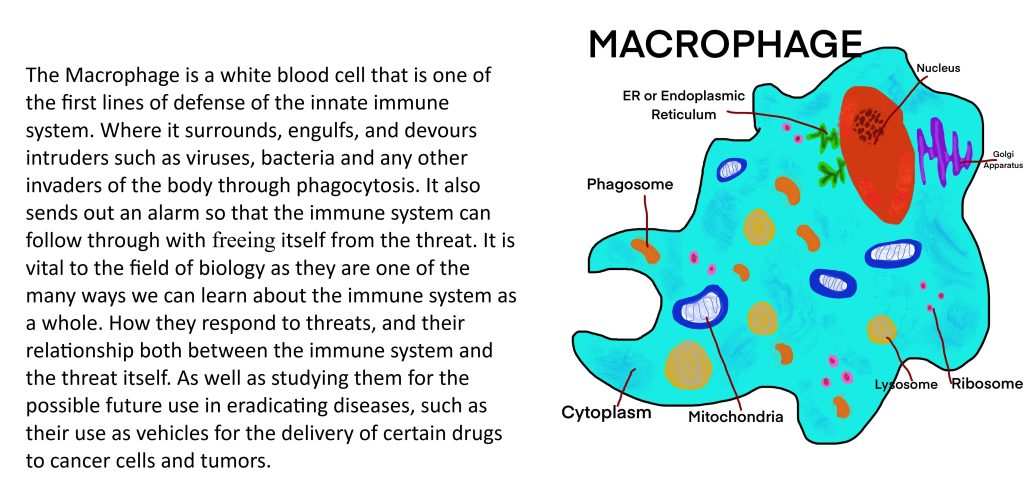
My first work as a current biology student. I am not the best at drawing though I hope it is understandable.

A macrophage is a white blood cell in the immune system that attacks intruders such as viruses and bacteria. I find them to be quite interesting as the are not only vital to the response of the immune system but our overall health as it would be. It is fascinating watching them work, essentially eating the invaders, and what has to take place to trigger them. Very interesting cell of the immune system.

August 29, 2025
by njenn009
1 Comment

New to ODU

As a new student here at ODU I hope to finally be on the right track to furthering not just my career but also my education and overall sense of self.