
Introduction to Immunology
Find me a -mAb
Find me a -mAb!: Adalimumab
Old Dominion University
Chelsea Aquino
BIOL 302: Intro to Immunology
March 8, 2026
Monoclonal antibodies (mAb) or biologics are medications that resemble naturally occurring antibodies that flag antigens for destruction. Biologics are particularly useful in treating cancer, autoimmune, and inherited diseases. Adalimumab, or Humira, is a commonly used biologic drug to treat autoimmune conditions such as rheumatoid arthritis (RA), ankylosing spondylitis, psoriasis, psoriatic arthritis, Crohn’s disease, and ulcerative colitis disorders. Adalimumab is an immunoglobulin G class (IgG) antibody that specifically inhibits tumor necrosis factor alpha (TNF-α ). Adalimumab was first approved for RA by the Food and Drug Administration in December 2002 (Vena et al., 2007). According to the World Health Organization, rheumatoid arthritis is a chronic inflammatory disorder affecting about 18 million people worldwide, with most patients being women above 55 years old (2023). Women are shown to be two to three times more likely to present with RA. Some studies suggest this may be due to the decrease in estrogen and progesterone and higher follicle-stimulating hormone during menopause (Venetsanopoulou et al., 2023). Common symptoms of RA include pain, stiffness, tenderness, heat, and swelling in joints (Venetsanopoulou et al., 2023). Advanced RA is indicated by chronic inflammation of the synovium in joints that can drastically limit joint range and movement (Venetsanopoulou et al., 2023). Epidemiology relates RA to genetic, environmental factors, and lifestyle factors. Environmental factors that increase risk for RA include exposure to infections, for instance, Parvo-B19, lower education and socio-economic status, air pollution, and exposure to silica. Lifestyle factors that increase risk for RA include smoking, low vitamin D, high red meat and sodium consumption, and obesity. Treatment plans are based on the severity of the condition and range from physical rehabilitation and prescription medications to surgical intervention.
Figure 1: Adalimumab Structure
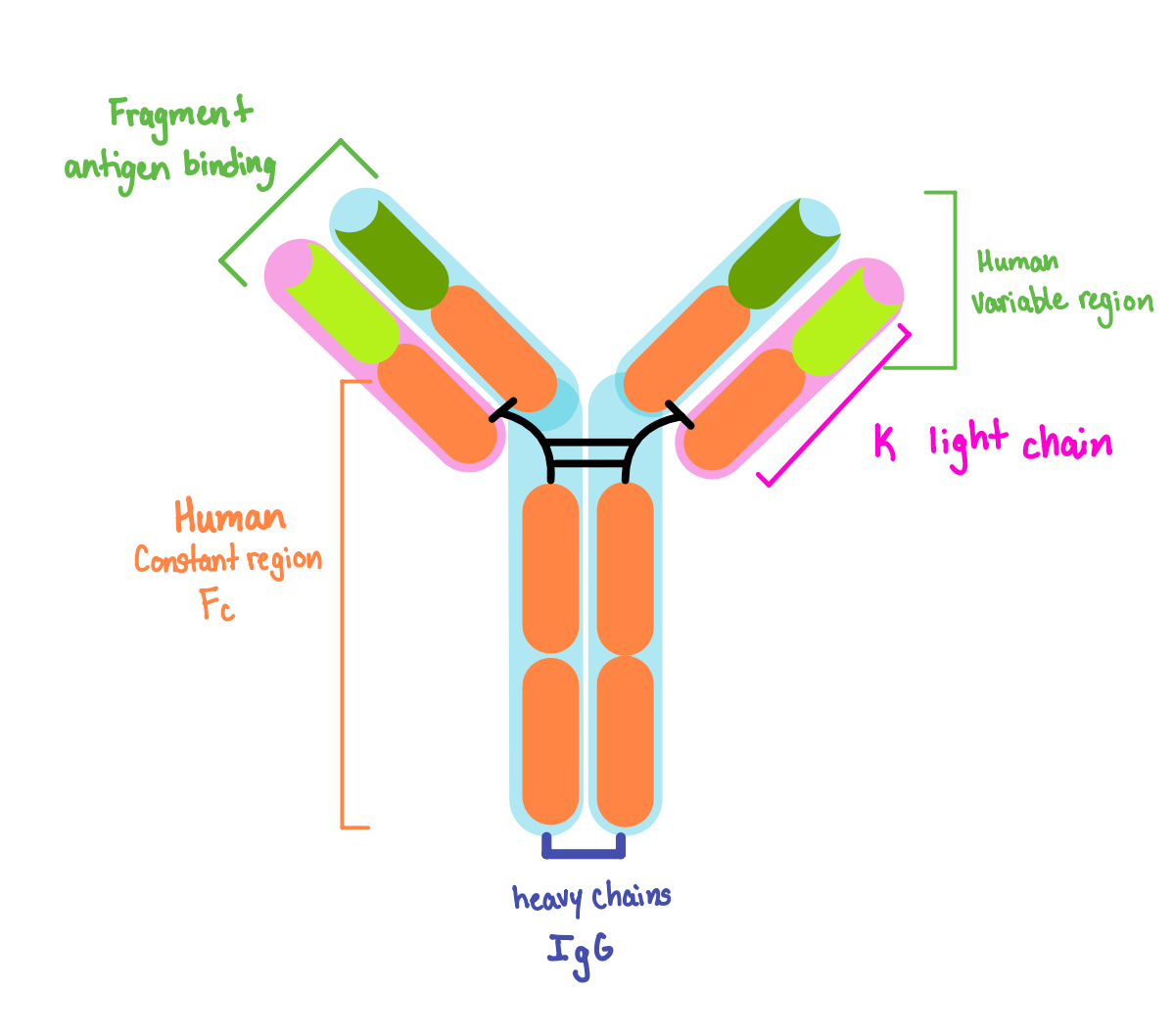
The figure depicts the Y shaped structure of Adalimumab class IgG, containing two heavy chains, and two kappa light chains. The structure has a human variable and constant region. The fragment antigen binding site is shown at the top of the light chain.
Adalimumab is fully synthesized from recombinant human amino acid sequences and shares an identical structure and function with naturally occurring human Immunoglobulin G subclass 1 (IgG1). Because Adalimumab shares a naturally occurring IgG1, the drug is highly specific in targeting TNF-α and has low immunogenicity (Ellis & Azmat, 2023). Antibody class IgG is responsible for binding to antigens for opsonization. When TNF-α binds to TNF receptors p55 (TNFR1) and p75 (TNFR2) induces cytokine activation, which induces osteoblast cells, cells that break down bone to calcium, which leads to the destruction of cartilage and bone (Ellis & Azmat, 2023). The TNF-α and TNFR1 complex leads to multiple signaling pathways, including NF-kB, MAPks, Capase-8 and MLKL (Jang et al., 2021). MLKL specifically triggers necroptosis and inflammation. Additionally, TNFR-2 complex leads to many of the same pathways, including MAPks, NF-kB, and AKT. These pathways lead to tissue regeneration, cell proliferation, host defense, and inflammation (Jang et al., 2021). The presence and function of TNF-α is an important component in the regulation of the immune system. However, when the TNF-α becomes overactive, causing excessive binding of TNF-α complexes ultimately leading to high inflammation and symptoms of RA. Adalimumab disrupts the binding of TNF-α to TNFR1 and TNFR2, which in turn inhibits the inflammation caused by these cytokines. Adalimumab does not target other cytokines such as interleukins which allows for low immunogenic potential. The standard adult dosage of Adalimumab for patients with RA is 40 mg injected subcutaneously every other week. These injections may improve symptoms, including joint pain, swelling, stiffness, and fatigue.
References
Ellis, C. R., & Azmat, C. (2023). Adalimumab. StatPearls. https://www.ncbi.nlm.nih.gov/books/NBK557889/
Jang, D., Lee, A.-H., Shin, H.-Y., Song, H.-R., Park, J.-H., Kang, T.-B., Lee, S.-R., & Yang, S.-H. (2021). The role of tumor necrosis factor alpha (TNF-α) in autoimmune disease and current TNF-α inhibitors in therapeutics. International Journal of Molecular Sciences, 22(5), 2719. https://doi.org/10.3390/ijms22052719
Vena, G. A., & Cassano, N. (2007). Drug focus: Adalimumab in the treatment of moderate to severe psoriasis. Biologics : targets & therapy. https://pmc.ncbi.nlm.nih.gov/articles/PMC2721299/
Venetsanopoulou, A. I., Alamanos, Y., Voulgari, P. V., & Drosos, A. A. (2023). Epidemiology and risk factors for rheumatoid arthritis development. Mediterranean Journal of Rheumatology, 34(4), 404. https://doi.org/10.31138/mjr.301223.eaf
World Health Organization. (2023). Rheumatoid arthritis. World Health Organization. https://www.who.int/news-room/fact-sheets/detail/Rheumatoid-arthritis
Draw IgM

IgM-BCR and soluble pentameric IgM differ from each other in structure, signaling, and location. Pentameric IgM is much larger than IgM-BCR. Pentameric IgM has 10 antigen binding sites and an J-chain while IgM-BCR has two antigen binding sites and no J-chain. A single pentameric IgM has 51 N-glycosylated sites while IgM-BCR has 14. IgM-BCR functions in B-cell development and activation. Pentameric IgM is produced as a primary immune response.
End-of-term reflection
One topic in particular that aided in my growth as a student was understanding monoclonal antibody medications. As I hope to continue on to pharmacy school, learning the mechanisms of these -mAbs is vital since they are a frequent topic of discussion in modern therapeutics. Most -mAbs are IgG, a fact that deepened my understanding of protein structure previously covered in my Biochemistry course. Specifically, I was able to connect how intermolecular and intramolecular disulfide bonds stabilize the quaternary level of these complex proteins. This connection between molecular structure and clinical application helped me realize how fundamental science directly informs patient care. By bridging these two subjects, I feel more prepared to tackle the advanced pharmacology coursework that lies ahead in my professional journey.