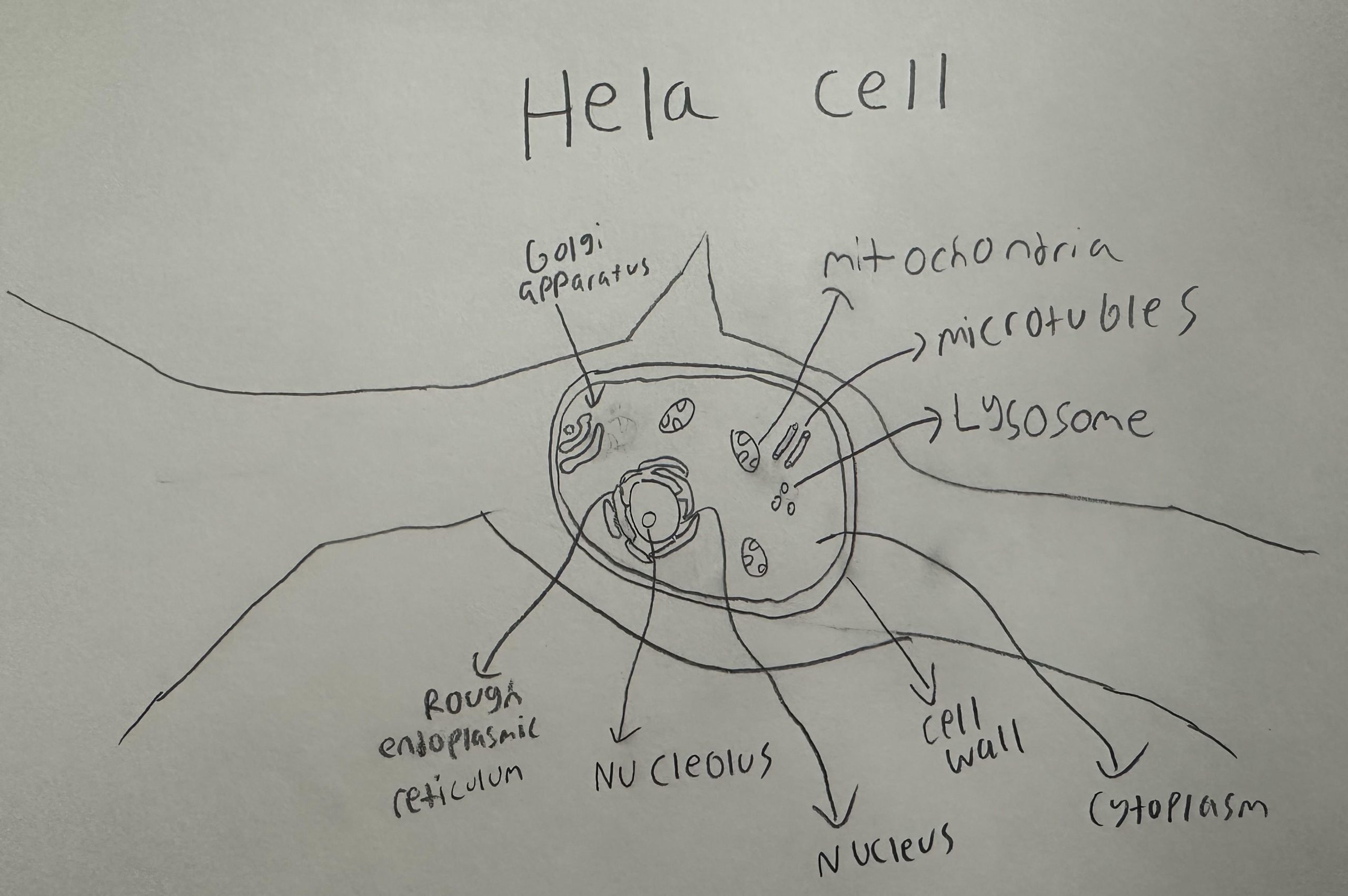
The specific cell that I chose to draw was a HeLa cell, as it plays a vital role in the medical field. HeLa cells are used extensively in cancer research, along with disease studies, because they are immortal and divide quickly. The cells double every 24 hours, which helps medical professionals accelerate vaccine development. HeLa cells are able to do this because they contain 76-82 chromosomes instead of the average 46 that most other cells have. An additional effect this has is genetic instability, which can cause chromothripsis.
Biomolecule Drawing
Find me a Meme post
The reason that I picked this gif to represent me is that I feel very confident about myself and the class so far. When the semester first started, I was kind of nervous, as I wasn’t entirely sure what to expect for the class, but over the first few weeks, I started to feel more confident about myself and my knowledge of cell biology. My past biology classes gave me a basic understanding of cells, and this class builds on each of the processes that I learned. The other students have been very kind, and I enjoy reading and responding to the packback questions as well, which has also helped me feel more confident about everything. The coursework hasn’t been too demanding either, and most of the assignments have had excellent instructions, which really helped me feel a lot less stressed.

Scientific Literacy Essay
The Advantages And Disadvantages Of Animal Studies And Models.
The use of animals in medical research is a practice that has existed for thousands of years, with cultures such as the ancient Greeks, Egyptians, and Chinese using them to understand the human body (Kinter et al., 2021). The information collected from these dissections and experiments would then go on to help with the production of traditional medicines and surgical procedures (Kinter et al., 2021). However, in the modern day, the use of animals in biomedical research is a controversial topic among some groups, with the morality and use of it coming into question (Kiani, 2022). To better understand the subject, it is important to look at both the advantages and disadvantages of animal models and studies in biomedical research.
One of the most advantageous features of using animal models is their similarity to that of humans, both in terms of size and placement of their internal organs, with the best example being the use of pigs (Lunney et al., 2021). The similarly sized organs allow researchers to test out drug dosage and toxicological effects, which help them develop safe ranges for new medications (Lunney et al., 2021). Another advantage of using animals, specifically pigs, yet again, is the ability to create or edit their genetic makeup and environment, which can help researchers study specific conditions (Onaciu et al., 2020). Some specific modifications that are often targeted are knockout/knock-ins, CRISPR, and humanized genes, which allow for the direct testing of a gene’s function, which helps prove the validity of models (Onaciu et al., 2020). With the researchers being in control of the animal’s environment, it also helps to eliminate any outside factors that could produce errors in any of their experiments, which is harder to do with humans, as they can’t be as closely controlled or constantly monitored. The cost efficiency of using animals is an additional benefit, with one of the most commonly used animals being rodents, which can be bought and housed cheaply (Peter et al., 2017). It is estimated that there are up to 111 million mice and rats used every year, which makes up 99.3% of all animals used in scientific studies (Carbone et al., 2021). The last advantage of using animals as a model that ties in with their cost is their availability. Animals like mice, pigs, rabbits, and insects are readily available for purchase in large quantities all around the world, which helps researchers easily come up with test subjects.
While there are numerous benefits of using animal models, there are also a plethora of negatives to them as well, starting with how animals can fail to mimic disease conditions as they are in humans (Pound & Ritskes-Hoitinga, 2018). Human diseases evolve over the course of one’s life, and while mice can grow breast tumors, it doesn’t fully represent the experience that a human would go through, since most cases of human breast cancer occur only postmenopausal (Pound & Ritskes-Hoitinga, 2018). Furthermore, a second disadvantage is that using animals as models in medical experiments is often ethically questionable, with many people arguing that animals should have the same moral status as humans (Kiani, 2022). Animal rights activists believe that animals shouldn’t be forced into any sort of service or be killed to be used in any sort of research, as they are intelligent creatures, just like humans are (Kiani, 2022). One of the more concerning disadvantageous factors in using animal models is the lack of ability to reproduce them properly, as they often have an incredibly low reproducibility rate, with one cancer biology study redoing 50 key experiments and only being able to replicate 46% of the results (Errington et al., 2021). Lastly, while mice and other smaller animals are cheap to buy, some larger ones, like nonhuman primates, sheep, and dogs, are typically very expensive. The animal that costs the most to house are great apes, which need intensive care, enrichment, and specialized facilities to properly maintain them for biomedical research (Aguilera et al., 2021).
In conclusion, while there are many disadvantages to using animal models in biomedical research, such as their lack of proper reproducibility (Errington et al., 2021), their poor ability to mimic complex diseases (Pound & Ritskes-Hoitinga, 2018), and the ethical concerns they raise (Kiani, 2022), they also have several advantages that make them viable to use to this day. As mentioned in paragraph two, the use of smaller animals, like rodents and insects, allows researchers a cheap way to conduct trials, with 99.3% of all animals used being mice and rats (Peter et al., 2017), and certain animals, like pigs, also have very similar anatomy to humans, which provides pharmaceutical companies with a way to test out proper drug dosages (Lunney et al., 2021). The use of animal models, while with its issues, is still a necessary building block in a large portion of the biomedical research process that contributes to the betterment of not only human health, but that of other animals as well (Kiani, 2022).
With the increasing scrutiny of animal testing, researchers have proposed several alternatives that could save the lives of many animals. All of these alternatives, while they have their own drawbacks, seem to be very reliable and can produce accurate results for scientists, with some saying that they can be better than live animals (Kwon, 2026). Some examples of these alternatives are microfluidic organs on chips, computational models and generative AI systems.
The first proposed alternative is using microfluidic organs that are placed on chips. These organs on chips are three dimensional microsystems that are used for cell culturing reasons, which try to recreate the functions of organs in vitro (Papamichail et al, 2025). Some examples of these cultured tissues include cell aggregates, spheroids and organoids (Papamichail et al, 2025). Organs on chips also use human-derived induced pluripotent stem cells, also known as iPSCs, to accurately create models by combining both stem cell produced 3D tissue with microfluidic perfusion, which nearly perfectly mimic human organ function (Fanizza, 2022). This alternative presents the benefit of not needing a lot of care, and are not nearly as cumbersome as animal models. One specific way that organs on chips beat animal models is the fact that they do not need to be genetically humanized, such as by not needing to have human antigens and other tissue promoters introduced, which is often a very complex process (Palasantzas et al, 2023).
The next two non-animal-based models are the computational model and using generative AI systems, which are somewhat similar. The first of these models is the computational model, which uses datasets from humans along with laboratory data to predict chemical hazards, specifically by analyzing chemical structures, molecular properties, and biological interaction patterns in order to predict endpoints such as skin sensitivity and liver damage (CIRS, 2025). Read-Across is also used in the computational model, which helps predict any unknown toxicity by looking for similar chemicals and using its data to make an educated guess as to the base chemical’s toxicity (Bennekou et al, 2025). Another vital technique that is used is Quantitative Structure-Activity Relationship, which can relate a compound’s structure and property to its biological toxicity (Perkins et al, 2003). Alternatively, generative AI systems can also be used to achieve accurate test results, using deep learning such as Generative Adversarial Networks to simulate highly complex biological responses, creating synthetic data (Chen, 2023). One model often used in research is AnimalGAN, which creates a digital twin of animals, which they learn from legacy study results to create synthetic clinical data (Chen, 2023). Both of these methods serve as a way for researchers to conduct studies without the need of live animals, with them simply needing to use past data that has already been collected to create endless synthetic trials.
Lastly, while these non-animal models can be fairly accurate, they still have issues, such as not being able to replicate complex systemic processes such as tissue aging, endocrine responses, and whole-organ interactions. The main reason that these models fail complex processes is that they are used to study isolated biological mechanisms, instead of them as a whole. One of the vital things that organs-on-chips lack is blood flow and resident immune cells, which are very critical for mediating inflammatory responses, chronic disease processes, and tissue repair (Rashidan et al 2025). Another process lacked by non-animal models is the ability to model endocrine crosstalk, as endocrine responses require systemic communication between multiple organs, and the current new approach methodologies lack the function to replicate hormone regulation in vivo (National Academies of Sciences, 2021). Lastly, non-animal models have a limited cellular diversity, lacking a full range of stroma, immune, and endothelial cells that are required to accurately replicate complex functions like immune-mediated injury (Wörsdörfer, 2020).
In conclusion, microfluidic organs on chips, computational models, and generative AI systems are non-animal-based models that scientists can use to replicate organs accurately without the need for live animals. Organs on chips do this by using iPSCs which combine stem cells with microfluidic perfusion that nearly perfectly copy human organs (Fanizza, 2022). Computational models and generative AI systems also replicate organ function by using data provided by humans and laboratory studies to accurately predict results (CIRS, 2025). However, even with their rise, they still suffer from a variety of issues, such as not being able to replicate complex system interactions, such as endocrine crosstalk and lacking blood flow (National Academies of Sciences, 2021).
Reflection
While taking BIO 293 this semester, I was also taking BIO 294, genetics. Much of the work and textbook information that we went over in this course applied to many of the topics that I read about in my genetics course, specifically when we covered DNA, RNA, and tRNA , which we did in chapters 6 and 3. DNA plays such a vital role in not just humans, but all living creatures, so knowing the pieces of it and how it is created really provides an interesting insight into life at an incredibly small level. Specifically, going over DNA translation and transcription, even if it wasn’t our major focus, was very informative. I did enjoy going over macromolecules and the other structures of cells, which we didn’t really cover in detail in my genetics course, so I feel like BIO 293 has definitely helped by providing me with a lot of general information.