The Incredible Hulk is a well-known franchise that increased in popularity in the late 1970s and the 2000s when the character was adapted for television and film. Since 1962, Hulk has been featured in several types of media, such as comics, film, and video games. Although Hulk is a familiar character, most people may not know how Hulk media influences fans.
Hulk stories depict extreme experiences of trauma, isolation, adversity, and resilience that are relatable and inspiring to fans. The story’s key themes allow it to serve as a platform for rhetorical arguments that retain a lasting impact.
First, a character timeline. Bruce Banner and his alter ego, the Hulk, were first introduced in 1962 by Stan Lee and Jack Kirby for Marvel Comics. In 1985, writer Bill Mantlo and artist Mike Mignola told the story of the physical abuse Bruce endured from his father from infancy until early childhood, when his father was institutionalized for murdering his mother.
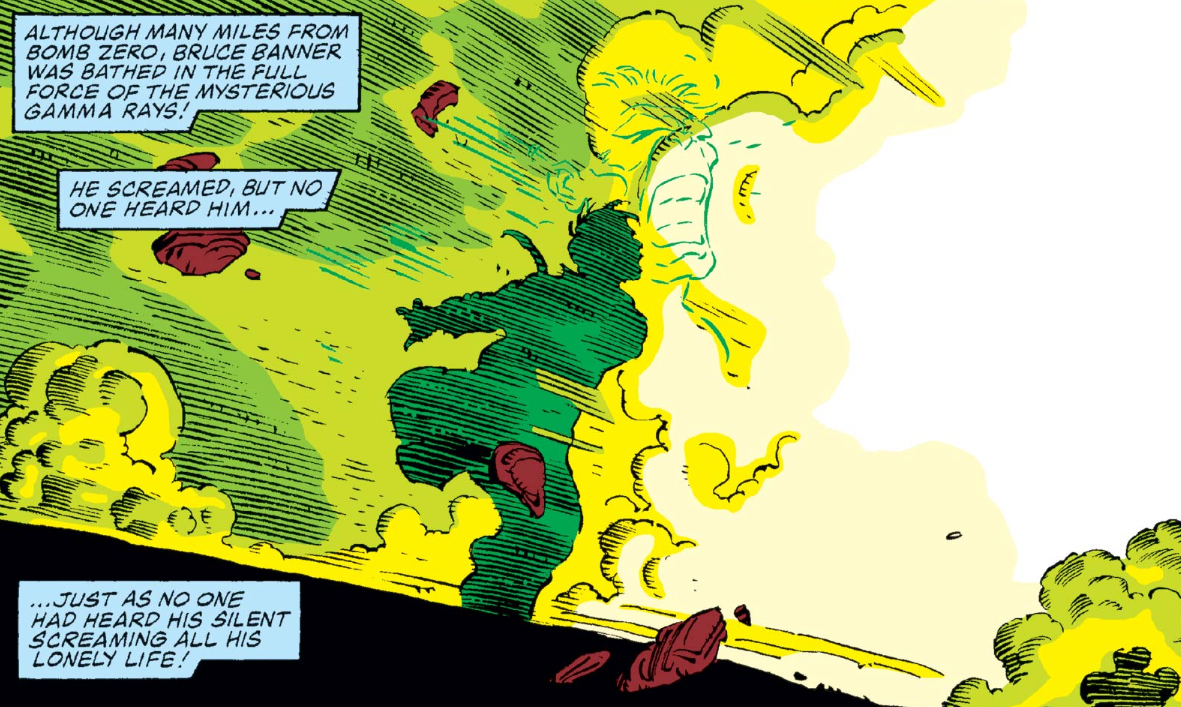
Mantlo connects how Bruce’s trauma led him to suppress his emotional side and until radiation from his gamma bomb unleashed his anger in the form of the Hulk. The weighty influence of trauma and resilience is present throughout the rest of the comic series, and more notably explored by Peter David in the 1990s and Al Ewing in the late 2010s and early 2020s.
Since 2018, I have been a major fan of Hulk. I have read every issue of the comics, and written a blog post for Marvel.com on the issues I find most significant for character dynamics. I run an international Hulk Discord server with a diverse group of members, some of whom responded to the following survey.
While involved in Hulk fan communities, I noticed that many fans have a strong emotional connection to the character because of the themes he represents.
To explore this connection, I turned to members of my Discord server and fan communities on X.com, Tumblr.com, and Reddit.com to ask:
- How has Hulk media uplifted you or enhanced your resilience?
- Do you feel that you have learned a value from the Hulk media?
- Has Hulk media made an impact on your worldview or sense of self?
Several major themes within the series were most important to respondents:
- Anger and negative emotions
- Mental health and trauma
- Shared experiences
- Identity and monstrosity
- Real-world positive influences
Let’s explore this in more detail.
How does Hulk media impact fans?
Healing from trauma is difficult, but with the right support system you’ll shine even brighter then before.

The respondents1 to my questions opened up about how Hulk media:
- Helped them reconcile with anger.
- Provided perspective on their own abuse, trauma, and mental illnesses.
- Improved their understanding of their identity, and how it has been altered because of the way others have treated them like monsters for being different.
- Depicted shared experiences that created a sense of connection.
- Improved their self acceptance, their empathy, and created interest in social justice.
- Respondents will remain anonymous because of the sensitive information they shared. ↩︎
- Responses have been edited for length and clarity. ↩︎
Respondents approached these themes from several directions2. I was touched not only by the responses, but by how eager respondents were to tell me about life difficulties they endure and connect to in Hulk media.
Bravery
Seeing Hulk have his power stripped away and still standing back up made me feel incredibly brave.
Emotions
Controlling your emotions doesn’t mean shoving them deep down, but actually analyzing them.
Kindness
Hulk has lead me to being a more kind, aware, and thoughtful person.
Resilience
Reading about the Hulk’s resilience gave me the push I needed to continue through the misery affecting me.
Shared experience
It was emotional to see a character with a lot of shared experiences as me.
Teenage rebellion
I realized that acting out and isolating myself as a teenager was something I could still grow from.
Cycle of violence
The Hulk inspires me when he learns that he doesn’t have to be destructive, and that he can choose to end the cycle of violence.
Endurance
Seeing Hulk endure pain for the sake of his loved ones and his potential to do good inspired me to do the same.
Mental health
I have new perspectives on mental health and how can I empathize and understand people I care about.
Scientific interest
Bruce helped me realize that being mentally ill and coming from a traumatised background does not detract from my ability to be a great scientist.
Social justice
The series challenged my right-wing ideas and made me someone who wants to help marginalized groups.
Tragedy
Tragedy happens and you can’t ever stop it but you can always keep going.
Dissociation
Bruce is a representation of a DID system that we heavily identify with.
Hope
Hulk media reminds me that there is always hope and we are never truly alone.
Monstrosity
Hulk made me question whether I was acting like the monster I thought people saw me as
Self acceptance
It’s easier to accept myself when I see my ugliest traits reflected in a character I love.
Suicide
Bruce taught me people who are depressed and suicidal can still be heroes, and that I wasn’t alone in those feelings.
Trauma
Even if you’re “broken” from past experiences, doesn’t mean you cant try to fix it now.
The video below is an audio testimonial from one of my respondents. You will hear that they express themes of shared experiences, coming to terms with trauma, self-acceptance and interest in social justice.
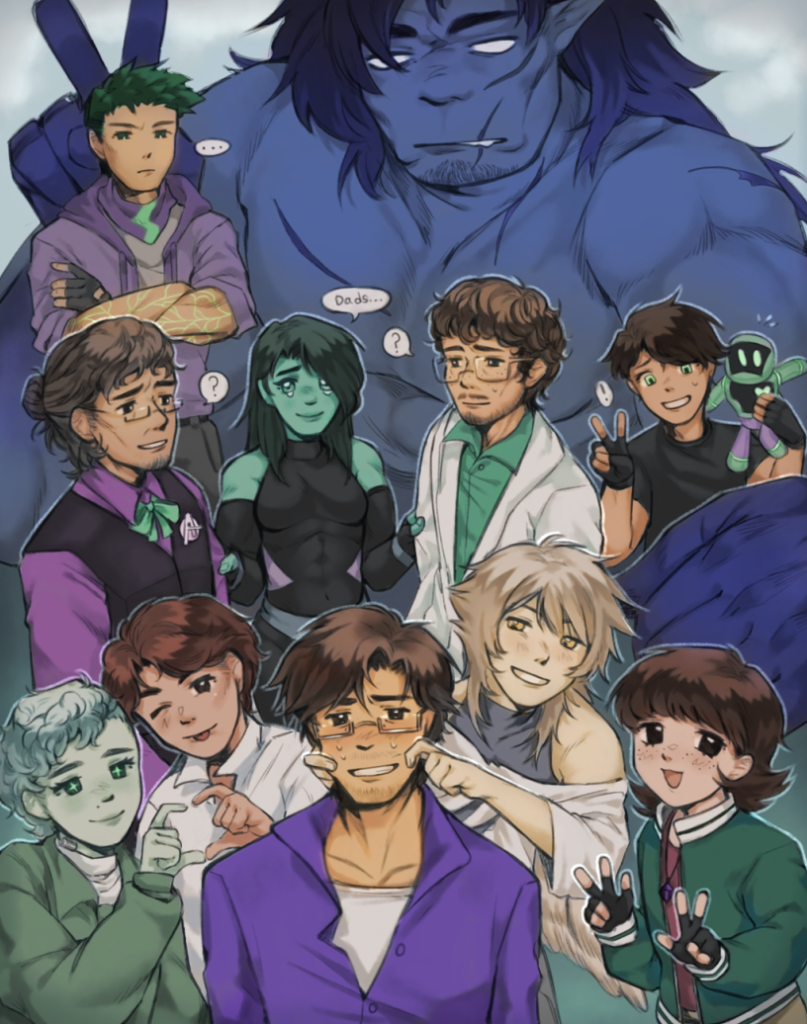
Many Hulk fans create original or self-insert characters to involve themselves in the story and highlight themes they find most meaningful. To the left is a group of characters created by members of my Discord server.
Some creatives write rhetorical arguments into the character’s identity. Self-insert characters with history of trauma may serve as arguments for their creators that they are owned justice for their own maltreatment.
Artwork used with persmission from the artist.
Why is Hulk’s influence significant?
Hulk is a tragic hero who is often persecuted, met with violence from friends and foes alike, and forced to live on the margins of society.
Since ostracization and oppression are long-running themes in Hulk’s story, Hulk writers have used the comic to make rhetorical arguments about major social issues at the time of writing.
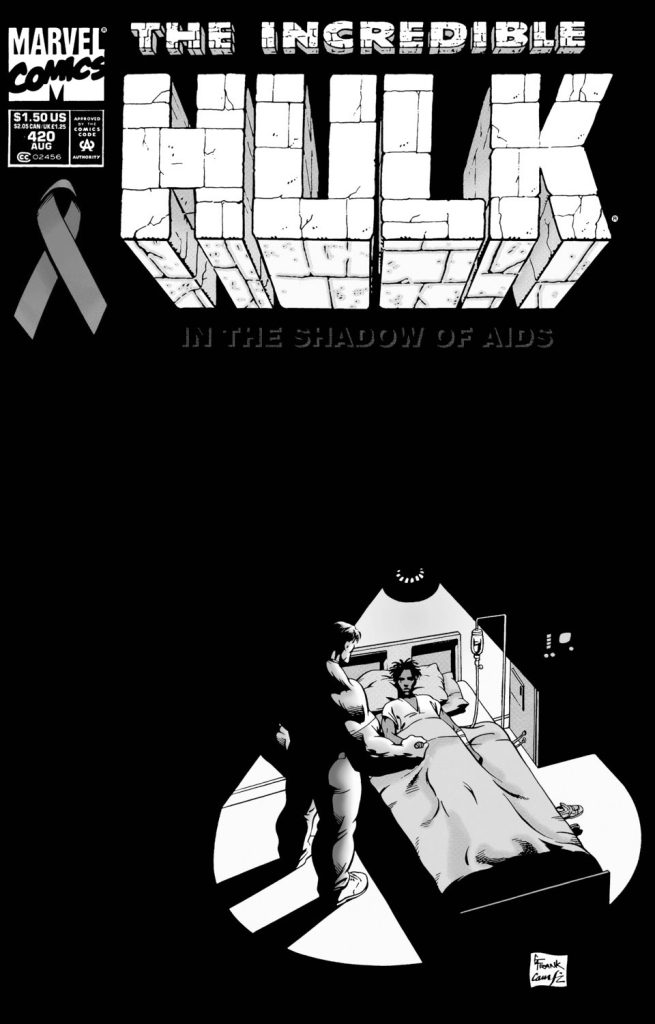
Highlighted issues include nuclear weaponry, child abuse, domestic abuse, enviromental issues, feminism, homelessness, international conflicts, LGBTQ+ rights, mental illness, police brutality, racism, and war.
One notable issue from the 1990s was written by Peter David and illustrated by Gary Frank with the rhetorical purpose of creating empathy for people afflicted with AIDs.
In many stories, Hulk is depicted with a childlike manner. This has a rhetorical purpose, and allows the character to rail against injustice using strong emotion and simplified logic that disrupts justifications borne from cognitive dissonance.
Hulk’s angry reaction mirrored my own, as I realized that a great deal of strife in the world can be attributed to old books.
A respondent’s perspective on Incredible Hulk (1962) #256’s simplification of the violence between Israel and Palestine and resulting loss of life. Horrifyingly, this story Bill Mantlo wrote in 1980 is still relevant.
In opposition, Bruce is a character with above average intelligence, who understands the complexity of social problems. This is plainly shown in Immortal Hulk #26 (2018) by Al Ewing and Joe Bennett, where Bruce outlays a manifesto to end the human world as we know it.
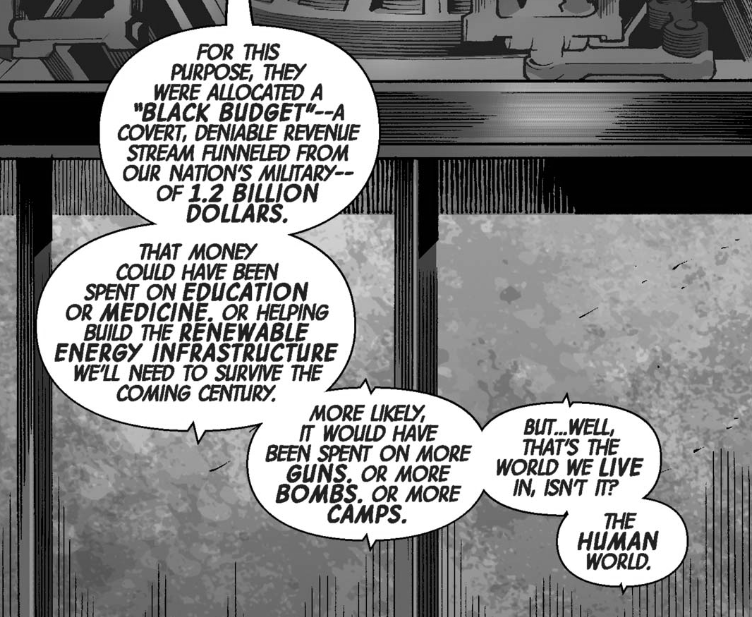
Explorations of social injustice through multiple forms of intelligence and interactions with violence within Hulk media advance fans’ abilities to evaluate to real world issues.
Although several respondents mentioned the impact of Hulk media on their worldview, one example was especially striking:
Hulk comics helped me recognize my toxic masculinity, self-hatred of my autism and mental illness, and that I am not at my full potential yet. I will always be thankful to the franchise for ending my ignorance and for teaching me that I can reject the bigoted ideas society tells me. My main goal in life now is to help marginalized people the same way Bruce would.
In my research, I successfully uncovered evidence to back my rhetorical argument: Hulk media influences fans through rhetoric, and inspires them to improve their understanding of themselves and the world in pro-social ways. Hulk is an incredibly popular character; it is significant and encouraging that those who are introduced to his media could benefit from analyzing and applying the themes within his stories.
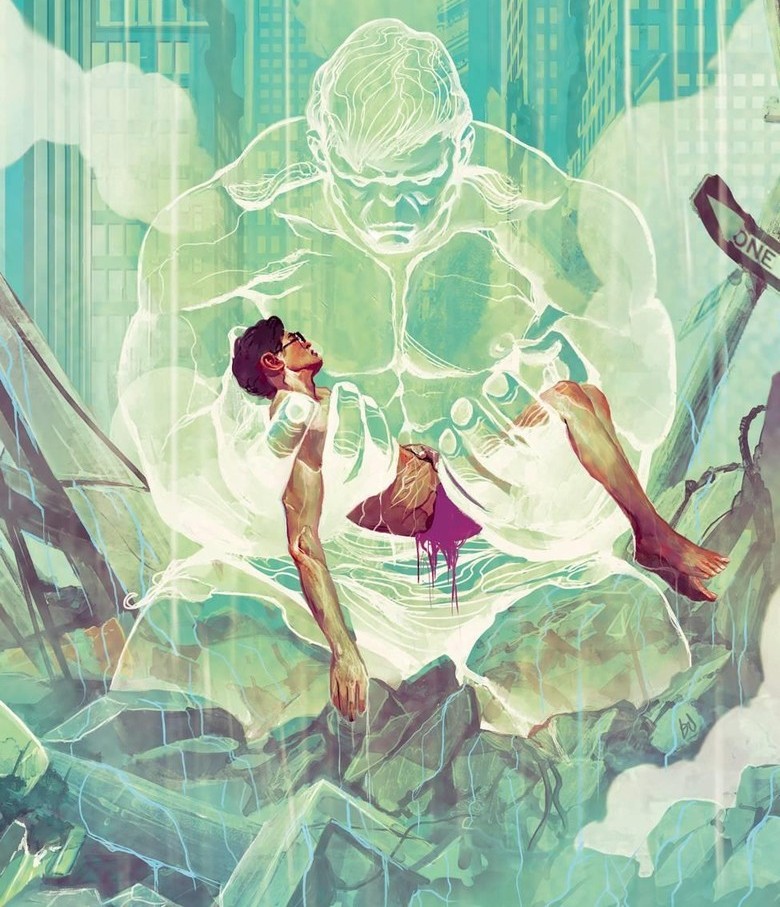
Hulk stories can be some of the darkest, tragic, and most real storytelling that exists in superhero media.
Superhero stories are by definition, impossible. Yet this allows them to explore themes of adversity and injustice at the height of extremity. When this impact is acknowledged, it can be fully realized.
Hulk media is not without fault. In my exploration, the influences that the character had on fans were overwhelmingly positive. However, the sample size I had access to for this research was small. Since I posted the survey in online communities for fans of Hulk and Marvel media, those who answered already had a significant connection to the character and his stories. People who are only vaguely familiar with Hulk may not respond the same.
In conclusion, Hulk fans are a microgenre within the wider community of superhero fans. Their investment in Hulk involves pro-social themes, specifically in regards to reconciling anger, making sense of trauma, rejecting identities as ‘monsters’, sharing experiences, and committing to social justice. The series has historical and future implications for disseminating pro-social rhetoric through pop culture.
- Comic credits:
- Incredible Hulk #312 by Bill Mantlo & Mike Mignola © Marvel Comics, retrieved from Marvel Unlimited, published July 9 1985.
- Incredible Hulk #377 by Peter David & Gary Frank © Marvel Comics, retrieved from Marvel Unlimited, published November 20 1990.
- Immortal Hulk #10 by Alex Ross © Marvel Comics, retrieved from Marvel Unlimited, published December 5 2018.
- Incredible Hulk #420 by Peter David & Gary Frank © Marvel Comics, retrieved from Marvel Unlimited, published June 21 1994.
- Immortal Hulk #26 by Al Ewing & Joe Bennett © Marvel Comics, retrieved from Marvel Unlimited, published November 6 2019.
- The Fallen by Mike del Mundo © Marvel Comics, retrieved from Marvel Unlimited, published August 17 2016.
- Timeline and pie chart by Cai Murphy Ritenour, licensed by Flourish.
- ‘Speaking on Hulk’ video by Cai Murphy Ritenour, was edited in CapCut, captions were added using Canva, uploaded and retrieved by YouTube.
- Original characters illustration by Ally Rooney, used with permission by the artist.