Exploring Culture
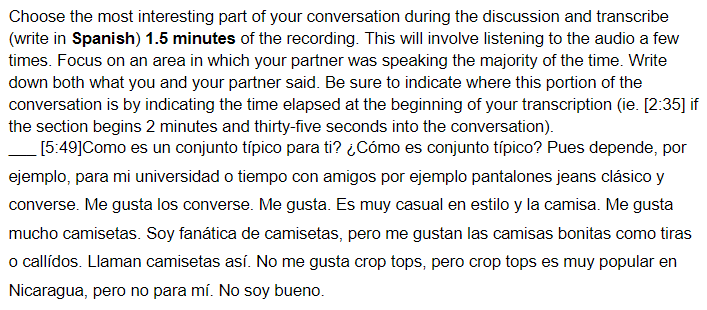
While enrolled in Spanish 201 I was able to explore culture through TalkAbroad and LingroHub. TalkAbroad allowed me to communicate with another Spanish speaking person from another country and talk to them about their culture and practices. For unit 11 and 12 we had our first conversation about clothes and ecotourism. When talking to my partner I was surprised by how different their climate was from ours here and the typical clothes worn everyday. Also, I was intrigued by what they usually do for ecotourism and how they gain money over there. There is a lot of activities to do in Venezuela and my partner and I had similar hobbies and attractions. I was able to understand what my partner was saying and respond appropriately although I did struggle at times with coming up with the correct wording for my responses. Overall I think the experience was a nice way to practice my Spanish skills and learn something new from a different perspective. An additional example that allowed me to explore culture was how in each unit on LingroHub, there was a culture section that allowed me to look at experiences from other countries and their views on ecotourism, short stories, etc.
Engaging in Communities
When using and learning Spanish it’s important to understand community and the values within them. Learning a new language can be valuable for making new connections with others. There are many ways in which one can make connections through the use of language and having others stored away for use can also lead to new friendships. Getting involved with your community can help introduce you to individuals who share similarities or may be different from you.
Interpersonal Communication
TalkAbroad was a very different experience for me since I had to actually use what I learned in order to have a conversation more fluently in another language. 15 minutes had initially seemed like a lot of time to me and I worried that I wouldn’t be able to fill the time but with both conversations that I had, time went quickly and before I knew it it was already time to go. I definitely believe that my Spanish speaking skills could use a little bit of work after reflecting on the two conversations but I am glad that I was able to get in some practice. I think that although I did pretty well with memorizing vocabulary for each unit I would like to continue to work on putting them into practice and also working on the different forms that we learned in class. I think that practicing those will help me become a better Spanish speaker and become more fluent.
Presentational Speaking
For presentational speaking we completed a couple of activities in class where we had to ask and answer questions from our classmates and they were recorded. Another presentational speaking opportunity that we had in class was our Proyecto 16 which had us complete a face to face conversation with our partner.
Personally I liked the project because it forced my partner and I to be creative and create a misunderstanding in text and then clear it up in face to face conversation. One thing that both my partner and I struggled with is memorizing our lines. Although we did learn them in chunks it was still hard to actually remember them once the camera was recording. I feel that if I were to complete the activity differently I would spend more time remembering the lines so that I can put more emotions behind the words and create a better conversation.
Presentational Writing
In Spanish 201 we actually had done a bit of writing such as doing research about a museum or piece of art and retelling the history, researching culture for our LingroHub assignments and retelling what we learned, and writing a style guide for a client.
I believe that the style guide from Unit 11 is my best presentation of my presentational writing because I was able to come up with a more personal style for the client and showcase my use of the Spanish language. Since it was the first unit that we did I feel more confident on my vocabulary used that pertained to the unit. In unit 16 we also had to complete presentational writing by creating a misunderstanding through text messages. This allowed me to learn more culture behind native Spanish speakers and how they use abbreviations as compared to how we normally use abbreviations.
Unit-11-Proyecto-India-DavisUnidad-14-Proyecto-India-Davis
Interpretive Listening
For LingroHub it was a little bit different because we mainly focused on listening for the correct answers or listening for culture/writing. In one of our units we learned about art and the history of the Modern Museum of Buenos Aires. For that unit it required us to listen closely in order to understand what the speakers were saying about the museum and how it came to fruition. I had struggled a little in this unit only because I had to keep rewatching the video to understand and get everything that they said. It was a bit of a struggle getting used to how fast the speakers talked but I was still able to catch their words. After listening to what they said I was then able to comprehend a good amount of what they were talking about. I believe that throughout the semester with each listening assignment I have gotten better at understand words individually and together when spoken very quickly. One last example of this skill is when attending a lecture we had to listen to an audio and transcribe what was being said. One thing that made it a little easier is that our professor played the audio section by section to make sure that we transcribed the audio more accurately. After completing the class I am more confident in my listening abilities.
Interpretive Reading
Throughout the class there were many opportunities for us to complete some interpretive reading in Lingrohub as well as assignments completed in class. During unit 14 when we had to complete research on an artist or painting we were required to read through lots of information in Spanish and then put all of the events into a timeline. I had fun exploring and learning about other cultures in the Spanish speaking community and also learning about my museum which was the Guggenheim.
One other example that required interpretive reading is when we read a short story called “El Eclipse” and had to understand what events took place. The short story was very interesting and I was able to learn even more culture about the natives and their interpretation of history.