Interpretive, Interpersonal, and Presentational Modes of Communication
Exploring Culture
- At the end of every unit we learned about the cultural differences between Spanish speaking countries and America through “Exploración cultural” in Lingo Learning. From LGBTQIA+ rights and Social Networks, to popular idols and common Hispanic dishes. I expanded my knowledge further by using my access to social media and listening to music to help gain more understanding of cultural perspectives. For example, the song Tití Me Preguntó by Puerto Rican rapper Bad Bunny is a recent song that I have found interest in. I first understood the main message of the song, but there were slang terms I wasn’t accustomed too. After a bit of research, I learned what slang terms are commonly used to help me further understand the of the song.
- Learning the slang used in the song, helped me understand that other cultures produce terms based off their environment and it differs from place to place. Like how Cuba might have a different slang term for “aunt” that differs from Puerto Rico just like American culture. I had to realize that Hispanic culture has some similarities to ours, but also different. For example, women experience specific gender roles in both American and Hispanic culture. But in Hispanic countries, the people who live in very hot places go home at noon to have lunch and rest for a few hours, which you typical won’t see here in America.
Engaging in Communities
- Engaging in your community and the global community, helps for your growth in learning a language. Knowing your initial community is important to recognize, because then you can easily translate it into Spanish to best describe it. For example, knowing my way around campus and learning my likes and dislikes about things, helped me easily translate it into this project. I had to talk about these things in Spanish so knowing what they are and what they mean to me, helped me translate it and learn new vocabulary smoothly. It was a little challenging to make sure I translated it the right way, but that’s a common struggle when learning a new language.
Interpersonal Communication
- TalkAbroad was a very immersive experience for me, never having spoken with a Spanish speaker other than teachers. Also having to respond back to my classmates to projects was another interpersonal connection we made during this semester. Our 3 TalkAbroad sessions consisted of a 30 minute conversation with a fluent Spanish speaker on what we have been learning.
- My TalkAbroad sessions were very difficult for me to complete. The first one was about “¿Quién soy yo? Mi universidad y a quién admiro” and I didn’t do so well. My partner was speaking fast and I did not remember a lot of my vocab. So I having my partner carry the conversation and telling them I didn’t understand. In the audio, I attached you can hear me say “no entiendo” or “repita” multiple times. The most recent one I did went a bit better, but I started off with tech issues. It was a little easier to talk about my health and the food I like to eat. I should’ve better prepared myself for these TalkAbroad conversations.
Presentational Speaking
- One of our first couple of projects, we had to ask a Spanish speaker some questions. I had interviewed an acquaintance of mine over zoom about some basic questions related to their identity and academics. This was our first video project and I had to show how I can talk to someone in a general conversation.
- I started out pretty well during the beginning units of Lingo Learning. It was like a mini review of what I remember doing in High School. So this conversation was easy to have with a little practice. Since then, I feel like my conversations have declined. Its due to me loosing focus and I haven’t been looking back at my notes. I’ve just been on auto pilot and just trying to complete the homework on time, rather than trying to learn and understand the homework
Presentational Writing
- This flyer was completed for Proyecto 7-1, it was about trying to get someone to come join your sports club and why its beneficial for them to come. I did mine about basketball and to join the ODU practices, while also stating why it will be good for that specific person. We were focusing on learning how to use informal commands.
- This activity was hard for me, this was in the area where my work started to decline. I was late to submit this project, but I pushed myself to finish. I understood the objective of using these commands and how to present them in text, but I struggling trying to remember the irregular verbs. For each writing project we turn in a rough draft, and I have always struggled with the drafts because I forget the vocabulary. So for this rough draft, I wanted to really remember the informal commands for the irregular verbs because it could make or break what the content is suppose to be about.
Interpretive Listening
- This screengrab is from unit 10, our last unit in Lingo Learning. We learned about how to discuss professions and professional preparation for after college. In this particular activity, we had to listen to Ana talk about herself and figure out what profession she should choose and avoid.
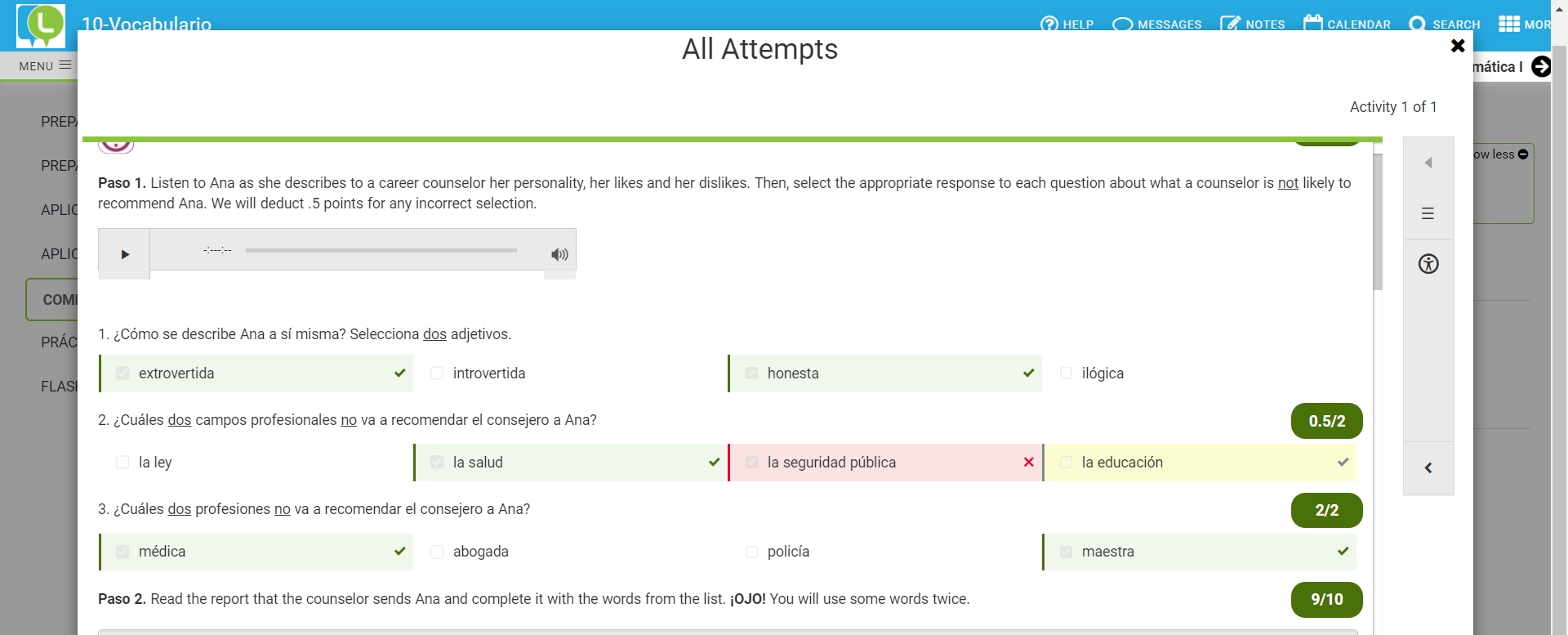
- In this section of the unit, we learned the vocabulary for the education, public safety, law, and media healthcare, business, and STEM professions. So by listening to the audio and knowing what I know about each profession, I have the base knowledge of what I think Ana should do. Listening to Ana talk to the counselor, I get to hear this vocab in action for someone trying to figure out their profession after college. A lot of these are cognates as well too, so it was easy to identify. In the last unit, we are basically combining everything we learned while adding on more vocabulary. So most of the text and audio you hear will be more advance then the previous units.
Interpretive Reading
- In Unit 7 we learned how to describe sports and how to give commands. We also read about gender inequality within sports in the Spanish-speaking world. Most of the perspectives said that soccer was popular among men and women, but men make more money and receive more attention from it.
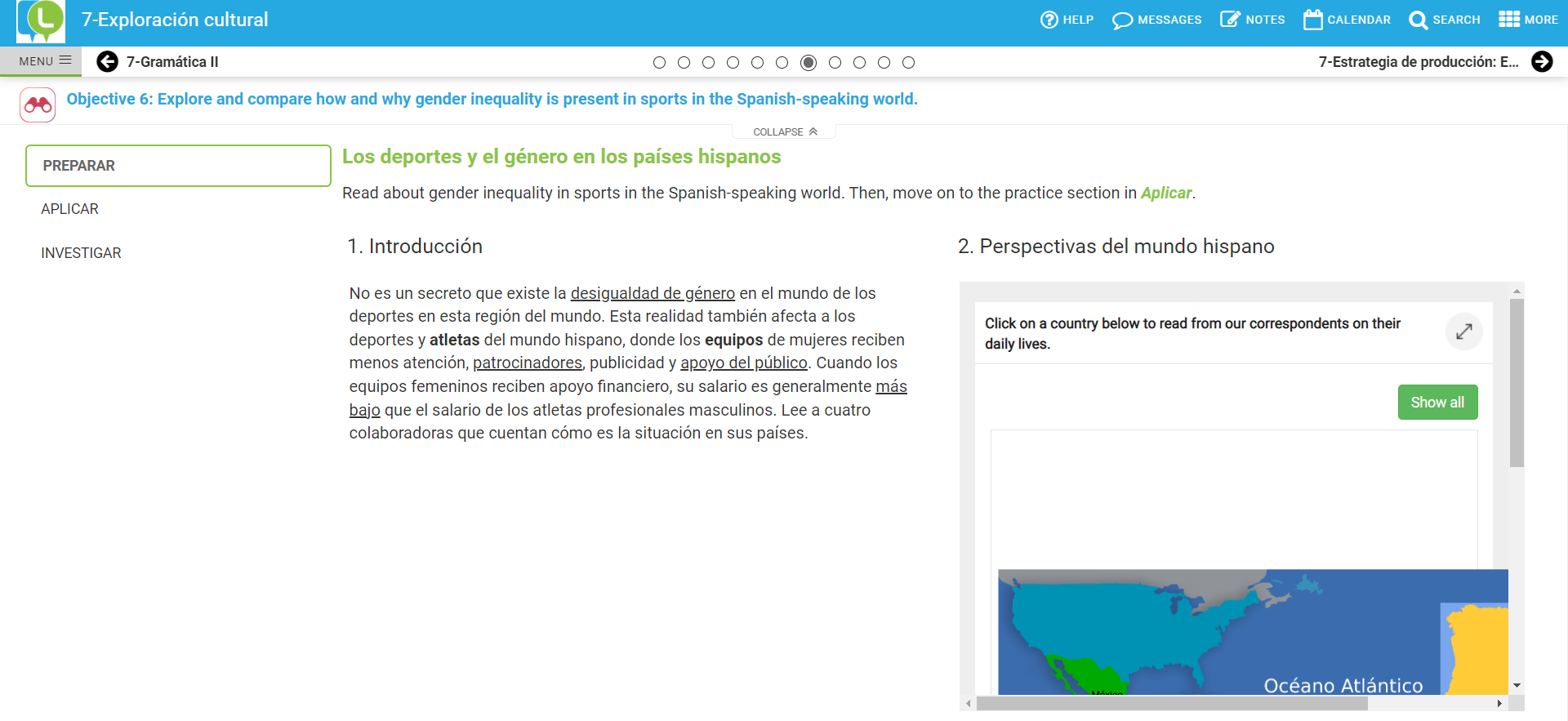
- Learning how to read paragraphs like this with words you are unfamiliar with, you have to develop the skill of looking at context clues and cognates. For example, you might not know what “apoyo del público” is, but after looking at the next sentence, “Cuando los equipos femeninos reciben apoyo financiero, su salario es generalmente más bajo” you can figure out what “apoyo” means. We know what the rest of the words are from the previous units or by telling which ones are cognates. I usually look at the cognates and skim the paragraph for the information I know. This just helps me get a general idea of what its about without reading the whole paragraph.