Throughout CYSE 600, I have been able to explore several different areas of cybersecurity and build upon the knowledge that I gained during my undergraduate studies. While many of these topics were familiar to me, this course helped me develop a better understanding of how they are applied in real-world environments and why they are important when it comes to protecting information systems.
The three topics I chose to focus on are cryptography and data protection, network and infrastructure security, and cloud and virtualization security. I chose these topics because they are important parts of cybersecurity and they also relate to technologies that I have previously worked with through my coursework and personal projects.
1. Cryptography and Data Protection
Throughout this course, I have been able to explore many different areas of cybersecurity and be able to build upon the knowledge that I gained during my undergraduate studies. Even though many of these topics were familiar to me already, this course helped me develop a better understanding of how they are applied inside of real-world environments and why they are important when it comes to protecting information systems.
This section I chose 3 topics which consists of cryptography and data protection, networks and infrastructure security, and cloud and virtualization security. I chose these topics specifically because they are important parts of cybersecurity and because they also relate to technologies that I previously worked with through my coursework and personal projects.
Cryptography has an important role within cybersecurity because it not only helps protect sensitive information from unauthorized access, but it also helps protect and maintain trust between systems. I was able to learn more about the different cryptographic methods and even though they work differently they all play a part in protecting information.
An important distinction that I learned about is the difference between encryption and hashing. Firstly, encryption is used to protect information by converting it into an unreadable format that can later be decrypted with the correct key. On the other hand, hashing creates a fixed length representation of data and is commonly used to verify integrity and unlike encryption, hashing is not designed to be reversed (Ciampa, 2025).
I had previously worked with these concepts through some labs that involve BitLocker or file encryption. These activities allowed me to understand how cryptography can be used to protect stored information.
Artifact 1: Cryptography and Data Protection
| Technology | Purpose | Practical application |
| Encryption | Protects confidentiality by converting readable information into ciphertext that can be decrypted with the correct key. | BitLocker protects data stored on a computer’s drive. |
| Hashing | Produces a fixed-length digest that can be used to detect changes to data. | SHA-256 can verify whether a downloaded file has been modified. |
| Digital Certificates | Bind an identity, such as a website’s domain name, to a public key through a digital signature. | TLS certificates help browsers authenticate websites and establish secure connections. |
Artifact 1 Reflection
For my first artifact I chose to compare encryption, hashing, and digital certificates because I believe that they are all important parts of cryptography, with each one serving a different purpose. Encryption is mainly used to protect the confidentiality of information, while hashing can be used to verify that the information has not been modified. Lastly digital certificates help establish trust between systems by verifying the association between the identity and the public key (Ciampa, 2025).
Throughout the previous cybersecurity labs that I completed, I had an opportunity to work with BitLocker, file hashing, and digital certificates. These experiences allow me to better understand how the different technologies are applied rather than just learning about their theories.
Something that stood out to me is how these technologies often worked together. An example of this would be when connecting to a secure website, digital certificates help authenticate the server while encryption is able to protect the information that is being transmitted.
2. Network and Infrastructure Security
Security of network and infrastructure focuses mainly on protecting the devices and communications that organizations depend upon. Throughout this course, I was able to learn more about network threats, security monitoring, wireless security, and the different methods that are used to reduce vulnerabilities within an organization’s infrastructure.
An important concept that I learned is network segmentation. This involves dividing a network into smaller sections in order to help control the communication between devices. This also can improve the security by limiting how easily an attacker is able to move between different parts of a network if one system were to become compromised (Ciampa, 2025).
I was able to explore these ideas by using my personal homelab that I built. This is where I worked with pfSense, Proxmox, and other different network configurations. One of the goals with this project has been to create simple network environments for different services while still being able to manage them securely.
I have also used a Wireshark in previous coursework to analyze network traffic which allowed me to better understand how information travels between devices.
Artifact 2: Network Security and Segmentation

Artifact 2 Reflection
For this artifact, I chose to use my personal homelab to demonstrate how network security concepts can be applied outside of a classroom environment. My homelab includes a Proxmox virtualization environment, a pfSense firewall, and a NETGEAR managed switch that I have been using to experiment with different networking configurations.
One of the main things I wanted to accomplish with this project was to have more control over how devices communicate with each other on my network. By using pfSense, I have been able to experiment with firewall configurations, routing, and network management without having to purchase a separate physical firewall.
One challenge that I encountered was configuring the different network interfaces between Proxmox and pfSense. Since the firewall operates as a virtual machine, I had to understand how the physical network interfaces and virtual bridges worked together.
Working on this project helped me better understand some of the concepts covered in CYSE 600, particularly infrastructure security and network defense. It also showed me how important proper network configuration is when it comes to protecting systems and controlling network traffic.
3. Cloud and Virtualization Security
In recent times cloud computing and virtualization have become important technologies for organizations because they allow for them to operate multiple systems without needing separate physical hardware for every service they use. With the flexibility and easier resource management that these technologies provide, they also introduce security considerations that need to be addressed.
Throughout this course, I was able to learn more about the security risks associated with these virtual environments as well as the importance of properly managing virtual machines, access controls, and network configurations. While virtual machines are logically separated from one another, they still depend on shared physical resources as well as the virtualization platform (Ciampa, 2025).
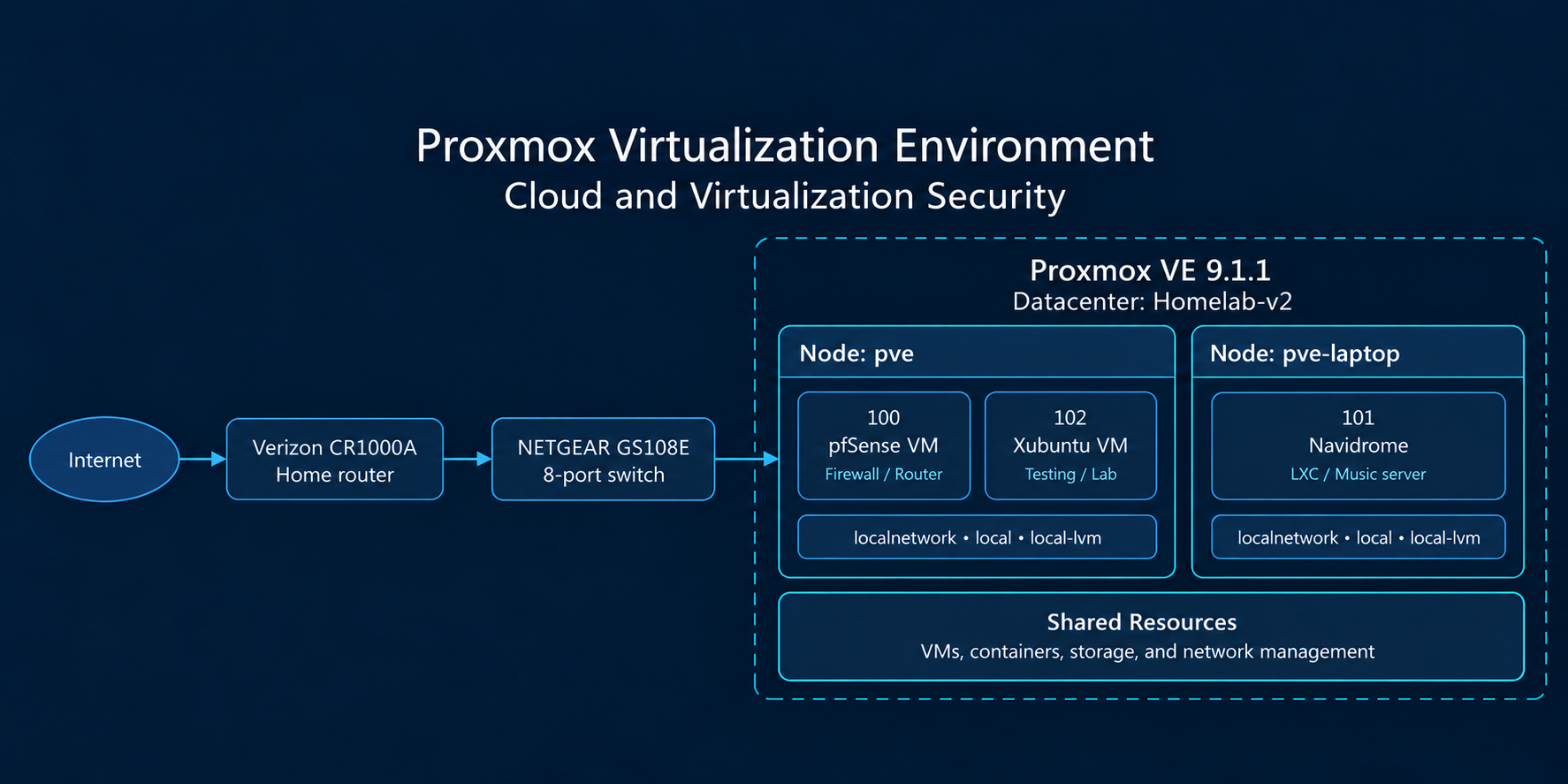
This topic relates rather closely to my personal homelab because I use Proxmox to manage a virtual machines and Linux containers. Through this project, I was able to experiment with different operating systems, services, and network configurations without needing separate computers for every single application that I use.
One of the challenges that I faced while working with virtualization was configuring the networking between the Proxmox hosts, pfSense, and other devices connected to my network. The challenge allow me to develop a better understanding of how virtual network interfaces comma bridges, and firewall rules affect communication between different systems.
Artifact 3: Virtualization Security
Artifact 3 Reflection
For this artifact, I chose to use my personal Proxmox environment to demonstrate how virtualization can be used to manage multiple systems on a single physical machine. With Proxmox, I have been able to experiment with virtual machines and Linux containers without needing separate computers for every service I want to run.
One thing I have learned from working with virtualization is how important it is to properly configure and manage the different systems running on the same host. Even though virtual machines and containers operate in separate environments, they still share resources from the physical computer. Because of this, a problem with the host or an improperly configured network could potentially affect multiple services.
I have also been able to work with different network interfaces and virtual bridges while setting up pfSense. This was one of the more challenging parts of my homelab because I needed to understand how the virtual and physical network connections worked together.