

A road needs repairs. A public building needs maintenance. Employees and suppliers need to be paid. For Virginia’s cities, counties and towns, meeting those obligations depends on more than balancing a budget on paper.
Residents need to know whether their local government can sustain the services they rely on, pay bills when they come due and respond when circumstances change.
As a public finance researcher, I study what helps governments meet those demands. My colleagues Ricardo Correa Gomes and Gustavo Andrey de Almeida Lopes Fernandes and I examined financial and political data covering roughly 5,500 Brazilian municipalities. Our study found a consistent pattern: Greater dependence on federal revenue was associated with weaker financial indicators.
That finding does not diagnose the finances of Virginia communities. Brazil’s municipalities operate under different rules. But examining another country’s experience can sharpen the questions we ask about our own local governments, particularly how the sources of their funding shape their ability to provide services.
A balanced budget tells only part of the story
Financial health is a government’s ability to meet its obligations while sustaining public services. A single budget total cannot capture that ability.
Consider two hypothetical local governments. Both receive enough revenue over a year to cover their spending. One has funds available when employees and suppliers need to be paid. The other faces a gap between when bills arrive and when revenue becomes available.
Their annual totals may look similar, but their ability to meet immediate obligations differs.
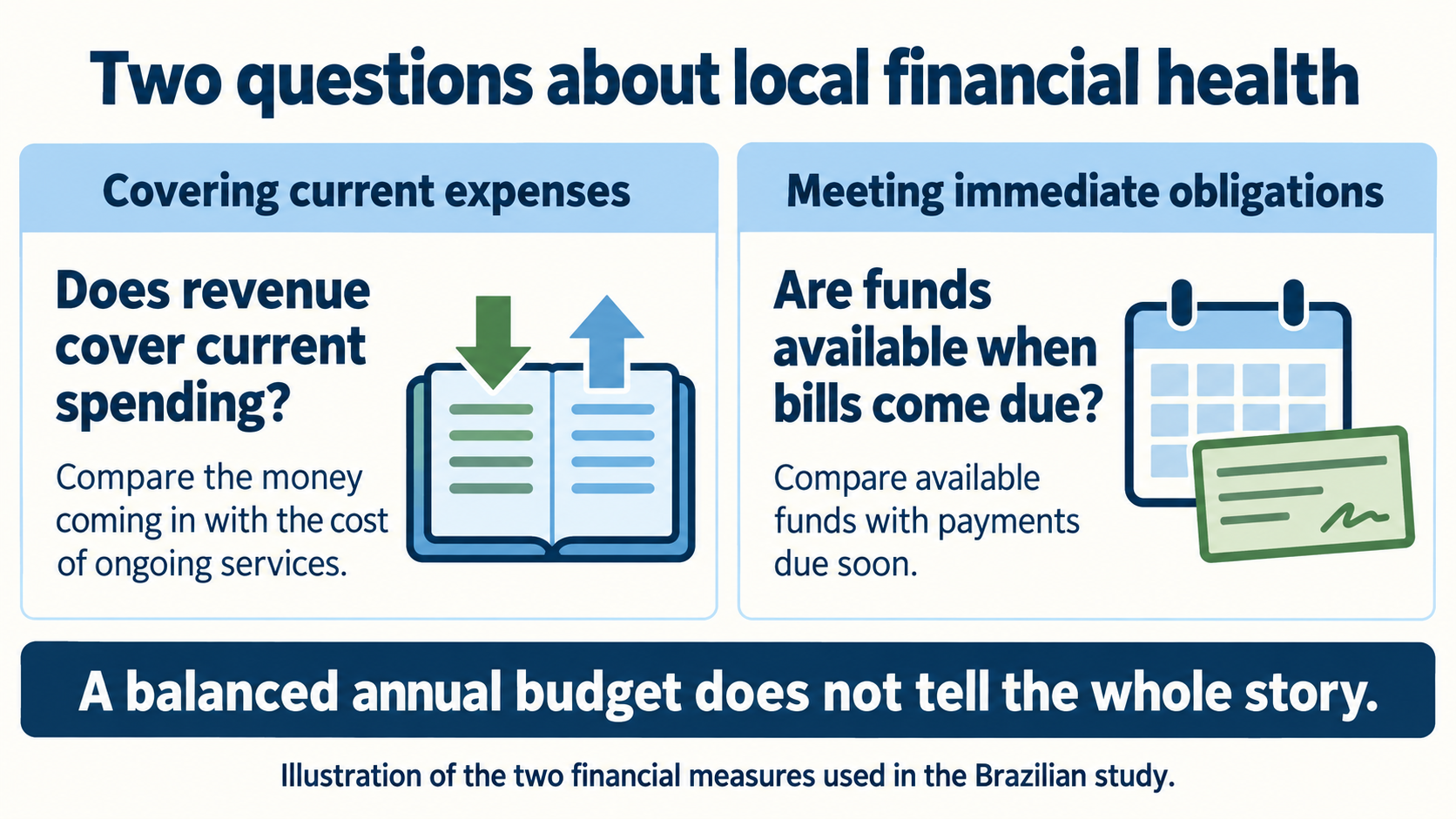
We used two measures to examine that distinction in Brazil. The first measured the operating surplus or deficit as a share of current revenue. It showed whether revenue covered current spending and how large the surplus or shortfall was relative to the money coming in.
The second compared available, unreserved funds with short-term liabilities. In everyday terms, it assessed the resources available to cover obligations due soon.
These measures help answer two different questions: Can the government cover its current expenses, and can it meet its immediate obligations?
Neither measure captures everything residents should care about. A surplus might accompany postponed maintenance, and these indicators do not fully measure long-term commitments or service quality. A government can look financially sound by one measure while facing problems that another measure reveals.
Why look to Brazil?
Much of the research on local government financial health has concentrated on the United States. Studying another country lets researchers examine whether familiar explanations hold under different accounting practices, political institutions and service responsibilities.
Brazil provides a useful setting. Its municipalities share a broad institutional framework, have directly elected mayors and serve communities with widely differing economic resources. They provide essential services, including education, health care and infrastructure.
Their finances also combine local taxing powers with substantial transfers from higher levels of government.
We combined municipal financial reports with information about local economies, populations and mayoral characteristics. Our statistical models accounted for persistent differences between municipalities and, in the fuller comparisons, conditions affecting municipalities in a given year.
This approach helped identify relationships across communities and over time. It could not establish cause and effect or capture every influence on municipal finances. Our models explained only a limited portion of changes in the financial indicators.
The source of revenue matters
Our clearest finding concerned reliance on federal funding. Municipalities receiving a larger share of their revenue from the federal government tended to have weaker operating positions and less favorable indicators of their capacity to meet immediate obligations.
That does not mean federal support caused those difficulties. It also does not mean cutting transfers would improve municipal finances.
Outside funding can help communities provide services their own tax bases cannot adequately support. Municipalities with greater financial needs may depend more heavily on transfers in the first place. Our study cannot fully separate those circumstances from any consequences of dependence itself.
The finding nevertheless draws attention to a practical issue: How well do a government’s revenue arrangements fit the responsibilities it must fulfill?
For Virginia residents, that means looking at where local funding comes from as well as how much is available. How much can officials raise through local decisions? How much depends on decisions by other governments? How dependable is that support, and what happens if it changes?
The timing and conditions of outside funding may also affect a government’s flexibility. Those are questions for further investigation; our study did not directly test the mechanisms behind the relationship.
Two governments with similar revenues may have different options when costs rise or community needs change. Understanding those options is part of assessing financial health.
Leadership is part of the picture
Residents understandably want capable people managing public money. We examined whether mayors’ age, education, gender, political orientation and service in a second term were associated with municipal financial outcomes.
Older mayors were associated with more favorable results on both measures. We used age as a proxy for broader professional and life experience, but it cannot show exactly what experience a particular mayor brings to office. It would be a mistake to interpret the finding as proof that electing older candidates improves finances.
Other leadership findings varied across measures and statistical comparisons. Education, second-term service and political orientation did not consistently explain stronger results across both indicators.
Taken together, the leadership characteristics we measured explained relatively little of the variation in municipal financial conditions. That does not establish that leadership is unimportant. It shows the limits of using a leader’s résumé or party label to explain a government’s finances.
For Virginia readers, evaluating financial performance also requires considering the resources, obligations and economic circumstances within which public officials work.
Four questions for your locality
The research suggests four questions residents can bring to discussions about their city, county or town’s budget:
- Can we sustain ongoing services? Consider whether dependable revenue supports recurring expenses.
- Can we meet immediate obligations? Annual revenue totals alone do not show whether resources are available when payments fall due.
- How much funding depends on decisions elsewhere? Ask about the reliability of that support and the options available if it changes.
- Are we postponing costs? A surplus deserves closer examination if necessary maintenance or other spending has been deferred.
These questions connect financial reports to everyday concerns about reliable services. For policymakers, they also emphasize the need to consider service responsibilities and the capacity to fund them together.
Greater local taxation is not a universal solution. Communities differ in their economic resources, and funding decisions must consider both residents’ ability to pay and the services they need.
For me, studying Brazil’s municipalities reinforces the value of looking beyond familiar explanations. The findings offer Virginia communities a starting point for examining whether the money behind their public services is sufficient, dependable and available when needed. Those are questions worth asking before financial difficulties turn into interruptions in daily life.