
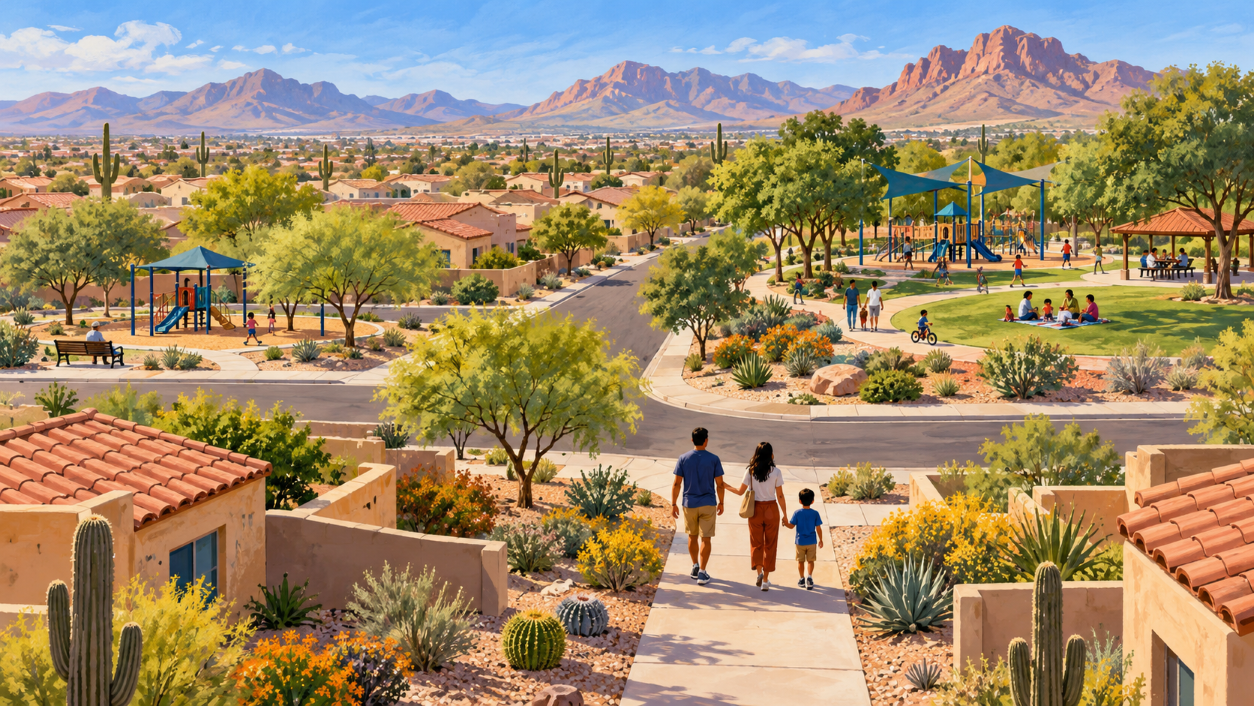
A park offers many benefits to our mental and physical health. It provides shade, cooler surfaces, and opportunities for activity and socializing. If you live within walking distance of a park, you probably use it. That assumption shapes how cities plan and evaluate green space. It has also driven environmental justice studies to examine whether green space is distributed equally across neighborhoods and to identify which communities should receive more. The question is: Once a park is provided, do residents use it?
Our recent study in Landscape and Urban Planning tested that assumption in the Phoenix-Mesa area of Arizona. The answer was more complicated than we expected. In about 40% of neighborhoods that had a park within walking distance, residents’ most-visited park was somewhere else.
This matters a great deal in the desert environment. Summer temperatures in the Phoenix area often exceed 100°F (37.8°C). While green spaces are scarce resources, they are crucial for mitigating extreme heat in the area. Therefore, it matters whether the ones we build actually get used. A park on the map only delivers health benefits if people go there.
Revealing visits to parks using mobile phone data
Most research on green space equity measures access: how close the nearest park is, how many parks a neighborhood has, and how large they are. A few studies look at whether residents actually use them. Surveys and site counts can capture some aspects, but they are expensive and hard to run across a whole metro area.
We used anonymized mobile phone data from SafeGraph from 2019, before the pandemic changed how people used parks. The data can estimate how many devices from each neighborhood visited each park. We combined it with the Trust for Public Land’s ParkServe data on park locations and with U.S. Census demographics.
The unit of analysis was the census block group, a small neighborhood unit. The study covered 2,102 block groups and 958 parks across the Phoenix-Mesa urbanized area, home to more than 4 million people. For each neighborhood, we did two things:
- Identified its local parks: any park within 1 km (about a 10–15 minute walk) of the neighborhood’s center.
- Identified its most-used park: the park that received the largest share of residents’ visits over the year.
As a result, we categorized neighborhoods into three groups. In Group 1, residents had local parks and used one of them most often. In Group 2, residents had local parks but most often went to a park farther away. Group 3 had no local park at all. We then used a statistical (logit) model to ask which neighborhood characteristics predicted being in Group 1 rather than Group 2.
Access does not guarantee use
Most neighborhoods in the area are reasonably well served: 82% (1,721 block groups) had at least one park within walking distance. But in 670 of them (about 40%), residents’ preferred park was a non-local one.
While proximity did not predict use in those neighborhoods, that does not mean better access does not matter at all. If the nearest park is farther away, residents were less likely to make it their primary destination. More local parks, including larger ones, help residents use local parks more often. These results support continued investment in nearby green space. But the story does not end here.
To whom do local parks matter most? Neighborhoods with more children and Hispanic residents
Block groups with a higher share of residents under 18 were significantly more likely to use a local park most. Families with kids may value a quick walk to a playground over a drive to a farther destination.
Neighborhoods with a higher share of Hispanic residents were more likely to use local parks most, which is consistent with earlier research on park use as a family and community activity. But that relationship depended on the parks themselves:
- Distance: When the nearest park was within about 800 meters of the neighborhood center, a higher Hispanic population increased the likelihood of local park use. Beyond that distance, the relationship reversed.
- Size: When the average size of local parks was more than 7.8 acres, a higher Hispanic population increased local park use. Where local parks were smaller, it decreased.
This non-linear pattern is the study’s most novel finding. When a small nearby park does not meet a community’s needs for gatherings, sports, or family outings, residents go elsewhere. Prior work has also shown that Hispanic neighborhoods in the Phoenix area tend to have fewer trees and less tree connectivity, which may compound the problem.
Practical recommendations for cities
For planners and local officials, our results point to a few lessons. Keep closing the access gap across neighborhoods. Provide local parks within walking distance, especially in the desert area, where traveling farther for green space is costly in time and money and risky under extreme heat. Access is not sufficient on its own, but it is necessary.
In addition to access, city planners should measure use to understand whether parks are serving neighborhoods as intended. Depending on needs and preferences, different population groups may use nearby parks differently. Communities know what they need from their parks. We recommend participatory planning, particularly in Hispanic neighborhoods that already face challenges with park quality, size, and tree cover. Asking residents what draws them to a distant park could guide improvements closer to home.
Building parks near people is the first step. In hot, dry cities where green space is scarce and precious, every park should serve the neighborhood it supports. That means paying attention to how residents actually use green space and what they look for in it.