
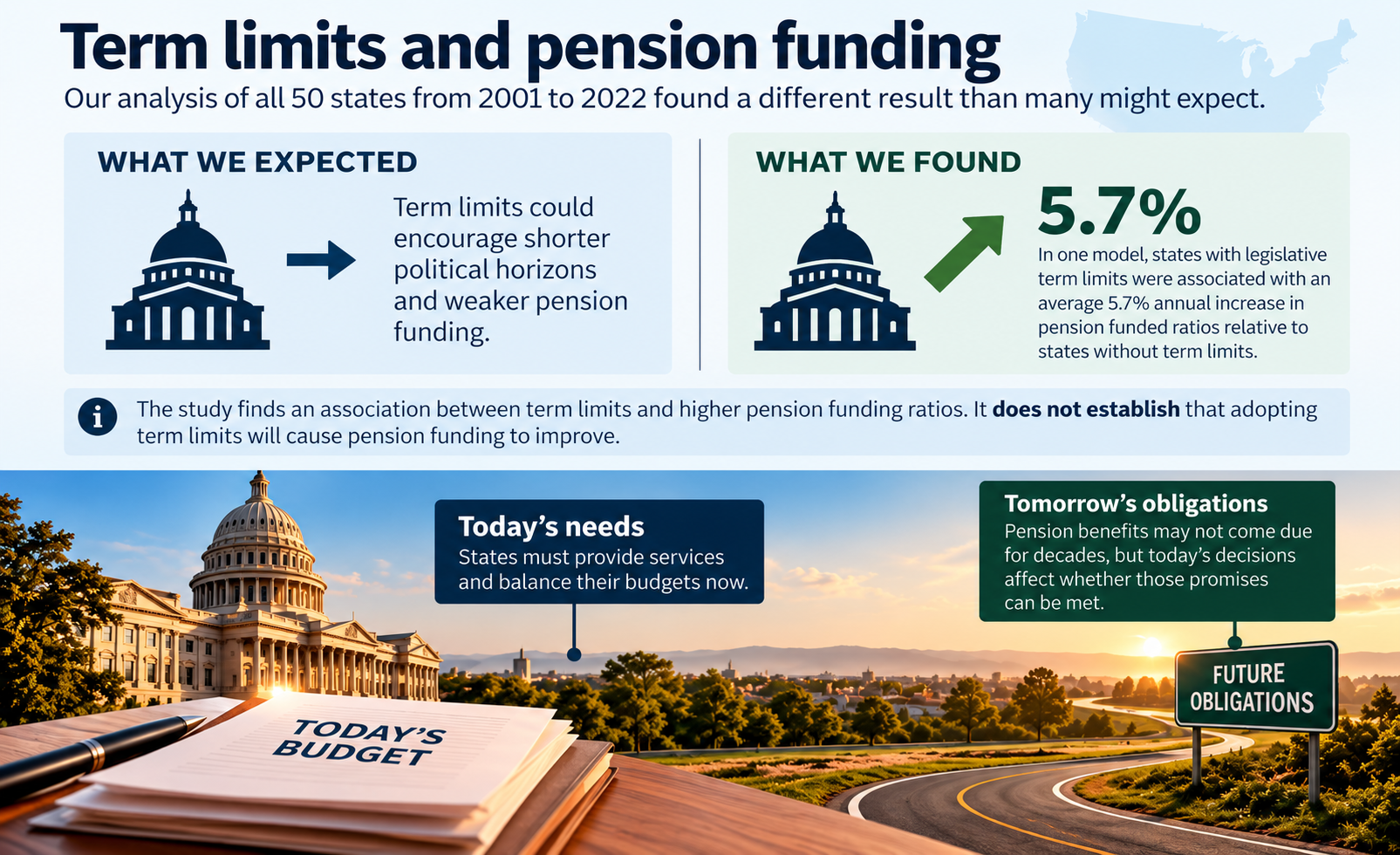
Governments constantly make choices between what needs to be paid for today and what can wait until tomorrow. Public pensions make that tradeoff especially important because states must provide services and balance their budgets now while also setting aside enough money to pay retirement benefits that may not come due for decades.
When governments fall behind on those contributions, the obligation does not disappear. It becomes a problem for future budgets, taxpayers and public employees.
As a public budgeting and finance professor, I joined Saman Afshan and Nikolay Anguelov to examine whether one feature of state political institutions affects how governments manage these long-term obligations: legislative term limits.
We analyzed the primary state employee pension plan in all 50 states from 2001 through 2022. We expected that term limits might encourage legislators to focus more heavily on immediate spending needs at the expense of obligations that extend well beyond their time in office.
Instead, we found that states with legislative term limits tended to have better-funded pension systems.
That finding doesn’t mean term limits cause states to fund their pensions better. But it does suggest that the relationship between political turnover and long-term financial decisions is more complicated than it might first appear.
Pensions look beyond the annual budget
Most states are required to balance their budgets, but balancing a budget does not necessarily mean a government is in good long-term fiscal health.
Governments facing a difficult budget year have several options. They can reduce spending, raise revenue, transfer money between funds, delay expenditures or use one-time resources. Those approaches can help reconcile revenues and expenditures for a particular year without necessarily addressing financial pressures that extend further into the future.
Pensions work differently. A pension system’s funded ratio compares the assets available to pay benefits with the liabilities it has accumulated. If a state does not adequately fund those obligations today, future officials still have to deal with them.
That makes pension funding a useful way to study how governments approach the future. Unlike an annual budget, a pension obligation can extend across multiple administrations and legislative sessions. In our study, we use pension funding as an indicator of long-term fiscal condition for precisely that reason.
Term limits give us an interesting way to examine those decisions because there are competing arguments about how they affect legislators.
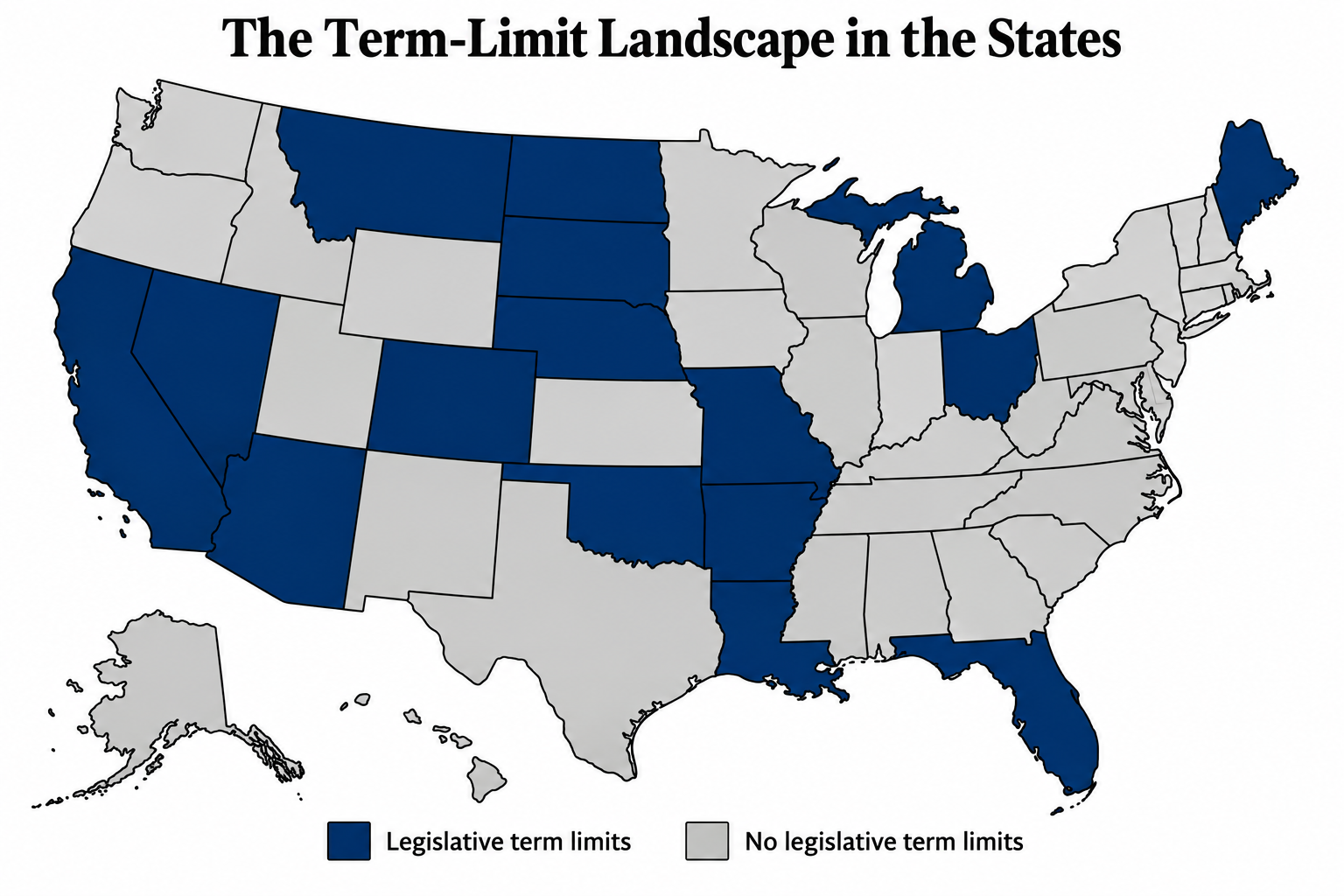
On one hand, legislative experience matters. Lawmakers learn how state budgets work, develop institutional knowledge and build relationships that help them navigate complicated fiscal decisions. Term limits increase turnover and can reduce some of that experience. Previous research has also raised the possibility that legislators with limited time remaining in office may favor expenditures that produce more immediate and visible benefits over obligations such as pension contributions.
That would lead us to expect states with term limits to have less well-funded pension systems.
But turnover could work in the other direction. New legislators may be more willing to reconsider practices that have allowed governments to push costs into the future. Term limits can also change relationships among legislatures, governors and other participants in the budget process. Our study therefore considered both possibilities.
Term limits were associated with better pension funding
To test the relationship, we examined pension funding across all 50 states over more than two decades. Because term limits are hardly the only factor that could affect pension funding, our models also accounted for differences in states’ political, governmental, economic and demographic conditions.
The results ran counter to the expectation that term limits would encourage states to neglect long-term pension obligations.
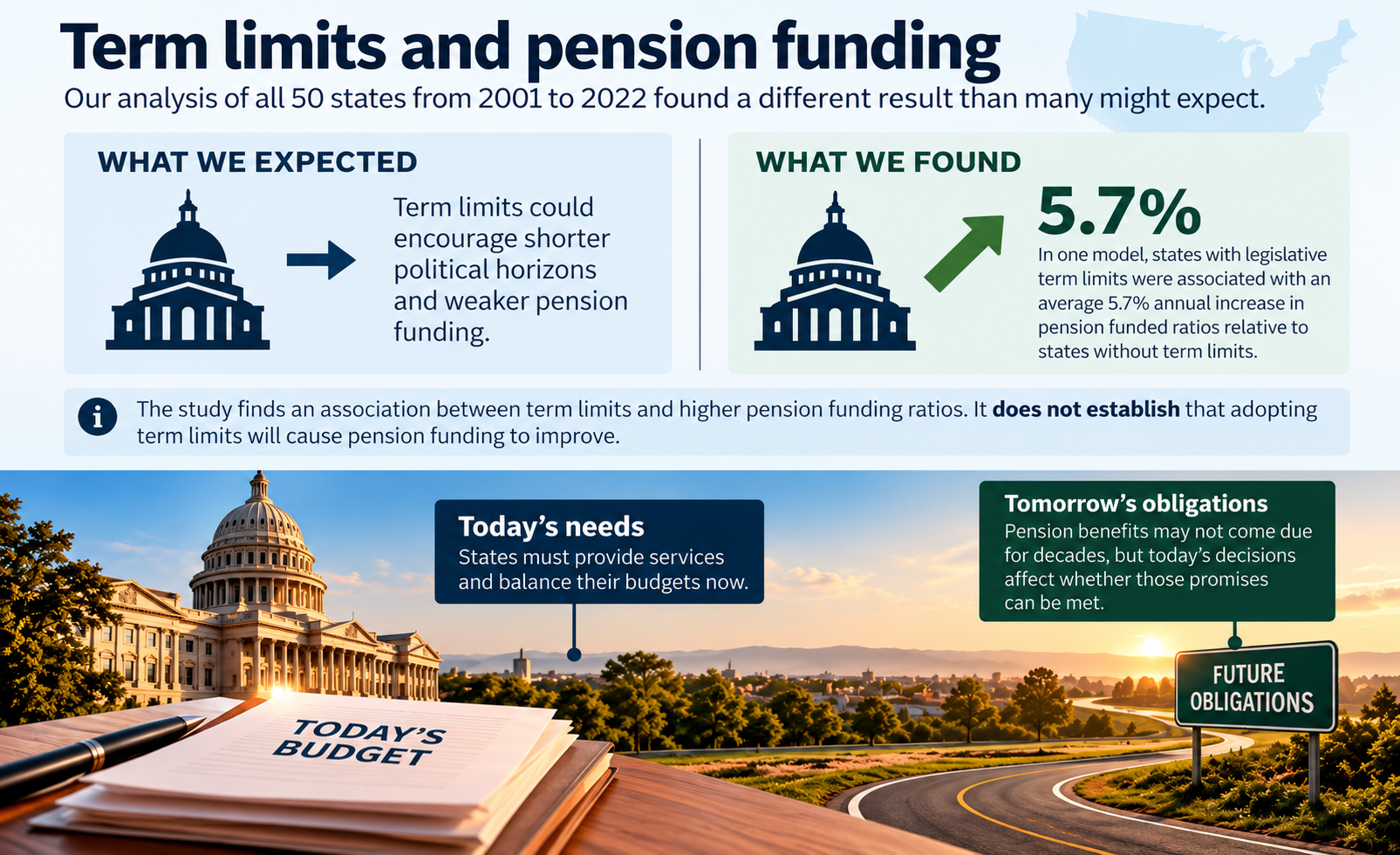
States with legislative term limits were associated with higher pension funding ratios. One of our models showed that funded ratios in states with term limits increased, on average, by 5.7% annually relative to states without them over the period we studied. We also found evidence that experience operating under term limits was positively associated with pension funding, although that relationship did not remain when both measures of term limits were considered together.
There are several possible explanations for what we found. Legislative turnover could disrupt established patterns of pension underfunding. New lawmakers could approach long-standing fiscal problems differently. Term limits could also alter the balance of power between legislatures and governors, changing who has influence over budget decisions.
Our research cannot determine which of these explanations, if any, accounts for the relationship. The study also does not account for changes in individual pension-plan governance, actuarial assumptions or informal political negotiations that could affect pension contributions.
Those limitations are important because our findings should not be interpreted as evidence that adopting term limits will cause a state’s pension funding to improve. Nor does the study settle the broader debate over whether term limits are good or bad for state government.
What the findings do show is that political turnover does not necessarily translate into weaker long-term pension funding. That gives researchers another reason to look more closely at how political institutions shape fiscal decisions.
The results also point to a broader problem facing public officials: immediate needs tend to be more visible than future obligations. Roads need repairs, agencies need employees and residents expect services now. The consequences of inadequate pension contributions may not become apparent for years.
Governments therefore need ways to keep those future obligations visible as elected officials, economic conditions and budget priorities change. Greater transparency, careful monitoring of pension contributions and clearer responsibility for funding decisions can help protect long-term commitments from short-term budget pressures. These are among the practical implications we identify in our study.
The same challenge extends beyond pensions. Infrastructure maintenance, capital investment and debt management all require governments to make decisions today whose full costs may not become apparent for years.
A balanced budget tells us something important about a government’s finances today. It doesn’t necessarily tell us whether that government is preparing for tomorrow. Our findings suggest that understanding long-term fiscal health requires paying attention not only to the choices public officials make, but also to the institutions in which they make them.