
Along coasts across the world, rising seas and intensifying storms present shoreline property owners with a difficult question: how to protect their land from washing away.
For decades, the standard response was armor. Waterfront owners installed concrete seawalls, wooden bulkheads, or giant piles of stone (riprap) to hold back the waves. But scientists and environmental managers now know that these rigid, hardened structures destroy coastal ecosystems. They starve beaches of sand, sever the connection between land and water, and eliminate essential tidal wetlands that serve as nurseries for marine life.
To combat this loss, states like Virginia introduced pioneering laws explicitly declaring “living shorelines” that use native plants, sand fill, and subtle rock sills to absorb wave energy as the default preference for coastal protection.
Yet, years after these mandates took effect, a puzzling trend persists: property owners continue to permit and build hard, artificial barriers.
A recent study published in Sustainability by researchers Juita-Elena (Wie) Yusuf, Mariana Saitgalina, and Michelle Covi uncovers why this disconnect happens. The breakdown occurs long before a permit application ever reaches a regulator’s desk. By examining how homeowners, marine contractors, and local officials interact in the preliminary stages of project planning, the authors reveal that ecological policy fails not because of lax enforcement, but because the decision-making pipeline is rigged upstream in favor of hard infrastructure.
Social norms and “neighborhood anchoring”
Individual homeowners do not make decisions in an ecological vacuum, they look over the fence.
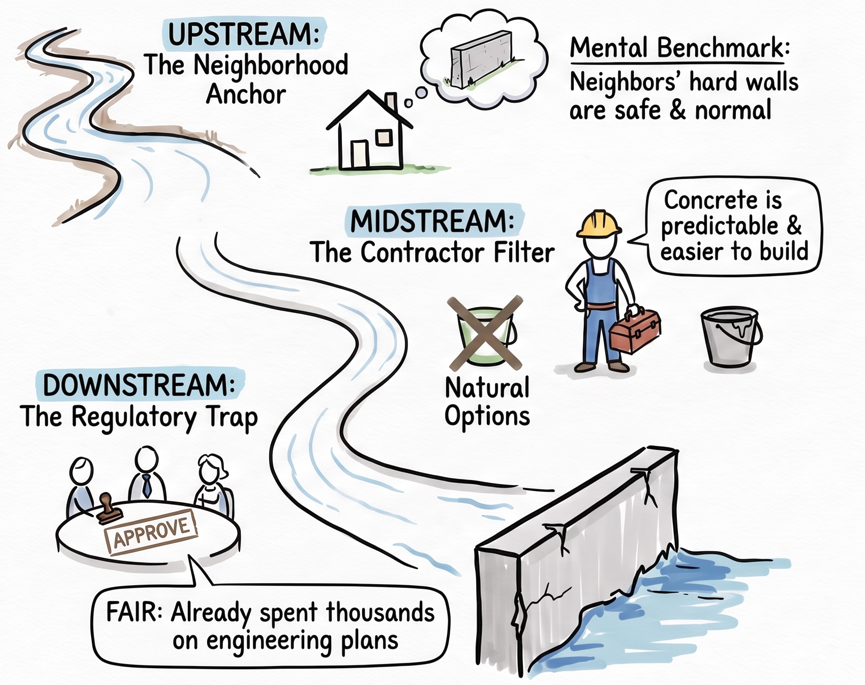
The study found that visual norms within a waterfront community heavily dictate individual choices. When a property owner looks down their riverbank and sees a continuous line of wooden bulkheads or stone revetments, those structures become the mental benchmark for what is normal, effective, and safe.
This creates a self-reinforcing cycle. When a property owner believes hard armoring is the default neighborhood standard, they actively request identical solutions from contractors.
While non-profit organizations and coastal outreach groups attempt to counter this by holding workshops and constructing demonstration sites, the study reveals their reach is selective. Non-profits predominantly engage homeowners who are already environmentally conscious or seeking green solutions. They struggle to reach the broader population, leaving commercial contractors and neighboring shorelines as the dominant influences.
The upstream decision-maker: Marine contractors
When a waterfront homeowner notices an eroding bank, their first call is rarely to a marine scientist or state environmental agency. Instead, they call a local marine contractor.
This initial point of contact turns out to be the single most critical juncture in the entire decision-making process. Marine contractors act as primary “agenda-setters” and knowledge filters. They shape the menu of options presented to the buyer.
The study’s findings are stark: property owners who ended up installing living shorelines were usually presented with natural alternatives by their contractor during early discussions. Conversely, homeowners who installed hard seawalls or bulkheads were rarely offered a living shoreline as a viable option in the first place.
Why do contractors lean toward hard armor? It comes down to practical incentives:
- Hard structures rely on standardized construction methods. Contractors understand their supply costs, installation timelines, and performance parameters.
- Living shorelines require establishing plant life and accommodating dynamic coastal forces, introducing operational variables contractors prefer to avoid.
- While institutions like the Virginia Institute of Marine Science (VIMS) train contractors on natural design, that scientific knowledge gets filtered. During sales pitch meetings, technical guidance gets translated through a lens of cost, constructability, and regulatory speed rather than ecological merit.
By the time a homeowner selects a design, the ecological alternative has often been quietly filtered out.
Local wetlands boards and the “property rights” trap
Once a project design is chosen and a permit submitted, it goes before local regulatory bodies, such as local wetlands boards, for review. Theoretically, these co-management institutions exist to uphold environmental laws and reject ecologically damaging proposals.
In practice, local boards are trapped at the end of a long chain of pre-existing choices.
Interviews with local regulators revealed that board members frequently see their mandate not as environmental protection at all costs, but as balancing ecological health against fairness to the homeowner. Many board members view themselves as arbitrators protecting private property rights.
This mindset introduces informal heuristics into decision-making:
- Applications submitted by well-known, local marine contractors or experienced permit agents receive significantly less scrutiny, assuming reputable contractors have already vetted the site’s feasibility.
- If adjacent properties are already armored, boards frequently deem it unreasonable or unfair to deny a neighboring homeowner the right to build a similar hard barrier.
- Because boards sit at the very end of the process, rejecting an application means forcing a homeowner to scrap thousands of dollars in engineering plans and start over.
Fixing coastal governance from the top of the funnel
The central takeaway of the research is clear: passing laws that favor living shorelines is insufficient if informal decision networks operate against them upstream. Regulatory agencies cannot simply write better technical manuals or tweak permitting guidelines and expect coastal landscapes to transform.
To align actual shoreline construction with environmental policy, coastal managers must intervene early in the decision pipeline.
Protecting fragile coastlines from climate change requires looking beyond the regulatory rubber stamp. Only by addressing the commercial incentives, neighborhood peer pressure, and early consultations that occur long before a permit application is typed can we hope to replace concrete walls with living, resilient shores.