
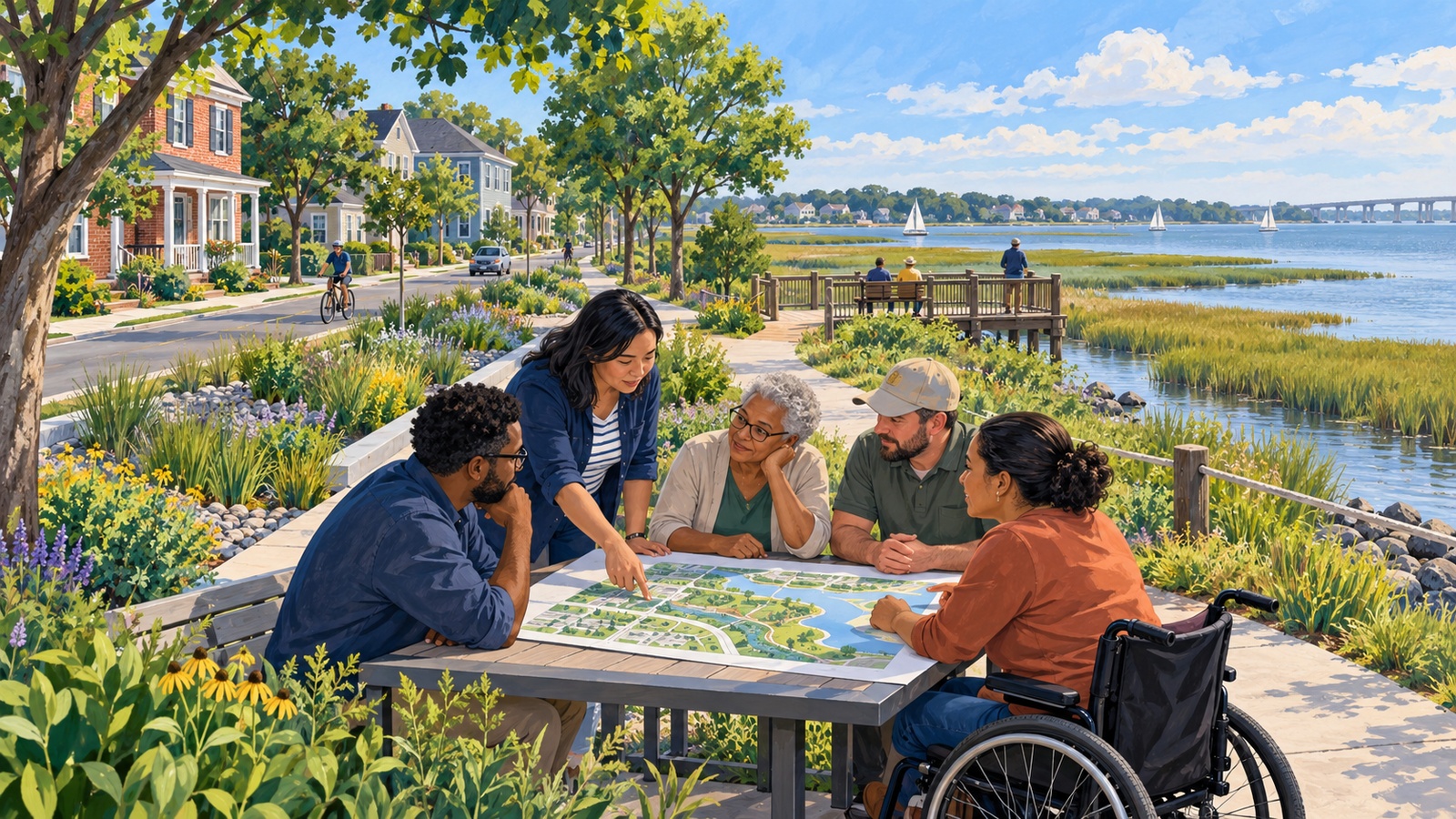
Flooding, storms, and rising seas threaten coastal communities across the U.S., prompting us to rethink how we protect people and places. For decades, the solution was mostly concrete or gray infrastructure: sea walls, levees, and bulkheads. Recently, green infrastructure, such as wetlands, urban forests, rain gardens, and living shorelines, has emerged as a promising strategy for enhancing resilience. These projects use natural systems to absorb floodwaters, filter runoff, cool neighborhoods, and provide green spaces to gather and play. They can be less costly to maintain and more sustainable over time than traditional gray infrastructure.
Our research, however, shows that implementing green infrastructure is not only a technical or environmental challenge. It is also a deeply social and equity-focused process. Benefits of green infrastructure are not automatically or evenly distributed. Planning practices that fail to explicitly consider equity can inadvertently reproduce the same patterns of exclusion that have long characterized infrastructure investment. In a study published in Public Works Management & Policy, we explore how to ensure green infrastructure investments build resilience for everyone, not just the few.
A framework for equity
Our team created an integrative planning framework for green infrastructure implementationas a roadmap for governments to design, fund, and maintain green infrastructure projects in ways that are effective, transparent, and fair.
The framework looks at three interconnected phases of a green infrastructure project’s life:
- Strategic planning, when priorities are set and projects are identified;
- Implementation, when designs are finalized, funding is secured, and projects are built; and
- Maintenance and monitoring, when projects are cared for and evaluated over time.
Equity is important at every phase. That means listening to the people most affected, accounting for who pays and who benefits, and making sure resources and information are shared fairly. Our framework highlights four cross-cutting themes or equity touchpoints:
- Stakeholder engagement and public participation
- Trade-offs and multiple benefits
- Resources and capacity
- Data, metrics, and analysis
To explore what this looks like in practice, we convened a national workshop, Making Waves in Equitable Coastal Resilience,that brought together more than 100 participants, including federal, state, and local government practitioners, nonprofit leaders, and academics.
Stakeholder engagement and education
One message came through clearly during the workshop: people need to be part of the process from the beginning. Many residents simply aren’t aware of what green infrastructure is or how it can help their neighborhoods. “People understand concrete – a bridge or levee – but not green infrastructure,” one participant said.
Others spoke about distrust of government, especially in communities that have felt ignored or left behind in past planning efforts. Without early and genuine engagement, residents may see projects as something being done to them, not for them. Equitable planning thus requires inclusive and sustained engagement, not one-time consultations. Building trust means meeting residents where they are, acknowledging differing values and risks, and ensuring community voices shape both design and implementation.
Counting multiple benefits
Another issue is how governments decide where to invest. Many agencies still rely on cost-benefit calculations based on property values or potential economic returns. This approach can unintentionally favor wealthier areas, while areas with lower property values are less likely to receive funding for green infrastructure projects.
These formulas overlook the multiple benefits that green infrastructure provides: cleaner water, better air, public recreation, and improved mental health. When decision-makers value these co-benefits alongside dollars and cents, they can justify investments in lower-income or under-resourced communities where returns may be less quantifiable but more transformative.
Bridging the capacity gap
Many small towns and rural counties simply don’t have the staff or expertise to apply for and manage complex grants. Simplifying these grant programs, providing technical assistance, and building local capacity can help ensure that all communities, not just the most well-resourced ones, can access funding and implement green infrastructure projects.
Closing the data gap
Our research also identified the need for better data and mapping to track where green infrastructure is being built, how it performs, and who it serves. Information on these projects is scattered and incomplete, making it hard to see the big picture. Without this data, it’s difficult to measure progress or identify inequities. Having national or regional databases could help planners learn from successful projects, offering essential tools for evidence-based decision-making and accountability.
From research to action
The message is simple: resilience and equity must go hand in hand. Investing in green infrastructure isn’t just about protecting coastlines. It’s about strengthening communities, restoring trust, and ensuring that the benefits are shared fairly. Our framework provides both a conceptual lens and a practical toolkit for advancing just green infrastructure. Equity considerations should be part of each phase, from strategic planning to evaluation, if we are to correct the long-standing injustice of overlooking vulnerable and underserved communities.
For local governments, that means building partnerships across departments, working closely with residents, and considering social outcomes alongside engineering performance. For citizens, it means speaking up and coming to the table: asking how decisions are made, learning about the issues, and attending meetings.
Why it matters
As communities invest billions in climate adaptation and infrastructure projects, decisions made today will shape who benefits and who pays for years to come. Green infrastructure offers a path toward ecological and social resilience. But realizing its promise requires a conscious effort to embed equity into every decision, dataset, and design.
For students and practitioners of public administration, the message is clear: equitable green infrastructure is not just good environmental policy, it is good governance.