
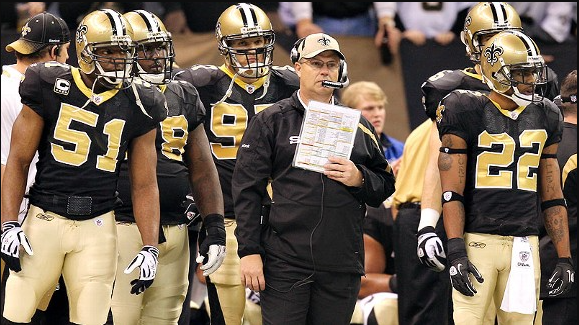
In the hard hitting world of the National Football League(NFL), where split-second decisions and raw physicality dominate, few scandals have rocked the sport quite like BountyGate, The New Orleans Saints’ bounty scheme, which paid players to hurt opponents, was exposed. This scandal rocked the league, resulting in harsh penalties and permanently changing how professional football players are perceived to be safe.
The True Scheme
The NFL, under the direction of Commissioner Roger Goodell, revealed the results of a months-long review into the New Orleans Saints organization in March 2012. According to the research, defensive players were rewarded with anything from $1,000 for a “cart-off” tackle to $1,500 for a “knockout” hit between 2009 and 2011. According to reports, defensive players and staff members combined to make these contributions, which were then distributed according to the extent of the injuries sustained. Gregg Williams, the defensive coordinator who reportedly planned the reward program, was at the core of the scandal. General manager Mickey Loomis and head coach Sean Payton were also held accountable for their failure to stop the scandal. When former defensive player Anthony Hargrove filed a written declaration confirming the program’s existence, the scandal which Saints management had first denied, came to light.
Actions Meet Consequences
The consequences were immediate and severe. Some of the most severe punishments in NFL history were imposed by the league: Sean Payton became the first head coach ever to receive a full-year suspension for a league infraction when he was banned for the entire 2012 season. Gregg Williams was essentially banished from the league for a while after being suspended indefinitely (he was later reinstated in 2013). For the first eight games of the 2012 season, Mickey Loomis was suspended. Joe Vitt, the assistant coach, was suspended for six games. Linebacker Jonathan Vilma was one of four players who received suspensions; however, former commissioner Paul Tagliabue eventually reversed their penalties. The Saints forfeited two second-round draft selections and paid a $500,000 fine.
Impact
After winning Super Bowl XLIV, the Saints were left in a state of chaos. They had a rough 2012 season, finishing 7-9 and missing the playoffs due to the absence of their offensive mastermind, Payton. The controversy also damaged the reputations of some of their most admired players, including Drew Brees, who openly supported his teammates and coaches. In general, BountyGate compelled the NFL to adopt a more aggressive player safety policy. The league boosted fines for illegal tackles, strengthened concussion protocols, and tightened regulations on forceful hits. However, several critics charged the NFL of hypocrisy, claiming that because of the violent nature of the sport, these kinds of accidents were unavoidable. While acknowledging the violence of the game, former players like Brett Favre, who was allegedly targeted by the bounty system, also underlined that “there’s a difference between playing hard and playing dirty.”
The Aftermath
Some uncertainties remained even as the league attempted to move forward. Was BountyGate an isolated incident or the beginning of something bigger? Although there was no hard proof, a number of former players said that the league had such incentive-based programs. Saints supporters, on the other hand, mostly viewed their team as scapegoats, claiming that the NFL set an example in New Orleans while ignoring other teams that were following suit. BountyGate is still regarded as one of the most notorious scandals in NFL history more than ten years later. It emphasizes the continuous conflict between football’s physical demands and the league’s duty to protect its players and serves as a warning about the repercussions of putting violence ahead of morality. One thing is clear as the NFL develops further, BountyGate will always be a pivotal event in the history of the league and an important reminder of the fine line separating corruption from competitiveness.