Interpretive, Interpersonal, and Presentational Modes of Communication
Exploring Culture
The website that was used in Spanish 101F, Lingrolearning, gave me the most insight into different cultural perspectives. Never before had I considered the different ways that countries interact with social media or the differences in schedules. I appreciated that my peers and I were required to include culture into our assignments as this helped me grow in my understanding.
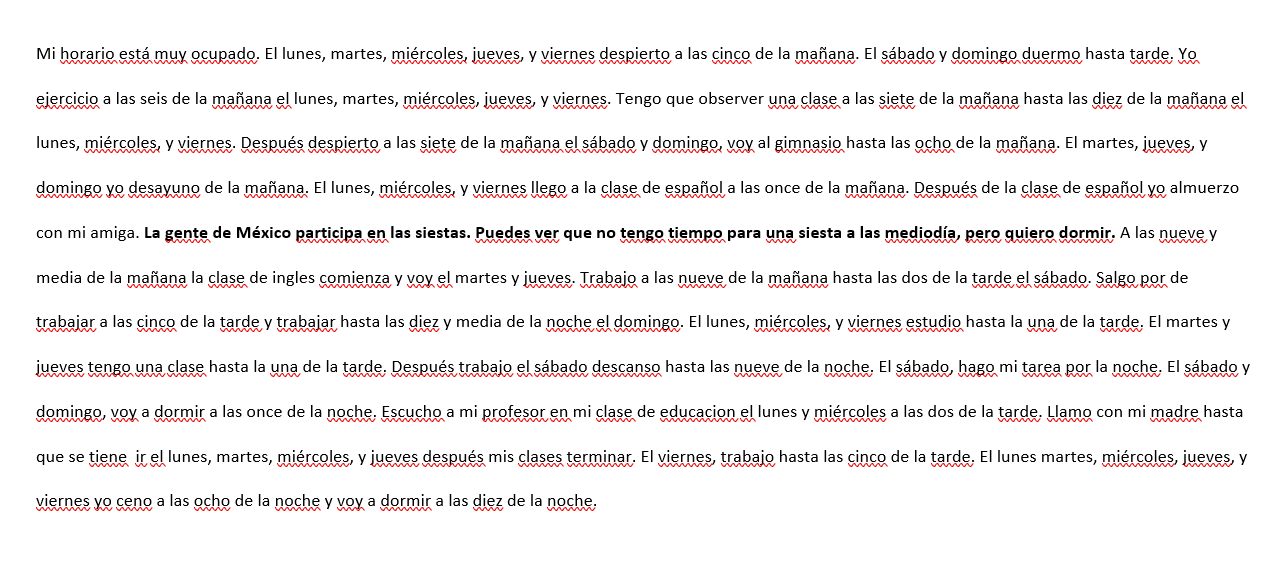
Lingrolearning enhanced my understanding of values and attitudes in the Hispanic culture through accounts from people living in Spanish-speaking countries. For example, there were activities that allowed a student to scroll through the different countries in order to read different individual’s experiences with technology, food, social media, and occupation/schedules. My worldview was challenged because my eyes were opened to the smaller differences that I might have not otherwise considered. I never thought about which social media would be most popular from country to country, or whether the fast pace of the United States is the norm or not. These realizations helped me to reflect on my own life and think through why I always feel so busy. I was forced to ask myself whether the issue is that many things are thrust upon me, or whether I take on too much like several others do in my culture. I think there is much to learn just from Spanish-speaking countries custom to simply take a nap after lunch.
Below is a project I submitted where Professor Vera-Guerrero asked us to include a cultural aspect. I have the cultural part in bold.
Engaging in Communities
During the course of an individual’s life, it is important to engage in immediate community as well as global community. Engaging in these communities helps a person not to feel cut off from the outside world. Through interactions people are able to express different cultures, beliefs, and practices that might have otherwise flown below another individual’s radar.
A community I have found myself particularly grateful to have gotten the chance to interact with are my Spanish 101F classmates. We have found unity in our desire to learn Spanish as cohesively as possible. I specifically got to know my classmate, Madison Colver, especially well due to an interactive assignment. Together, she and I completed proyecto 2 and got to know one another more through our questions and answers.
The following is the project that Madison and I did together.
https://clipchamp.com/watch/fDsvlVNPzrj
Interpersonal Communication
My Spanish 101F class completed several activities in Lingrolearning that were a part of the “Conversar” section. “Foro de conversación” was an activity that was completed in class and in live time. Students would answer the prompt provided and the professor went through our submissions as well as our replies to our peer’s submissions. This was a intelligent way to gauge interactions with one another as well as student’s ability to think quickly and put those thoughts to paper.
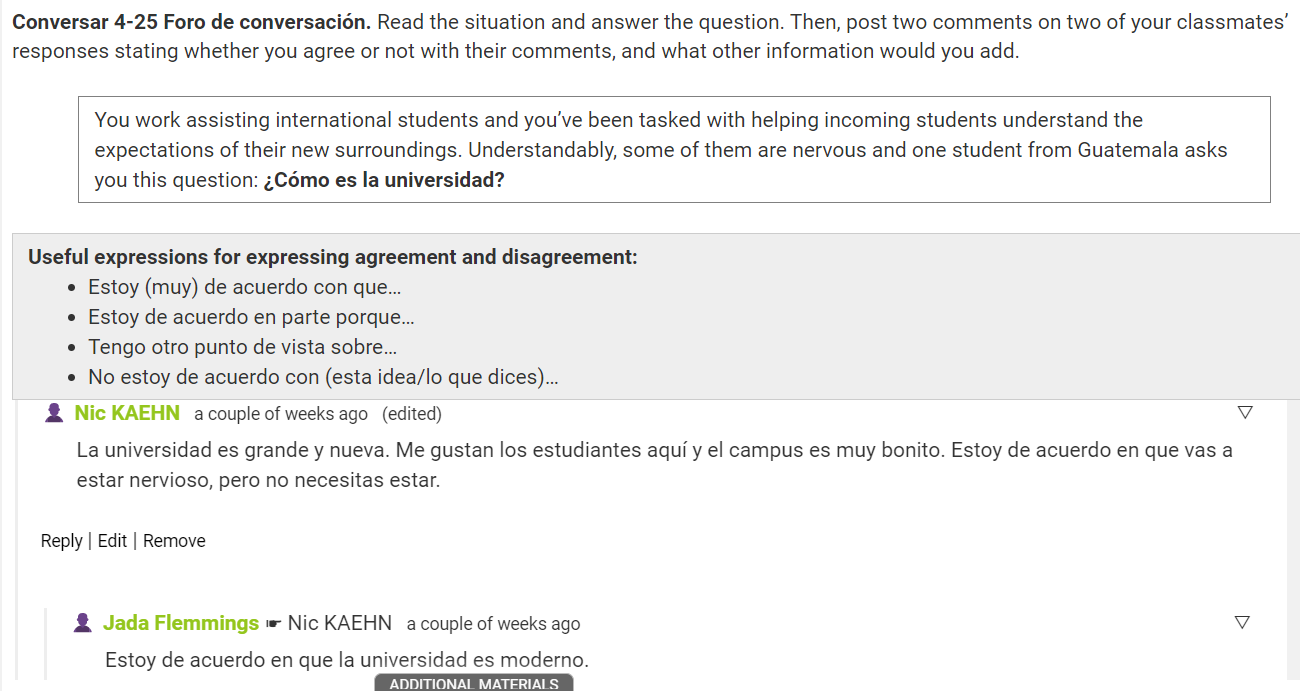
I first struggled mainly with an aversion to being incorrect. I would take longer to post than my classmates in fear of answering the prompt even slightly wrong. As the semester went on, I cared less and less about the idea of making a mistake. My professor would simply call the mistake out, instruct us on how to fix it, and move on. This kind of motivation and reinforcement is exactly why interpersonal communication is so important.
Presentational Speaking
The main speaking activities we were required to do in Spanish 101F were through projects and in class. In class my professor required total participation from all of the students that resided within the class. This was mainly done to practice how our vocabulary should be spoken and what it should sound like in application. This was fairly helpful as these exercises increased familiarity and made the class feel more comfortable overall when speaking. The projects were less group oriented when it came to speaking activities and were opportunities to show off our skills and learn from our mistakes.
Below is a link to my proyecto 4 video.
https://clipchamp.com/watch/sCaH1IgjLTA
In my speaking presentations I found that I struggle under pressure of others watching. During the small classroom presentations, my voice would wobble and I would feel small pulses of anxiety whenever I knew it was close to be my turn. Because of my internal panic, I would sometimes stutter or hesitate on Spanish I knew. In my project, I still struggled with pauses and stutters, but they were not as bad due to the lack of attention my way when recording. I want to expose myself to more situations where people are watching me as I speak Spanish; I would do this in hopes of desensitizing myself to the fear that comes with public speaking in Spanish.
Presentational Writing
Proyecto 1 is the best example of presentational writing that my class experienced. In this project we were meant to formally and briefly establish who we were, where we were from, how old we were, and the things we do. Presentational writing should be able to express details in an assortment of ways and our project taught us an effective route.
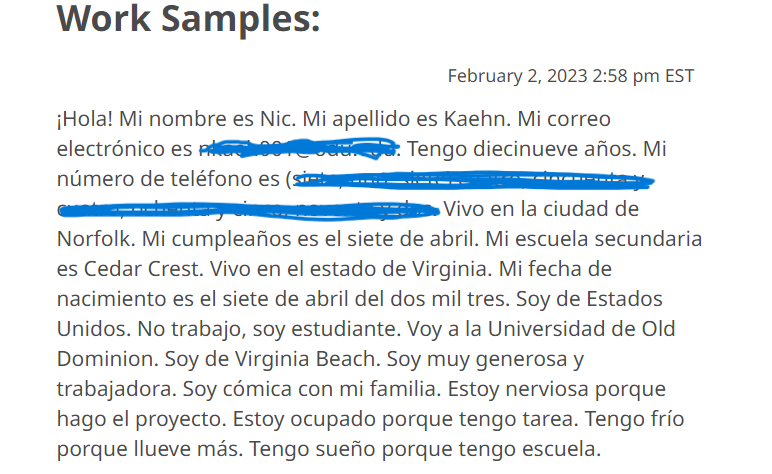
Above is the first project. This project was a portfolio in which students were meant to describe themselves and certain aspects of their lives/personality. I have grown in my grammar most of all when it comes to presentational writing in Spanish. I have come to understand more of the rules and have been given the opportunity to clarify with my professor. In the future when it comes to presentational writing in Spanish I plan to utilize a tutor or a formal Spanish-speaker to overlook my assignment and challenge the way in which I may have written certain things.
Interpretive Listening
The main kind of listening activities I completed this semester were within my oral quizzes. While there were some opportunities for listening and comprehension practice in the homework assigned, they were few and far between. The second best place to experience this kind of learning/practice was in the “Conversar” section of Lingrolearing.
The link below is an example of what a listening and comprehension section looks like completed in “Conversar”.
https://clipchamp.com/watch/qDGvlC1llI5
I found in this semester that I struggle a large amount when it comes to interpreting Spanish that is spoken. Though I try my hardest, the speed is often to fast, or the sounds feel muffled to me due to conflicting accents to my own (much like I imagine my own accent sounds like to non-native English speakers). In the exercise above, I struggled to understand the third question. If not for the instructions listed in English, I most likely would not have been able to make out what he was saying as there was no option to slow down the audio. I am able to take away from this experience that I need to surround myself with more Spanish speakers so that I can work on my processing and auditorial skills.
Interpretive Reading
Most of the interpretive readings that I completed for this class were done through the “Conversar” section of Lingrolearning. These activities often included references to homework before breaking off into pairs to read and discuss what we have learned. Much of this kind of coursework was review, further helping us to process what it was we were trying to learn.
For Spanish class, my classmates and I were instructed to break off into pairs following a brief video. The video was a campus tour that contained several vocabulary words from the unit. In our groups we were meant to reiterate the feelings, ideas, and descriptions that the guide Lucía voiced in the video.

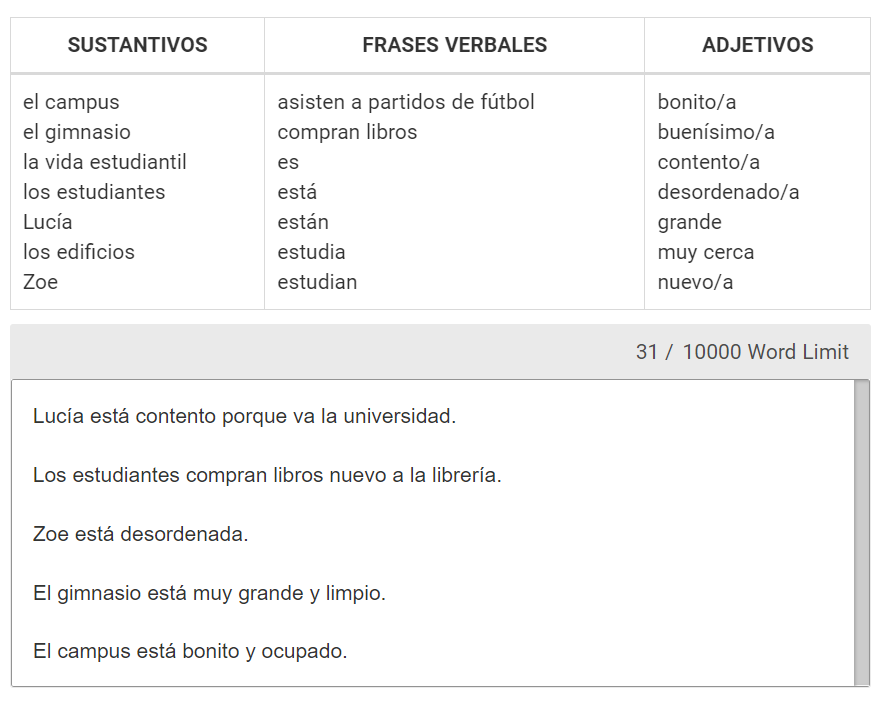
The most unclear or challenging part for me when it came to our interpretive reading assignments were the instructions voiced by the professor. Sometimes the instructions would be changed, or we had not had to complete something before that class period. More often than not, the instructions on Lingrolearning were clear, but myself and my classmates did not always understand the expectations of our professor when completing these assignments. I found the discussion aspect of these assignments most compelling as there were always new perspectives to bring to light. The reading helped build my confidence in my Spanish knowledge and each assignment exhibited my growth.