Interpretive, Interpersonal, and Presentational Modes of Communication
Exploring Culture
Completing assignments on Lingro learning and on canvas has helped me gain understanding of cultural perspectives. For example, the exploración cultural units on Lingro learning helped a lot because I learned about how the people in different countries view the same topic. Personally, I liked the unit about universities because the activities in Lingro learning were very relatable. Andrea Camacho from Bolivia, for example, is someone I could relate to because I am a commuter, live with my parents, and I have a part time job just like her. While I was reading the preparar portion of the exploración cultural assignment in unidad 4, I learned that each country are pretty similar as far as how they feel or how they organize their university lives. Compared to here in the States, college life isn’t really different no matter where you go.
These assignments opened my eyes to see a whole new perspective of the Hispanic culture. One reason why these activities helped is because they made me more aware of how I think and even what I would say. Reading through each exploración cultural activity, I realized not every country has the same advantage in some areas compared to the States. Since I’m from the States, I assumed that everyone has internet and we all communicate in the same way. While completing these activities, I learned that was not the case, which is a great thing. Branching out and really seeing how each person showcased on Lingro learning helped me improve my understanding of Hispanic culture.
Moreover, I would have to say learning more about Hispanic culture on a global scale definitely taught me to see some countries may have different views of a similar topic. Learning more about Hispanic culture has also allowed me to have more meaningful and understanding social interactions.
Engaging in Communities
It is very important to engage with not only our family, friends, peers, and even professors but we communicate globally also. Coming together as one unit, communicating with others who are global is very beneficial to how we communicate with those who are closer to us. I believe it is beneficial to us, as a society, that we communicate globally and positively. This helps us in many ways such as rising and standing on an issue we all agree needs to be addressed.
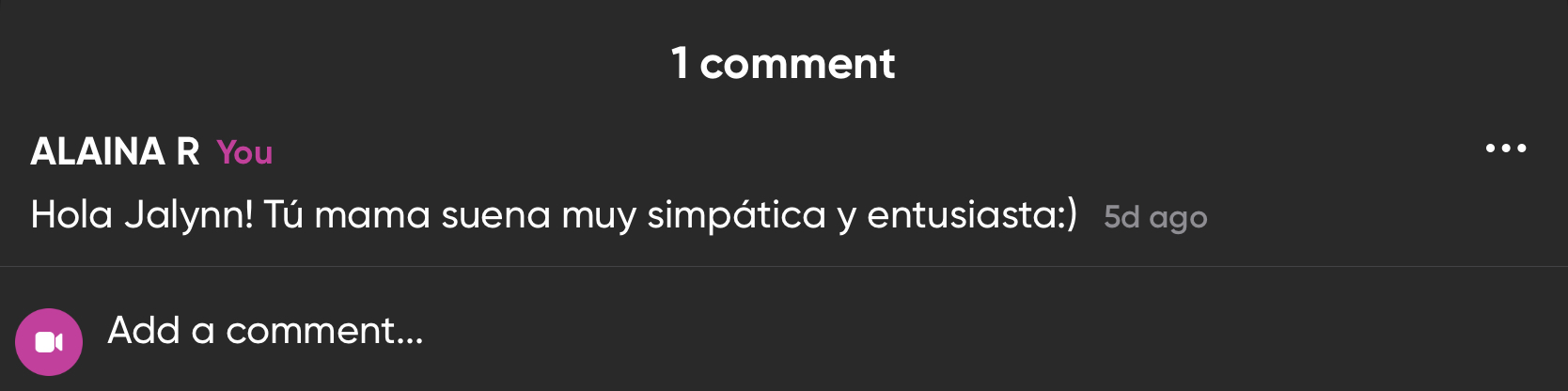
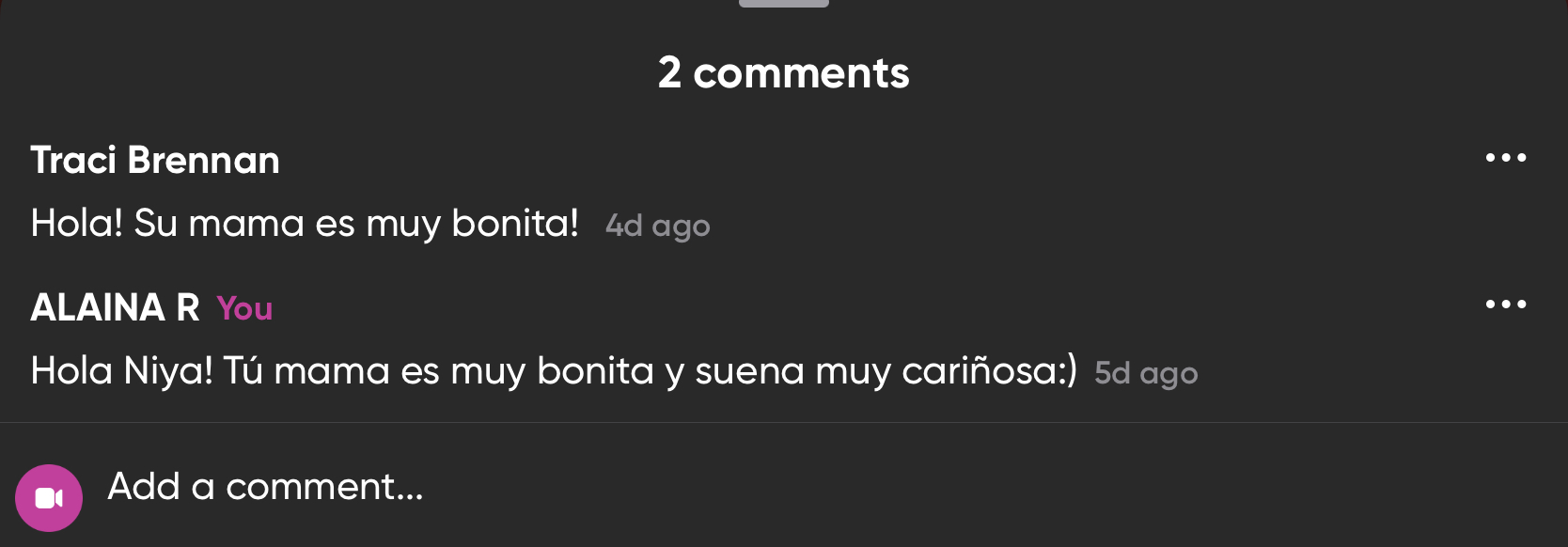
Participation in class discussions is the main way I engaged in communication. Flipgrid and even the discussions on canvas gave me the opportunity to try maintaining a conversation with a peer. On the last flipgrid assignment that was due, I looked through everyone’s video that was on there and noticed a couple of people who I normally would reply to on previous discussion boards. Since I had already seen how their perspectives of certain topics were, I feel like I can sort of have a conversation with them. Below is an example of communication on Flipgrid with my peers:
Interpersonal Communication
The audio activities on Lingro learning is how I practiced the speaking portion during this course. I benefited from these assignments because I got the chance to practice using vocabulary while also conjugating various verbs.
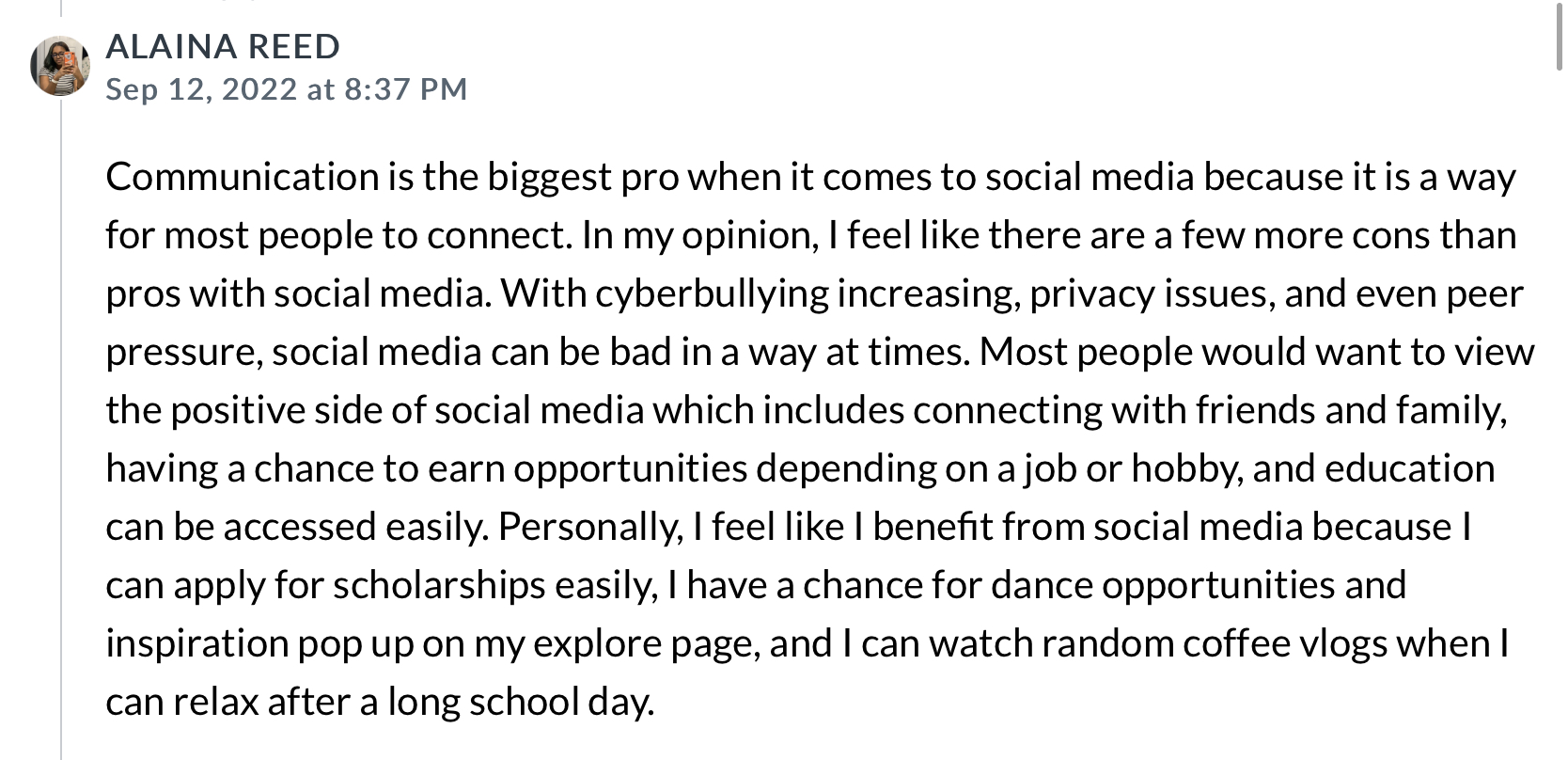
Discussion boards on canvas is another example of how I got the chance to communicate with my peers while also exploring cultural perspectives during this course. During module 2, there was a discussion board about how Latin America and the States view personal space. The main question was how would we feel about greeting people with a kiss on the cheek. While I was reading the responses, I could relate to a good portion of my peers. Since the pandemic, I feel like there is a health hazard when it comes to a kiss on the cheek. However, it is important to be open-minded and embrace the culture. Demonstrated below is my response for this discussion board:
Furthermore, reflecting on each assignment before I start another is one way I feel like I’ve made growth in this class. By looking over the comments from my peers and comparing it to the next assignment’s directions, I feel like I would be prepared on what to say in order to complete the assignment efficiently. What I excelled at the most was being able to successfully say correct sentences with vocab and grammar for the assignments in Lingro learning. I feel like I excelled more at that because I had some familiarity with it before taking this class, so I got the chance to improve what I had previously learned. As you can see, below I have an audio clip from a Lingro learning assignment:
However, one thing I would do differently in future courses would be to really take my time diving into what each question is asking of me. Really trying to process what I’m learning not only grammar wise but connecting with my peers is something I can improve in the future.
Presentational Speaking
Lingro learning is the most beneficial tool I’ve used to learn Spanish. Playing back the audio assignments I completed as well as audio examples has helped me to improve my listening skills.
Having a good memory so that I can excel on my quizzes and test is one thing I feel like I excelled at because a good majority of the quizzes were listening tests and practicing on Lingro learning has helped me during those quizzes. Using more vocabulary is the main thing I could’ve done differently this semester. I noticed in a few of my audio assignments and even looking back to oral exams with the professor, I use the same words I already knew based on prior knowledge. In the future, I am going to try going out of my comfort zone and use more vocabulary when I speak.
Interpretive Listening
Duolingo has a portion on the app where I have the opportunity to complete listening sections. These activities have helped me to improve my listening skills. Although I still have a little bit of difficulty with comprehension, little improvement goes a long way.
Lingro learning also has a lot of listening activities. However, I would say it was a little more challenging because both applications offer differently arranged content. Shown below is an example of a listening activity on Duolingo:
The most challenging part of using Lingro learning for listening activities was that there isn’t a way to slow down what the audio is saying like Duolingo offers. Repeating and interpreting the content to the best of my abilities was the only way I could really try overcoming this challenge. What I took away from this experience was that I need to get used to how native speakers speak because in reality, no one would speak slow while they are talking to someone.
Interpretive Reading
During the semester, I had to research about the most popular and admired people in the Spanish-speaking world. While researching, I found that Bianca Pérez-Mora Macías is a very popular actress and activist from Nicaragua. Here is a link to the article about her:
https://es.celeb-true.com/bianca-jagger-former-wife-rolling-stones-lead-singer-mick-jagger: SPAN 101The most interesting thing about this assignment was that there are plenty of entertainers and activists who are admired in various Spanish-speaking countries. Bianca Pérez-Mora Macías drew my eye the most while working on this assignment because she was married to Mick Jagger, a well-known English singer, and I thought the connection was interesting to read about. Working on this assignment has helped me to know how to not only change my language preference on the internet, but to learn more about other celebrities in Spanish-speaking countries.
Works Cited
“Biografía de Bianca Jagger.” Celeb.com, https://es.celeb-true.com/bianca-jagger-former-wife-rolling-stones-lead-singer-mick-jagger
Accessed 9 December 2022