Interpretive, Interpersonal, and Presentational Modes of Communication
Exploring Culture
The assignments on Lingro learning helped me to gain more understanding of Spanish culture. The exploración cultural units, for example, helped me understand how each Spanish-speaking country has different views on the same topic. For example, Vanessa Corzano from Unit 8 is from Perú. In Perú, she likes to eat la mazamorra morada because it reminds her of her country. After researching what the dish is, I learned that it is a purple porridge dish with a jelly-like texture made of corn and fruit. Each unit in Lingro learning has helped me better understand Hispanic culture because, with each person describing their daily habits and culture, it made me see how family and staying close together are important.
Family is very important in my community as well and I think that is also why I understand the values of Hispanic culture. During the discussion boards, we compared cultures in the United States and Spain. I do think this has challenged my worldview of different subjects such as healthcare. The unit where we talked about healthcare really had me thinking because it is completely different in Spain than here in the United States. Here is an example of my perspective from the discussion boards:

Engaging in Communities
It is extremely important to be able to bond and find a community to community with. Luckily, I found it very easy to do so in this class. Being able to formally and informally communicate with others is also important because it is going to be needed in the real world. When applying for jobs, emailing an important individual, or even just having a casual conversation with someone like a supervisor, it is beneficial to know how to “turn the switch” as far as learning how to engage in communication. As the semester progressed, I felt like I was able to engage in community conversations because it was comfortable to know I had peers to who I could relate.
Discussion boards on Canvas provided me with the opportunity to engage with my peers. This semester, I knew a few people who were in the class and it was nice to be able to communicate with them in Spanish and relate a little more. I really like how also on Flipgrid I was able to have a conversation with my professor, even though it was a recording of her. Below is a snippet from one of the Flipgrid assignments this semester:
Interpersonal Communication
TalkAbroad is an activity completed during the semester that I felt helped me the most with communication. Being able to have that one-on-one conversation with someone whose first language is Spanish was a nerve-wracking but nice experience. At first, I thought the conversations I had weren’t going to go well because I worried about using the correct grammar, but I’m glad I was given the opportunity to talk to two partners who are experienced with beginner learners.
I completed discussion boards as well, but TalkAbroad was what really helped me improve with communication. This audio activity helped me to further my thinking skills because I’m able to construct sentences with few mistakes. Lingro learning helped with this as well because of the fill-in-the-blank activities. The most difficult part was trying to find words I would use in English but in Spanish. For example, during the first TalkAbroad, I found that I struggled to find words that could continue to carry the conversation. Words like bien, así así, sí, or entonces would help me to carry the conversation. I overcame this difficulty by practicing with a friend prior to other conversations, and also knowing that I shouldn’t be embarrassed or nervous because Spanish speakers I talk to most likely understand that Spanish is not my first language. Here is an example of my first TalkAbroad recording:
One thing I would do differently is study grammar more than vocabulary. It’s easy for me to pick up vocabulary mainly because some words have similar spelling to English, but I think knowing formal and informal commands is just as important to understand.
Presentational Speaking
During each Lingro learning unit, there was an audio activity where I had to record myself describing a picture given. These activities helped me understand not only how to practice sentence structure but also practice how I sound. The feedback I received from the professor helped a lot also because when I practice speaking as well as submit other audio activities, I know what I need to work on and improve. Here is an example of one Lingro learning audio assignment:
Based on the recording above, this was from towards the beginning of the semester. Now that I’ve completed other audio assignments, I feel like I’ve overcome a fear of trying to be as perfect as possible. Practice makes progress, so it’s okay to make mistakes because, at the end of the day, I can just try all over again. I excelled at using a lot of various vocabulary in my sentence structure, but one thing I would’ve done differently is practicing more with a peer rather than having a conversation by myself.
Interpretive Listening
Lingro learning has a lot of listening activities that I completed throughout the semester. For example, listening to how Spanish vowels sound, and interpreting what a person said in a recording to answer various questions were the two main types of listening assignments I did this semester. Here is an example of both types of listening assignments:
The most challenging thing for me was that it was hard to hear a sentence being said fast as native Spanish speakers talk. Another challenge for me was to practice speaking with Spanish vowels. By breaking down a sentence from a recording, it was a little easier for me to translate what the speaker was saying. The most interesting thing I learned was that when trying to practice conjugating words and putting them in a sentence, you have to listen closely to who a person is talking to. I feel like I’ve grown with these activities because my goal last semester was to go out of my comfort zone and use other vocabulary words, and I feel like I’ve done that.
Interpretive Reading
Throughout the semester, I had to research for the “Investigar” assignments on Lingro Learning. These assignments helped me to understand more about Hispanic culture as well as I can practice how to read in Spanish. During Module 8, I researched typical dishes in Peru. While researching, I discovered that Ceviche is one of the typical dishes served in Peru. Below is an example of the research I did in this module as well as the link to the article I read:
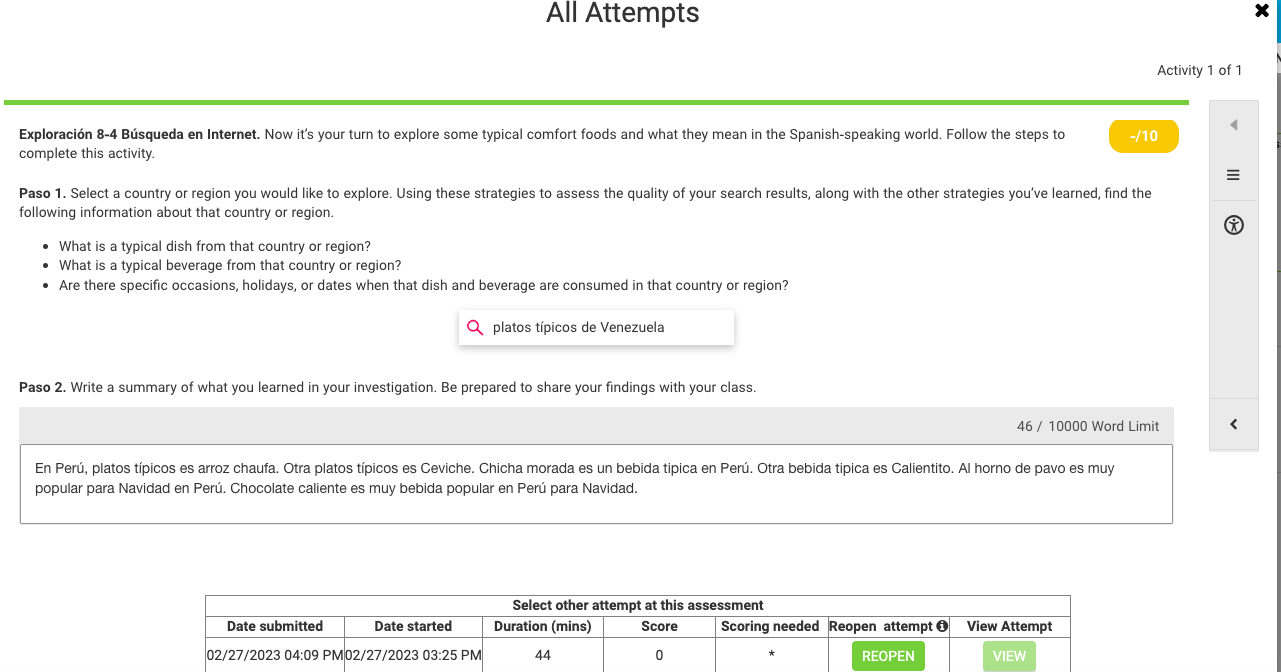
https://www.recetasnestle.com.pe/escuela-sabor/coccion/platos-tipicos-peruanos
Trying to translate certain words or sentences to fully understand what I was reading was a challenge. It was very interesting to see how similar Spanish and English words can be. Learning about various dishes from Peru was also interesting because it helped me gain knowledge of Hispanic Culture. I feel like I’ve grown by making connections on what each part of the sentence from the articles I’ve read based on these “Investigar” assignments is supposed to be about.
Works Cited
“9 platos típicos peruanos que debes conocer.”, https://www.recetasnestle.com.pe/escuela-sabor/coccion/platos-tipicos-peruanos
Accessed 20 April 2023