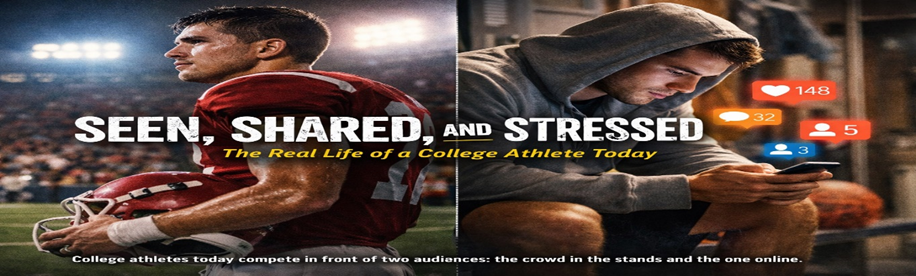
In the NIL era, college athletes are not just playing the game; they are living it online, where every moment is watched, judged, and remembered.
“The game ends. The pressure does not.”
Division I athlete, mid-major basketball program
The game ends, but the moment does not. The buzzer sounds, and the crowd slowly fades into the background. For a second, everything feels quiet, like you can finally breathe. Then, almost instantly, it starts again, just on a different screen. A college athlete walks off the court, reaches for their phone, and sees everything all at once: mentions, highlights, comments, opinions from people they know, and thousands of ones they don’t. Some are hyping them up. Some are picking them apart. And somehow, everyone has something to say.
College sports today just hit different. The pressure doesn’t end when the game ends; it follows athletes everywhere, into the locker room, onto the bus, and back to their dorm rooms. It lives on their phones, replaying repeatedly in real time. So, what changed? In 2021, the National Collegiate Athletic Association (NCAA) introduced Name, Image, and Likeness (NIL) rights, and everything shifted. College athletes are no longer just players; their brands, influencers, and public figures are expected to show up not only in their sport but online too.
According to the NCAA, athletes can now profit from endorsements, sponsorships, and personal branding opportunities, something that wasn’t even allowed before. And yes, it sounds like a dream. Getting paid, gaining recognition, building something for yourself? Of course, that’s exciting. But nobody really talks about what comes with it. When I talked to student-athletes I know at ODU, one of them said it best: “We’re happy we get paid and have more opportunities, but the pressure is greater than ever. You can’t really fail; you always have to be on. It can be a lot” (Diggs, 2026).
And that’s the part people don’t always see. What looks like an opportunity on the outside can feel like constant pressure on the inside. The idea of “team” is still there, but now it exists alongside individual brands, followers, and deals. Athletes aren’t just representing their school anymore; they’re representing themselves, all the time. Even smaller programs are getting attention on platforms like ESPN, which is huge, but it also means more eyes, more opinions, and more pressure to keep up.
With all that visibility comes something that doesn’t show up in highlight reels: mental health. Social media has turned into a place where athletes are constantly judged not just for how they play but for who they are. One bad game isn’t just a bad night anymore. It turns into clips, comments, and sometimes messages that go way too far. The same apps that help athletes grow their brand can also tear them down just as fast. And unlike professionals, a lot of college athletes are still figuring life out, balancing classes, practices, relationships, and now a public image. Being “on” all the time, playing, posting, and responding, it’s exhausting. And sometimes, there’s no real space to just be a student.
Before NIL, being a college athlete was still hard, but it was simpler. The pressure mostly stayed in the game. Your coaches, your teammates, maybe the crowd. And when it was over, you could breathe a little. You weren’t stressing about what to post or whether your performance might affect a deal. It was just about your sport and getting through school.
Now, everything is connected. Athletes are thinking about how they play, how they look, what they post, and how people are reacting to it all at the same time. A great game can mean more than just a win; it can bring attention, followers, maybe even money. But a bad game? That sticks. People reply to it, talk about it, and judge it, and it follows you. Being a college athlete now honestly feels like having two full-time jobs: showing up for your team and showing up online.
The game may end, but for college athletes today, the moment rarely does. What used to stay on the court now lives everywhere on screens. NIL has created real opportunities, giving athletes the chance to build something for themselves beyond the game. But it has also created a kind of pressure that never really shuts off. Schools that have never been in the big light but have money can now compete with the schools that were known for winning. The transfer portal has made the talent that used to be stacked on the big schools spread out, depending on who can put up the cash. Teams are making it to the championship that have never been, and while that sounds good, it also takes away from why athletes used to choose a college. The degree has become secondary to the brand, and being in education is a problem.
In the end, NIL didn’t just change college sports; it changed what it feelslike to live in them. Behind every post, every highlight, and every comment is still a student, still a person, just trying to keep up with a world that never stops watching. And long after the buzzer sounds, that pressure is still there, waiting on the next screen.
Because at the end of the day, they’re not just athletes; they’re people who deserve the chance to log off, breathe, and just be human for a minute. College is supposed to be fun!
Written by: Tamara Barnes