Interpretive, Interpersonal, and Presentational Modes of Communication
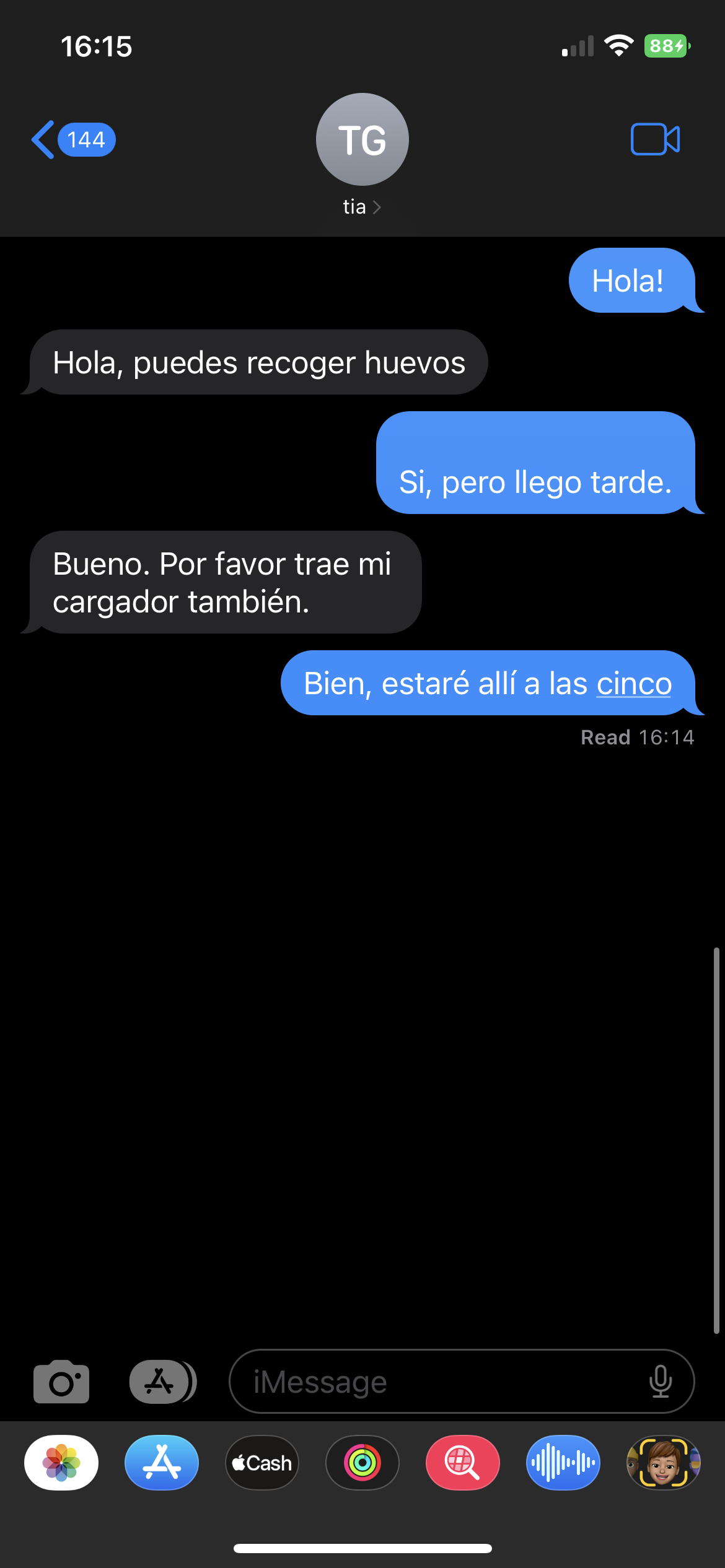
An example of me being in interpersonal mode this semester is attached below. I was communicating with my aunt about coming by, and she requested I pick up eggs and bring her charger. I understood entirely what she was saying, and I had proper responses back. I was able to engage by comprehending what she said and replying in an effective manner.
An example of presentation mode is the TalkAbroad conversation I had. It is attached further down, but I had to be fully engaged throughout the entire conversation to make sure I understood what was going on. My partner spoke really fast, so my attention to detail and ability to adapt helped me throughout the conversation.
Exploring Culture
In reference to gaining an understanding of culture, utilizing Talk Abroad, and analyzing the articles provided by my professor helped me gain understanding of cultural perspectives.
When speaking with international students from different origins, it helped me gain insight on their specific culture. Additionally, it challenged my worldview by providing me with details on how culture varies and how unique it is. I was able to work through common stereotypes and miscommunication that caused me to view the world from a different perspective. For example, it is stereotypical to assume Hispanic cultures love soccer, but I was shocked to learn that many of the people I spoke with did not like soccer at all. I have enjoyed this semester because it enabled me to not only gain insight on the language, but I was also able to have a deeper understanding of the culture.
Engaging in Communities
In English, give a brief description of the value of, and importance of, engaging in your immediate community and the global community.
Reflect on your experience and participation in these communities. Include artifacts such as photos, audio/video clips, etc.
Interpersonal Communication
For this specific Spanish course, I participated in two TalkAbroad assignments that each lasted approximately 15 minutes. Additionally, I was involved with multiple discussions pertaining to sports, food, and culture. I also had to participate in multiple graded oral exams with my professor.
TalkAbroad and the oral exams challenged my Spanish speaking skills because I was unable to reference any type of notes, and I had to go entirely based off memory. I was able to get through those assignments because I have solid usage of vocabulary, but I need to work on filler word and completing the sentence. The discussion boards required one sentence to be in Spanish, and it was related to the vocabulary we learned in the same week. I will continue to grow my understanding of the language by watching shows and listening to music in Spanish.
Presentational Speaking
Similar to above, I participated in TalkAbroad and two oral exams. They were each 15 minutes long and were at a high rate of speed.
For the oral presentations, I believe that not only is practice needed, but also a broader understanding of the words and language would enable me to fully understand what was being asked. Additionally, slowing down before I respond would help calm my nerves. Overall, I did really well with understanding what was being asked and responding back.
Presentational Writing
In reference to writing, my favorite part were the discussion boards I got to participate in. Additionally, I enjoyed the grammar aspect as well.
I have attached my discussion response previously, but other than that we did not do too much writing. The writing was usually for exams and quizzes which are blocked off, but they were effective.
I will admit, on many of the quizzes I did not do too well on because I would mix up the endings. However, I was able to overcome this by continuing to practice. i would write out each word and its proper conjugation at least 3 times. Eventually I was able to understand the proper conjugations, and my grade increased instantly.
Interpretive Listening
Attached below is a brief 2 minute clip of one of my TalkAbroad conversations. It begins with my partner, and then it leads straight back to me. Below we are discussing our family.
talkabroad-record.docxAs you can hear, it became a little tough for me and I would have to pause before responding because she was speaking a little fast. I was able to overcome this by asking her to slow down and repeat for me. Additionally, as the conversation went on, I got more and more comfortable. The great thing about Spanish is many words are similar to English, so when I got stuck I was able to put the main words together to figure out what was being said.
Interpretive Reading
For my Spanish class, I had the pleasure to read “Importance of Family Structures in Hispanic families”Links to an external site. I also had the opportunity to read “The healthcare system in Spain”Links to an external site.
For the most part, both articles were straight forward for me, and I understood them both fairly well. I found the Importance of Family Structures article fascinating because I was able to make a personal connection with myself, along with the target audience. That article opened up a deeper understanding for me in reference to family within the Hispanic household. Without those articles, I would have just simply learned the Spanish language without knowing its history, and developing a deeper respect for the language itself.
When you have finished adding content to this page, delete all the instructions except the link to the Modes of Communication.