BLOG 10
My original expectation from this course was to have a better understanding of how behaviors form and to understand the behaviors of building and maintaining relationships. I hoped this would give me deeper insight to myself and how I can help others with this knowledge. I do not believe that this course has met my expectations for it. A few assignments gave me pause and allowed me to reflect on myself and my behaviors, but they didn’t really help me understand the why and the how of them. Regarding the course objectives, I also don’t feel that I have much to take away from the assignments that the objectives touched on. Most of the blogs and assignments were giving opinions on topics and situations, but there wasn’t a connection to the theory, origins, effects, explanations or processes behind it. It was easy because I only had to give my opinions (which did result in moments of reflection), but I didn’t make connections to the course objectives.
My opinion about Social Psychology shifted towards an uninterested mind-set because I don’t feel that I have learned much about the concepts of social psychology compared to how much I gave an opinion. Since there wasn’t a direct connection to the source material, it was hard to see where and why these assignments were important and how they related to social psychology. If I were to take the class again, I would take it in the classroom where I would be able to ask questions and promote discussion on the topics allowing me an opportunity to act upon my expectations for the course.
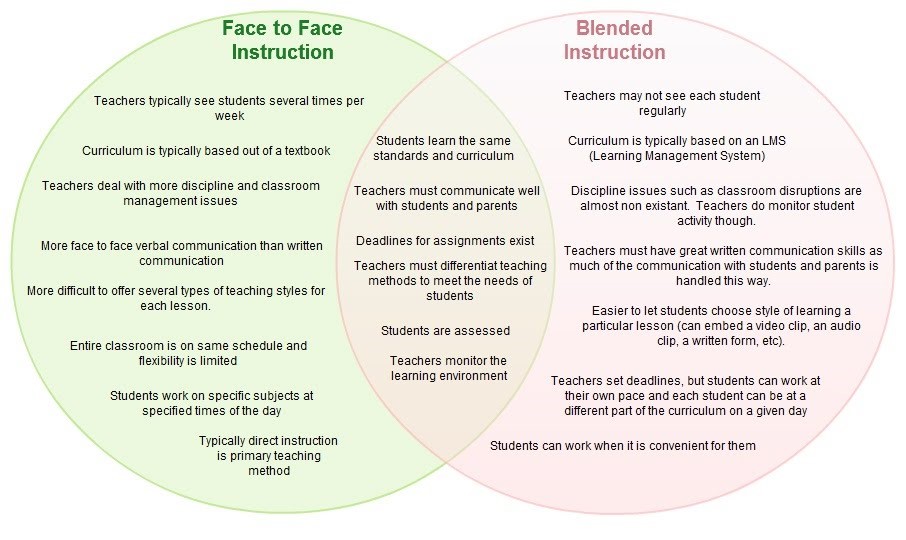
I’ve grown academically in the sense that I better understand what it is I expect to get from my courses. I want a textbook understanding reinforced with the real-life examples. I’ve concluded that perhaps it’s better for me to take these types of courses in person where discussion can be had amongst myself and my peers rather than alone online. From this course I have been able to improve my ability to self-reflect. I often spoke about my professional life in the assignments and this course allowed me to step back and see myself from a different perspective. I can take this reflection and use it to make myself a better co-worker and employee as well and improve my happiness in my professional life.
I chose the image below as a visual representation of my academic growth because it shows the pros and cons of taking an online course vs a traditional class. There are certain areas of academia that I know I will do better in if I am in the classroom rather than online, however I understand the benefits offered by each method.
BLOG 9
The top three things I’ve learned in this course include heuristics and how it applies to other psychology areas of study, the cause and effect of racism in social psychology and emotional intelligence (EQ), including my journey of recognizing my own. I learned in the Human Cognition course what heuristics are and briefly how they apply to our ability to process information. This social psychology course allowed me to understand it better by applying it to how the processing of information (allowing us to make judgements and solve problems) factors into our behavior and social interactions. Our third assignment, which discussed the racist tirade of comedian Michael Richards, made me stop and reflect on my own thoughts and opinions of racism. We were tasked with writing the assignment to discuss the perceived intent behind Richards tirade try to determine if racism can stem from different places and be done without malicious intent. In our Module 8 Archive assignment we chose adjectives that represented stereotypes of different ethnic and racial groups. This made me think in broader terms of stereotypes and how that is connected to racism. The questions we asked ourselves in the third assignment came back into play when we discussed stereotypes. Our social behavior regarding racism can stem from an array of places. Heuristics is a factor in this as we make snap judgements which affect our social behavior. Hate and racism is a learned concept, and it can be changed as well. My own emotional intelligence was put under the spotlight when we completed eBlog 7. Before this assignment, I would have rated myself high for EQ in all aspects, however, when really digging into my work life I realized I am not on the level of emotional intelligence I thought I was. I had to be honest with myself and be open to self-constructive criticisms in order to start the process of improving my self-management. It was humbling and this real-life experience allowed me to better understand the importance and roll of EQ in social behaviors.
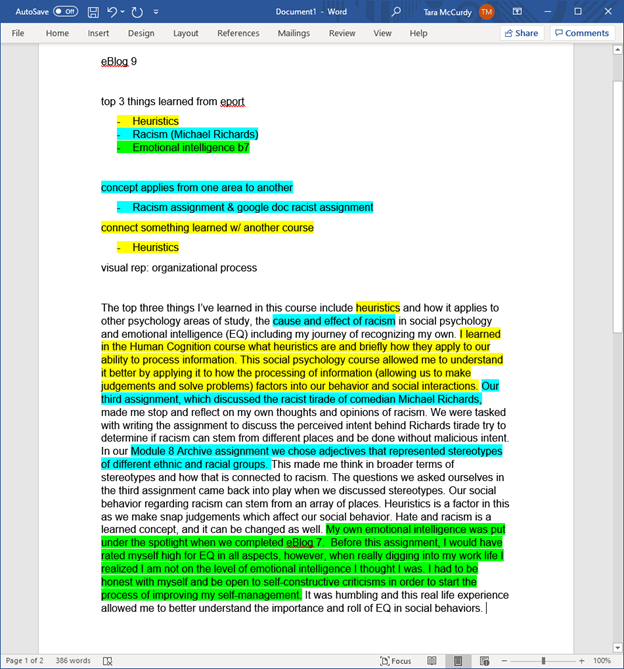
Below is the visual representation of my organization process for this assignment. I use a hierarchy diagram type layout. I first include the fields that need to be addressed (i.e. “top 3 things learned”). From there I add the topics that I plan to use or address so that I can build a foundation. Once I have a topic to address for each field, I find my connections and highlight them in the same colors to show their association. Once I start writing I use the same colors to highlight the topics so that I know I’ve hit all the fields needed. I compare my work to the rubric and then once I’m ready to post, I remove the highlights and hierarchy diagram and post it to the e-Portfolio.
BLOG 8
After reading this article I come away thinking that there is a lot more that needs to be discussed. The article doesn’t explain what evolutionary psychology means. For example, when Buss talks about the sexual interests, he then references genetic predispositions; without a basic understanding of the science behind biological/genetic reproduction, the reader will likely not understand how this relates to evolutionary psychology, or what evolutionary psychology itself means. It seems that the point the author is trying to get across is that sexual conflict between partners can affect social interactions.
My thoughts on this subject…well, I find the idea interesting to say the least. I think there is more than sexual conflict involved for a person who, after a breakup will stalk their previous partner. This isn’t just about sex, there are other factors that should be considered here; other branches of psychology to be addressed. That applies to all three stages.
As a woman, I’ve been upset by men when they treat me like I’m ignorant, and like I’m incapable of doing something because I’m weaker than they are or unskilled. I’ve been upset by men who treat me like less of person because I’m not their standard of “good-looking”. I believe ways women upset men include being overbearing, accusatory or threatening their masculinity and virility. I would be remiss to also point out that women can do the same thing to other women and men to other men. It’s not only heterosexual people who experience sexual conflict. It seems to me that this is more of a human issue than a male/female issue.
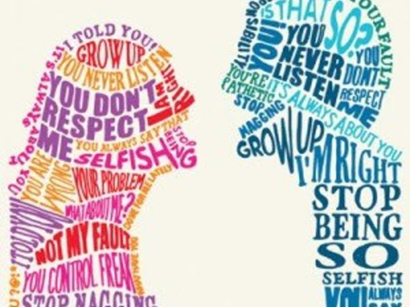
I chose the image above as a visual representation of men and women upsetting each other because it shows core examples of things that are said that the sexes get angry with each other for. It’s easy to understand the message from this image upon first look.
BLOG 7
Emotional Intelligence (EQ) is the awareness of emotions and being able to control and express them with sensibly and with empathy. Self-regulation is a component of Emotional intelligence that is achieved when a person can control their behavior and emotions without active impulsively. Personally, I believe emotional intelligence is the ability to be aware of what you are feeling, understand why you are feeling it, and being able to express it maturely. The ability to not impulsively respond to a stimulus allows time to reflect on the situation and use rationality and reason to find solutions or appropriate responses.
One sign of high emotional intelligence can be found in the workplace with people who are able to express themselves. In my workplace I find that I can express myself professionally and be open with management when it comes to workplace issues among staff or with procedures and other department updates. I am often selected as the representative for my team to meet and discuss issues and changes with management because I am open and honest, without being critical and offer solutions. Recently, I was selected by my supervisor to represent my team in the Voice of the Associate meeting held by upper management. In this meeting I was tasked to provide feedback on what areas the department is doing well in, what areas they could improve and how. At the same time, when it comes to working directly with my supervisor, I can sometimes exhibit low EQ. I think this is because I am comfortable with him as a person and feel that I can show my thought process and emotional responses without judgement. I need to remind myself often that EQ is still important and necessary in these closer, personal situations as well. Just because I can talk to my supervisor like I would a friend, I can’t forget that they’re still my immediate boss. It’s going to be his opinion asked for by others in the company if I seek to move up and demonstrating lower EQ with him could potentially have a negative impact on my career.
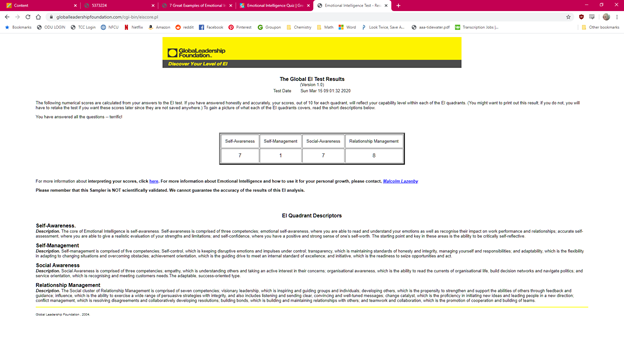
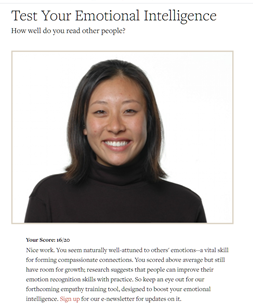
I took two EQ tests, the first from Global Leadership Foundation and the second from Greater Good Berkeley . The GLF test was a series of questions which graded me in Self-Awareness, Self-Management, Social-Awareness and Relationship Management while the Berkeley test had me select the emotion of the facial expression being given by the person in the photo.
The results in the images are difficult to see, so I’ve entered them below:
GLF: Self-Awareness: 7, Self-Management: 1, Social-Awareness: 7 and Relationship Management: 8
Berkeley: 16/20 “You seem naturally well attuned to others emotions…” and “you scored above average but still have room for growth…”
BLOG 6
The Tedx Talk titled The Dangerous Ways Ads See Women was informative and familiar. I have seen other responses and work about this type of media so this was familiar to me. It wasn’t surprising because it’s a known issue for most women. I understood all of Jean Kilbourne’s points in this video, but I think that there has been a lot of progress and positive change since the 1960’s, when she first started to see this problem. Women in current times have more options of employment and those who chose to model or act in precarious advertisements are likely doing so because they want to, not because it’s their only option to earn money. I’m not saying that the industry is perfect; if #MeToo has taught us nothing else, it’s that dehumanization, manipulation and objectification of woman (and men) is still a widespread issue in society.
I cannot say that I had a different perception of this subject before watching this talk, because I’m familiar with it already, but it did touch on the objectification and sexualization of men in advertising which I felt was a relevant and important point to include. Kilbourne’s inclusion of sexualizing children was the most important and profound for me. I know that this is something that is done already with beauty pageants and the like, but to see the toys; like the stripper pole, for young girls really baffled me. Who thinks this is appropriate? It’s changed my perception on advertising all together. Is it safe to say that there is something wrong with a group people who think that the sexualization of children is cool? I was surprised to find how disgusted I felt after watching that and looking into it more afterwards. The sexualization of children in ads made me angry compared to the women and men adverts.
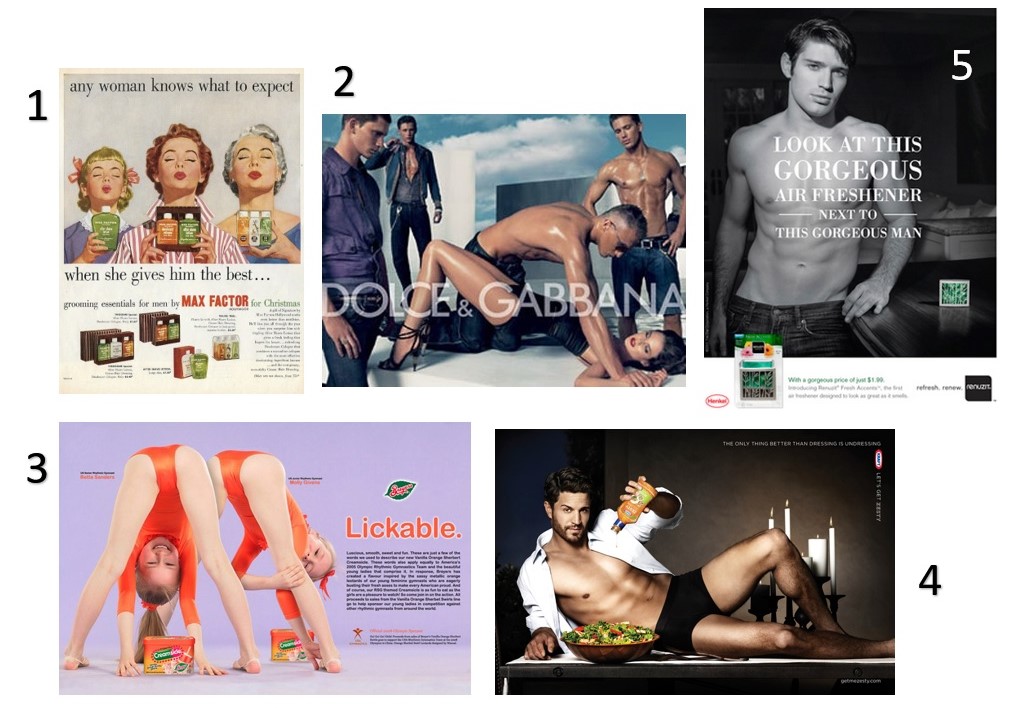
Above are five images that represent sexualization in advertising. I chose these because it spans over all areas touched on in Jean Kilbourne’s Tedx Talk: women, men and children.
The first ad is a dated advertisement from around the 50’s. It’s depicting a rather innocent inuendo of getting a kiss as reward for giving a good gift to their significant other. I found this ad interesting because while a kiss seems innocent enough, it also portrays a young girl giving this gift of aftershave lotion and cologne. Why is a young girl getting a kiss from a grown man?
The second ad is a modern ad you’d find in a magazine. It shows a woman surrounded by four men in a suggestive situation. Is she there because she chooses to be? What exactly is the item for sale here? It’s seems overly sexual for no real reason. In real life, I assume the female model is participating of her own freewill, but what is this ad telling people on the outside?
The third ad is an ice cream ad featuring two very young gymnast girls. While their gymnastics are harmless and not sexualized, the company taking this innocent sport and making it into a disgusting sexual innuendo with ice cream is beyond inappropriate. It’s predatory and the idea that these girls’ parents were okay with this really speaks to their character. Also, the fact that this company thought this was a good idea and approved this really speaks to the type of company they are. It makes me want to stay away from Breyers and Unilever (who owns Breyers) but that is seemingly impossible because of how much Unilever owns. Their titan status in the industry allows them to get away with despicable acts like this ad.
Kilbourne also talked in her video about the current sexualization of men and while they are more sexualized now, it’s not in the same derogatory way that women are still advertised. The fourth and fifth ads show a man being sexualized. While it’s not in a demeaning nature, it’s still relevant to what Kilbourne touched on. We’re not telling these men that if they don’t eat that salad or use that air freshener then no one will want them, and their looks won’t save them. It’s more harming to women than men in the sense that a woman may think that if that attractive man has an interest in this product and they see me with it, then maybe I stand a chance with that attractive man.
BLOG 5
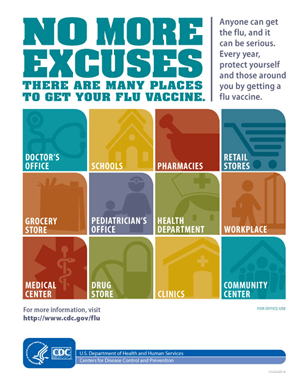
The advertisement above shows a credible source primarily because it refers the viewer to the Centers for Disease Control and Prevention website; CDC.gov and encourages the viewers to seek more information from other credible resources like pharmacists, doctors and health departments. The CDC is a credible source of information because they thoroughly implement scientific methods to research test and release medical information. They peer-review in the scientific community to assure quality control [1]. Doctors and pharmacists train rigorously in medical and pharmacology school among other sciences to practice their field of medicine. It doesn’t tell you “you should or shouldn’t do this because…” it just tells you the flu vaccine is important, and who you can contact for more information. It allows the viewer the opportunity to inform and educate themselves on the topic without forcing opinions on them.
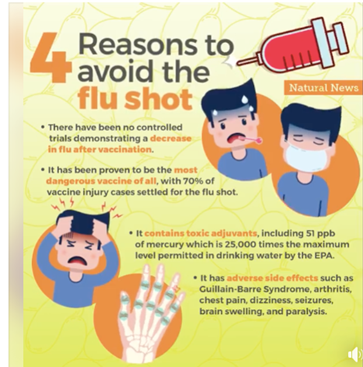
This advertisement (above) is not a credible source because it doesn’t offer sources to the viewer to fact check the information. It just tells you its “facts” and expects you to believe them at face-value. It’s using fear to try and impose its beliefs onto the viewer with the pictures of the sick and pained man. It uses scientific terminology and facts misleadingly. For example, it says that in a flu shot there is 25K times more mercury than the permitted level of mercury in water by the EPA. There are three different types of mercury. Mercury in water is organic mercury called methylmercury while mercury in vaccines are thimerosal called ethylmercury. These are derived from different sources, are used by the body differently. This ad takes advantage of the ignorance of those who don’t know the difference or that there even is one.

This advertisement is an attractive source because of the color contrast. It’s a bright green and yellow leaf with bold white cutouts. It’s clean and simple in its design and I understand the message immediately. I did find this effective because it’s a subject that I am currently studying in my Chemistry of the Environment class and it’s always been an important topic for me. People like things that are aesthetically pleasing, clever and easy to understand.
BLOG 4
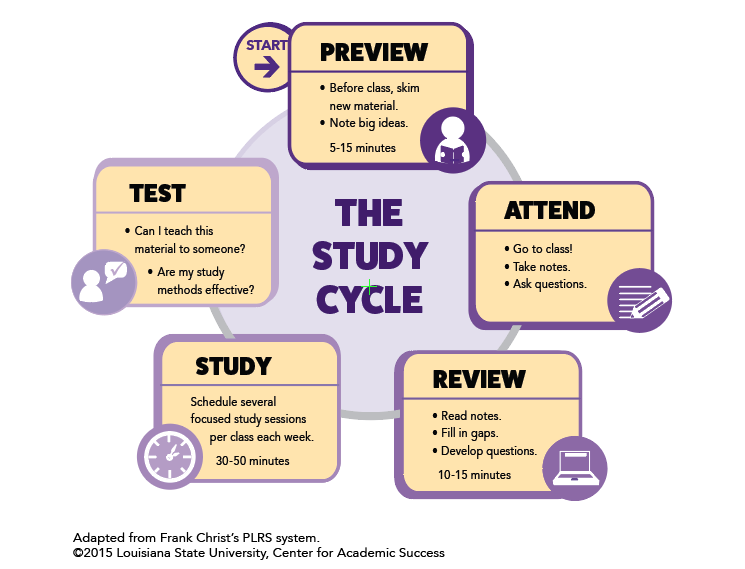
Reading through my test results made me realize that I hadn’t studied the text as thoroughly as I had thought. There were a lot of answers that sounded familiar to me or just based on their name sounded right, but I wasn’t 100% sure. I didn’t take extensive notes for this exam and honestly, I didn’t read the Study Tips prior to taking the first test. I took notes as I read through the text and referred to the text as I was completing other assignments to ensure I understood the connection between the given task and the course content. I am the type that learns by writing things out, memorization and making personal associations with the content. The best area of opportunity from my Exam 1 review and this eBlog assignment will be to utilize the resources given to me beforehand! I know I could have done better with better organization, more thoughtful and structured studying, and of course, taking advantage of the extra credit. I plan to do all of that while preparing for the next exam.
I chose this image because it emphasizes at least 3 areas of improvement for my studying habits. I can do better by implementing these rules into my study habits. I think the most important one is the Test section. If I can teach it someone else I should be able to perform well on an exam, but to be able to teach it, I must Preview, Attend, Review and Study.
BLOG 3
Music and Relationships
Music is an integral part of my and my husbands relationship; we spent our first date together talking late into the night about music. While we each favor some of our own different genres, we have a lot of overlap. We bonded over our love of 70’s and 80’s rock and metal. We were raised listening to the same bands which strengthened our bond because we could talk about life events and share personal stories based on how a particular song related to it. I am confident in saying that we share the same values and ideals. There may be some variances here and there, but overall we have the same values, morals, sense of integrity and ethic as each other.
The song I chose for association with my husband is a fun and upbeat song. We have so much fun together, we always laugh and he is my true best friend, so this song shows the fun and full love we have.
When I first heard Your Song by Elton John I thought that he said “…it’s for people like you, dad…” so I always thought of my dad. I wanted this to be the song we danced to whenever I got married, but I didn’t have a wedding so we didn’t get that chance. I still plan to dance with him to it one day though! Speaking of weddings, my sister and I danced all over and crazy at her wedding to Billy Idol’s “White Wedding”…I am her little sister!
The song for myself is inspirational. I find myself getting down a lot by life and the outside world and it reminds me that we are all on this planet together trying to get by, and to do the best I can. There are so many songs for myself though, it was hard to pick one. When I think of life in general now, I feel that “For What It’s Worth” really hits home for where our country currently stands.
Lastly, I included a song that highlights another large aspect of my life: work. I’m burnt out at work and poor management has me in a constant “rage quit” mode and this song really relates to my apathy and disdain for my place of work.
Myself – “Beautiful People, Beautiful Problems” by Lana Del Rey ft. Stevie Nicks
Husband – “Best Friend” by Sofi Tukker
Dad – “Your Song” by Elton John
Sister – “White Wedding” by Billy Idol
Life Outlook – “For What It’s Worth” by Buffalo Springfield
Work Life Outlook – “Various Disgraces” by The Blam
I chose this image because it represents the musical integration within my tree of life. Some branches are longer than others but they all have a common connection: music. Almost every relationship I’ve ever had has had a musical component.

BLOG 2
Self-Efficacy
I consider myself to be a good student, but not an excellent one. I do not study, complete assignments, organize or prepare the typical way other college students do. I still have a high level of confidence as a student because, thus far in my education I have maintained above average grades and the length of time it’s taking me to complete my degrees hasn’t become a deterrent. I attribute this to my being a non-traditional student, as I had eight years of adult-life experiences behind me before reentering academia. I’ve learned valuable communication skills and developed work ethic which heavily factors into my studies. I am still learning how to navigate adult life and student life at the age of 34. Learning isn’t something that I’ll ever stop doing, but my self-efficacy has had its ups and downs.
Right now, in my studies I have confidence because I’m taking classes with subject matters I’m interested in and like learning about. After the first exams for my classes are done and I get results that show where I stand in my comprehension, I’ll be able to adjust my self-efficacy accordingly. Doing well in a course always makes me feel good and my self-efficacy levels rise because I‘m doing well. When I’ve done poorly in a course my self-efficacy has taken a steep nosedive! I struggle to do well and often consider my options, like withdrawing and trying again later or pushing through and seeing how it ends up. The best way to increase my self-efficacy level is by feeling accomplished and seeing growth. I may not do well on a quiz, but if I can learn from my mistakes and do better on the next quiz or test, I have grown and see change in myself which boosts my confidence and self-efficacy.
My self-efficacy score in relation to my task accomplishments reflect that I try to always bring a solution to the table with me when I have a problem. A lot of the GSE questions are asking about problem solving; often the problem I find for myself is when I don’t understand a specific subject matter, I get anxiety, feel frustrated and get impatient. However, I am usually able to talk myself down and find a way to help me understand better, whether that be watching videos online, asking a teacher, reading different source materials etc… I think that my GSE score of 3.6 shows that I can overcome a lot of the fear and anxiety I get and shows my ability to persevere. I try to always bring a solution to the table with me when I have a problem, and my GSE score reflects that.
My GSE: 3.6
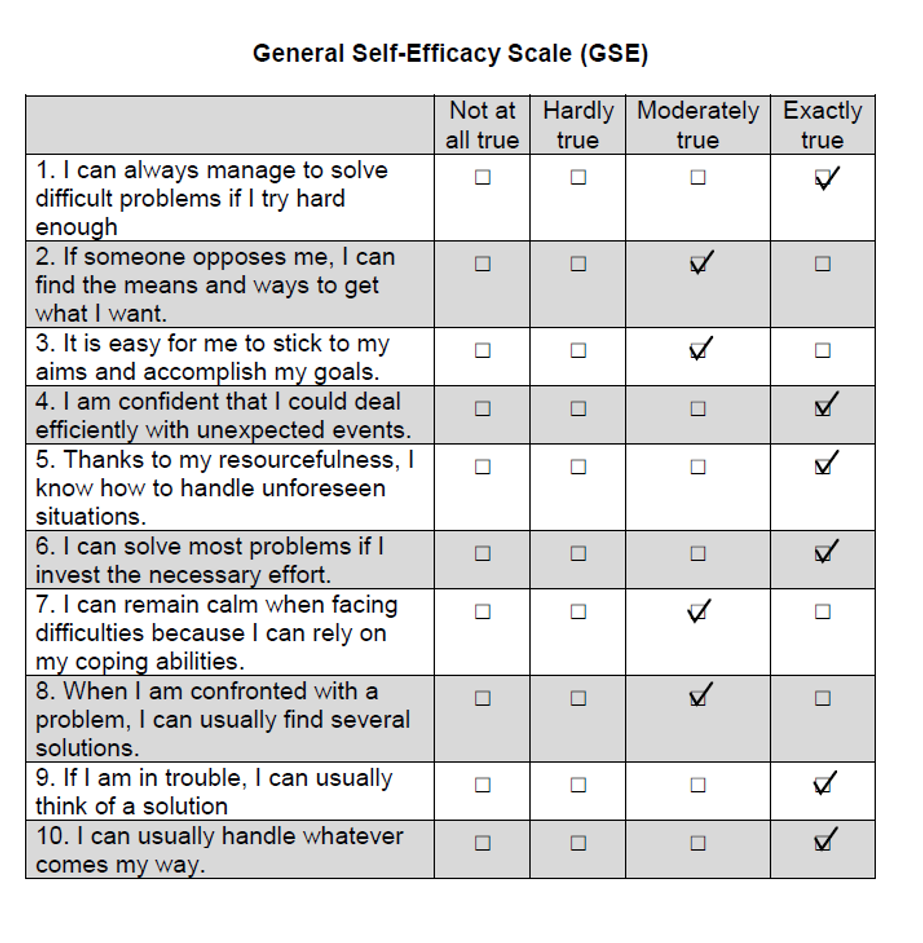
I chose to show my results above because I hope that I am able to come back to this image when I feel my GSE dropping. I hope that I can regain confidence in my myself to overcome difficult tasks and remind me that I do have what it takes to get life done!
BLOG 1
The ability to identify behaviors in ourselves and others is integral to being able to find our places in society. To have an understanding of the “why” behind our social expectations and stigmas can promote growth and allow one to become a more productive member of their society. There are six objectives to this course (see list below) which will teach us to identify and observe these behaviors in ourselves and others, which allows us to understand the root of the behavior and provoke change.
Personally, I hope to gain a better understanding of the formation and behaviors of building and maintaining relationships. If I can better understand this about myself then I can not only help myself, but others as well. To assure I am understanding the concepts this course focuses on I intend to make personal connections to my life to reinforce the lessons.
- Outlining procedures that are used to test hypotheses of individual and group behaviors.
- Discussion of the processes used that affect perception and understanding of others.
- Provide explanations on the formation and change of attitudes and their relation to behavior.
- Discussion of the origins and effects of prejudice and discrimintation.
- Discussion of factors that that influence our attraction, or liking, of others that can lead to close friendships.
- The ability to make connections between this course content and other psychology courses as well as outside experiences and implementing things we’ve learned.
Neuroscience and Psychology and their connection to Social Behaviors
https://www.soz.psy.unibe.ch/index_eng.html
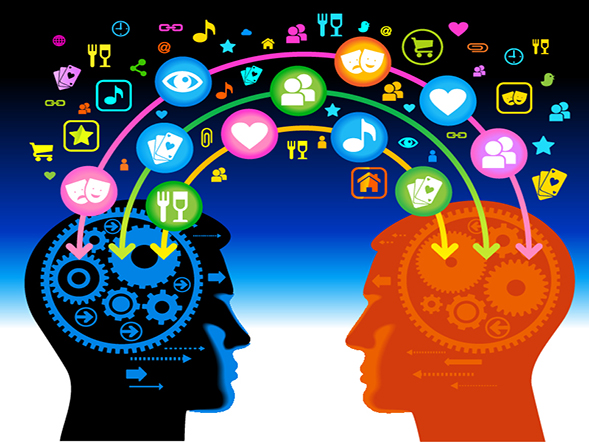
I chose this image because it represents the two forms of healthcare that people need. As a future healthcare professional, it is important to understand how our mental health affects our psychical health and how they work together.