Assignment Takeaway
ATA 4
I gave the drive-thru person at McDonald’s a ten-dollar gift card. I did this because the car in front of me seemed to be giving them a hard time, and having worked at McDonald’s in high school I understand how stressful that situation can be. It rare that any other customers notice these situations or show any compassion.
The drive-thru person was surprised and didn’t know if I was being serious at first. When they accepted that I was sincere, they were extremely thankful and told me that they had been having a really bad week but took this as a sign that maybe things would start improving. It made me happy to make them happy. I do hope that their week started going better after that interaction!
I was reviewing resumes and saw that a couple had typos. Instead of letting my supervisor review them with typos—and ultimately throw them out because she’s stickler for common grammar mistakes, I emailed the candidates that had errors and told them about the errors. Most, two out of three, were able to get their corrected resumes back to me before I had to send them to her for consideration.
The ones that emailed back thanked me. One error was particularly difficult to catch, as the text was in all caps, which makes it so that Word doesn’t recognize the error. The individual with that resume was particularly appreciative and said they were embarrassed but was glad they were able to correct the typo! I felt good about myself afterwards, I only wish I could impact my supervisor’s viewpoint on simple grammatical errors.

I let a mom and her kids go in front of me in line at the grocery check-out. I did this because my friends have kids and they always dread taking them out when they have to run errands. From what I’ve learned, the less time spent out, the better the chances are that meltdowns are avoided!
The mom thanked me and the kids complimented my Crocs. So, overall, it was a very pleasant experience and was glad that could help ease a little bit of stress for somebody. And, put into perspective that no matter how stressed I am when I am at the store, that I could always be *more* stressed.
I left a water and snack bag with candy and chips in it for our DoorDash delivery person. I did this because it made me feel better about being too lazy to go pick up the food myself. I don’t usually order delivery and feel bad for drivers when they have to figure the apartment complex because it can be kind of complicated, so I truly appreciate the people who do.
The delivery person was appreciative and said that they hadn’t eaten lunch and that the snack was helpful! It made me feel better about being lazy and almost made spending extra, worth it! It inspired me to start leaving more surprise snack bags out for other delivery drivers.
I let somebody into the lane. I noticed that a car had its turn signal on and needed to get over, but nobody was letting them in. When I got behind them I slowed down and allowed for a safe distance in front of me and the other car so they could get over without fear that I was going to gun it last minute. I’ve been in the other driver’s shoes many times and of all the places I’ve driven, the roads in Virginia are the most intimidating.
I don’t know how they reacted, other than moving into the lane, but I imagine they were relieved. It made me feel like I was repaying the kindness of all the others that had let me in the lane all the times before. It also made me feel like I was building my “car karma”, so that hopefully in the future somebody will do the same for me.
If the one good act a day requirement was in place every day, I think I may become more comfortable around strangers and less afraid of feeling like an inconvenience or like I might be being intrusive. I have noticed in the past that some people don’t know how to react when others offer help, especially strangers. It can feel like we are all on edge and are afraid of each other, when really, we all need help sometimes. Though we’ve all heard of literal horror stories about the things that can go wrong because somebody accepted help from a dangerous stranger, I like to think that there are more kind and virtuous people in the world than ones to fear.
ATA 3
For Eros, my score was below the mean. We have been together for twelve years, married for nine. And throughout, there are good times and bad, but at the end of the day, when you’re with the person that makes you feel like home, then you know you’ve found the one. The second category’s name made me chuckle. I scored very high above the mean for Ludus—which I can only hope is the Latin base for ‘ludicrous’. I was exactly at the mean for Storage, and I think that this is because there are all sorts of ways to fall in love. For some it’s instantaneous, and for others it can be gradual. I scored above the mean for Pragma. My husband and I met when we were nineteen, dated for three years, and then got married. And, now, almost a decade later, I realize how young we were and I think if I had been jaded by failed relationships or was in a different life circumstance, that perhaps I would have considered the Pragma questions more, but it didn’t feel necessary at the time. My Mania average was a little lower than the mean, but not by much. I think this also fluctuates throughout the years. My Agape score was higher than average, and again, this fluctuates with time. I think the more intimate the relationship is over the years and you learn how to be together as both a team and an individual on the team, the sort of “all or nothing” approach goes away some.

I think this was a great assignment, it helped me evaluate my relationship with my husband and reflect on previous versions of ourselves. I’m always thankful that we have each other, and even more so, incredibly thankful that we met the “old fashioned” way. A lot of my friends use dating apps and can be so quick to judge others but also are always afraid of being judged—before they even talk to somebody. It seems exhausting.
ATA 2
The pictures I chose to reflect my self-concept represent me as a wife, a friend, a cat mom, a student, a veteran, and a volunteer.
The picture with my husband is one of my favorites. It reflects our goofiness, something that has been a theme since the beginning (we dressed up as tourists and got married in Vegas—granted, we already lived there!). For this picture we went to Goodwill and found 90s themed clothing. This picture reminds me of our adventure together that day and the hysterics we were in after trying them on.
I love to travel and being in the military for a decade helped me do that. Now that I’m out my friends and I take at least one trip a year together and we always go somewhere new. On this most recent trip we went to D.C. and had a blast. Later after that photo was taken, my feet had started to get blisters so I rocked socks with sandals and still laugh about how I looked. It’s now an inside joke between my friends and I.
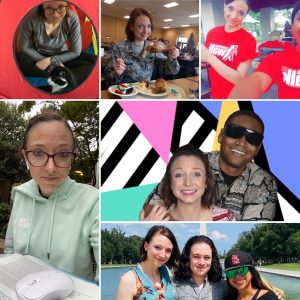
I have two kitties and very rarely does my husband take pictures of the cats and I together. But on the day this was taken I had built a fort and was hanging out with them while trying to do homework. My husband thought it was cute and surprised me with a “hey look!” and captured this moment.
This past fall was my first semester of being able to attend classes in person at ODU! As such, I would get to campus early so I could drink coffee and sit outside almost every day. Fall on campus was absolutely gorgeous and that’s what this picture reminds me of.
The picture of me with a turkey leg is comical to me. Work wasn’t always fun, but sometimes it was the little things, *or the big turkey legs* that made it better. Now, being out, it still feels weird to call myself a “veteran” because I’m not the face I think of when I hear that term. I think of older generations and of my grandparents.
Lastly, volunteering is something I’ve passionate about since high school. At that specific event, I was able to convince two of my friends to come out and volunteer with me which made the experience more memorable.
Take Away Summary
This exercise allowed me to take inventory of how I see myself, or perhaps, the way I want others to perceive me. I think it’s important to do this every once in a while and to be honest with yourself while doing it. It is easy to take a positive light to the pictures of ourselves because rarely are we ever taking pictures during times of stress or without looking a certain way. We may have other self-concepts that cannot be viewed and those may be in need of evaluation just as much.
This exercise also helps highlight the problem with social media. Nobody posts media that paints them in a negative light or shows the struggles they face. At least not publicly. Spaces like Reddit may be the counter to filters of Instagram and TikTok, with made up usernames and sometimes brutally forthcoming information.
ATA 1
Heuristics can be thought of as self-created reference points used to gauge novel situations and personal qualities of others. Heuristics are generally based on our prior knowledge and experience, as such, they are self-informed and may be at risk for being incorrect. Heuristics can be classified into four categories, which include, representativeness, availability, anchoring & adjustment, and status quo.
As an example of a representativeness heuristic we could consider the following situation. A new coworker drives an expensive car, often talks about going out on the weekends, and listens to music with adult lyrics. Given these pieces of observable information, a person may conclude that the new coworker does not have a spouse or children. Though, in actuality, the coworker may be a devoted family member with a spouse and many children.
The availability heuristic can be exemplified by the thought process of believing that your chances for severe outcomes are more likely than they are statistically feasible. For example, going to the website, WebMD, when feeling ill may lead a person to believe that their symptoms are related to cancer rather than a more likely, less severe illness. If a person were to solely rely on this type of heuristic it could lead to increased anxiety.
Anchoring & adjustment heuristics can be thought of as somewhat malleable set points. For instance, when a new governing bill is purposed, it is likely the writers understand that their bill may be adjusted many times before it is passed. During the writing, a high anchor may be present in the form of a surplus of direction and idealism. This would be done given the understanding that it will be edited and adjusted before officially being voted on. And that the anchoring point, the overall purpose of the bill, will still be present.
The status quo heuristic speaks to the quality being uncomfortable with change and dictates that people are more likely to make decisions based off of outcomes that can be easily predicted. For instance, people may be fearful or reluctant to make social or governing changes even though the changes could be positive. Some may use the old adage, “if it’s not broken, don’t fix it” when in reality circumstances could be improved even if they’re not per se, “broken”.
Take Away Summary
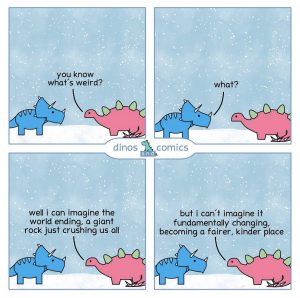
To summarize, heuristics play a role in our lives and social interactions in many ways we may not even be aware of. It is important that we familiarize ourselves with our internal biases and question our immediate thoughts and feelings. I think the image above, retrieved from the Instagram page dinosandcomics, is reflective of the initial thought process many of us instinctively tune into when faced with potential adverse outcomes. It depicts what happens when we fail to look for the bigger picture.
It can be difficult to think outside the box in order to make the best decisions. To do this we need to gather evidence beyond our observations and previous experiences. Ultimately, by making better informed decisions we can build better relationships, worry an appropriate amount, get a better deal, and even perhaps realize that change isn’t always as scary as it may initially appear!