Interpretive, Interpersonal, and Presentational Modes of Communication
Exploring Culture
There is no substitute for travel to, and living in a country for a time to change a worldview, and I have lived in many countries in my life, so I am fully aware that misconceptions and stereotypes are present in all of us, especially Americans. I am not sure that any of these products helped change my worldview or change any misconceptions. If anything, they reminded me of how much we have to learn about others, and from that education, learn about ourselves.
There were many things that helped me gain an understanding of different cultural perspectives of Spanish-speaking countries—from South America, to Spain, and even Spanish-speaking people in the United States. One small contribution to those understandings were the videos of vocabulary words in Canvas. Each of those presented visual contexts for the vocabulary words that were different from the ones in Lingro. In addition, the ImmerseMe exercises, with 3D images, provided visual connections to a bread store or a clothing store or someone´s living room, each of which provided cues to cultural differences. The modules in Lingro illuminated many stories of culture, from a Mexican boy emigrating to California to a Peruvian chef changing the world of food sustainability. The actual conversations from my TalkAbroad partner in Barcelona and the conversations with the Professora from Bogota added valuable perspectives and language for cultural exploration and understanding.
Engaging in Communities
As the saying goes, no man is an island, and being fully engaged not only in our own communities, but in the larger world is critical to understanding the complexities of the world around us. By engaging in our local communities with an understanding of how our challenges inevitably intersect the larger world allows us to embrace creative and sustainable solutions to problems facing our world. Glocalización!
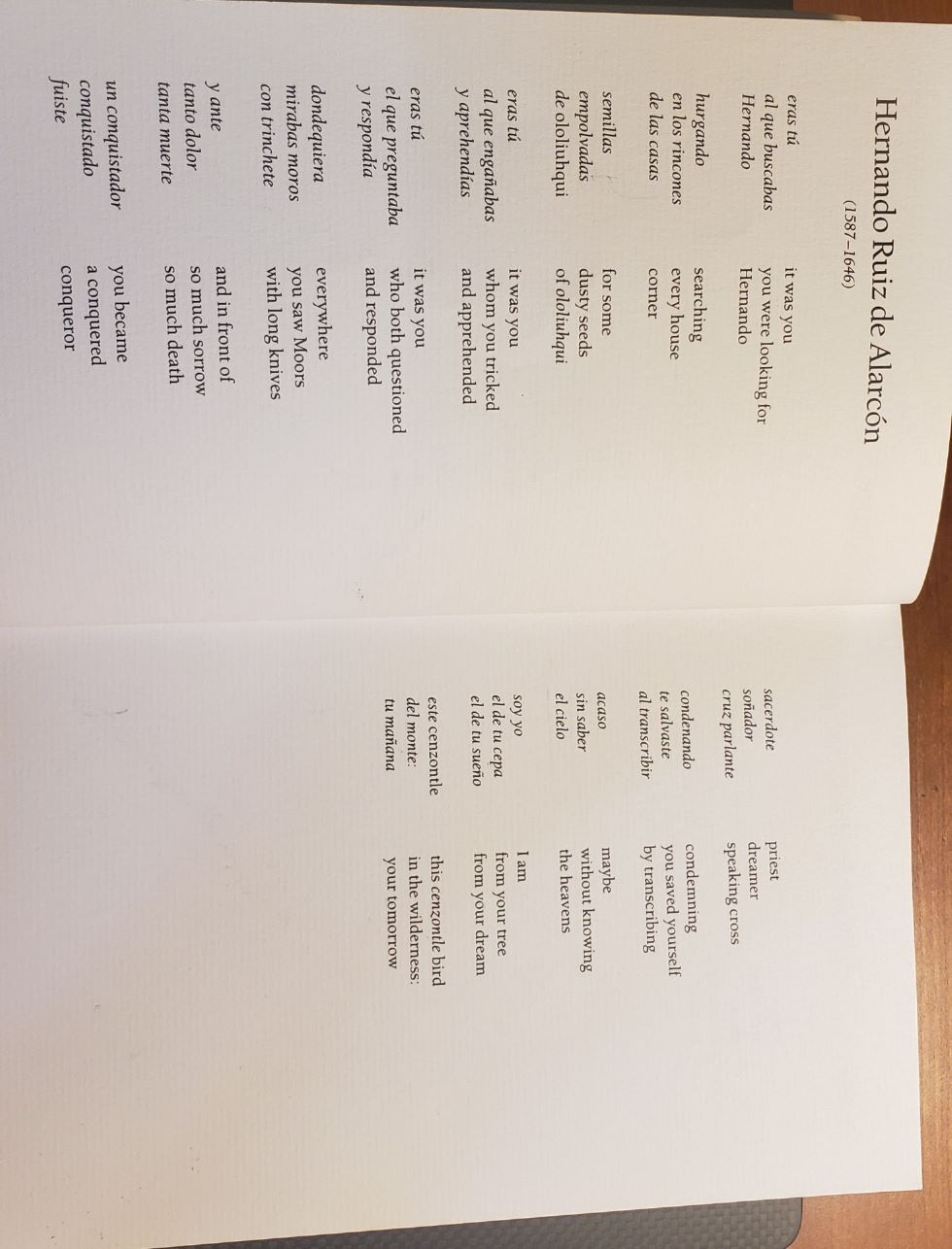
One of our first assignments was to explore how poetry can express our identity. I found a collection of poems by Francisco Alarcón, a Mexican poet, who connected his name and his ancestry to a priest from the early 17th century. I was able to write an explanation of the poet´s intent, which hit me on an unexpected level. Reading his poem aloud helped me feel connected not only to him, but to his Aztec heritage, his language, and strangely, to my own ancestors– whoever they might have been.
What I wrote about him:
El título de esto poema es Hernando Ruiz de Alarcón (1587 – 1646). Hernando Ruiz fue un sacerdote en Mexico durante el Spanish Inquisition y tiene el mismo nombre que la poeta, Francisco de Alarcón. Es possible que Hernando sea antepasado de Franciso. Ya que Hernando se completá un Tratado de sus encontrados con los Aztecos nativos que se lea Francisco, la conneción de Francisco con su herencia y su lingua materna es hecho. Para apoyar la tema de la conexión con su idenitad étnica, el poeta constucta el poema como serpiente a través dos paginas y los estrofas y lineas muy cortas. Los serpientos son simbólicos de la cultura Axteca, pues es possible que la estructura del poema enfatice la conexión de Francisco con su herencia. También usa muchos vocabulos que tienan ¨r¨ , un sonido que se pueda sonar como un serpiente. Además, el poeto Francisco incorpora vocabulo Azteca en la poema: ololuihqui. Y también, incorpora otras imágenes para reforzar sus ideas. La poema comienza a Hernando buscarando su mismo identidad para hurgandar semillas emolvadas de su patria y refiere tanto dolor y tanta muerte. Yo creo que no solo son metáfores, pero también referencias de las sentimientos del poeto mismo que se busque su identidad personal. Mi reacción emocional al poema es un poco sorpriende porque antes de leer este poema y todas las poemas en este recopilación no conocia mucho de la cultura Azteca y la conexión a la cultura mexicano. Pero más importante tal vez es que la realidad es que todos quieren buscar sus antepasados y los razgos que influencian la identidad pesonal y esto poema es un recordatorio de estos sentimientos.
In other assignments we also learned of different traditions and customs. One of my favorites was learning about mate! I told my TalkAbroad companion that I would love to travel to Peru one day to experience a mateada. It seems like such a nice way of slowing down and really appreciating a group of friends in a deliberate way. We have much to learn from that custom!

Interpersonal Communication
Discussion board posts, TalkAbroad conversations, conversations with Professor Mitchell, and conversations with a friend who is fluent in Spanish having lived in Guatemala were all communications that contributed to my learning.
Discussion board posts, though generally short, provided snapshots of different cultural customs among our classmates, who hailed from across the country and from a variety of backgrounds. Many of my classmates were biracial or from multi-cultural backgrounds. At first, I wondered how we would find connection, but as we progressed, what was interesting to me was how much I might have in common with them, even if they are much younger than I am. We shared enjoyment of shared meals with family, of cooking with grandmothers, and thoughts on global hunger. Their posts made me feel hopeful. I rather wish there were more DB opportunities– perhaps with an assigned DB partner.
I really enjoyed my TalkAbroad conversations with Maria Isabel from Barcelona. I knew that Spanish in Spain and Spanish in South America are slightly different and sound different, so I was a bit nervous about engaging with her, but I found that I did understand her quite well (perhaps because she was generous and spoke slowly!), but from her I also learned about several Spanish customs– a small cup of strong coffee following the large mid-day meal, for example (another very civilized- sounding custom that slows one down). By even the second conversation, I felt much more comfortable in conversing with her, extending the assigned conversation to related, but different topics. If I were to do anything differently next time, I would extend those conversations in both time and number.
I truly enjoyed talking with Prof Mitchell– I was always nervous about those conversations as their purpose was to engage in a certain number of topics for a grade, and I always left feeling like I could have said things very differently or fluently, but the feedback was always positive, reminding me that this is only a 200-level course! From these conversations and the feedback, I gained some confidence in my ability to figure out how to say something, even in a round about way.
Through both TalkAbroad and conversations with Prof Mitchell, I began to be able to speak in Spanish rather than trying to think in English and then translate (not always, but a good deal of the time).
Over the course of the semester I also met several times with a friend who is fluent in Spanish, having lived in Panama for many years with the Peace Corps. We conducted our conversations in Spanish, which led to some changes in our conversations– more slow, more deliberate, not quite as intimate. But we have even started messaging each other in Spanish. For whatever reason, I found these conversations very intimidating, perhaps because it is easier to feel foolish with someone you will likely not see again that it is with someone you are in contact with all the time. But as we continue these conversations, I hope I will feel less intimidated, and be able to pick up in Spanish were we left off in English!
My TalkAbroad videos:
Presentational Speaking
In this course, we completed several Proyectos in which we had to record ourselves presenting on several topics. We started these Proyectos by recording the reading of a poem, then graduated to discussing a personal experience of growth, an influencer, a hispanic custom that we researched, and finally an issue of food shortage and how to resolve it. Each one was more challenging than the next.
The challenge for me in these projects was to practice enough that I felt like I was talking smoothly and naturally, but not so much that I sounded robotic with my speech memorized word for word. It did become easier as I progressed– to the point that to my surprise, the presentation on a custom turned into a long description- way longer than required or perhaps necessary. But I left it because it truly surprised me. I had enjoyed doing the research with my friend on a custom from Panama.
The proyecto I had most fun with perhaps, was the one on an influencer, despite the fact that that was my least favorite module content, and I was dreading the research. I think the whole topic of influencers is crazy, but I found a delightful, 101-year old influencer named Iris Apfel who is a colorful, powerful, independent woman. I enjoyed presenting her sense of humor, and grand-scale fashion sense. I think that is the project in which I was perhaps able to achieve the most natural and engaged style. If I had to do this project over, I would have dared to expand more on Iris. I think I could do it (though I wish I had pronounced some words better, and in the future, I would focus more on that).
http://sites.wp.odu.edu/westspanish202/wp-content/uploads/sites/33172/2023/04/Iris-Apfel-1.docx
Presentational Writing
Most of what would qualify as presentational writing I did for this class was writing the project preparations in Lingro — drafts for the outlines for the video artifacts for the project. In these drafts I tried to use as much of the module vocabulary as possible as I moved to thinking and writing in Spanish rather than writing in English and then translating. I did not focus on grammar and spelling at this point, but only in getting my thoughts down, knowing these were drafts only and the focus for the project might change slightly. And, to be frank, verb conjugations are still not fluid for me– I have to stop and think about the rules for those. As a small consideration, one of my early challenges was remembering the Spanish keyboard for symbols, but as I progressed through the course, those too, became second nature. I will be happy when the grammar and verb conjugation become second nature as well!
My presentation for solving the challenge of food insecurity– una idea poquito loco!
De acuerdo a Feeding America, en los Estados Unidos, el país mas rico del mundo, hay más que 34 millión personas, inclusivo de 9 millión niños, qui tienen alimenta inseguridad. Esto es 10.2 portentaje de la populación. 10.2 portentage del país mas rico del mundo. Es una tragedia, pero sea que ser vergüenza. ¿qué podemos hacer para al respecto? No hay escasez de alimentos aquí, pero 100 portentaje de los condados tienen alimenta inseguridad. ¿Lo que da? Tenemos que pasar a la acción y trabajar en el objetivo colectivo.
En orden elaborar una agenda sobre comida asequible y saludable, tenemos que cambiar la política pública y construir puentes nuevos para intenta algo nuevo. En algunos países europeos se construyen viviendas sociales donde vive personas de múltiple datos demográficos y niveles de ingreso –las clases bajas y las clases medias y altas. Los que tienen más dinero y recursos se apoyan los que tienen menos. Y es muy exitoso. En los estados unidos, por otra vez, tenemos poblados de multiuso en medio de una ciudad más grande, donde existen condominios, restaurantes, varias tiendas, y oficinas. Se apoyan todos. Es posible construir un puente entre estas dos ideas para resolver el problema de alimento inseguridad. ¡Imagina! Un poblado de multiuso y de múltiple demográficos y niveles de ingreso conjuntos. Todos pueden ayudar todos. Los restaurantes pueden dar los alimentos que no usan (¡y los restaurantes se tienen mucho de eso!) a los que necesitan. Fuera especialmente beneficioso si los restaurantes, como los de Acurio, abrazan la comida sostenible. Es un modelo que no permite codicia o depredado. Es un modelo innovador de integración. Es posible que no fue la herramienta infalible, pero antes de se opone, tenemos que motivarnos a traer algo nuevo. ¡Atreferse comenzar a pensar ideas grandes para llevar prosperidad a muchos que sufrieren!
Interpretive Listening
We encountered several interpretive listening activities this semester, including from several short exercises where we had to choose appropriate responses to spoken questions, and in module themes in Lingro. One of the most difficult was in the Lingro Modulo 24, a TED talk in Spanish by the famous chef, Gastón Acurio, presented to a Spanish-speaking audience. He spoke quickly and in an accent that seemed unlike ones I had heard before about the topic of food sustainability. The topic itself was one I was not completely familiar with, making understanding even more challenging. In order to understand it fully, I had to listen to it in sections, trying to get the gist first (as we had been instructed to do in one of the earlier listening exercises), the diving for deeper comprehension. It took many tries, but in the end, I think I understood it well– and I ultimately found it a fascinating discussion of how world class chefs from around the world have changed eating habits and have formed a bond to address issues of food sustainability across the globe.
Gastón Acurio TED Talk:
Interpretive Reading
It feels like we were doing interpretive reading all semester in all Lingro practicar and aplicar exercises!
From the simplest like this from Lingro Aplicar module 20:
https://docs.google.com/document/d/1J9sUEZa_l3_7mPFZyIvIRt_A65QYL42s/edit
to more complicated ones.
I don’t think any of these exercises were unclear, but they did require some interpretive skills that enabled a deeper understanding of the words and how they fit into context. As the aplicar exercises increased, the complexity increased, so that by the end of those exercises, I had a good idea of the words, their contexts, and how they intersected.