Instructions
Exploring Culture
As part of this semester’s exercises, we were presented with profiles of different cultures from around the world in order to gain a better understanding of cultural perspectives. It became obvious to me after viewing their profiles that things aren’t the same everywhere. Each individual has their own preferences, and that applies to Americans as well as people around the world. It is especially important when it comes to communication. Each country has different standards in the Spanish-speaking world. By gaining a better understanding of how other nations go about their business, I began to open my eyes to a whole new world of understanding that just as America has its own ways of doing things that make sense, so too do other countries have their own ways of doing things that make sense. In light of this knowledge, I believe that both the United States of America and other countries I have studied can benefit from receiving ideas and inspiration that can improve the quality of life in their own countries.
Engaging in Communities
Developing a balanced approach to social responsibility requires engagement both within the local community and across the globe. As a result of global engagement, perspectives are widened and challenges that transcend borders are addressed while local bonds are strengthened, and specific community needs are met. In combining these two approaches, a sense of responsibility can be created at various levels of society, resulting in a more harmonious, interconnected world. In this course we learned about stereotypes and personal stories about different countries, as well as discussed and read about life experiences and influencers. Furthermore, we discussed the traditions of families around the world. The video below includes text discussing a popular Guarani legend from Argentina, Paraguay, and Uruguay. The protagonist is the moon goddess Yací who offers a hunter the yerba mate plant as a gift. While reading the text, we had to identify the main events and answer the question, “How do traditions endure through time?” Engaging with various perspectives of the Spanish-speaking world throughout this course has been rewarding and enlightening. Participating in discussions on these topics allowed me to gain an understanding of the cultural richness and complexity unique to Spanish-speaking societies. It has been through this experience that I have gained an appreciation for cultural diversity and a better understanding of the importance of diverse perspectives in the development of global understanding.
Interpersonal Communication
In this semester’s TalkAbroad program, I engaged in live oral conversations with native Spanish speakers in order to enhance my conversational skills and cultural understanding. As well as learning the course content, I was required to participate in a number of interpersonal writing activities, such as writing compositions, in which I had to practice reading and responding to prompts that were given in Spanish. While in class, I also answered Spanish-based questions from my classmates. Additionally, these experiences have benefitted my formal studies by providing practical applications and fostering a diverse approach to studying languages.
My ability to communicate spontaneously in Spanish has greatly improved as a result of engaging in telecollaborative conversations through TalkAbroad. The ability to think quickly and respond in a timely manner was challenging at first, but I gained confidence and fluency as time went on. As I’ve been engaging with complex prompts and presenting my thoughts consistently through my writing compositions thus far, I have developed my written communication skills. For me, balancing accuracy and clarity was a difficult task. It pushed me to become more precise in my writing. My cultural awareness was broadened through these activities because I encountered a variety of perspectives and nuances in language. Considering that my level of proficiency in Spanish at present is not at its highest level, I would like to be able to expand the language resources that I already have, and educate myself further in reliable materials so that I can enhance my overall proficiency in Spanish, whether it is on the spoken or written side.
Presentational Speaking
Lingo Learning has been a useful tool for our class throughout the semester to practice presentational speaking. As part of Lingo learning, we were asked to create a three-minute talking about a transformative moment in our lives for our Projecto in section nineteen. I did my project on my probate coming out as an AKA which is a D nine origination fully known as Alpha Kappa Alpha Sorority Incorporated. In the direction it states how it is important to pay close attention to the tone of how we present our voice and our body language. Additionally, the story should include a hook that will catch the reader’s attention, the narrative with all the important details that are important to the story, a dialogue that illustrates a key part of the story, a reflection that explains relevance, purpose, and target audience, and photos or images that illustrate the story.
As far as speaking activities are concerned, I found them to be easy, except that I had to keep taking new takes in order to match the picture and screen timing with the audio timing. When I said each sentence that I planned to say, I timed myself to make sure it matched the time the slide would appear in the video. It was also challenging to keep each clip under a particular time limit. Despite wanting to say a lot in my video, I didn’t want to make it too long and lengthy. In the process, my pronunciation improved, and my speech flowed better as well as was quicker. As far as how I did things, I wouldn’t change anything about how I did it. You get better at something by practicing, so the more you do it, the better it will sound.
Presentational Writing
In this course, we had to write multiple 250-300-word reports on a variety of topics during the presentational writing portion. The role of influencers in my culture was one of the topics we had to write about. Answering the big question: Under the influence of influencers? The topics we had to write about included influencers and their social media presence: type of influencer, topics they talk about, platforms they use, etc. As well as the level of closeness they have with their fans and followers outside of social networks and; the challenges influencers face and the dangers of the industry for the users who follow them. We also had to include verb tenses in the present, the preterite, the imperfect, the present and past perfect.
These writing assignments not only helped me practice writing my Spanish, but also educated me on influencers and their backgrounds based on the research I had to conduct. As a result of this assignment, I have improved my language proficiency as well as my writing skills. My language skills significantly improved as I expressed details and emotions in Spanish throughout each assignment. The challenge for me was to use words that made sense to me in Spanish rather than using Google Translate. For these assignments, it is sometimes necessary to conduct extensive research on influencers and include the right facts. I used vocabulary that I learned in the project section along with basic but meaningful vocabulary to overcome this challenge. If I had to do this assignment again, I would incorporate more influencer details, aiming for a deeper and more engaging report.
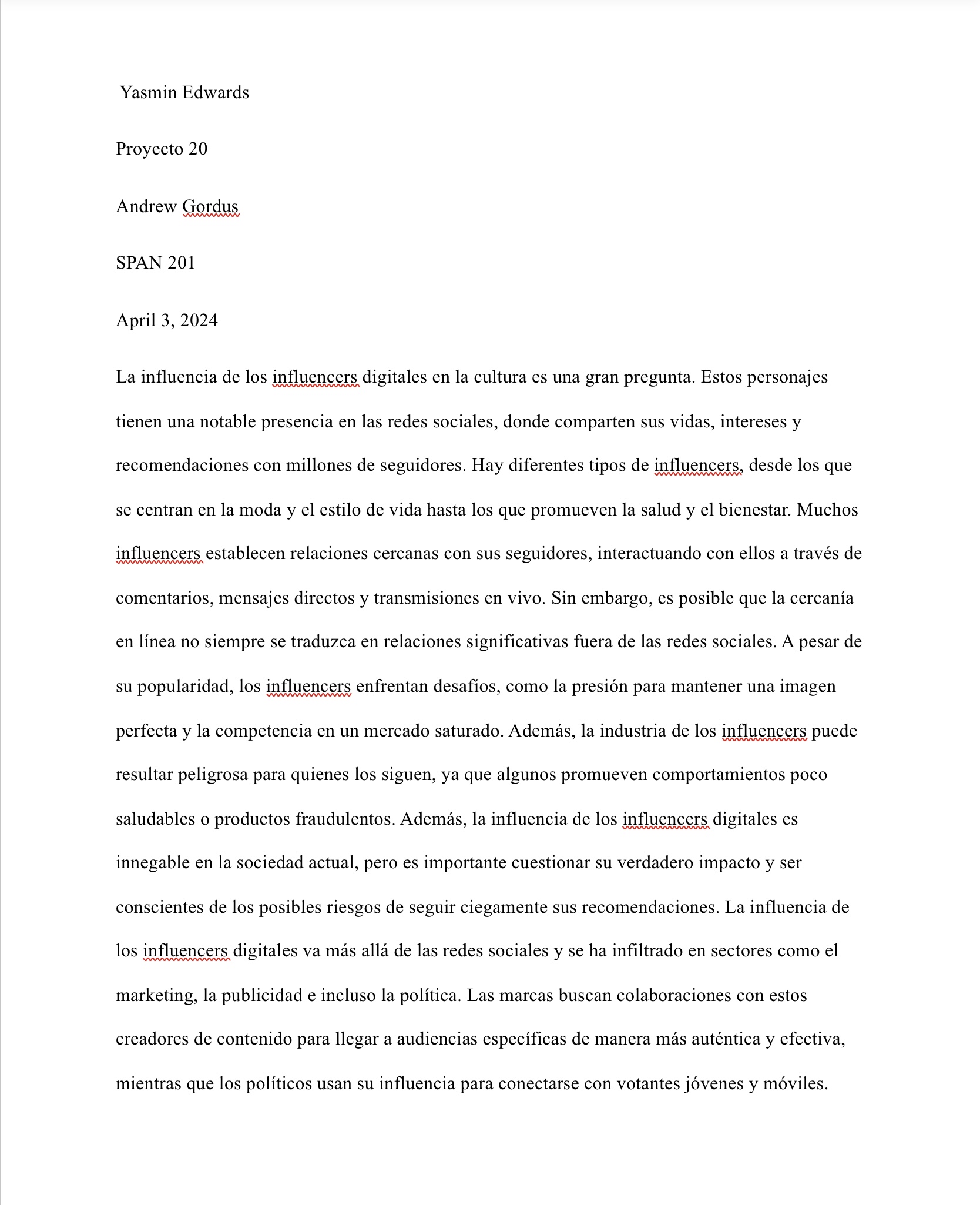
Proyecto 20-1 El mundo influence
Interpretive Listening
For this course, we listened to multiple videos that discussed different stereotypes about the United States and the Spanish-speaking world. The term stereotyping refers to pre-conceived ideas and beliefs about certain groups of people. It is common for these ideas to originate in reality, but over time and repeated repetition they end up being exaggerated and even distorted. A number of countries and nationalities have stereotypes associated with them in the Hispanic world. It is risky to believe these stereotypes without being open-minded to meeting people from other countries. I actively studied the video rather than passively watching it by looking up unfamiliar terms and conducting further research. Through the listening experience, I gained a greater understanding of how vocabulary can be used in the real world. The takeaway for me was a better understanding of stereotyping in different countries and how it impacts certain communities. These activities have improved my language comprehension and ability to recognize meaning from natural content, helping me gain a more thorough and practical understanding of the Spanish language.
Interpretive Reading
With Lingo learning, we read Journey to the University (excerpt from Beyond Me) by Francisco Jiménez and identified major ideas. While reading the slides, this short story included mostly text to follow along. I found reading a short story in Spanish to be both a challenge and an opportunity for learning. Initially, unfamiliar vocabulary and complex expressions made it difficult to understand the narrative. To overcome this problem, I combined contextual inference with language practice, resulting in a better grasp of the language’s features. This experience provided a deeper understanding of Spanish culture through the way cultural elements were intertwined with the storyline. It was through reading that I gained a deeper understanding of how language reflects cultural differences. Over the course of these assignments, I have developed a greater understanding of Spanish and become more adept at navigating challenging situations. This journey has not only improved my language skills, but also fostered better understanding of the interconnections between languages and cultures.