Journal Entry Assignments
#15 (04/19/2024)
Mr. Lee began his journey as an accountant. He was introduced to Digital Forensics later in his career. If I remember correctly, he did not receive any formal education for the job. He also said that once he was introduced to the position, he felt as though he had finally found his “niche.” I believe Lee’s journey to the realm of cybersecurity – digital forensics through accounting speaks on how throughout our lives we are still learning about ourselves and what we enjoy doing. Even if we begin a career in one thing (in Lee’s case, accounting), it is completely possibly to find and must enact a life change that may or may not be better for your life/career.
#14 (04/02/2024)
The first violation that I deem to be serious would be that of illegal searches made online. One should have a good sense of self control in general. Asking questionable online searches seems to only put them at risk of exposure. The second would be using someone’s internet without their permission, which is stealing. This leads me into the next violation: pirating or streaming free services. This is done so often; however, it is not a victimless crime as many may assume. Another one that is very serious is faking your identity online. If a person chooses to be online, it is in their best interest to be themselves. This will protect them as well as other people, since we are aware of identity theft and the concept of catfishing. The fifth would be the usage of Torrent services, which is along the lines of pirating.
#13 (03/29/2024)
In this article’s introduction, the reader is told how most companies lack proper vulnerability policies. Some even refuse to establish this within their organizations. Attitudes toward implementing this have shifted, however, companies seemed to prefer hiring hackers to find the vulnerabilities of the organization instead with a process called bug bounties. This has caused an increase in the hiring competition realm to find qualified hackers to get the job done. This article has helped me to understand why so many computer science and cybersecurity majors chose to be self-contracted hackers. I wonder if it is worth it to hackers, however, because of the amount of time it takes for them to digest the company’s securities and vulnerabilities.
#12 (03/28/2024)
The first economic theory related to this letter could be the Marxian economic theory. This theory says that those with power exploit those without power for economic gains. In this case, the ones with power are the attackers who gained access to this organization’s data, including customer’s sensitive information. This sort of breach could’ve led to the economic loss of these customers. The next economic theory that relates to this letter is the Laissez-fare economic theory, which says that the government cannot interfere with an organization’s economy unless to protect an individual’s rights. In this case, the customers of this organization have had their rights affected as they did not know until later in the breach that their information had been compromised, so law enforcement forced the organization to make the information known about the breach known to the customers.
The first social science theory that can be related to the letter is structural functionalism. This theory says that society is a complex system made of interconnected parts that work together to maintain structure. This relates to the letter because the laws have requirements for the company in the best interest of its customers. The rational choice theory can also be related because it was only rational for the company to follow regulations set by the law.
#11 (03/21/2024)
In the presentation, Youtuber Nicole Enesse talks about a cybersecurity analyst job, what they do, the requirements for the job, as well as how much they make in different parts of the United States. A cybersecurity analyst’s role is primarily to monitor, analyze, and respond to security incidents/threats. This is where our first social theme expressed in this week’s module arrives; mitigation. Mitigation is how a social cybersecurity attack can be countered as well as how those who are attacked can become more resilient to those attacks. A secondary theme that could also elate to the role of a cybersecurity analyst in information maneuver. information maneuver is understanding the strategies used to conduct an attack and the intent of those strategies. This concept can be useful to a cybersecurity analyst as they must be able to understand a threat in order to properly respond to it.
#10 (03/19/2024)
Social cybersecurity is an emerging focus of study that is used to characterize, understand and predict changes that may occur in human behaviors that are cyber related. Through these changes it is necessary that cybersecurity maintains its character and increases its security, which social cybersecurity also helps with. This article goes into detail about how it is necessary for especially our military and Department of Defense to be able to properly understand and use cybersecurity. The interactions between all types of people in the cyber realm help spread all sorts of information that can pin certain parties against others.
#9 (03/17/2024)
My scores after taking the Social Media Disorder Scale gave me three out of nine Yes’. Five Yes’ were necessary to meet the requirements for a formal diagnosis, of which I was short by only two Yes’. I think the questions asked to achieve evaluation for proper diagnosis were sensible. I do believe that some of the questions could have and even need to be altered to include adults who may have issues with Social Media use. One pattern pointed out to us in this module was the statistics concerning what gender of youth is particularly susceptible to online bullying. Maybe I did not search correctly, however, I did not see the United States on the report. The PowerPoint claimed that there are more female users of social media than males. I have a fashion page that I began promoting about four months ago. I am still learning how to reach my target audience, which would ideally be more female than male or at least equally female and male. What I have found so far is that for each post with which I engage new audience, those who see my audience are 0.7-1.3% female and nearly 98% male.
#8 (03/03/2024)
The media – for example films produced in Hollywood – often seem to portray the activity of hacking as easier than it really is. One thing that can be noticed in hacking produced for entertainment is that timelines on projects are often sped up. This leaves viewers with the impression that some hacks take way less time than they would in real life. Another aspect to consider is the creation of super advanced technologies that do not actually exist. Some tools presented in movies make it seem as though hacking does not require much skill if one has access to superpower tools. The media can also portray the process to be more aesthetically pleasing than it is.
#7 (02/19/2024)
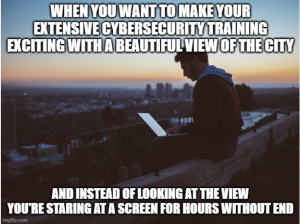
Human Centered Cybersecurity in the form of extensive, long, and information packed educational programs to be completed on one’s own time.

Human Centered Cybersecurity in the form of education , a personal problem I have encountered and have yet to solve (program learning, accessing desired files).

Information Security in the for of biometric authentication (facial scanning protocol)
#6 (02/17/2024)
The first example that we have here is a USPS fake. One way that we can see make the website fake is the improper URL address where USPS is instead spelled USZWPS. The site is all red which probably wouldn’t be with an error on USPS and has faulty links.
The next fake website we have is a Facebook fluke. Again, the site is spelled incorrectly. If one clicks the link, it automatically prompts to allow pop-ups.
The last one has another example of a misspelled URL. The website doesn’t even lead to an operational domain.
https://www.xn--amazn-3ta.com/
https://www.amazon.com/
#5 (02/07/2024)
To begin my ranking of the motives from 1 to 7, with 1 making the most sense and 7 making the least, at 1 I will be placing monetary gain. This is because it is a regular goal for most members of society to learn a specific trade for money. As a Cybersecurity student, I have learned that I could work as a white-hat hacker if I chose to.
At two, I will place multiple reasons. For example, hacking a system for monetary gains as well as political reasons. Any reason added on to monetary gain makes sense to me because unless someone is born into money, money is always a necessity.
At three, I will place political reasons. However illegal, there can be some honor gained in “hacktivism.” For example, if a hacker were to hack a company’s finances and send more money to the underpaid children working for them in another country.
At four I will place recognition. It is not honorable to me but can make sense to me. Many people use social media for fame and recognition, this is along those lines for me. We live in a day and age where it is considered a good thing to be known by many for your actions.
I will place entertainment at five. One might be practicing their skills to know how they would do in a real-world situation. This could be avoided by using simulators created for this reason.
At six I will place Boredom. It may be true to some that boredom deserves a higher place on my list. Illegal hacking of systems just because someone is board would say that they are highly intelligent, however, it would also say that they do not have proper regard for other people.
Revenge will be placed at seven. The revenge porn example in this module’s PowerPoint really got to me because I was groomed via the internet online as a child/young teen and nearly made a victim of human trafficking. If someone were to access my own files and release them because they were mad at me, I would feel terribly helpless and would have an internal battle wondering if this was my fault
#4 (02/03/2024)
My review of Maslow’s Hierarchy of Needs begins with the most basic physiological needs: food, water, warmth, and rest. Every day during my life here on campus I use my phone to order phone ahead of time, whether it be for pick up or grocery and water delivery. I often use the same devices to ease my mind into sleep with entertaining shows, readings, or meditation sounds. The next basic need is one of safety. Technology and cybersecurity play roles in my safety. I am sure the key to my apartment was made by a machine. My funds and personal information are protected behind the security systems within my phone and laptop. The next level is one of belongingness and love; psychological needs of intimacy, friends, and relationship. I communicate with friends and family through different means; texting, calling, emailing, and social media to name a few. The next level are esteem needs; feeling of prestige and feeling accomplished. Just like any other person of this generation, much of what I perceive to be success came through what I have viewed in the media, much of which is communicated to me through technology. The last and highest level on the hierarchy is self-actualization; self-fulfillment and achieving one’s full potential. Part of what this looks like is achieving a sort of success on social media where I have a mass following of people to whom I share my creativity and what has helped me to become successful in life.
#3 (01/27/2024)
The first thing I noticed about the site is the possibility that this organization is based in California. It is easy to navigate with there being a search page as well as different topics of resources found at the bottom of the site, including data breaches. Once on the Data Breaches page, a user has access to many articles on the subject, as well as surveys, reports, news, and general information in the form of Q&As to inform the public on safety. Any researcher or student who needs information on breaches can use this page on the site to learn about diverse types of security breaches and how they occur, as well as how one can better protect themselves from becoming a victim of such events. Information on past breaches and how they have been settled is also on this page.
#2 (01/21/2024)
Science is both a body of knowledge and a process of understanding the world (nature and social) using systematic methodology based on evidence. Theories to explain the unknown must be proven to be viewed as correct or sensible. Cybersecurity is also a collection of knowledge, as well as many developed methodologies used to protect information owed by organizations using the CIA Triad of confidentiality, integrity, and availability, and much more. These methodologies must also be proven to know they are sustainable and effective. Both topics apply scientific methods of relativism, ethical practices, and objectivity. Cybersecurity can be viewed as a focused derivative of computer science, which is the science of the development and testing of software and its systems.
#1 (01/10/2024)
The first sector that draws me in is oversee and govern, with specific roles like cybersecurity management and executive cyber leadership. This is because when being apart of a team, I like to know everything that needs to be done, how it should be done, as well as who will be accomplishing each individual task and their individual skillsets to ensure that each part is being done by someone efficient in that area. Another sector that interests me is cybersecurity operation and maintenance. This seems like the average position for someone working in technology, like an IT position. A sector that didn’t draw my interest was systems development and architecture. This is because I feel as though I am very entry level in technology and jumping into a development role I think would be a bit overwhelming to me.