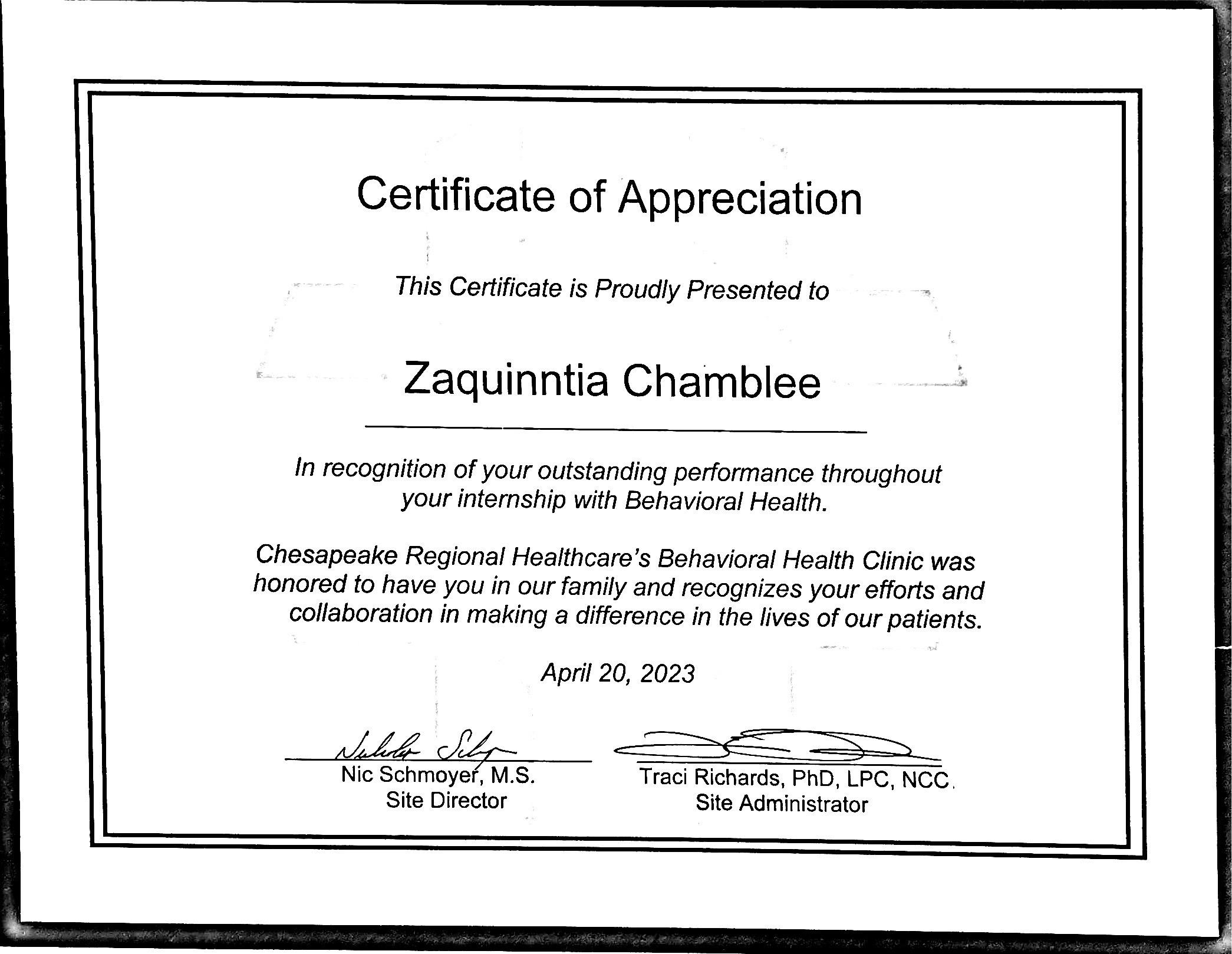
It has been an honor being a part of the LeADERS program process. Through my Human Services educational journey, I have taken some rigorous and interesting classes. I enjoyed taking (diversity)Diversity Issues, (research) Program-Development Implement-Funding, and Academic Internship, Career Development & Appraisal, Field Observation, Crisis Intervention, Family Guidance, Substance Abuse Treatment and Research, and more.
I believe the knowledge I gained from my diversity course helped to prepare for the diverse population where I volunteered, internship, and now currently working. It is about being non-judgment and treating everyone with respect regardless who they are or what situation they are in when you assist them. I also found that the research aspect of the Human Services department afforded me with the capabilities of learning how significant stakeholders are in the organizations that we find ourselves working with, from the clients or patients to the CEO of an organization, everyone has a say in how and what they expect as far as fair treatment and care across the board. The internship program has been life changing. It allowed me to learn hands on what it would be like in the field of human services. We were able to utilize all of the studies from amazing professors from the start of the course to the finish line and apply those skills accordingly to better serve our communities by abiding by our Ethical Standards, advocating for our clients by assessing, using active listening, showing empathy, knowing when and how to refer clients and the proper way of termination. The Human Services program at ODU has prepared me through live mock counseling assignments, evidence-based research, observation of facilities, how to construct group therapy sessions, and more. I feel confident in the work that I am doing today by way of my internship site but it is a good feeling that if I still have questions, I have professors and peers at ODU who have told me that if I need any help after graduation and while working in our field, they are available and willing to help me in any way that they can and that is an attestant of what a true Monarch is.
Please some of my written research assignments with comments from some of my professors and teacher assistants.
ANNOTATED BIBLIOGRAPHY 9
This evidenced-based research study focused on aftercare treatment. The article
reports that there was a 150% increase in opioid-related admissions in hospitals
over two decades. According to this article, the method tested was Truven Health
Analytics Market Scan Commercial Claims and Encounters database. They
studied patients, ages 18-64 who were admitted as an inpatient for opioid use
disorder or overdose. This study showed that patients with previous relationships
with behavioral health providers would follow their aftercare treatment plan. This
research states that the patient who does not have a personal provider probably
would not follow up with the aftercare treatment care plan, therefore it is
suggested that the clinician should focus on these patients. This study aids me
with information and policies that hospitals should utilize to make sure that all
patients follow up but especially the ones who do not have a provider and utilizes
the hospitals for care. MUENI MWENDWA – “Excellent.“
I think the outcome evaluation would be valuable for my evaluation at Chesapeake Regional Medical Behavioral Health because it allows observance of how many patients were given short-term therapy care and if the nurses and clinicians assisted the patients with locating aftercare programs such as AA and SA programs to manage their substance abuse disorder. Although our readings state that this is one of the simplest forms of outcomes evaluation, you can still evaluate how many of the patients had successful or negative outcomes based on the department’s positive or negative statistics. Also observing and following up with the patients to see if their therapy and medication management systems are set up and if they understand the instructions before they are discharged from the facility.
The way the evaluation type will address my questions regarding the patient’s transfer from the Emergency Department to the Behavioral Health Department is if the clinicians are utilizing the steps in their treatment plans during their short-term stay and after the patient has been discharged. It also addresses my observation and evaluation of whether the patients received the proper referrals and aftercare instruction from the clinicians. And finally, note if the clinicians are inputting the correct documentation records of the patient’s medical and mental information based on their instructional guidelines and standards created by other stakeholders.
RESEARCH SUPPORTED TREAMENT PLAN 3
The client states that he is in a same-sex relationship, and he stated that it can become
volatile at times because of his partner’s insecurities and jealousy. Mr. Blue also mentioned that
he is trying to change his sexual orientation because of his beliefs and how he was raised. He
stated that when he told his family, some of his family responded that they already knew he was
gay and accepted it, but his mother was hurt at first but later accepted it because he said that she
loved and cared for him and would not turn her back on him. Mr. Blue stated that his father was
upset and disowned him. He states that his mother and older sister are his only supports.
The client’s drugs of choice are alcohol, marijuana, nicotine, cocaine, alcohol, and
heroin, prescribed Adderall 20 mg once a day but the client took it 2x a day. He mentioned at
age sixteen he would smoke one pack to two packs of cigarettes a day and smokes marijuana 4x
a day, drink one case of beer 5x a week, he states that he takes two oxycodone (10 mg) orally
with alcohol 2x weekly. He states that he started using heroin $5 worth intravenously in his mid-
twenties, whenever he could get it but states he stopped using it because he did not like needles.
The client was prescribed Seroquel for Bipolar Disorder but stated he does not remember the
dosage only took it once and it made him too sluggish, so the client discontinued use.
Short-Term Goals and Objectives
1) Mr. Blue would like to stop using illegal drugs
a. The practitioner will provide the client with information on detox facilities in the
client’s area
b. Mr. Blue will check himself into a detox facility within a week for 60 days
c. The practitioner will follow up with the detox facility to check the status of Mr.
Blue’s check-in status and send any requested information needed by the detox
facility.
Plan for Relapse
Mr. Blue has agreed to the following plan in case of relapse:
1. Mr. Blue will call his SA sponsor if he cannot reach his sponsor, he will go to step 2
2. Mr. Blue will call SAMHSA Helpline at 1-800-662-4357 if he still cannot get help go
to step 3
3. Mr. Blue is to check himself back into a detox facility. JESSICA HUFFMAN –“Excellent job including 24 hour support resources.”
Zaquinntia Chamblee
Department of Human Services, Old Dominion University
HMSV 452 Substance Abuse Treatment and Research
Dr. Chaniece Winfield
October 28, 2022
Research Supported Treatment
Client Information
Client Name: Mr. Herman Blue
Gender: Male
DOB: September 25, 1987
Race: African American
Address: 2222 Uphill Road, Suffolk, VA. 22222
Phone: 757- 222-2222
Assessment Date: October 3, 2022
Treatment Plan Date: October 5, 2022
Referral Source: Self Referred
Presenting Problem
Herman Blue is a 35-year-old African American man. He lives in the Hampton Roads area of Virginia. Mr. Blue needs medical assistance due to his HIV status. He is also in need of mental illness care due to his bipolar episodes. Mr. Blue was working at a fast-food restaurant and trying to attend college online but due to his co-occurring issues, he stopped working and is currently unemployed and is no longer enrolled in school.
Mr. Blue was arrested for drug possession on September 2, 2022. He spent three months in the county jail, after being released he was on probation for a year, and he did not have any legal involvement until two years later. He was arrested for DUI and spent a few nights in jail; a court date was set, and Mr. Blue was put on probation again. He decided to enroll in a drug and alcohol treatment program, where he spent three weeks and voluntarily left the facility. The client stated that he needs help with detox and gaining sobriety, as well as assistance with his mental illnesses.
The client states that he is in a same-sex relationship, and he stated that it can become volatile at times because of his partner’s insecurities and jealousy. Mr. Blue also mentioned that he is trying to change his sexual orientation because of his beliefs and how he was raised. He stated that when he told his family, some of his family responded that they already knew he was gay and accepted it, but his mother was hurt at first but later accepted it because he said that she loved and cared for him and would not turn her back on him. Mr. Blue stated that his father was upset and disowned him. He states that his mother and older sister are his only supports.
The client’s drugs of choice are alcohol, marijuana, nicotine, cocaine, alcohol, and heroin, prescribed Adderall 20 mg once a day but the client took it 2x a day. He mentioned at age sixteen he would smoke one pack to two packs of cigarettes a day and smokes marijuana 4x a day, drink one case of beer 5x a week, he states that he takes two oxycodone (10 mg) orally with alcohol 2x weekly. He states that he started using heroin $5 worth intravenously in his mid-twenties, whenever he could get it but states he stopped using it because he did not like needles. The client was prescribed Seroquel for Bipolar Disorder but stated he does not remember the dosage only took it once and it made him too sluggish, so the client discontinued use. Mr. Blue states that he is currently drinking a case of beer 5x a week, and currently taking two oxycodone (10 mg) orally along with the beer. He states that he is currently smoking marijuana 4x a day.
Short-Term Goals and Objectives
- Mr. Blue would like to stop using illegal drugs
- The practitioner will provide the client with information on detox facilities in the client’s area
- Mr. Blue will check himself into a detox facility within a week for 60 days
- The practitioner will follow up with the detox facility to check the status of Mr. Blue’s check-in status and send any requested information needed by the detox facility
- Mr. Blue would like to receive assistance with his mental health illness
- The practitioner will refer Mr. Blue to a psychiatrist to be assessed and possibly prescribed a different medication for his Bipolar Disorder and to be seen and monitored by-weekly until the psychiatrist changes the visits accordingly to how well the medication is working for Mr. Blue
Mr. Blue will attend counseling sessions with a Psychologist a minimum of 4 sessions
- per month to assist with the abuse and traumas he has inquired
- Mr. Blue will attend community-based SA group meeting a minimum of 2x weekly
- Mr. Blue would like to move out of the house that he is sharing with his partner because of the toxicity
- Refer Mr. Blue to a Caseworker who can assist him with community residential living
- Mr. Blue will apply for a job
- Mr. Blue will start a savings account to save money so that he will be able to move out of residential community living and move into an apartment
Plan for Relapse
Mr. Blue has agreed to the following plan in case of relapse:
- Mr. Blue will call his SA sponsor if he cannot reach his sponsor, he will go to step 2
- Mr. Blue will call SAMHSA Helpline at 1-800-662-4357 if he still cannot get help go to step 3
- Mr. Blue is to check himself back into a detox facility
Research Triggers for Substance Addiction Mr. Blue has experienced several traumatic events throughout his life. When he was a teenager, he was beaten up by several teenage boys, which resulted in Mr. Blue having a concussion. Mr. Blue also had physical fights with his partners resulting in black eyes and a broken jaw. According to the article Exposure to violence and Posttreatmentwith Opioid Use Disorder, traumatic events such as exposure to violence can lead to a person developing SUD. The article, Exposure to violence and Posttreatment with Opioid Use Disorder also states that the overlapping of substance use and abuse can be a way of coping to manage the trauma and their usage increases leading to SUD.
Mr. Blue struggles with co-occurring conditions, not only struggling with SUD but also experiencing symptoms from his mental health illnesses – Bipolar Disorder, PTSD, and ADHD. According to a research study article, First-person experience of recovery in co-occurring mental health and substance use, conditions of co-occurring and SUD, and the recovery evidence, there were improvements from a method using in-depth interviews with eight individuals. The article states the approach used was called a phenomenological approach. The research findings stated analysis produced four dimensions of recovery where the individuals started feeling useful and accepted again and even began loving themselves. The research mentioned the study supported an increase in social and community factors that improved the recovery for those dealing with co-occurring conditions. The study also suggested that the combination of social services and health care was beneficial in recovery.
Alcohol Use Disorder plays another aspect of the fact that Mr. Blue states that drinking alcohol, numbs him, which temporarily gives him an escape from his mental health issues and thoughts of the physical abuse that he experiences. A research study focusing on adolescents’ alcohol use disorder mentions that mental disorders play a role in the epidemic. The article, Epidemiology of alcohol use late adolescence in Greece and Comorbidity with Depression and Other Common Mental Disorders studied adolescents aged 16-18 years old. This is the age that Mr. Blue began drinking alcohol. According to the article, the researchers recruited 2,431 adolescents from 25 different high schools. The researchers also mentioned that they assessed depression and anxiety disorders among adolescents by using a computerized version of structured psychiatric interviews. The article states that the study proved that alcohol and drunkenness were connected to depression and anxiety. Mr. Blue also mentioned smoking cannabis, being disowned by his father, and not having good relationships. The article states that Cannabis use and bad relationships with parents also caused alcohol disorder.
As stated in the article Mental and Physical Health among Homeless Sexual and Gender Minorities in a Major Urban US City, sexual and gender minorities have higher rates of mental illness and substance disorders. The research studied different causes of sexual orientation questions and it found that this population had a higher rate of psychiatric problems and PTSD as well.
Risk and Protective Factors
According to a research article, Risk and Protective Factors for Addiction among Individuals in Substance Abuse Treatment, one of the risks is the age the individual started using drugs. Mr. Blue started using drugs at the age of sixteen. Another risk factor that was researched was based on the family. Both sides of Mr. Blue’s family struggled with SUD. The article also mentioned that researchers should develop programs for children before they turn 13 years old to deter them from wanting to try drugs.
Psychotherapeutic Approaches
The cognitive-behavioral approach would be beneficial for Mr. Blue. According to our text, this psychotherapeutic approach teaches and enhances coping skills, motivational interviewing, treatment for co-occurring substance use disorder, and trauma. Mr. Blue struggles with how to cope with his co-occurring substance use disorder and cravings. He also has issues staying motivated and this approach can assist him in this area.
Evidence-Based Practice According to the research in the article, The Effects of Cognitive-Behavioral model-based Intervention on Depression, Anxiety, and Self-Efficacy in AlcoholUse Disorder, its goal was to examine the effects of CBM intervention relating to depression, anxiety, self-efficacy, and alcohol use disorder. The article states that the researchers used pre- and post-results from aerobic exercise with a controlled group and measured their reduction in the symptoms for three days with psychoeducation once a week. As stated in the article, the results were favorable and there was proof of a reduction in the controlled group’s well-being. Adding aerobic exercise to Mr. Blue’s treatment plan might aid with his symptoms from his mental illness and alcohol use disorder.
Brekke, E., Lien, L., Davidson, L., & Biong, S. (2017). First-person experiences of recovery in co-occurring mental health and substance use conditions. Advances in Dual Diagnosis, 10(1), 13–24. https://doi.org/10.1108/add-07-2016-0015
Flentje, A., Leon, A., Carrico, A., Zheng, D., & Dilley, J. (2016). Mental and physical health among homeless sexual and gender minorities in a major urban US City. Journal of Urban Health, 93(6), 997–1009. https://doi.org/10.1007/s11524-016-0084-3
Ganime, C. G., & Okanli, A. (2019). The effects of cognitive-behavioral model-based intervention on depression, anxiety, and self-efficacy in alcohol use disorder. Clinical nursing research. Retrieved October 29, 2022. https://pubmed.ncbi.nlm.nih.gov/287781341
Maegley, Tiffany R. Risk and Protective Factors for Addiction among Individuals in Substance Abuse Treatment (2022). https://etd.ohiolink.edu/apexprod/rws_etd/send_file/send?accession=ucin1649859772198548&disposition=inline
Michalis, G., Bellos, S., Politis, S., Magklara, K., Petrikis, P., & Skapinakis, P. (2019). Epidemiology of alcohol use in late adolescence in Greece and comorbidity with depression and other common mental disorders. Depression Research and Treatment, 2019, 1–9. https://doi.org/10.1155/2019/5871857
Van Brown, B. L., Kopak, A., & Hoffmann, N. (2019). Exposure to violence and posttreatment substance use among patients with opioid use disorder. Journal of Drug Education, 49(1-2), 15–29. https://doi.org/10.1177/0047237919894959
Black Lives Indeed Matter: Diverse Perspective
Zaquinntia Chamblee
Department of Human Services, Old Dominion University
HMSV 346: Cultural Diversity
Dr. Christa Gambrell
November 13, 2021
The Importance of a Movement
Black Lives Matter (BLM) originated because a young man was shot and killed because a citizen called the police and reported a suspicious black male walking. The citizen took it upon himself to confront this young black man and ended up taking a parent’s child’s life. After this horrific crime against another black male, with the shooter being acquitted, according to https://library.law.howard.edu/civilrightshistory/BLM/ the Black Lives Matter movement began with a social media hashtag #BlackLivesMatter. The organizers of this political campaign are three black females. The purpose of the movement is to shine a spotlight on the disproportion of how police or others who feel they are in authority mishandle situations with men and women of color.
As stated in the article, https://library.law.howard.edu/civilrightshistory/BLM/ the three black females, Alicia Garza, Patrisse Cullors and Opal Tometi produced BLM in 2013, after a young man named Trayvon Martin was shot to death by a man named George Zimmerman, who was found not guilty in 2012.
I chose the article because it demonstrates the inequality and oppression of the Black communities throughout our world that has been going on for hundreds of years. It is written from a racial perspective. The diversity issues that were addressed in this article were the perception that white police officers and other white people who are in a position of authority over black people, which leads to many deaths that could have been prevented. For example, the officers should use the same rules and regulations that they use when dealing with white people who find themselves in similar positions with the officers. This article is important to show and teach the world that racism and the insensible murders of black men and women at the hands of police must stop and the laws must change to protect and serve all people.
An Alternative Perspective of Black Lives Matter
According to our course material, the Netflix movie American Son, a young black man and his friends were pulled over because he was driving a nice car, which was his car. The mother in the movie was divorced and her ex-husband was a white FBI agent. When she was at the police station trying to get information about the whereabouts of her son, she was not treated with respect by the white officer, who was white and did not seem to care, he was slow to give her information about her son. She was a black, single female and she was alone, it appeared that she was vulnerable and maybe the officer could see and feel that; she was from an oppressed culture, gender, race, and natural origin. Her ex-husband showed up and the white officer gave him respect because he was white, he was a man, and he was an FBI agent, which showed him as being powerful and privileged. Having those attributes, afforded him obtaining the necessary information quickly about his son being shot and killed by a police officer, although the officer who shot him was black; that officer was privileged because of his position and authority over the young black man who was killed. Our studies, the video, The Unequal Opportunity Race, gave great illustrations on the unequal playing field of life between the white race and the black race. The video showed how slavery held black people back for hundreds of years, giving the white people huge jump starts on education, finances, and many other opportunities. It showed that white men had the power and they passed it on to their sons, while black people could not get jobs because of discrimination, they had a hard time getting into good schools because according to the video, standardized testing was not fair and in the end because of the unfair race in the world, the stress leads to shorter lifespans for Black Americans. The Ted Talk video by Luiza Lodder in our course studies was based on white privilege. Lodder stated that she did not know what white privilege was, she just knew she had it pretty good having white skin and she thought everyone else was ok too. Her bottom line was that white people must do and say more than “I am not racist, or I am color blind.” Lodder stated that “white people need to feel accountable and maybe then we will see the demise of racism.”
Self-Reflection I believe the limitations and misunderstandings that the white race has, are showing empathy and ignorance in cultural diversity education. It may be hard for some white people to show empathy because they have not put themselves in a black person’s shoes; they may not have ever thought about it, as Luiza Lodder mentioned that she thought that since she was good, everyone else was good too, she even mentioned because she thought slavery was over, that we were in a better place. I believe the educational system has gotten better with teaching on diversity, especially in higher education but it is not a mandated order to discuss and learn more about people of different cultures and races, therefore white people and other races will always be limited in their understanding of the black race’s plight.
My perception of this experience has widened my worldview and ideals of the ramification of white privilege and the oppression of black people. The most challenging aspect was the replaying of knowing that the world is still unequally yoked, but the realization that there still is not a lot of progression across the board for all people and how black men and women are still being mistreated and murdered because of the skin they are in.
Zaquinntia Chamblee
Department of Human Services, Old Dominion University
HMSV 468 Internship
Professor Kristen Rodriguez
March 11, 2023
Social History of Client Mr. J. Smiles is an African American male; he is 54 years old. He is a double retired United States military veteran. He is a double amputee of his legs, and he is also a diabetic and must use insulin to regulate his glucose levels. Mr. Smiles stated that he has great relationships with both of his adult children, one daughter and one son, both in their mid-thirties, although previous progress notes stated differently. He rents a room from a landlord who specifically rents to people with substance and mental disorders. Mr. Smiles did not want to share about any other family members. He stated that he was not suicidal now but has been in the past. Mr. Smiles admits that his drug of choice, cocaine overdoses have brought him to the ED. Mr. Smiles has a co-occurring disorder; he suffers from paranoia schizophrenia and substance use disorder.
Background Information
Client Name: Mr. Smiles
Gender: Male
DOB: March 19, 1969
Race: African American
Address: 0101 Recovery Street, Chesapeake, VA. 23320
Phone: 757-757-7577
Assessment Date: February 7, 2023
Treatment Plan Date: February 14, 2023
Referral Sources: Self Referred
Client’s Presenting Problem
According to Mr. Smiles, his living environment is not safe. He mentioned that before coming to the ED, his landlord evicted him and put his personal belongings outside and that neighbors stole his clothes and other sentimental items. He first stated that he did not have anywhere to go after being released from the hospital, but later in the conversation, he mentioned that he was waiting on a call from another landlord and that he would be moving there. Mr. Smiles does not have a healthy support team outside of the hospital, although he maintains he has good relationships with his children, previous progress notes do not align. Mr. Smiles stated that he was physically abused by his landlord on several occasions, especially the time of the month when he received his monthly disability check of over three thousand dollars a month. He shared that his monthly income was a trigger for him to use crack cocaine, spending up to $300-$400 daily, and that he needed someone to help him regulate his monies monthly. Mr. Smiles mentioned that his physical health issues and substance use disorder are a lot to handle, but he did not want to discuss his mental illness.
Impressions and Recommendations
Mr. Smiles has overdosed on cocaine, he suffers from paranoia schizophrenia, trust issues, and physical and mental abuse. It is recommended that he restarts SUD group sessions, enroll in the Proud Program at Chesapeake Regional, individual talk therapy, and psychiatry visits to maintain his medications, and continued diabetic issues with his primary care physician. He needs to live in an assisted living facility. Mr. Smiles needs a reliable caregiver or guardian over his finances.
Treatment Plan
Goal: Mr. Smiles will restart substance use disorder treatment groups, talk therapy, psychiatry therapy, and continued diabetic insulin treatments with his medical physician.
- Objective: Mr. Smiles will restart group therapy 2-3 times weekly to learn accountability competence.
- Objective: Mr. Smiles will get in contact with his accountability partner when he feels triggered to use.
Goal: Mr. Smiles will change his living environment and assign a guardian over his finances, to lower the triggers of his substance use disorder.
- Objective: Mr. Smiles will be given a list of assisted living facilities, changing his living environment, and providing stability.
- Objective: Mr. Smiles will assign his financial affairs over to a caregiver or guardian, preventing triggers from using.
Contact Notes
B: Mr. Smiles stressed that he wanted to stop using crack cocaine. He stated that he knows using cocaine is not good for his health and wants to stop. He stated that he could save the money he uses for cocaine and find a better living arrangement. Mr. Smiles’s appearance was disheveled, although his mood was positive, and showed signs of paranoia.
I: Group and individual therapy, change in living environment, assignment of caregiver to assist in financial affairs.
R: Mr. Smiles does not like group therapy but stated he is willing to try it again and he agreed to 2-3 weekly group sessions. He also agreed to attend individual talk therapy, and maintain his visits with his psychiatrist. Mr. Smiles appeared hopeful about his prospective new living arrangement and financial affairs being governed by a trustworthy guardian or caretaker.
P: Mr. Smiles was given referrals and information pamphlets on the Proud Program through Chesapeake Regional Health – Behavioral Health due to his crack cocaine usage. The Proud program treatment is for opioid use disorder. There will be a 1–2-week phone call to follow up on Mr. Smiles’ progress.
I enjoyed my volunteering with Alive counseling, I was responsible for several clients on a weekly basis. I am still actively volunteering with Innovation Veterans Outreach, we serve veterans and their families by providing holiday meals, gifts for their children during the holidays, random acts of kindness, such as surprises customers in the grocery store with free gift cards to help with their groceries, and we provide school supplies for students and faculty in the Hampton Roads area. We also led a Covid-19 intervention program by donating Covid-19 prevention tools, such as masks and hand sanitizer. The Friendly Visitor’s Program at Chesapeake Regional Healthcare (Behavioral Health) is and will always be near and dear to my heart. Our program visits palliative patients. We read with them, play games of checkers, connect four, put puzzles together, watch their favorite tv shows with them, or just simply share conversations. The patients enjoy the friendly visits and I enjoy them as well.
I am grateful to have earned certification in Addiction Prevention Treatment(ODU 2022), I have been on The Dean’s list three times at ODU and hopefully this semester too. I was honored to be accepted and received the BHWET grant through my program of study. I am a member of The Society for Collegiate Leadership & Achievement, NOHS (2021) Tau Upsilon Alpha (Beta Gamma), and LeADERS. I will graduate with my Bachelors degree in Human Services on May 6, 2023; I am a first generation college graduate as well.
It has been a great learning experience at Old Dominion University and I would not change any of the experiences I had throughout my span at ODU. Something I will never forget are the roles that my peers played, which was a tremendous part in my learning process by giving insightful and constructive input through our discussion boards and that was one of my favorite parts of learning, along with the lectures. I would like to go higher and attend graduate school at ODU to receive my masters degree in counseling to expand my knowledge in the helping profession.