
Overview of Dendritic Cells
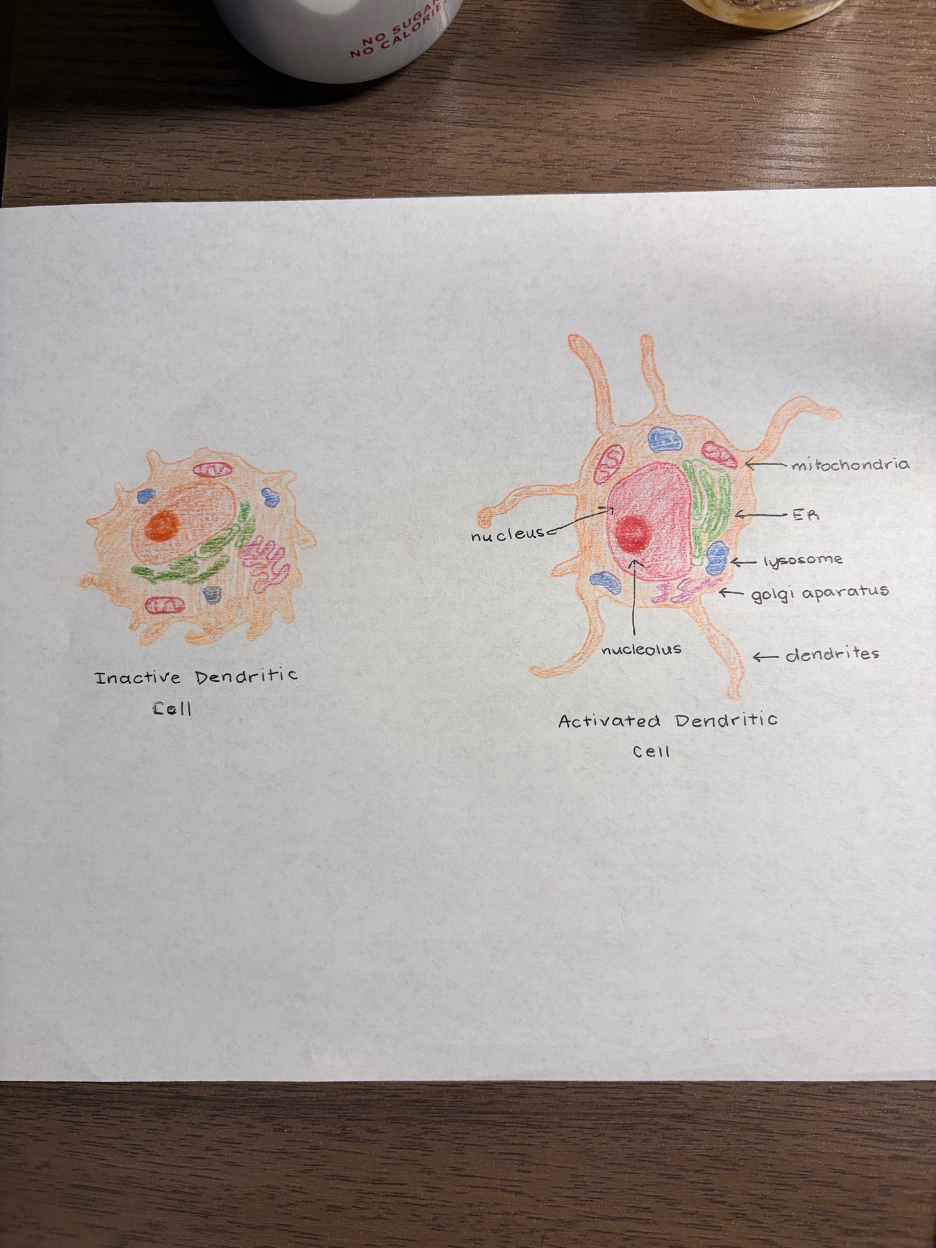
Dendritic cells (DCs) are specialized immune cells that originate in bone marrow. They are derived from hematopoietic stem cells. DCs function as messengers between the innate and adaptive immune system, sampling and breaking down pathogens before transporting them to the lymph nodes and activating T-cells. They are located throughout the body in the blood stream, lymphatic, and integumentary systems. The surface of a DC is lined with dendrites, small branch-like structures that extend out in multiple directions, which increase the DC’s surface area and allow the cell to perform phagocytosis at an accelerated rate. Thanks to its dendrites, a single DC can activate 10-20 naive T-cells at once. According to Tai, Wang, and Korner of the National Library of Medicine, when dendritic cells detect a pathogen or irregularity, they undergo a process called maturation. The DCs produce pathogen-derived proteins and peptides through phagocytosis. These pathogen-derived proteins and peptides are then taken by mature DCs to lymph nodes and presented to T-cells using a special display platform called MHC class II. DCs then use an activation signal called CD40 or B7 in conjunction with the T-cell’s own activation molecule CD40L or CD28. The types of T-cells produced are regulated by the DCs using cytokines like IL-12 (Tai, 2018). Activated T-cells then begin rapid clonal expansion, separating into distinct effector cells before leaving the lymph nodes to fight the invasive infection or damaged cells.
Overview of Cancer
As stated by Cooper in the 2nd edition of The Cell: A Molecular Approach, cancer occurs when a genetic mutation causes rapid, uncontrolled cell division, growth, and death. Proliferation of any of the cells in the body can lead to cancer, meaning there are hundreds of different forms of cancer. Different forms of cancer subsequently vary in their behavior and response to treatment (Cooper, 2000). All cancers result from induced mutations linked to damaged DNA. Scientists have identified radiation and many known chemicals as carcinogens, cancer-inducing agents. Normal cells divide until they achieve a particular finite cell density, which is regulated by cell growth factors. Once the induced mutation occurs, cancer cells are no longer limited by density-dependent inhibition and continue to proliferate out of control (Cooper, 2000). A large clump of cancer cells is known as a tumor. Tumors are divided into two groups: benign and malignant tumors. Benign tumors are less severe and do not possess the ability to spread through the body. Malignant tumors, on the other hand, can affect other cells and spread through the body (Cooper, 2000). As tumors grow, they draw nutrients away from other systems and put physical pressure on their surroundings. This can eventually lead to vital systems losing their ability to function.
Dendritic Cell Vaccines
DC vaccines are used to treat cancer by introducing tumor antigens to a patient’s pre-existing immune cells. The first step is to perform Leukapheresis, the extraction of excess white blood cells using an IV connected to a centrifuge, which separates WBCs from other blood components like RBCs and platelets. WBCs are collected and then undergo monocyte separation, which isolates monocyte-derived DCs. Mature DCs are then electroporated, the use of high-voltage currents to create nanoscopic pores in the cell membrane, with specific tumor genes or antigens. These antigen-loaded DCs are then injected back into the patient’s blood, where they travel to lymph nodes and present T-cells with tumor antigens. The T-cells then use the antigens to recognize and fight the specifically targeted cancer cells.
Citations
Cooper, G. M. (1970, January 1). The development and causes of cancer. The Cell: A Molecular Approach. 2nd edition. https://www.ncbi.nlm.nih.gov/books/NBK9963/
Duarte, A. da S. S., Zangirolami, A. B., Santos, I., Niemann, F. S., Honma, H. N., Amaro, E. C., Perroud, M. W., Pericole, F. V., Gilli, S. C. O., Benites, B. D., & Saad, S. T. O. (2024). Production of dendritic cell vaccines using different methods with equivalent results: Implications for emerging centers. Hematology, transfusion and cell therapy. https://pmc.ncbi.nlm.nih.gov/articles/PMC10935473/
Sabado, R. L., Balan, S., & Bhardwaj, N. (2017, January). Dendritic cell-based immunotherapy. Cell research. https://pmc.ncbi.nlm.nih.gov/articles/PMC5223236/
Leave a Reply