Screenshots of Assignments

Exploring Culture
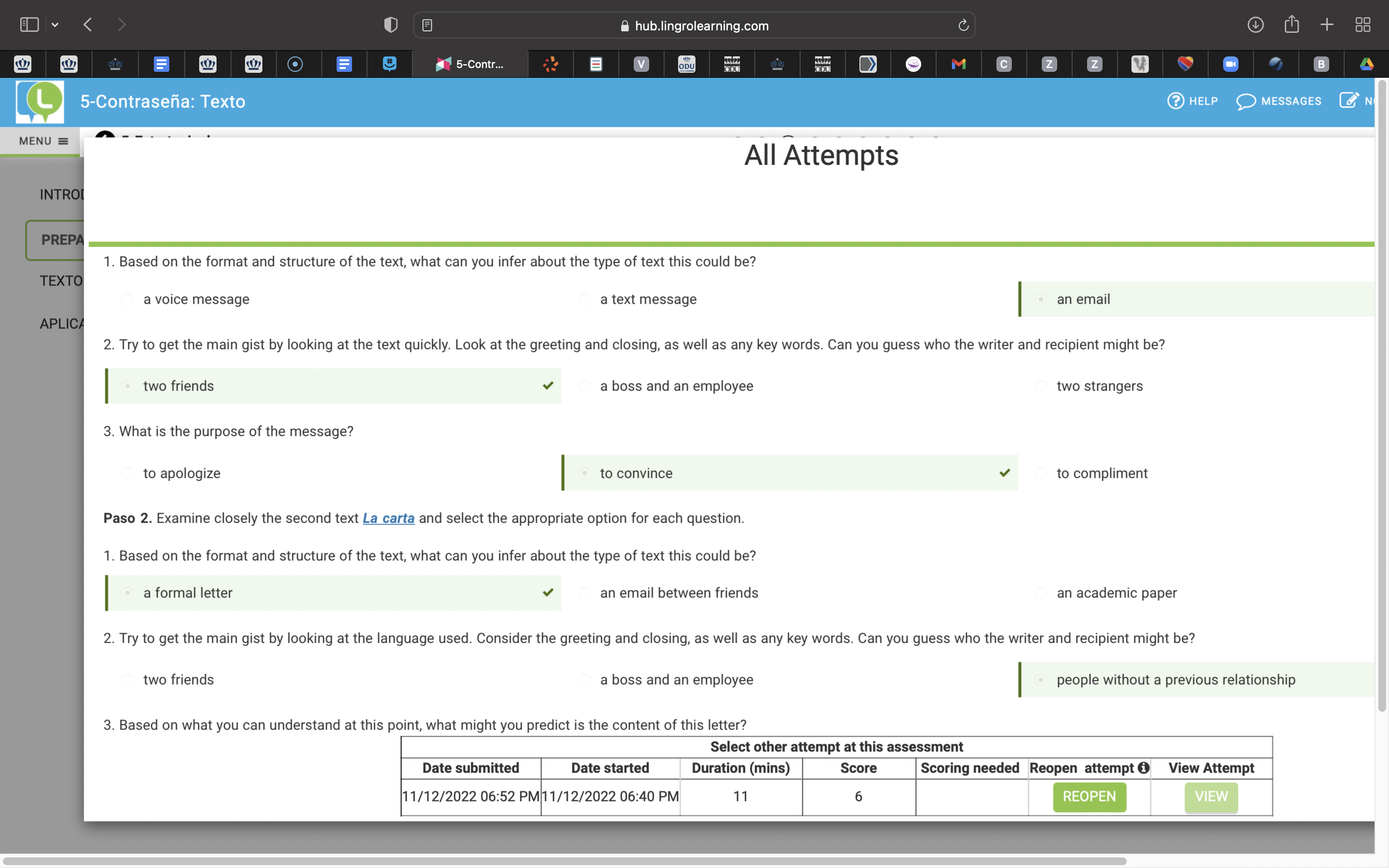
I used LingroLearning through my whole Spanish 101 course, it was really great practice. I also used websites like babble which my Professor posted in our Modules on Canvas.
In Lingrolearning they had culture style assignments where we would read about someone from another Spanish speaking country, and learn about how they went about their day or how it was in school for them. Learning about the different festivities they had was very interesting. They have carnival which includes lots of colors and music. We also had writing assignments within LingroLearning that we had to do research on like a mini project. One was on the hero of a Spanish speaking country, and the other was about siestas and how they operated in different countries. I choose Columbia, they closed all businesses at a certain time, and it was known as the Spanish country that slept the most. Learning about how the universities worked in Spanish countries challenged my worldview, because they had extremely high rates for student success. It made me want to consider going to one of their universities to find out. I think what was revealed to me after learning about universities was that student success and the teachers loving their jobs has to be due to people actually being paid properly and caring about their job. Everything I learned outside of siestas was brand new information. I didn’t have any specific world views that would’ve changed because of this course. My perspective for how much you can learn in one semester of Spanish as a full time online student is a lot.
Engaging in Communities
It’s a very important thing for me to be involved in my own race and community. As a Black woman it has always been a priority for me to see my people grown and develop on higher levels. It starts at home, you have to give back to your community, open the doors for people in your own community. I haven’t had the opportunity to work with any other countries, but I hope I’ll be able to in the future.
When I was younger, I went with my family to feed the homeless for Thanksgiving in Norfolk, Virginia. I also, just got hired a job that prides themselves and makes it an important thing to have diversity in their work place. When someone opens the door for you, when it’s your turn you have to make sure you do the same once you’re able.
Interpersonal Communication
We often had to record sentences or paragraphs for lingroLearning. Another thing we had to do in this class was post a video on FlipGrid answering the professors video. It gave us so much practice as online students to be able to actually speak in Spanish for these activities. https://drive.google.com/drive/u/1/folders/18gVG93Q_iRcSTlGVKpoLtyvjpSB8D_lY
Then, in a short paragraph or two, write a reflection that includes each type of the interpersonal (spontaneous, unplanned) communication activities: telecollaborative (TalkAbroad) conversations, discussion board posts, and any other interpersonal exchange. Explain how you’ve grown with each assignment/activity. What was difficult and how did you overcome that difficulty? What did you excel at and why/how? What/how did you learn from it and would you do differently next time?
I didn’t use excel in this class. We used a lot of communication activities like the ones I spoke on above, discussions on the different cultures compared to ours in America, and Lingrolearning which had videos, downloadable flashcards, and papers. They also had activities where you had to read about other cultures as well. I believe each module on LingroLearning made it clear that you had to bring prior activities together or remember what you learned to incorporate it into the new assignments in the new module. You’re growth through each assignment made it easier for you to learn everything necessary to move forward easily, and also prepared you to speak the language. I think the most difficult thing was just learning a brand new language to being with. It’s difficult remembering the order things go in, the spelling, and the conjugating of words. The flashcards, and verbal assignments helped me improve in all areas.
Presentational Speaking
On flip grid we had to post videos responding to our professor on what we learned in the module we had been working in. It was very good practice. https://drive.google.com/drive/u/1/folders/18gVG93Q_iRcSTlGVKpoLtyvjpSB8D_lY
I believe my best presentation was Conversation 4 on flip grid for module 5. That was my first 100 I made on the verbal assignments. My first 3 flip grid conversation assignments were slightly difficult because it takes time to understand exactly what the professor is saying in her video. You just have to listen closely, and write it down. When it’s your turn to record, you have as many tries as you need to post a good video. As you continued on through each verbal assignment, you should’ve been able to see the how much easier it became to make a video responding back to your professor. I excelled at taking my time, and making sure I understood what I was saying, and understood what my professor was saying before I finalized my video. Practice makes perfect, and that was how I got through my difficulty.
Interpretive Reading
I used this website called Babble and Juan to help me practice outside of my classwork and tests. It had different sections, they were verbal, spelling, and putting sentences together. I was able to speak through my MacBook to answer questions on Babble to increase my verbal skills. If I didn’t say something right I wouldn’t be able to move forward throughout the lessons until I did. 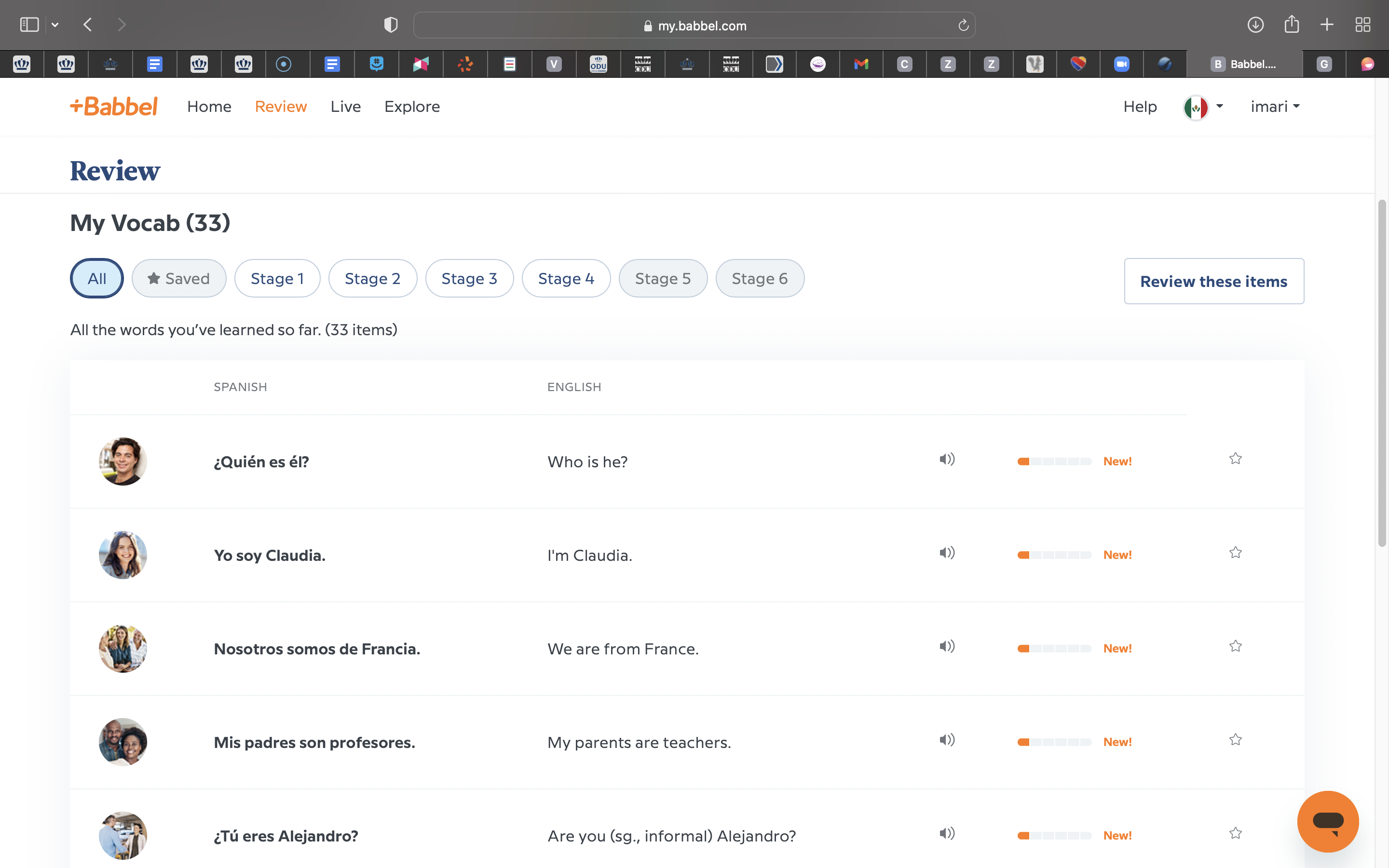
Then, write a short reflection paragraph that includes the activities you described above. What was unclear or challenging for you? How did you overcome this difficulty? What did you find most interesting or compelling? What was your takeaway from the reading? How have you grown with each assignment? I think the most unclear thing was just making sure that I was learning the same dialect and style of language as my class. Every Spanish class from high school to college teaches different dialects of Spanish. The most challenging was making sure that I spelled things correctly because it would mark it wrong, or keep me on the same thing until I got the spelling correct. I overcame this by just making sure I referred to my notes, and practiced the spelling however many times I needed to so I remembered. The most interesting thing to me is the formation of the sentences, you don’t have to capitalize everything, you have two punctuation points in different places depending on how many sentences you have. If you have two exciting sentences or two separate questions you’ll have 4 different punctuation marks, one at the beginning, and one at the end. My takeaway is how easy speaking Spanish can be with the right tools to help you through it. Babble and Lingrolearning are great tools to push you through every level of Spanish, whenever you need to review on either one you can refer back to work. Nothing is deleted, Spanish is something that requires you to go back over the basics, until it is implanted in your head like the english language.