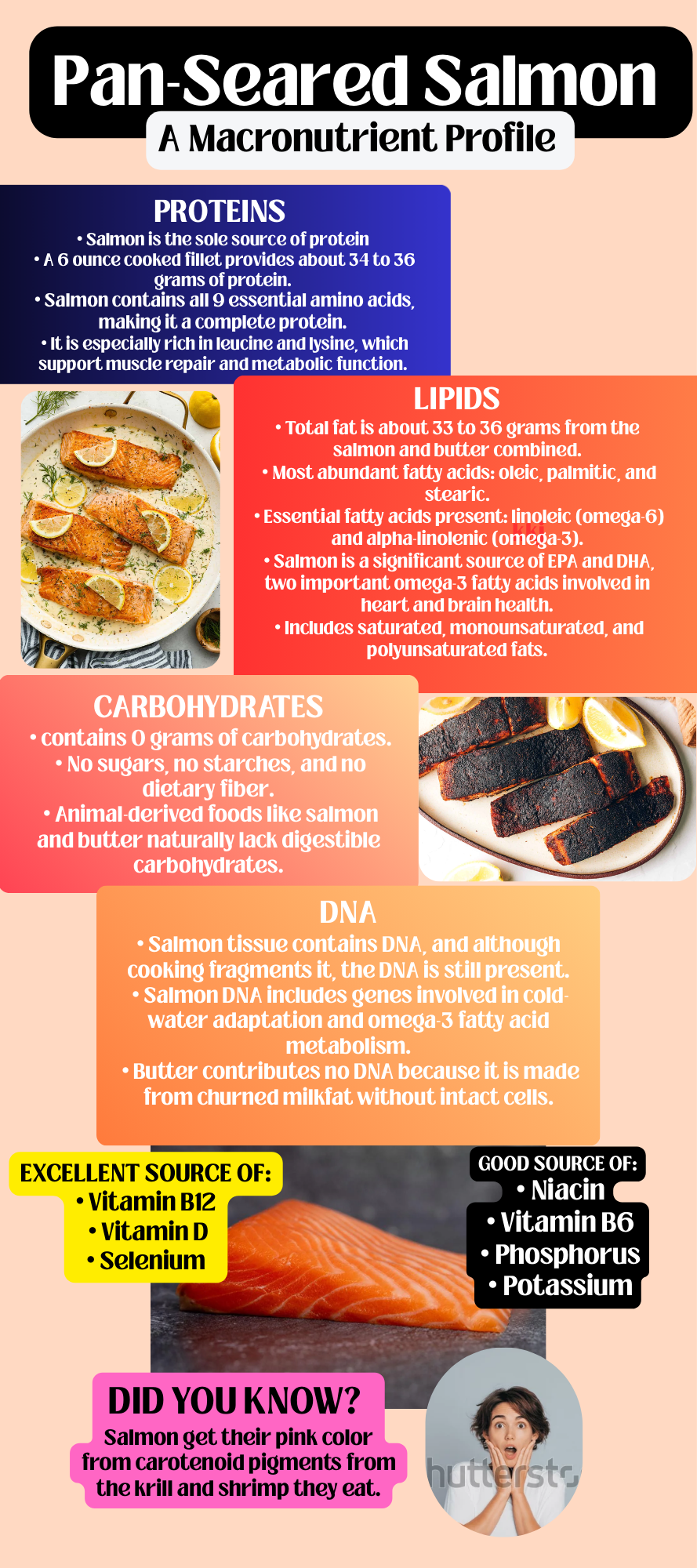
Pan-Seared Salmon – Write-up Portion
![]() FATS
FATS
6 oz salmon filet: 22 g of fat
1 tbsp unsalted butter: 11 g of fat
Total fat ~ 33g of fat
MAJOR FATTY ACIDS
| Fatty Acid | Carbons | Saturated or Unsaturated | Mono or Poly | Omega Number | Essential? |
| Oleic Acid | 18 | Unsaturated | Monounsaturated | Omega-9 | No |
| Palmitic Acid | 16 | Saturated | N/A | N/A | No |
| Stearic Acid | 18 | Saturated | N/A | N/A | No |
| Myristic Acid | 14 | Saturated | N/A | N/A | No |
| Palmitoleic Acid | 16 | Unsaturated | Monounsaturated | Omega-7 | No |
| Eicosapentaenoic Acid | 20 | Unsaturated | Polyunsaturated | Omega-3 | Conditionally essential |
| Docosahexaenoic Acid | 22 | Unsaturated | Polyunsaturated | Omega-3 | Conditionally essential |
| Linoleic Acid | 18 | Unsaturated | Polyunsaturated | Omega-6 | Essential |
| Vaccenic Acid | 18 | Unsaturated | Monounsaturated | Omega-7 | No |
| Alpha-Linolenic Acid | 18 | Unsaturated | Polyunsaturated | Omega-3 | Essential |
| Lauric Acid | 12 | Saturated | N/A | N/A | No |
| Arachidonic Acid | 20 | Unsaturated | Polyunsaturated | Omega-6 | No |
CARBOHYDRATES
Neither salmon nor the butter its seared in contain any carbohydrates.
0g of carbohydrates, sugars, added sugars, starches, fiber, etc.
PROTEINS
Most, if not all, of the protein in the dish comes from the amino acid-rich salmon filet. Butter doesn’t contribute to the protein profile of the dish. A standard 6 oz salmon filet contains around 35 grams of protein.
Salmon contains all 9 essential amino acids in adequate proportions, making it a complete protein source. Most animal-derived protein sources are complete proteins with great amino acid compositions.
ESSENTIAL AMINO ACIDS
Histodine
Isoleucine
Leucine (Particularly rich in this one)
Lysine
Methionine
Phenylalanine
Threonine
Tryptophan
Valine
VITAMINS AND MINERALS
Salmon cooked in butter is an incredibly nutrient dense food.
According to the FDA, it is an excellent source of:
- Vitamin B12 (180-200% DV)
- Vitamin D (50-100% DV)
- Selenium (55-65% DV)
& a good source of:
- Niacin/Vitamin B3 (35-45% DV)
- Vitamin B6 (25-30% DV)
- Phosphorus (25-30%)
- Potassium (15-20% DV)
- Vitamin A (8-10% DV)
- Vitamin E (8-10% DV)
DNA Privacy Policy: 23andMe and AncestryDNA
23andMe and AncestryDNA are two of the leading companies in direct-to-consumer genetic DNA testing. Just the concept of online, direct-to-consumer genetic testing raises questions and concerns about consumer privacy and safety considering that the companies require DNA samples from its users. These concerns have been confounded by growing awareness around the abuse of data collection in general, as well as major scandals involving genetic data breaches on a massive scale. Due to public perception, these companies have to brand themselves as secure places to store intimate genetic information without the risk of abuse, so their privacy policies are comprehensive and at the forefront of their marketing. The goal of these policies is the same, but the two companies do differ in some of the protections they explicitly offer.
Both emphasize the general protection of data but have some key differences. Like basically any internet platform, 23andMe and Ancestry build a profile on their users using any and all demographic data they consent to giving, as well as the provided DNA sample to build an overall portrait of health and/or familial ties. They both collect PII, though with Ancestry, the PII is separated from genetic data, which could mitigate being directly identified. Ancestry’s protection is more user consent driven, claiming that users can delete their data and request sample destruction at any time. 23andMe emphasizes transparency with how they use one’s DNA and share genetic data with third parties. 23andMe links your PII and genetic data, and in cases like the 2023 data breach, can make sensitive information vulnerable.
Both companies tout that “valid legal process” is required for them to hand over genetic information to the law enforcement. I assume that means that police would require a warrant to gain access to user samples and health information. Which is encouraging but also could lead to self-incrimination down the line. They also state that they do not share any information with insurance companies. This might technically be true, but I’m sure data breaches and de-personalized aggregate information can still be used against you.
AncestryDNA keeps your sample and data for as long as your account is active, so both one’s information and sample should theoretically disappear upon request. In the case of 23andMe, your depersonalized info can still remain in databases indefinitely, and there is no guarantee that they will retain that information.
Overall, I just don’t think the novelty or insight I’ll get from these sites outweigh the privacy and safety concerns that are lying underneath. Tech companies mine our behavioral surplus data at levels we can’t even comprehend. Personally, I’m not going to volunteer information that I could eventually lose control of. Any opportunity where I am given a choice whether or not to surrender my personal information I will always err on the side of caution because there is no guarantee that I will have control of that information down the line. If anything, modern economic incentives would make sure that I won’t keep control of it. So for now, I will steer clear.
All that being said, and based on these privacy policies alone, I would probably use Ancestry if I had to choose one. 23andMe has already been involved in major scandals and data breaches, and their close association with “research partners” is skeptical at best and predatory at worst. They both appear to be committed to not crossing any consent barriers, but with Ancestry it feels more concrete. If I want my information to be wiped completely, it will be completely, and that will be that. The same cannot be said for 23andMe and the way they disseminate “de-personalized” genetic and demographic information.