Interpretive, Interpersonal, and Presentational Modes of Communication
Exploring Culture
A new practice we used this semester in Spanish 202 was ImmerseMe. ImmerseMe is a great way to immerse yourself in Spanish culture. I learned a lot about how to order food and how to buy clothes using ImmerseMe. I think ImmerseMe is a very effective program for learning about the differences between my culture to people from Spanish-speaking countries.
ImmerseMe helped me better understand what different interactions with buying food, clothes, and having conversations would be like in another Spanish-speaking country. It helped me feel better prepared if I did travel to a Spanish-speaking country. We also used TalkAbroad to talk to people from Spanish-speaking countries, and I got to learn about their and their countries’ values and attitudes toward the Hispanic culture. For example, during my second conversation, I got to learn about my partner’s customs. It was interesting to see how much her country values greetings. In America, greetings are important, but I don’t necessarily think people would be too mad if people didn’t show proper manners. The ideas I learned from Spanish culture didn’t challenge me much. I was very understanding of their attitudes and values. I feel like I learned much more about Spanish culture this semester and how I would adapt to Spanish culture.
ImmerseMe-Reflections-M21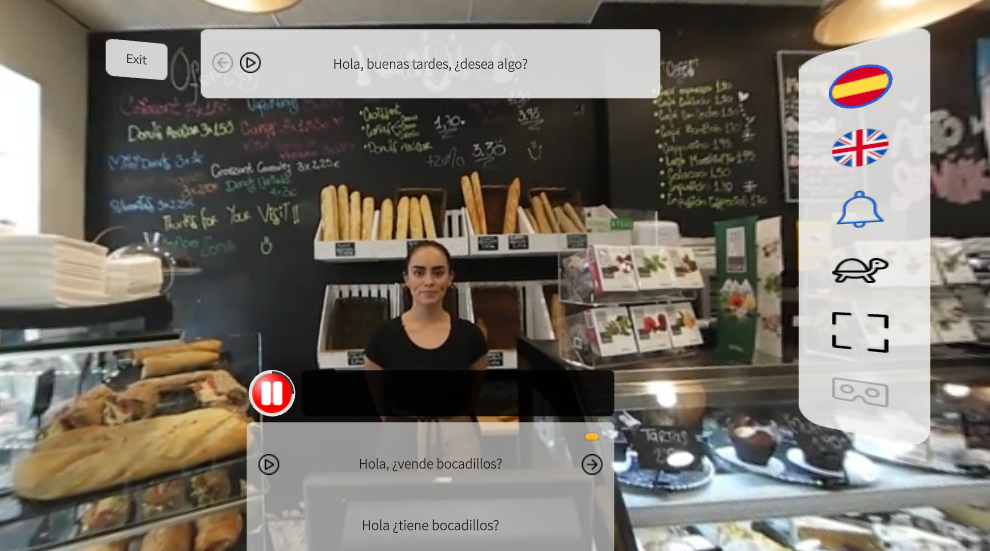
Engaging in Communities
Engaging in my immediate community and global community is important and valuable because it makes learning Spanish easier to learn when you are learning with others. You also gain more knowledge about others when engaging with others in Spanish.
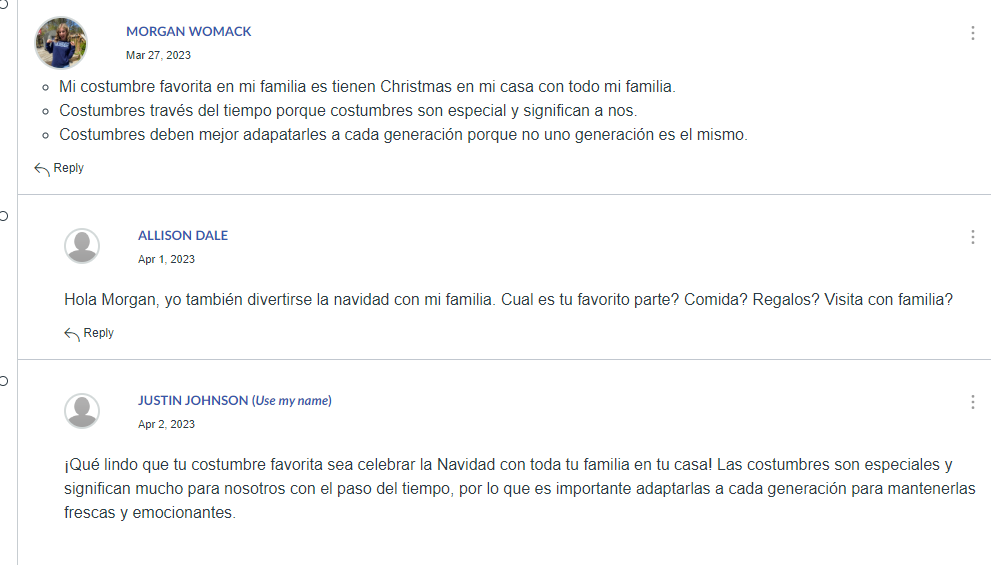
Every other week we had to do a discussion board where we would share our opinions and then reply to two classmates about their posts. We also used Flipgrid at the beginning of the semester, where we would make videos and then reply to our classmate’s videos. This helped me stay engaged in Spanish and my immediate community because I was able to learn more about them through Spanish.
Interpersonal Communication
TalkAbroad is a great tool to help strengthen your Spanish-speaking skills. Every TalkAbroad conversation has benefited me in learning Spanish. You learn about the Spanish speaker’s culture and about themselves, learn new words, and get the chance to practice your Spanish. As a result, it has helped me become more confident in my Spanish.
In Spanish 202, I had interpersonal communication using TalkAborad and talking with my professor for oral exams. These conversations helped me grow in my Spanish-speaking abilities. The telecollaborative conversations I had in Spanish were through TalkAbroad. TalkAbroad this semester challenged me but also was rewarding. The topics we talked about were a bit more challenging and required more time out of class to prepare for them. In the first conversation I had using TalkAbroad, we talked about stereotypes, identity, and experiences that define us. I felt prepared for this conversation but had trouble understanding what she was saying. I think for future conversations that I will have in Spanish, I want to know more basic terms like, “I agree with you,” “What does that mean, “etc. I want to be able to have these conversations in Spanish without feeling anxious and knowing what to say. In the second conversation I had in TalkAbroad (linked below), we talked about influencers and customs/traditions. I felt this conversation went really well, and I was able to understand a lot of what she was saying. I felt that I was able to learn a lot about my speaker, Shirley, and I would honestly love to get to know her more. Overall, I think TalkAbroad was very beneficial in my interpersonal communication this Semester because it helped me talk in Spanish more.
https://drive.google.com/file/d/1z0gvQpMmQItXLhcSDnotaBETJPA0RXaZ/view?usp=sharing
Presentational Speaking
We had a few presentational speaking activities this Semester. All of them were projects. The last few projects we had to do were three minutes videos about the modules we had studied throughout the prior weeks. These projects required us to talk about different topics like influencers, customs/traditions, and food insecurities.
Each presentation we had to do was pretty much the same besides the topic of the video. A challenge I usually face with presentational speaking is pronouncing the words correctly. For me, pronunciation is always a problem when speaking Spanish because I want to say it how I see it. I did get better at putting the words that I struggled to pronounce into Word Reference and hearing how the word was pronounced before saying it. I think my videos were put together well, and I think my thoughts/ideas represented what I learned during the module well. If I ever have to do a Spanish video presentation again, I will ensure that I prepare a lot more before making the videos so I have more time to make it perfect.
https://drive.google.com/file/d/1BSCucR9LuYnCxKUSvZhpVlRtmVbagPaF/view?usp=sharing
Presentational Writing
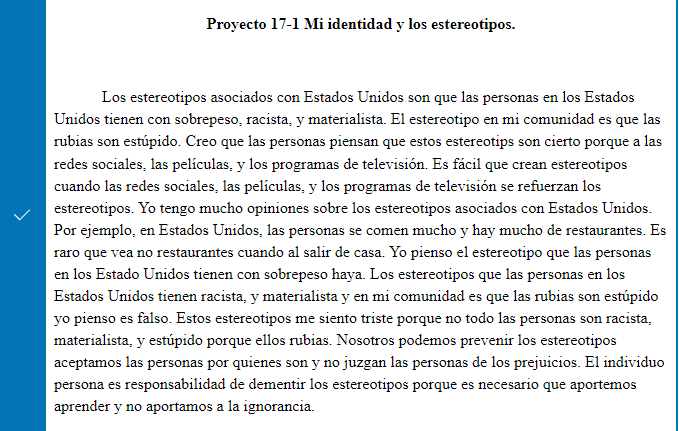
In Spanish 202, we mainly wrote in our discussion boards, some projects, and during tests. The artifact I chose to show was our written project in module 17 about stereotypes.
I learned a lot about writing in Spanish this semester. Spanish has a lot of rules when it comes to grammar and sentence structure, which was difficult for me at times. It was nice to challenge myself and use the grammar we learned in each module in my writing. I learned about the subjunctive and more about preterite and the imperfect. I also feel I learned a lot of new words through the vocabulary we learned in the modules and with the help of Word Reference. Compared to last semester, I feel more comfortable writing in Spanish and actually enjoy doing it. It reminds me of solving a puzzle and making sure each part of the sentence is correct and fits correctly. I wish I could have written more this semester in Spanish, but I do think it has helped me be better in my Spanish altogether. With more practice, I will hopefully be able to write in Spanish easily.
Interpretive Listening
Most of the listening activities we did in this class were through Lingrohub. These activities helped me understand more Spanish and required me to use my listening abilities to get the right answer.
A lot of the text we had to read for each module also had an audio option that we could listen to. This helped me with learning how words are pronounced and made it easier to understand the texts. Listening to Spanish can be complicated because I may understand some of it but not all of it, which requires me to relisten to the audio several times. Repetition is important, though, so I think it benefited me to listen to it several times because it helped me learn how to pronounce words in Spanish and helped me learned more Spanish. I grew through each activity by better understanding the audio each time I practiced listening to Spanish. A lot of the listening activities came from Lingrohub during the vocabulary activities. Below is an activity where I had to listen to the description of the new vocabulary words I learned, and then I had to pick which vocabulary word fits the description best.

Interpretive Reading
We read a lot of Spanish this Semester. Lingrohub provided all of the readings we did this Semester in Spanish, which included poetry, fiction, and non-fiction.
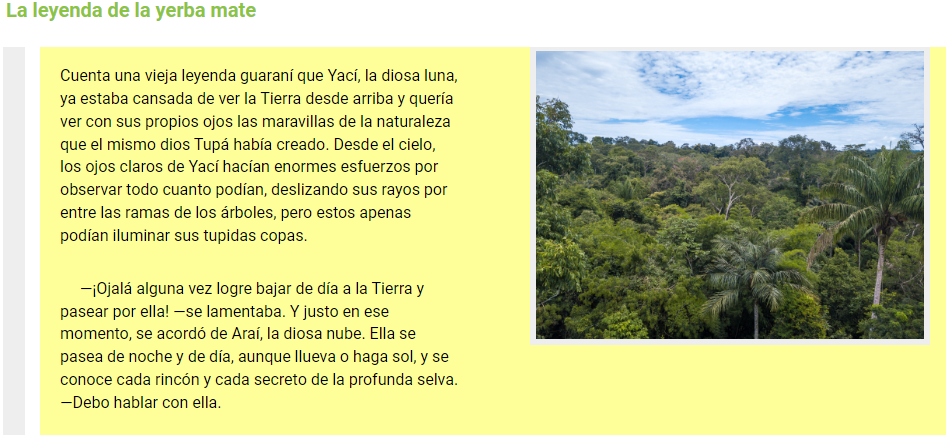
Almost all of the modules this semester required us to read in Spanish. Some of my favorites were “Nuyorican Tales,” “Viaje a la Universidad,” and “La leyenda de la yerba mate.” Reading has always been easy for me, so reading Spanish was easy. Whenever I was reading, if something became unclear, I used context clues to help me figure out what was being said. With each reading, I was able to learn new words and was able to learn more about Spanish culture. Below is the beginning of the story “La leyenda de la yerba mate,” where I learned about the origin (legend) of mate and how it became a custom in Argentina, Paraguay, and Uruguay.