Interpretive, Interpersonal, and Presentational Modes of Communication
Exploring Culture
I have always possessed a desire to learn Spanish and understand Spanish culture on a deeper level. The first time I met my husband’s grandmother, I was taken back because she greeted me with an air kiss on the cheek, or “un beso”. If I had a deeper understanding of Spanish culture, I would have been prepared for this encounter and would have embraced this greeting rather than express confusion. Because of this moment, I realized the importance of understanding other cultures and seeing the world through a different perspective. A few of the products and practices that have helped my understanding along the way were Flash Cultura videos, Comprehension Lecturas, and videoclips of Hispanic culture and practices.
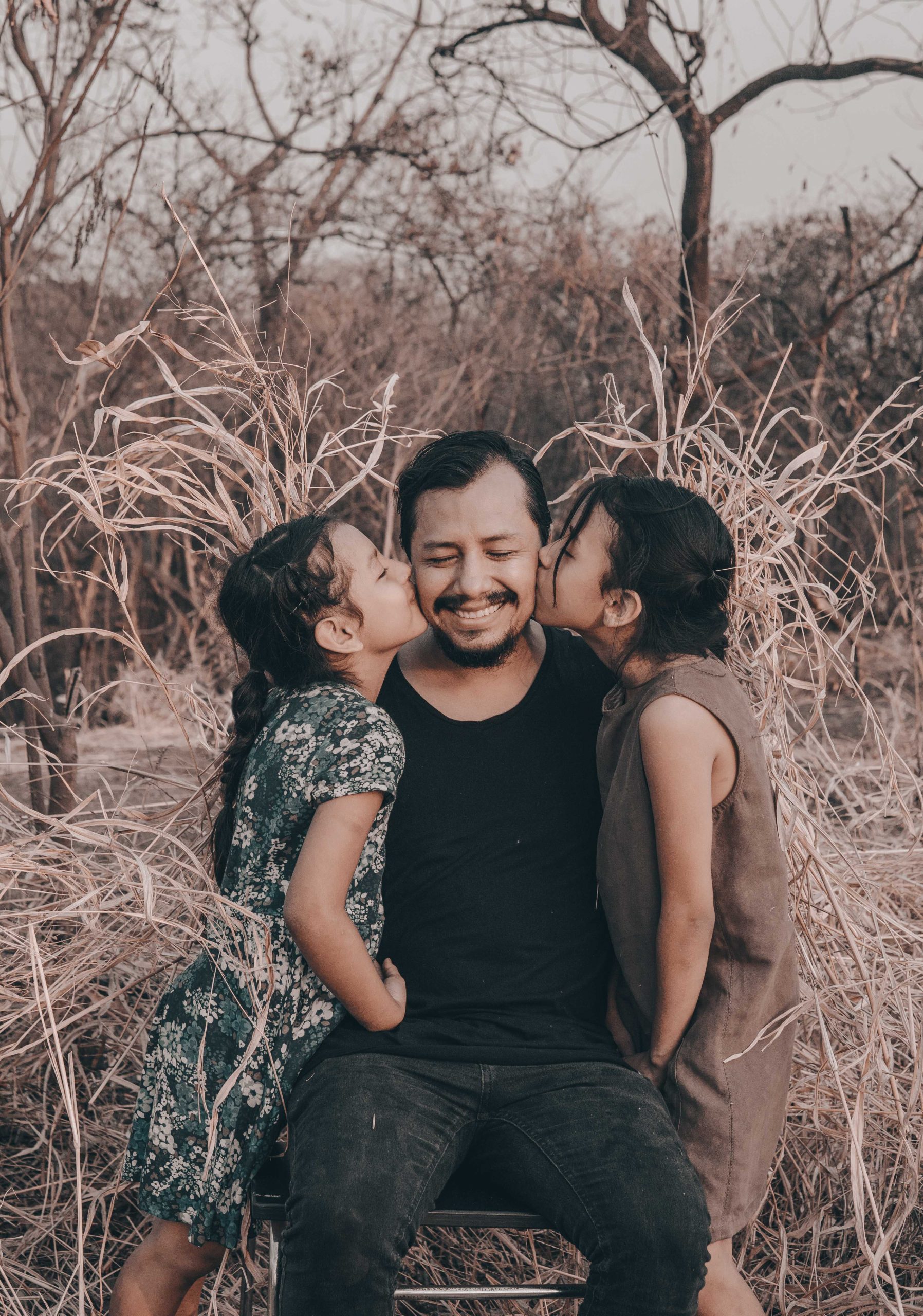
In one of the first Flash Cultura videos we watched in SPAN 101, they showed differences between greetings in Latin American countries and the United States. This video explained that Spanish culture is very friendly and does not require the same distance “bubbles” that many people from the U.S. are acquired to. This explains why I had such an awkward interaction with my husband’s grandmother and how my lack of understanding of Spanish culture interfered with my ability to connect with someone from another culture than my own. This challenged my worldview in assuming that all initial greetings began with a handshake or hug. These lectures and videos also helped me to understand how tightly-connected families and communities are in traditional Spanish culture and that many of their values are centered around family.
Engaging in Communities
I believe it is absolutely important to engage in immediate and global communities. I know that many small businesses were extremely hurt from COVID-19, so my husband and I try to order from local restaurants when we can. While we were in California, we would visit several local street vendors selling street tacos among an array of Mexican dishes. It was unfortunate that I could not speak Spanish because there was an immense language barrier that was difficult to cross and a missed opportunity for a positive connection.
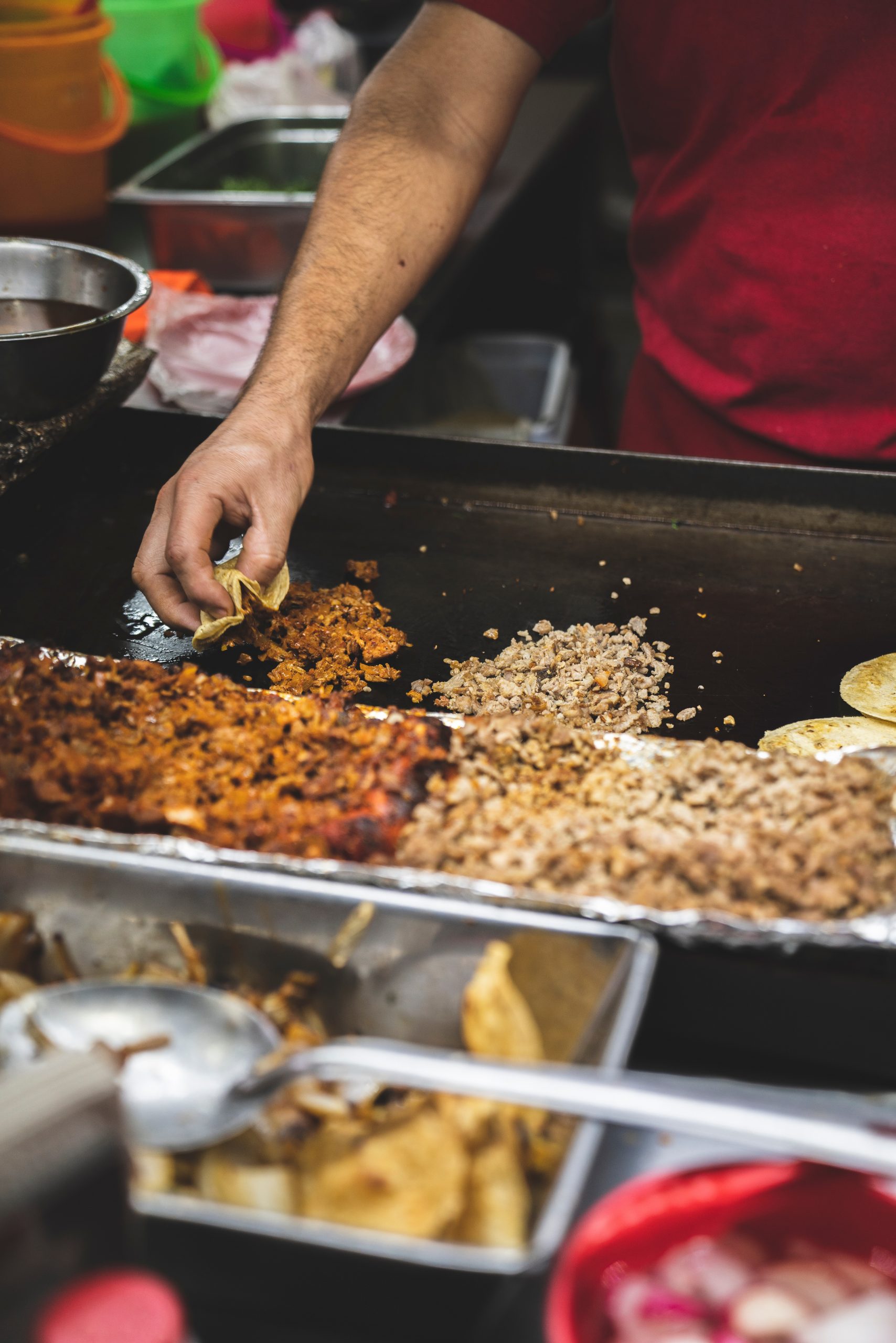
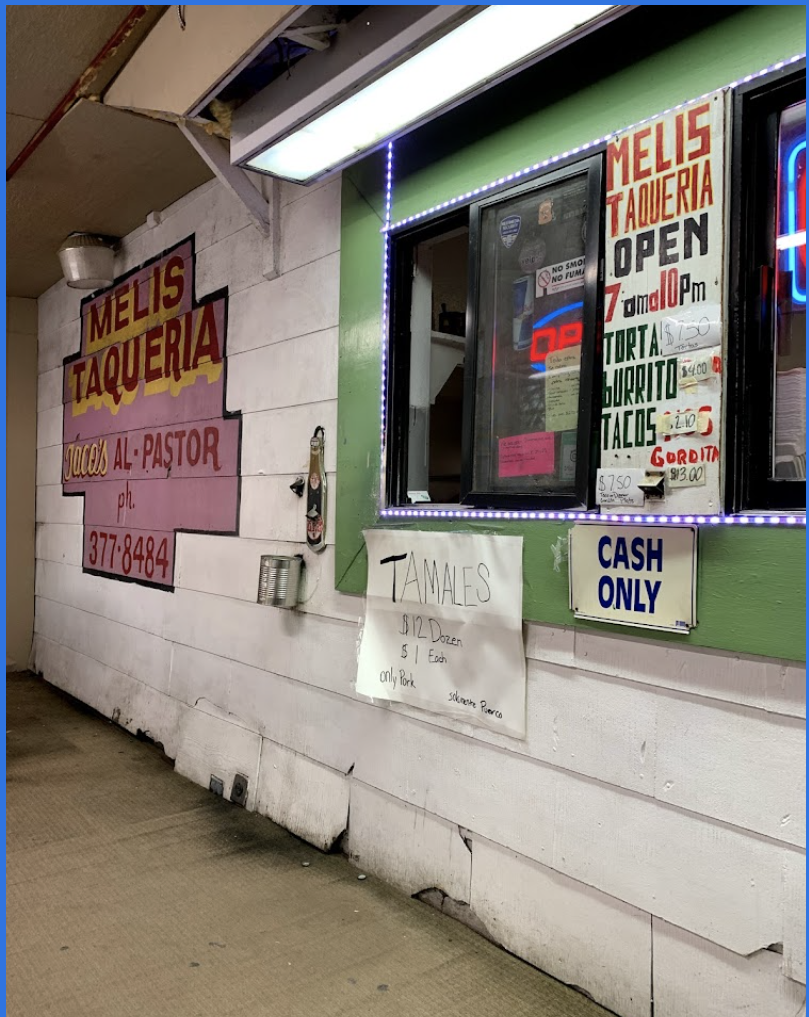
After taking SPAN 101, my husband and I have since visited other local Mexican restaurants in Texas who only speak Spanish and now I am able to understand and communicate with them more clearly than I could in California. Being able to engage with these business owners in our community has been incredibly rewarding, but there is still so much more help to be given. I hope to be able to further participate in our community and experience the invaluable culture that each of our community members has to offer.
Interpersonal Communication
In SPAN 101 we had several interpersonal oral, audio, writing, and reading activities such as our weekly discussion boards and breakout room chats in Spanish with other classmates. We also had Lecturas in Blackboard that required for us to read a portion of text in Spanish, then interpret it and answer questions in Spanish. Below is an example of what a few of our discussion posts look like:
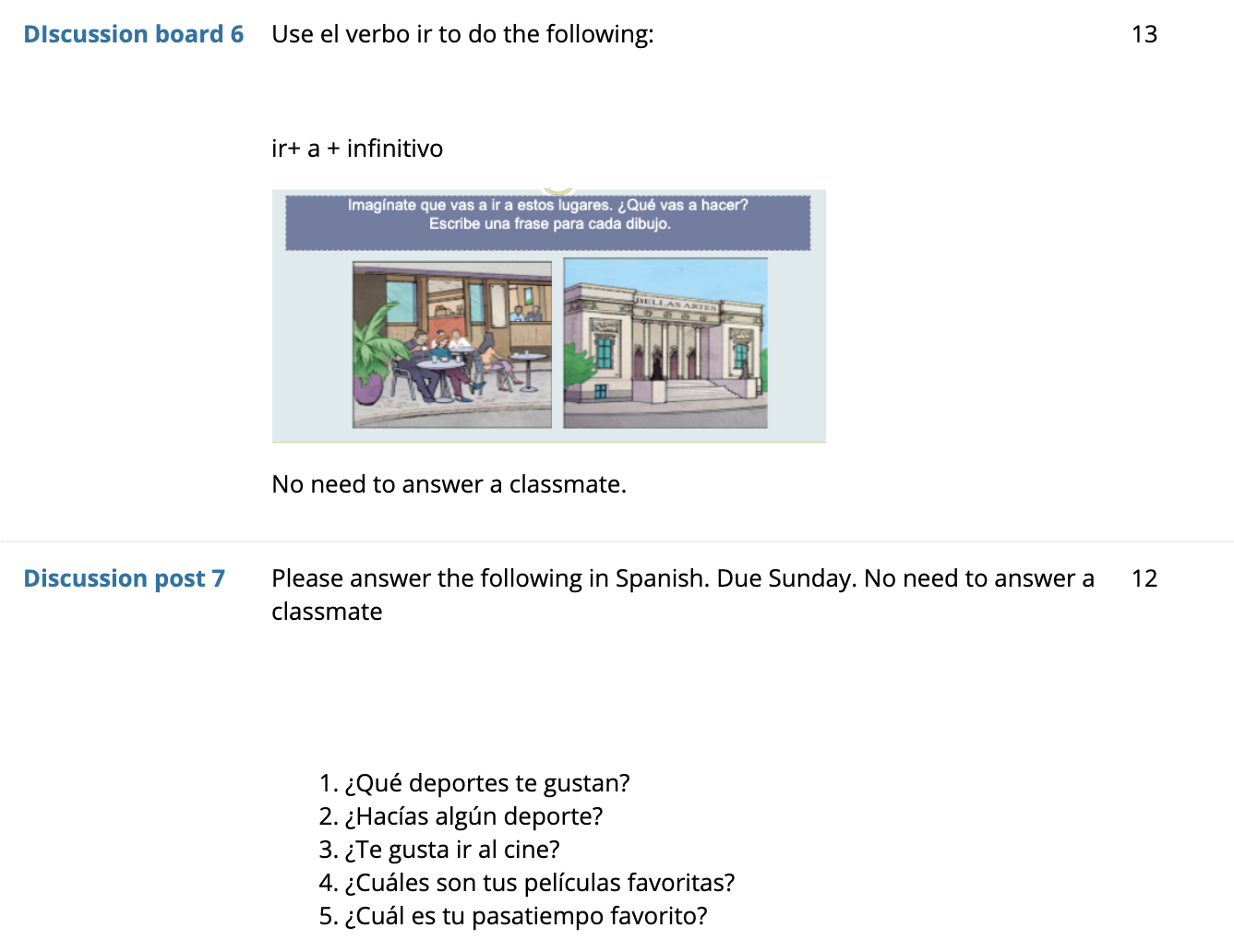
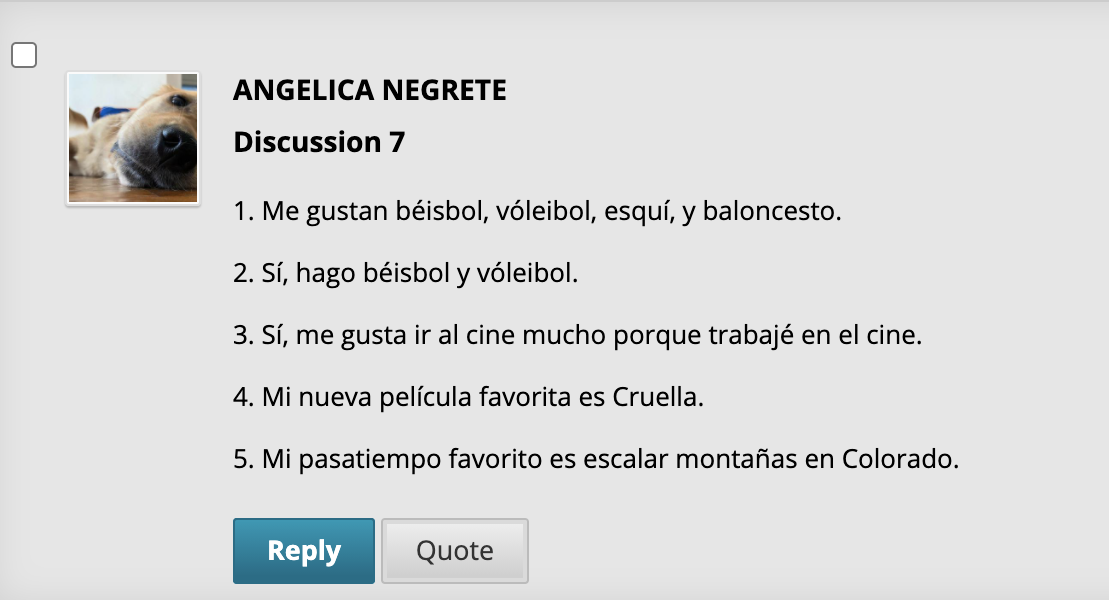
Our very first interpersonal communication in SPAN 101 were introductions between ourselves, the professor, and our classmates in breakout rooms. With each new week, the questions covered in our breakout chats grew more extensive and complex. For instance, we started with “¡Hola! ¿Cómo estás?” and we eventually graduated to questions like, “¿Te gustan los deportes? ¿Qué deportes practicas?”. Our first discussions were very simple and introductory, but as our vocabulary and confidence grew, my classmates and I were much more fluent with our conversations and sentences. The interviews were specifically challenging because of the spontaneous nature of the questions and the inability to prepare answers or thoughts. These interviews were immensely important in helping me to think on my feet and engage in a conversation in a more natural manner. I was able to learn how to ask questions if I did not understand something in order to continue the conversation rather than abruptly pausing. I think that I still have quite a bit of room for improvement in my interpersonal communication skills as I would like to be able to answer questions and sentences more spontaneously.
Presentational Speaking
Since SPAN 101 was online, our presentational speaking was replaced through breakout room chats in Spanish, Interviews with one another and the professor, and in-class participation by answering questions. Below is a video of a conversation in Spanish between myself and my classmate, Hailey.
I noticed that in the beginning of the course, although I had a few years of Spanish under my belt from high school, that I was still very timid in actually speaking the language itself. I realized that I still remembered quite a bit of vocabulary and conjugations, however, I was not confident enough to present them in a conversational approach. I think the interviews and class break out rooms really pushed me out of this comfort zone and helped me to find my voice in Spanish. I definitely still find myself second-guessing my responses, but I think that the more questions I ask, the deeper level of understanding I gain to help accelerate my growth in this language. I am able to formulate entire thoughts and complex sentences in my head, however, in actual conversations it is as if I have forgotten everything. I still have quite a bit of work to do, but next time I will instead focus on the flow of the conversation rather than remembering specific vocabulary that may or may not contribute to the conversation. Practice makes perfect, and I plan to continue practicing even outside of SPAN 101.
Presentational Writing
In SPAN 101, we completed two Composiciónes as well as answering exam prompts in full sentences. Below, I have provided my two Composiciónes to show the development of my writing style and comprehension of the Spanish language.
Composición-1-FinalMy first Composición was very generic and provided a basic-level of understanding of beginner’s Spanish. Compare this with my second Composición below:
Composición-2-FinalIn comparing these Composiciónes, I am able to see my progression and comprehension of Spanish vocabulary and sentence structures. In my first writing, I had a basic understanding of greetings, people, and simple vocabulary. In my second, I felt more comfortable exploring new sentences and creating a more conversational piece. I still have a long way to go, but this progression has definitely inspired me to continue with my growth and development in the Spanish language. I knew several of the words I needed to use, however, structuring them in a full comprehensive sentence was a challenge. With continuous practice and repetition of seeing sentence structures, I felt more comfortable formulating them for myself. I noticed that the time it took for me to write my Composición 1 was significantly longer than the time it took to write the second. For the second, I felt as though I could more naturally pull phrases together to form cohesive thoughts and sentences unlike the first. I think next time I will be even more prepared in my writing and will have a better understanding of conjugations, possessive adjectives, and sentence structure.
Interpretive Listening
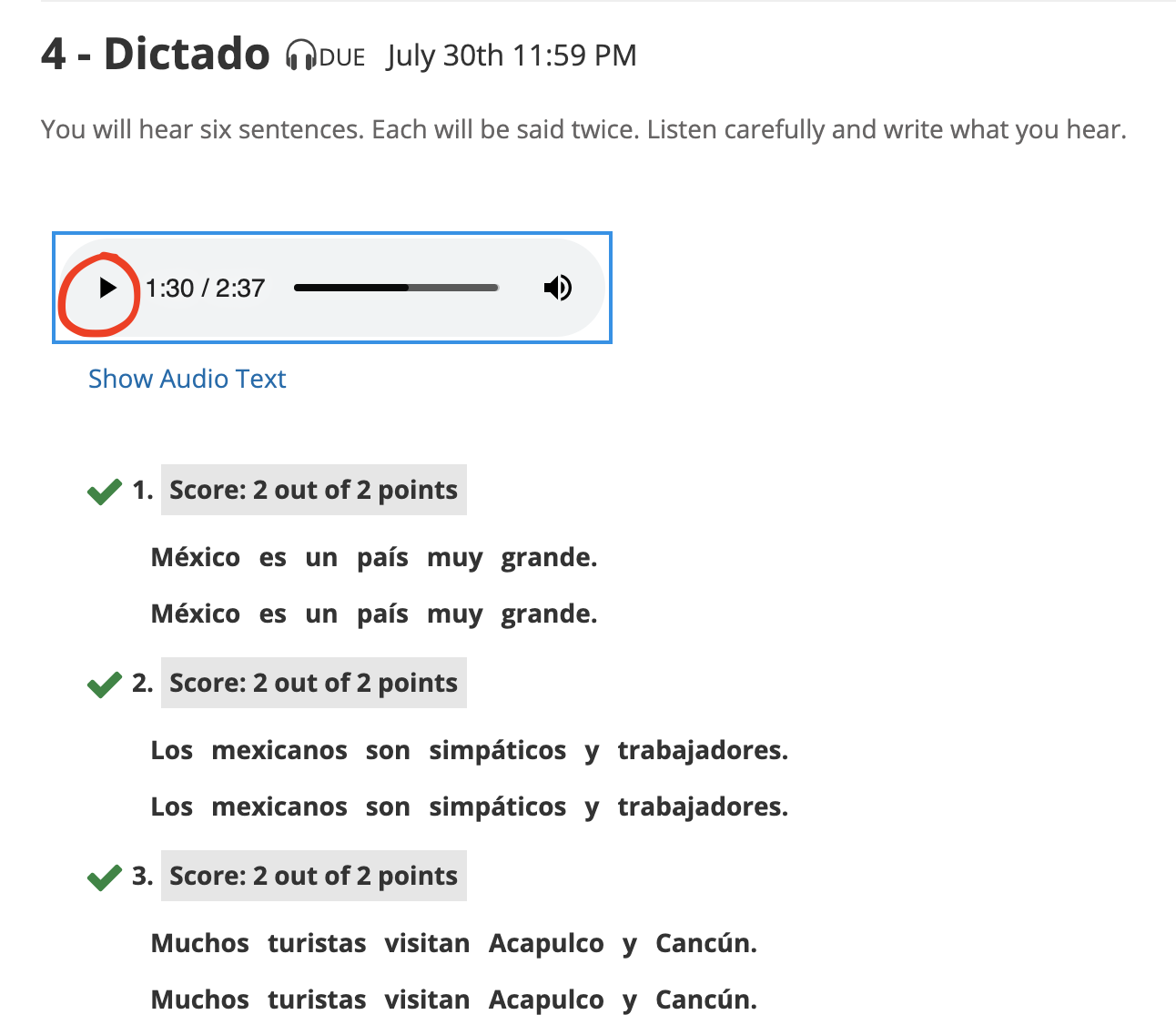
On VHL Central, there were several listening activities such as the ‘Dictado’ sections where students listen to an audio recording and type the sentence or phrase that they heard in Spanish (Blanco and Donley):
In addition to ‘Dictado’ there were Flash Cultura and Aventura videos in which we were to listen to the conversations entirely in Spanish and interpret them in the corresponding questions (Blanco and Donley):
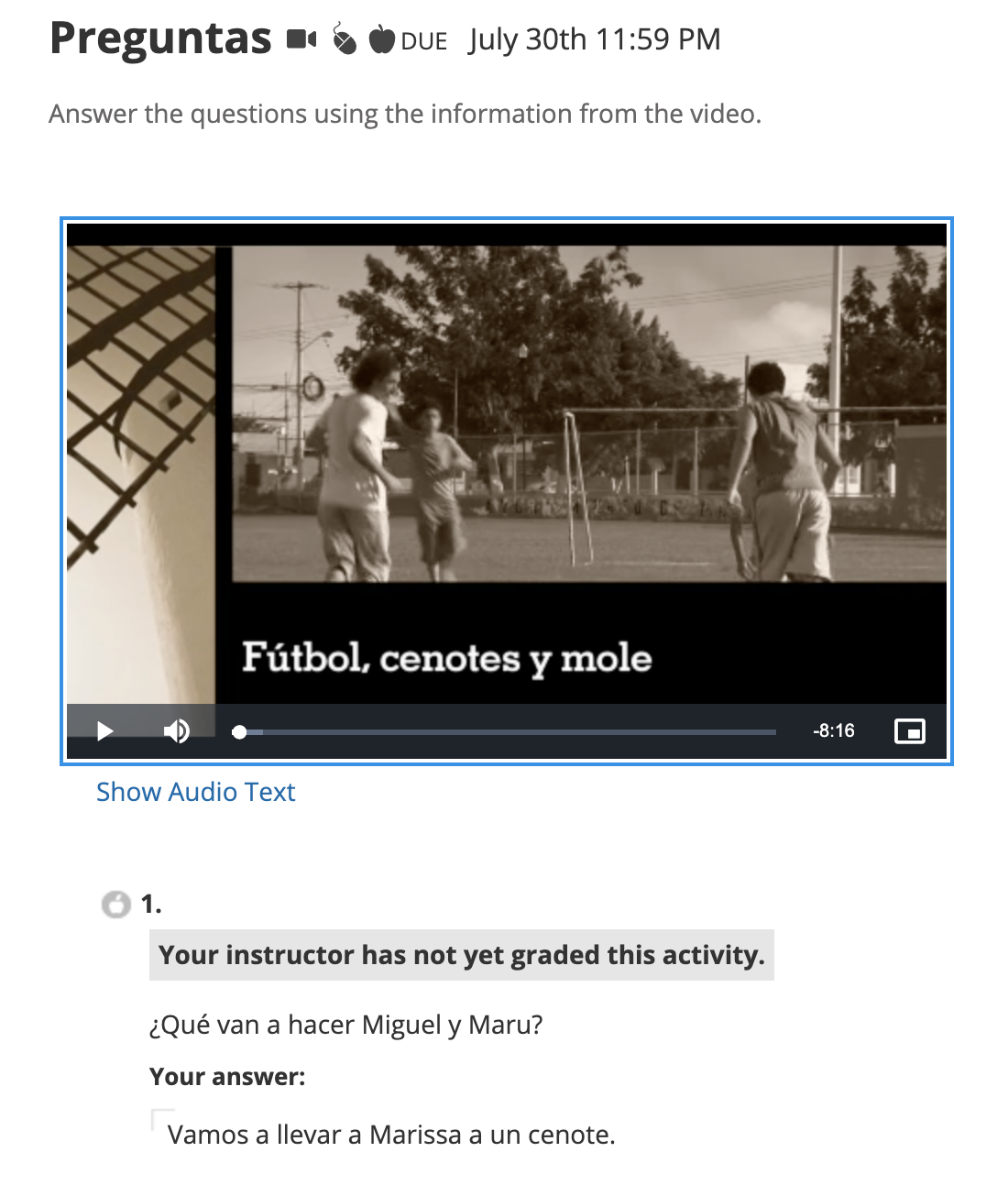
In these interpretive listening portions, there were numerous challenges, but also multiple opportunities for growth. For me, the biggest challenge was re-constructing the sentences after hearing multiple diphthongs that sounded similar to other combinations of words. In order for me to overcome this difficulty, the sections in VHL called ‘Pronunciation’ really helped elaborate on the flow and oration of Spanish words and sentences (Blanco and Donley).
I found syllable stressing and accents challenging as well because there are so many different locations for accents and so many syllables that require stressing. In order to overcome these challenges, I would listen to my professor and VHL audio recordings say the vocabulary while reading the text to see where the accents were placed. The listening experiences were crucial to my understanding because real conversation happens fast and spontaneous, which is exactly what the listening exercises are meant to prepare for. I started this class feeling fairly unprepared for a realistic conversation with a native Spanish speaker, but now I am more confident in my ability to at least conduct a basic level of communication and have the ability to ask questions to gain a deeper understanding.
Interpretive Reading
In SPAN 101, one of our weekly assignments was called our ‘Lecturas’ in which we would read a passage from our VHL book, and then answer questions (preguntas) in Spanish on Blackboard (Blanco and Donley). These Lecturas required for us to read text in Spanish, interpret it, then make comprehensive sentences answering contextual questions. Below is an example of the Lectura text and the corresponding questions we were given:
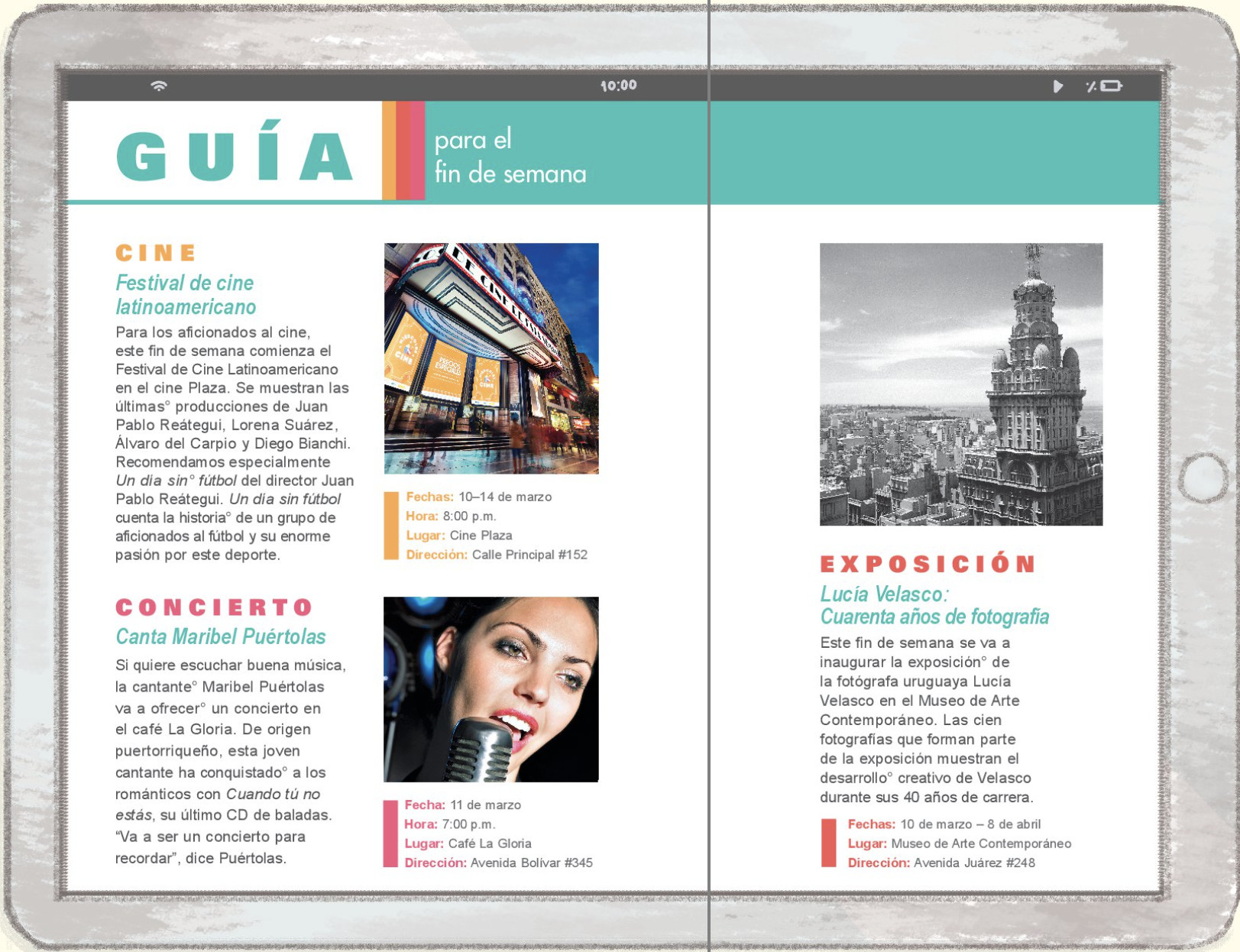
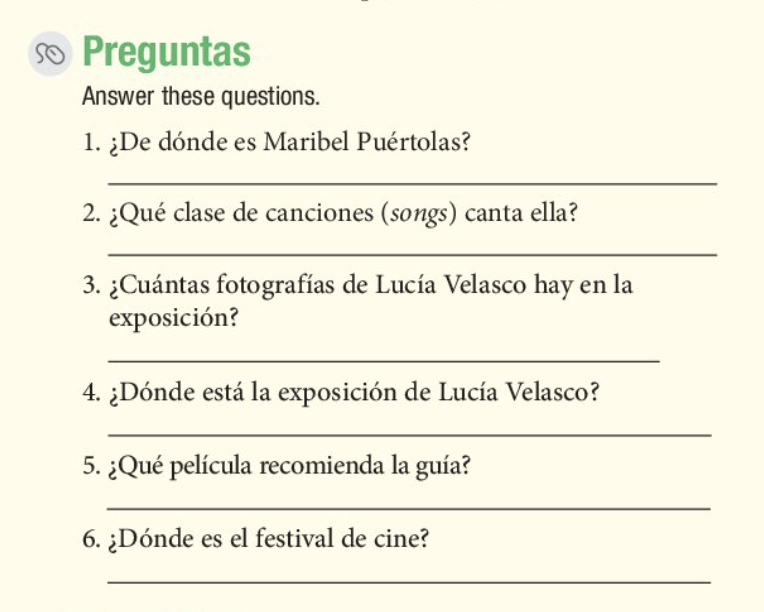
I actually found the interpretive reading section the most comprehensive. I think that I am a very visual learner so being able to see the text made translating and understanding much clearer. I still struggle remembering exactly where accents are placed, however, I think the repetition of specific words made this challenge much less severe. I found that the text I would read would often have different sentence constructions than what I am used to which was also an initial challenge for me while writing my Composición 1 in which I would reverse the adjectives and their possessive nouns. Being able to read text in Spanish helped me overcome this challenge though because I was continuously exposed to the correct formation of sentence structures.
Works Cited
Blanco, José A. and Philip Redwine Donley. Aventuras: Primer Curso De Lengua Española. edited by Judith Bach et al., 5 ed., Blanco, José A., 2018. Vista Higher Learning.