My literacy journey starts inside a small townhouse located in Northern Virginia—the childhood house I grew up in with my mom and dad. We had all the traditional immigrant household essentials: plastic grocery bags under the sink, wooden back massagers under the coffee table, and the plate of eggshells and fruit peels my mom would use to fertilize her plants. The memories I’ve made in that house will always stay close to me, but it wasn’t the objects that defined the space; it was the air. The gentle words my mother uttered to wake me up for school in the mornings: “Con dậy chưa?” My cultural upbringing has played a huge part in not just how I physically speak, but in my values and how I carry my words.
We spoke Vietnamese at home. My parents were at work for most of the day, so it was my grandma I spent the most time with. Bà ngoại (Vietnamese for “grandma” on my mom’s side) would come over every weekday to take care of me and my next-door neighbor. Bà ngoại knew a couple of English words—”good morning,” “yes,” “no,” etc.—but pretty much only spoke Vietnamese. I remember one day our neighbor brought over this green baby book with flaps that showed pictures of animals and objects, which folded out to reveal the English word. We proceeded to teach these words to my grandma. Bà ngoại and I would take turns choosing the TV channel, although most of the time she would just give up the TV to me upon request. My channel of choice was 297: Cartoon Network on DirecTV cable. My favorite show to put on was Tom and Jerry. Bà ngoại found it quite amusing as well since there was no language barrier. Cat chases mouse, mouse tricks cat—an idea universal across all languages.
At night, my mom would read me a bedtime story. We had this set of storybooks that had both Vietnamese text and the English translation. My mom and I would take turns reading; she attempted to pronounce the English words, and I tried to read the Vietnamese. My culture was never hidden from me, and my family encouraged me to embrace it.
The people who raised me speak in broken English. When I was younger, I would laugh at my mom or dad when they pronounced something wrong. I knew it wasn’t right, but I couldn’t help feeling a little embarrassed when they came to my school, and I had to translate for them in front of my friends whose parents spoke perfect English. I thought, Why couldn’t they be more American? Western culture paints English as the perfect language. To succeed, one must speak it fluently and with etiquette. But for my immigrant parents, English was never about perfection; it was about connection. They spoke it not because it defined them, but because it was the only way others could understand. It was what would benefit their child.
Through growing up, I realized that language isn’t just about words—it’s about love, sacrifice, and the silent ways we shape each other. My literacy journey isn’t just about how the words I speak come out; it’s about honoring the voices that spoke them for me.
Visual:
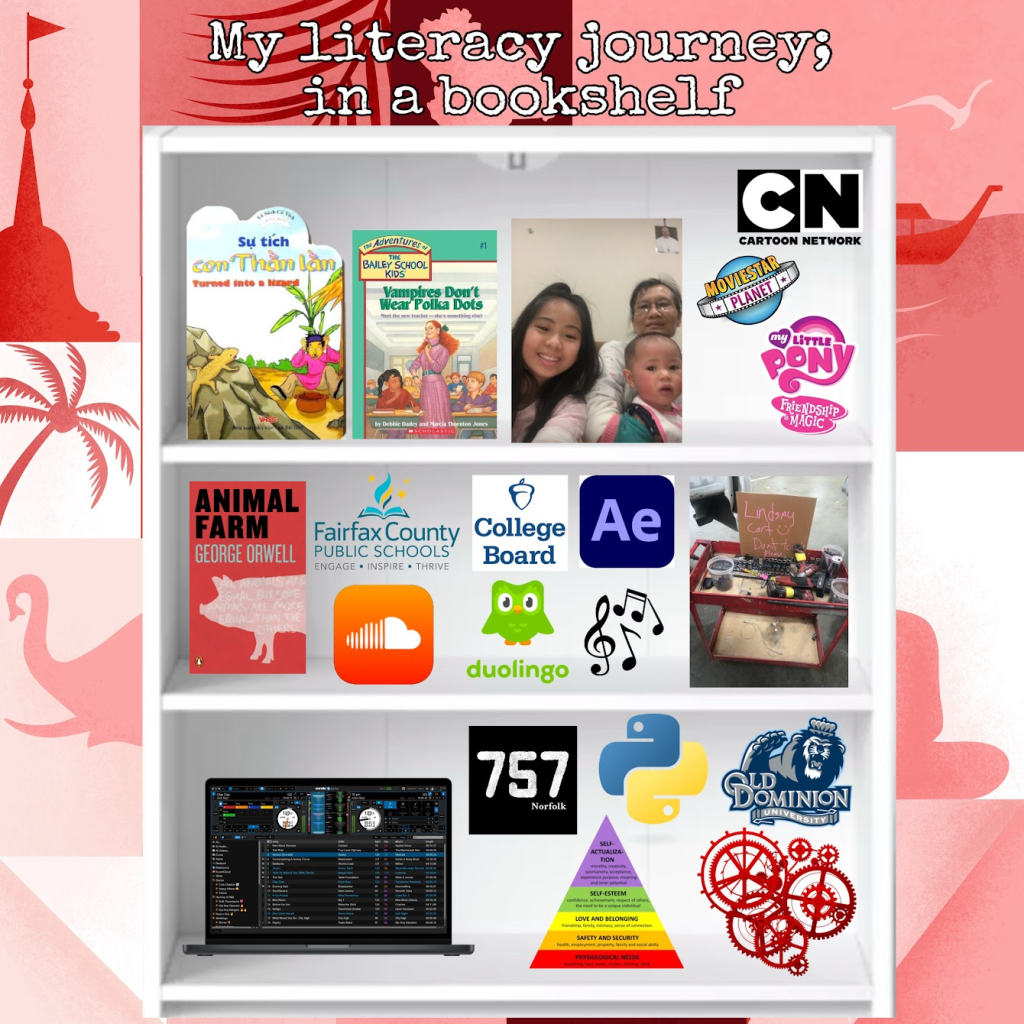
Reflection: Writing this essay helped me reflect deeply on how language connects to identity, family, and culture. In telling my story, I realized that my literacy journey is not just about learning to read and write, but about recognizing the love and sacrifice behind every word spoken to me in both Vietnamese and English. One of the main themes that emerged is how language can carry emotional weight—it can be a bridge between generations, a tool for connection, and even a source of struggle or pride. Through this process, I learned to appreciate the quiet strength of my upbringing and the way my family’s voice shaped my own. Writing this also reminded me that every small memory—every TV show, every storybook, every mispronounced word—has played a part in how I understand language today.