
Here are the blog posts for ENGL 893 in Spring 2024 with Dr. Romberger.
Final Paper 4/24/24
Parallel paths, sister cities, and billion dollar demands:
Relocation threats used in stadium funding discussions in Major League Baseball in the last five years
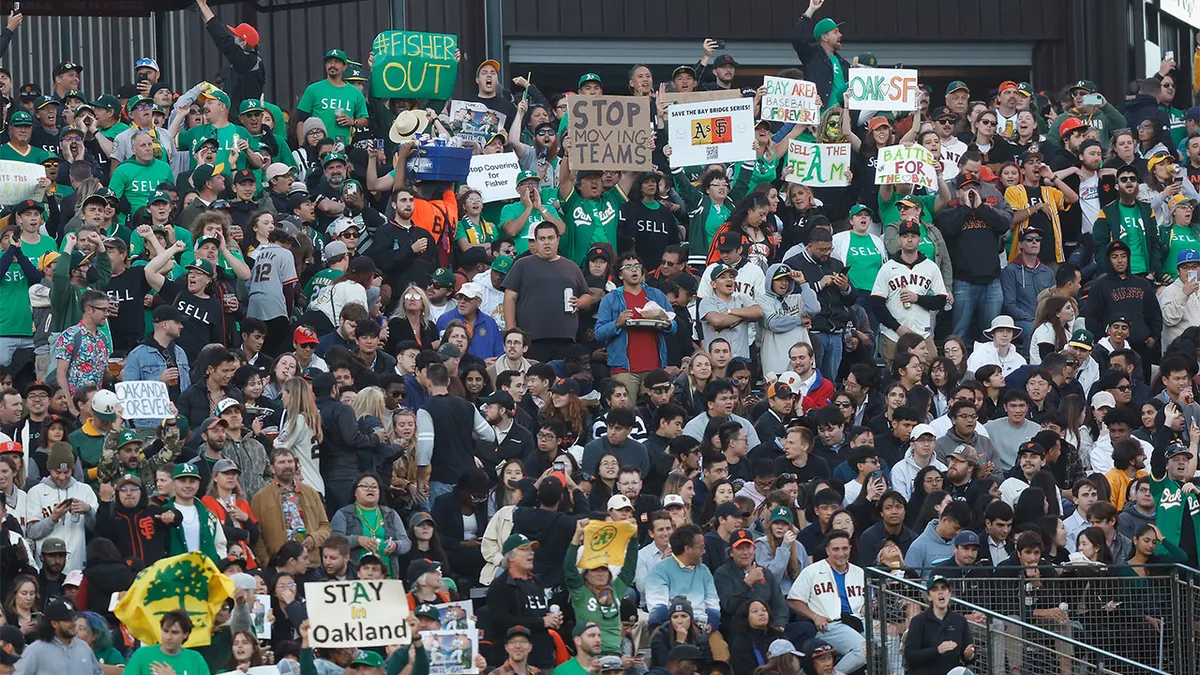
Oakland Athletics and San Francisco Giants fans chanting in response to the Athletics relocation on July 25, 2023. (Lachlan Cunningham / Getty Images)
Relocation in any form is an often contentious situation between a community and those who chose to leave. In America, relocation is not an uncommon situation, as companies move and shift frequently, forcing employees and communities to shift and adjust to their whims. Nick Trujillo (2012) states that sport is one of the biggest industries in the world where, “Sport is…a trillion dollar industry and shapes cultural values in most countries on the planet [emphasis Trujillo’s]” (p. 69). Also, Sport in America, and more specifically Major League Baseball (MLB), is perceived as deeply rooted to its nation and communities as America’s Pastime was used as a descriptor for baseball as early as 1856 (Curtis 2009; Thorn 2020). In fact these factors have helped stave off relocations in baseball compared to other “Big Five” sports in America (football, basketball, hockey, and soccer) as there have been only fourteen team relocations in MLB since 1901, the year that the American League and the National League began the creation of Major League Baseball as we know it today (Jozsa Jr. 2010; Law Institute of Marquette 2018; NFL.com; NBA.com; NHL.com; MLS.com). These economic and cultural factors only amplify the contention that surrounds discussions of relocation.
What is not as often researched is how these arguments for relocation are made beyond economic or quality of life standards. Often these arguments play out in the media where fans and communities first hear about the possibility of relocation in ways that can be both jarring and demeaning to the communities that have supported the league and owners in the past. This study will look at five recent relocation discussions that involve MLB teams over the last five plus years (from 2019-2024), for responses to threats of the potential loss of a professional sports team to an area by the local public and fans of those chosen teams. This work will be done through an analysis of specific team related media (SBNation articles) for the identification of threats of relocation made on behalf of the team or MLB as a way of initiating the process of relocation or force stadium development conversations and the fan responses found in the comment sections of those articles to those threats. The goal is to see what responses do fans make to particular types of threats made in stadium development discussions.
Literature Review
Relocation
Relocation is defined as one professional team’s ownership decides to move a team from one metropolitan area to another, rather than sell the team to a different local ownership group, merge with another team (as was frequent early in a leagues life), or disband the team altogether. Relocation is different from contraction or teams folding altogether. In these situations teams are not moved from one location to another, they just cease to exist anymore. These moments are often due to owners choosing not to fund a team any longer. The similarity here is that both relocation and contraction most commonly happen to “small market” teams or teams with secondary teams in the area. Also, conversations of relocation often start from a capitalist view of location as just another marketable piece of team ownership (along with the stadiums that house teams), often separating the team from the community in which it resides. Defining relocation for our purposes in this way helps us locate disconnects between team ownership and the community of fans where teams are located.
Even the way that professional sports teams in North America are marketed to audiences and communities is one of capitalist land control that affects team locations and value. These locations are discussed in terms of “markets” rather than communities or sometimes even cities. This is less common with sports around the world where teams are closely associated with the communities in which they are located and historic labor classes from those communities. In North America, a quick look at the biggest leagues in the country proves that many teams identify and brand with a combination of “market” identifiers that leave them open to relocating more easily. One example is when teams use “market” identifiers that omit the city (or even specific state) in which a team is located altogether, such as the Golden State Warriors (NBA), Carolina Panthers (NFL), or Carolina Hurricanes (NHL). These open variations in the naming of teams would help team owners explain how their teams can be less focused on the “local” contexts of their existence and focus on the “global” or “regional market” factors of the teams. Meaning that when a conversation of relocation happens, the team can fit anywhere in a given market, such as the Warriors moving from Oakland to San Francisco without having to do any rebranding. Thinking about relocation in these ways is essential for researchers to be able to acknowledge the economic effects of any given potential relocation events.
More than just the “market” power of professional sports owners themselves, the relocation of teams amounts to its own big business in the professional sports landscape of North American leagues. Through an analysis of the traditional “Big Five” sports leagues in the North American sports landscape (which includes Major League Baseball [MLB], National Basketball Association [NBA], National Football League [NFL], National Hockey League [NHL], and Major League Soccer [MLS]), I have found that there have been fifty-seven franchises (teams) that have relocated from one region to new regions since 1950 (Law Institute of Marquette 2018 pp. 1-3; MLS.com; Kaplan 2024). Through the previous definition of relocation, I am not including any teams that relocate to new stadium developments in the same metropolitan area (Jozsa Jr. 2010) but specifically looking at those that left a metropolitan area. This means that there has been nearly one relocation per year in North American sports leagues at an average of 0.77 relocations per year in the 74-year span since 1950.
Conversations of relocation have become more prevalent in professional sports recently and the discussions around new stadium development in North America may lead to an increase in actual relocations similar to the 1950’s and 1960’s. In just the past 12 months, from April 2023 to April 2024, two leagues have already announced relocations of teams for the following seasons, The Oakland Athletics relocation from Oakland, California to Las Vegas, Nevada (via Sacramento, California) and the Arizona Coyotes move from Phoenix, Arizona to Salt Lake City, Utah. As you can see in Table 1.1 there has been a steady growth in team relocation since the turn of the 21st century among major professional sports in North America. In MLB these discussions have recently encompassed the conversations of six teams, five of which will be discussed further in the paper.
Table 1.1 Relocations in North American sports since the development of MLB in 1901
| MLB* | NBA** | NFL*** | NHL**** | MLS***** | |
| Relocations 2001-present | 2 | 3 | 3 | 2 | 1 |
| Relocations 1950-2000 | 11 | 18 | 9 | 9 | 0 |
| Relocations 1901-1950 | 2 | 0 | 3 | 4 | 0 |
* – MLB founded in 1901, data includes Oakland Athletics announced relocation (expected 2028)
** – NBA founded in 1946
*** – NFL founded in 1920
**** – NHL founded in 1917, data includes Arizona Coyotes upcoming relocation (expected 2024)
***** – MLS founded in 1993 but first game was in 1996
As seen in table 1.1, relocation in MLB has historically come in waves, with the last major wave being a westward expansion in the 1950’s and 1960’s (Jozsa 2010). Most other leagues in North America have seen more steady relocations over time, such as one or two every handful of years, like in the NFL’s most recent relocations of the Raiders, Rams, and Chargers happening within a 4 year span (Law Institute of Marquette 2018 p. 3). Table 1.2 shows that there are two “waves of relocation.” The first includes the two relocations as MLB establishes itself (including others that happened in the late 1800s (Jozsa 2010). The second, as stated earlier, holds the bulk of MLB relocations and happened mid-century. In this wave, MLB had eleven relocations within a twenty year span from 1953-1972. The only relocation to happen outside of one of these “waves” was the Montreal Expos relocation, which is unique in its own right as it was the only relocation in MLB for decades on either side of it. Also, at the time of relocation the team had been owned for three years by MLB, which decided in the need for relocation due to a history of poor ownership (Keri 2014). Based on current conversations happening in MLB news reports and the recent relocation decision on the Oakland Athletics, baseball could be leaning into a new wave of relocations in the not-too-distant future, as more teams have been mentioned in relocation rumors in the last two years (Milwaukee Brewers, Tampa Bay Rays, Arizona Diamondbacks, Kansas City Royals, and Chicago White Sox).
Table 1.2 Data on the fourteen MLB Relocations Since 1901
| Team | Seasons in community | First season in new location | From community | To community |
| Milwaukee Brewers * | 1 (1901) | 1902 | Milwaukee** | St. Louis |
| Baltimore Orioles | 2 (1901-1902) | 1903 | Baltimore** | New York |
| Boston Braves * | 41 (1912-1952 | 1953 | Boston | Milwaukee |
| St. Louis Browns * | 52 (1902-1953) | 1954 | St. Louis | Baltimore |
| Philadelphia Athletics * | 54 (1901-1954) | 1955 | Philadelphia | Kansas City |
| Brooklyn Dodgers | 57 (1901-1957) | 1958 | Brooklyn | Los Angeles |
| New York Giants | 57 (1901-1957) | 1958 | New York** | San Francisco |
| Washington Senators | 60 (1901-1960) | 1961 | Washington D.C.** | Minneapolis |
| Milwaukee Braves * | 13 (1953-1965) | 1966 | Milwaukee** | Atlanta |
| Los Angeles/California Angels *** | 5 (1961-1965) | 1966 | Los Angeles | Anaheim |
| Kansas City Athletics * | 13 (1955-1967) | 1968 | Kansas City** | Oakland |
| Seattle Pilots *** | 1 (1969-1969) | 1970 | Seattle** | Milwaukee |
| Washington Senators *** | 11 (1961-1971) | 1972 | Washington D.C.** | Arlington |
| Montreal Expos ***, **** | 36 (1969-2004) | 2005 | Montreal | Washington D.C. |
| Oakland Athletics *,***** | 57 (1968-2024) | 2024 | Oakland | Las Vegas via Sacramento |
* – Relocated again
** – MLB returned to city through expansion/relocation
** – Expansion team
*** – league owned team when relocation decided
**** – Expected Relocation timeline
Threat
In the context of this paper threats are moments when those in power (in this context either team owners or the league officials) make claims that support from the community is needed or the organization will need to look to new locations for that support. In North American sports this often looks like an team owner looking for public funding for new stadium development or stadium improvements (either from deals with city/county/state leaders or through passing legislation through public voting) rather than spending their own revenue on such things (such as new revenue streams or the selling of publishing/filming rights or ownership stakes). The way these threats are also made is important as they can range from vague or veiled threats to overt and explicit threats. The latter is often blanketed over conversations of relocation from the start while the former is often used within other factors such as roster payrolls being slashed or experiences at the ballpark being cut for money or safety reasons. Other methods may include the “leak” of stadium negotiations or targeted marketing campaigns (the Oakland Athletics tactics echo these threat styles). These create a dynamic of “do this or else” between the wealthy individuals/families and the general population of the communities where teams are located.
The ultimate goal of looking at threats is to determine the frequency of use of these methods in stadium development and not necessarily their effectiveness, because the dynamics of “success” could have a vast number of factors. I will be looking specifically at frequency of use by ownership and how the communities respond to threats to their identities as fans and the membership of the team to the community.These threats can affect the perception of a given community and the identity of those involved as their community is treated as potentially no longer a “major league city” (Sapotichne 2012 pp. 176-177).
Identification
Using Kenneth Burke’s work on identification and identifying acts addressed in A Rhetoric of Motives (1969), this study will balance the analysis of threat language/usage with how communities identify with the teams making the threats. The use of Burke’s work here is important because as he shares, the goal of identification is to bring people together when they have been in opposition with each other and being able to identify similar interests can help create a sense of belonging or community (22). Relocation conversations are filled with both opposition to relocation (and ownership) and a sense of belonging to the community through the potential loss of the local sports team. Burke (1969) explains that loss and subsequent belonging is “in this sense is rhetoric” (p. 28).
Burke’s identification helps to further solidify the ways in which the conversations that surround relocation show a need for connection among fans and communities to help create the sense of belonging in which he is speaking. For sports fans this identification can be both the belonging as a group of fans (rather than individuals, as well as their “home” being viewed as one of the exclusive “major league cities” (Sapotichne 2012 pp. 176-177) that are limited in number in North America. Within A Rhetoric of Motives (1969), Burke argues that “Identification is affirmed with earnestness precisely because there is division; Identification is compensatory to division” (p. 22). This means that for us to be able to identify we have to understand the division that is taking place or at least acknowledge difference. This can be seen when “team identity…requires an individual to recognize membership to a group, and evaluative in that an individual must continuously reflect on this group’s status (by comparing to relevant out-groups and/or considering positive elements of the in-group” (Lock & Heere, 2017 as qtd. in Wegner, Delia, and Baker 2019 p. 216). It is within this conflict, or difference, that this work of considering impact on community when a team leaves is important. The human connection and how sports can be a function of how people identify as a community are at the heart of the problem with threats as a rhetorical tactic in relocation conversations.
The use of Burke’s theory of identification as a framework allows this research to negotiate moments where the conversations about relocation lead to moments of incongruence. The incongruence however is not specifically a rejection of various arguments but an observation of moments where disconnect just happens. This understanding is important for looking at the rhetoric because “individuals organize their multiple group identities at different levels of abstraction” (Wegner, Delia, and Baker 2019 p. 216) meaning that while their fandom may be at a moment of incongruence in which the local community may not be in. It is useful in at least two moments of conversation: between the relocating team and the community, and between different groups within the community—such as when fans identify and respond differently to changes to their connection to team identity (Wegner, Delia, & Baker 2019). Their work looks at the Rams relocation from, and subsequent return to, Los Angeles, and both relocations are moves that are recent enough that many fans remember the Rams arriving in St. Louis as well as leaving St. Louis, meaning their identity might be shaped differently than that of a team located in a community longer. This means that the idea of relocation is both substantially one idea, where all relocations are similar but by relating various relocations to each other they become consubstantial of each other, meaning that they are both similar but with each “remaining unique” with “an individual locus of motives” (Burke p. 21). By framing relocation research this way, the work can specifically be looking for moments of what Burke (1969) defines as “substance” which is “an act; and a way of life is an acting-together” and when these moments happen people shared “substance,” and they become consubstantial (p. 21).
This framework of identification also connects to the work that has been done previously in stadium development research and fan studies work in looking at how we create opportunities to persuade (or in some of these cases did not make the attempts when they could have been made). Burke (1974) identifies three ways that identification can be enacted. The first is through identification by sympathy or finding common ground with others. The second is through identification by antithesis or framing a common enemy between entities. The third is identification by false assumption or inaccurate identification between association in another group. An current example in MLB is the conflict between the Oakland Athletics organization and the fan and community as they respond to the growing relocation news of the teams ownership through reverse boycotts and other fan led events (Mastrodonato 2024; Smith 2024; Burke 2024a; Simon 2024). By finding both the connections between the fans and the organization we also see the inherent divisions involved with the process of identifying and responding. As often happens with relocation (and with most fandoms), the concept of identification plays out like a theatrical production (drama), where there is a division between the powerful (actors) and the those that are often less economically influential, but more socially influential in the fans and communities (audiences) that do the supporting and this drama allows audiences to identify and make associations with the actors.
Memory (Memorialization)
Including concepts of rhetorical memory and memorialization to my framework will help focus the research on not only how conversations of relocation happen but also how communities mourn (or do not mourn) any potential loss of professional teams that have been located (and in some cases ingratiate themselves to) in a community for years or decades. These affective moments become heavily linked to how we communicate identity, often in ways to “recollect and communicate experience” (Martin 2021 p. 477). Martin (2021) shows that within the context of relocation there is both a desire for the presence of the team (in the instance of relocation) and, through the act of communicating these moments, a loss through recollections are never complete. The rhetorical moments in which fans and communities enact memory practices become vital to how experience is shared within the community, solidifying our membership and identification with that community.
This study uses Bizzell and Herzberg’s (2000) definition of rhetoric, which states that
“rhetoric is synonymous with meaning, for meaning is in use and context, not words themselves. Knowledge and belief are products of persuasion, which seeks to make the arguable seem natural, to turn positions into premises—and it is rhetoric’s responsibility to reveal these ideological operations” (2000 p. 14).
The importance of what Bizzell and Herzberg state here is that rhetoric is about the making of meaning and not just the methods in which we use to persuade others. This connects both the threats with the identification practices, and in turn how we apply collective memory practices of communities and fans in relocation situations. What this research can find in rhetoric, and specifically the canon of memory, will help create meaning in these situations that evolves the identities of fans and communities from what was to something new.
Another issue of rhetorical memory is that of all the canons of classical rhetoric (invention, style, arrangement, delivery, memory), memory is the canon that has needed the most recovery through the centuries, especially as the study of rhetoric moved through the medieval and renaissance periods. These moments shifted focus of rhetoric to the classical canons of invention and arrangement (Ramus) or separating rhetoric from the production of knowledge (Bacon) (Eyman 2018 p. 15; Pruchnic & Lacey 2011 p. 472-473). The once vaunted memory, “the treasure-house of the ideas…the guardian of all the parts of rhetoric” (Rhetorica Ad Herennium 2004 p. 205) had been left to mere memorization. However, Brooke (2009) offers another view where “memory is painted as the victim of technological change…, without much thought offered as to how it is being represented or how memory is actually practiced” (p. 31). It is here that my focus on rhetorical memory is found. The use (or misuse) and (d)evolution of rhetorical memory has caused it to lag behind the other rhetorical canons in its rediscovery. However, reclaiming it as a “guardian” of rhetoric makes it the most important of the canons when we look at how memory is used to create knowledge as technologies and communication practices evolve. Memory then becomes something more than memorization, it gets “promoted” to being about associations (memories) and accessibility, allowing for better understanding and effectiveness of the other four canons.
This redefining of rhetorical memory also shows that there is a difficulty with how memory is communicated. Miller (2021) argues that it is “frequently staged inside the rhetorical strategies of epideictic (or ceremonial) speech which foregrounds the present moment’s articulation to the past and future” (p. 478), and this runs in line with most discussions of relocation. However, Miller’s work also places the use of memory as a discussion of both the past and future to create meaning, or at the very least identify with something else. This understanding, when combined with Pruchnic and Lacey’s (2011) work as they share that the “mere potential of exteriorizing memory in media can suggest that only those memories captured in such ways are real or reliable” (p. 479), shows that there is a rhetorical power of how meaning is constructed communally and how it solidifies in spaces outside of the self. Also, “memories of individuals and groups are inextricably intertwined and shared” and memories are stored and recalled through collective experiences and communications (Whittemore 2015 p. 14). When we have extended moments of memorializing, such as within protracted relocations of sports teams, how fans communicate their understanding and experience creates the narratives that will be remembered, not the actions actually taken in the process. In the example of the Oakland Athletics, the relocation event will be remembered for not just the initial actions and communications from the Athletics organization, but also through the external memory practices and storage of the fans and community responses to these actions taken.
Methods
Context
This project is a pilot study of relocation rhetoric, specifically focused on the use of threats as a tactic to force decisions on relocation. There are six teams in MLB who have been part of relocation conversations over the last five years where conversations of market size, attendance, public funding, land, and team performance have been mentioned as factors of relocation.
Method
This research used digital ethnography to investigate the use of threats in relocation discussions, how those threats affect identification to teams by their fans and communities, and how memorialization plays into the threat and response. Digital ethnography was chosen because of its observation-based inquiry practices and because of the ability to do that inquiry within digital spaces. Similar to Wegner, Delia, and Baker’s (2019) work, this method allows me to unobtrusively observe interactions in a well defined community without directing any interactions through SBNation (p 218).
This work will look at SBNation, an MLB and sport “news” outlet that has dedicated team specific news pages and writers, for content on relocation. SBNation was chosen over other sites because it is owned and operated by a reputable company in Vox Media as well as has clear guidelines that claim, in part, that “SB Nation is a network of communities where sports fans from all backgrounds gather to share their passion for the teams they love” (Community Guidelines 2024). These guidelines also share that the sites are moderated respectfully while still allowing for a variety of content and opinions to be shared by its writers and its audience without the oversight of the teams or leagues that are being discussed. Because there is no oversight by the teams/league on SBNation’s writers, the research will cover editorial articles by team beat writers and the comments by the fans in the comments sections when there are comments attached (some pages do not have comments enabled). For the sake of the conversation of relocation, the Oakland Athletics have been excluded from this study because they have officially announced their relocation to Las Vegas (by way of Sacramento for 3+ seasons). The focus was chosen to cover teams that are currently having conversations about relocation possibilities so that any comments analyzed were not added post announcement of relocation and skewing any results. SBNation team pages chosen were the South Side Sox (Chicago White Sox), Royals Review (Kansas City Royals), Brew Crew Ball (Milwaukee Brewers), AZ Snake Pit (Arizona Diamondbacks), and DRays Bay (Tampa Bay Rays). Initial searches of these pages were the keywords “relocation” and “stadium” for a period from 2019-2024. In total there were 150 articles that were originally chosen before narrowing that list to the individual article chosen for each team. From the results the pages will then be analyzed for any mention of threats to narrow down the specific reports before then coding for types of identification and threats.
Coding
Coding was done in three phases that are in line with Braun and Clark’s work (2006) through data familiarization, coding, and theme generation. The initial coding was done through process and values coding (Saldana 2016), and at times expanded into In Vivo and Descriptive coding (See Table 1.3). The research started by coding for threat and identification. Secondary codes identified types of threats made, specific identification markers (type of identification made), and memorialization done by organizations or fans that solidify identification. By limiting my data set to the last five years of articles and only five teams, there was more opportunity to test codes and coding methods than would be possible in a larger study. The following Table 1.3 outlines all of the coding methods used in the collection of data.
Table 1.3 First cycle coding methods and coding types for use on this project
| Coding Method | Coding Type | Rationale* |
| Elemental | Descriptive | · Appropriate for a wide variety of data sources· Foundational in qualitative study · Uses include documenting material products and physical environments of ethnographies |
| In Vivo | · Appropriate for participant-generated language from members of a culture or subculture · Prioritizes and honors the voice of the participant · Can be used with several other coding methods | |
| Process** | · Appropriate for finding action and interactions· Focuses on processes that are embedded in actions as well as the psychological concepts of identity and memory· Searches for consequences of actions and interactions as well as the action itself | |
| Initial | · Appropriate for grounded theory work, ethnographies, and studies with a wide variety of data forms · Creates a starting point to provide leads for further exploration · Suitable for interview transcripts | |
| Affective | Values** | · Appropriate for exploring cultural values and belief systems, identity, actions in case studies, and oral histories · Can look for areas of interplay, influence, and affect · Use of multiple sources corroborates the coding and enhances trustworthiness of findings |
** – initial coding method chosen
Ethics
Even though this research uses digital ethnography as a research method, I acknowledge that there are still ethical concerns when researching public spaces and privacy concerns (see Wegner, Delia, and Baker 2019). These concerns were one of the reasons why SBNation was chosen as a research location because their terms of use are very clear about anything being posted on their sites is considered public (Terms of Use 2024). The use of pseudonyms for usernames through SBNation was also taken into account because commenter chosen usernames already keep the information anonymous to readers. This means that under the Protection of Human Research Subjects this would be considered secondary data because of how it is recorded and publicly available and is therefore exempt from the common rule for human subject research (Protection of Human Research Subjects 2018; Wegner, Delia, and Baker 2019).
Analysis of Data
Initial data for coding consisted of 404 comments in response to the five chosen articles. There were 296 comments that ultimately were eliminated from the coding process because they were off-topic or otherwise unproductive comments, leaving 108 comments in the data set. Two themes that emerged from the data (seen in Table 1.4 below) was that commenters were most focused on issues that involved either civic issues (such as government duty, voting, or taxes) and/or the conflict between the fans and the teams owner or leagues actions.
Table 1.4 Total coding data of five articles’ comments sections
| Codes | Description examples | Total Codes |
| Memory | Team history mentioned in response | 15 |
| Team Quality | Good vs. bad teams, Attendance issues | 8 |
| Civic or Community | Reference community or city needs or actions | 42 |
| Conflict with owner or league | Anti-owner/anti-league comment | 43 |
| Overall comments for coding | Totalled 404 comments | 108 |
Tampa Bay Rays
The chosen article on DRays Bay, the Tampa Bay Rays page on SBNation, was “Reactions to the Montreal Rays split-city proposal around Tampa Bay” by Daniel Russell on June 21, 2019. This article was the most unique in that it was the oldest by nearly four years, and it was the only one that did not have a comments section attached to it, as DRaysBay does not use the comment function on any of its articles. The fact that it did not have a comments section is in part why this article was chosen because it had commentary by the community members, government, team, and others within the piece. The situation that the article is responding to is a “sister city” proposal announced by the Tampa Bay Rays and approved as an opportunity for further consideration by MLB, where the team would split the season between St. Petersburg, Florida (where the team currently plays) and the city of Montreal, Quebec, Canada.
The threat represented in this article was the announcement that the Rays have received permission to consider a split season between two cities as a view to potential relocation if a stadium deal cannot be reached. Because of the nature of the threat being clear and a challenge to the city of St. Petersburg, the codes were heavily focused on community and conflict with the owner, which matches the patterns of the total data set. It also matches the structure of the article as there were more individuals with civic responsibilities responding to the announcement, meaning that there would be more mention of civic duty and greater good to a community, rather than on team quality. It was also interesting how often members of these communities were at odds with the ownership of the team on this proposal.
Table 1.5 Total coding data of DRays Bay’s comments
| Codes | Description Examples | Total Codes |
| Memory | Team history mentioned in response | 1 |
| Team Quality | Good vs. bad teams, Attendance issues | 0 |
| Civic or Community | Reference community or city needs or actions | 10 |
| Conflict with owner or league | Anti-owner/anti-league comment | 11 |
| Overall comments for coding | Totalled 13 comments | 22 |
Milwaukee Brewers
The chosen article on Brew Crew Ball, the Milwaukee Brewers page on SBNation, was “MLB says American Family Field needs renovations or the Brewers face the possibility of relocating” by Matt_Aho on May 25, 2023. What makes this article stand out is that it was the only one studied that had the information being discussed coming from the commissioner of baseball, rather than the owner of the Brewers. It was also the article that initially had the most comments to code, which I believed to be a sign of the fans reaction to not just the news, but the speaker in that instance as well. Another interesting thing that was noticed as I was reading through the comments was actually that there was a fair amount of conversation that was being had between commenters, rather than a large amount of single posts in direct response to the article.
The threat represented in this article was that the commissioner mentioned that if requested upgrades to the stadium were not funded partially by the county or state the team may have to find an alternate location for playing games. Unlike other threats in this research, this was a more veiled threat because the commissioner never actually used the word relocation (although the Milwaukee area has no other location to house the team); he implied this by comparing the stadium renovation situation to another team that had announced relocation argued on the basis of stadium quality issues (the Oakland Athletics). The main part of the article was about the possibilities of relocation, and the information came from the league and not the team’s owner, the most common code found was about the conflict with the owner or league. It also stands out that many of the comments coded for ‘conflict with owner or league’ were angry at the owner for not being the individual who was making the comments, passing that job to the league instead.
Table 1.6 Total coding data of Brew Crew Ball’s comments
| Codes | Description Examples | Total Codes |
| Memory | Team history mentioned in response | 2 |
| Team Quality | Good vs. bad teams, Attendance issues | 2 |
| Civic or Community | Reference community or city needs or actions | 7 |
| Conflict with owner or league | Anti-owner/anti-league comment | 17 |
| Overall comments for coding | Totalled 186 comments | 28 |
Kansas City Royals
The chosen article on Royals Review, the Kansas City Royals page on SBNation, was “Royals announce commitment to Jackson County if sales tax extension passes” by Max Rieper on January 5, 2024. This is the first article that came out during the current season and is one that also affects more than just baseball, as the Kansas City Chiefs are involved with the potential relocation issues that face the metropolitan area. The relationship between the two teams created a complexity to the coding because comments were about both as fans seemed to be invested in both teams (the NFL and MLB teams). This article was also interesting because while it is relatively new it also had 118 comments, second most of all articles chosen for the study, potentially related to the timing in relation to the preparation for the new MLB season.
The threat represented in this article was the team announcing their intent to stay in Jackson County (the county that Kansas City, MO resides) if the residents of the county vote in favor of the tax bill that is on the ballot in April. This threat is a veiled threat, along the lines of the Milwaukee Brewers alternate location threat, but is open enough that it is clear that there is no intention to stay if the vote does not go in the teams favor. Due to the fact that this article is addressing the civic duty of voting, it is not surprising that the most frequent code was on the Civic or Community code. It was also interesting how polarizing the topic of the vote seemed in the comment section; there were clear lines for both pro and con on the tax vote in the county. Ultimately, many of the comments were not in the scope of the research as some commenters were devolving into unproductive responses to other commenters, rather than about the topic of the article.
Table 1.7 Total coding data of Royals Review’s comments
| Codes | Description Examples | Total Codes |
| Memory | Team history mentioned in response | 5 |
| Team Quality | Good vs. bad teams, Attendance issues | 2 |
| Civic or Community | Reference community or city needs or actions | 12 |
| Conflict with owner or league | Anti-owner/anti-league comment | 6 |
| Overall comments for coding | Totalled 118 comments | 25 |
Arizona Diamondbacks
The chosen article on AZ Snake Pit, the Arizona Diamondbacks page on SBNation, was “Ken Kendrick on relocation: ‘We aren’t having those conversations’” by Jim McLennan on February 19, 2024. This is an interesting article for this study because it, on the surface, seems to be attempting to say “there is nothing to see here, move along.” The author explains how comments that the owner of the team made in a press conference have been taken out of context by other media in the name of views. The irony in this statement is that the author is writing in a space that is designed for gaining traffic and comments, the exact thing they are claiming against other news outlets. Ultimately however, the amount of data shared in response of the owner of the team’s comments that the team is not having conversations but they know what other locations want a team, but they are not looking yet is interesting.
The threat represented in this article was the team announcing that they are not part of any conversations to relocate, but there are opportunities because the team knows what locations are interested and it may come to that down the road if stadium renovation issues are not met. What is interesting in the coding of responses to this threat is that the codes were split between there being a civic duty (as the stadium in Phoenix is owned by a split between the county and the city) and an argument against the wealthy owner asking for money to pay for stadium renovations. Those who agreed with one of the codes in the comments disagreed with the other code. Much like other comment sections, and because there was some polarization some of the commenters were not responding to the discussions in very productive ways, and making their comments useless for coding.
Table 1.8 Total coding data of AZ Snake Pit’s comments
| Codes | Description Examples | Total Codes |
| Memory | Team history mentioned in response | 4 |
| Team Quality | Good vs. bad teams, Attendance issues | 2 |
| Civic or Community | Reference community or city needs or actions | 8 |
| Conflict with owner or league | Anti-owner/anti-league comment | 7 |
| Overall comments for coding | Totalled 78 comments | 21 |
Chicago White Sox
The chosen article on South Side Sox, the Chicago White Sox page on SBNation, was “The metaphorical White Sox rebuild failed, but the literal rebuild may be exactly what Chicago needs” by Di Billick on March 21, 2024. This article, like many of those read as possible choices for this study from SouthSideSox, had the most author opinion embedded into it. From the start of the article, it was very clear the author’s opinion of the owner of the team and the threats that were being made in the name of building a new stadium for the team. The reason why this article was picked over others, however, was the fact that while there was a lot of opinion there was also a lot of contextual information about the relocation/stadium discussion compared to other pieces on the site. The tone/opinionated style of Billick’s piece was in alignment with the style of writing common across articles on South Side Sox that comment on Jerry Reinsdorf (the owner) and how he runs the team.
The threat represented in this article was the owner claiming that they needed upwards of $1 billion dollars of city, county, and/or state funding for a new stadium or else they may have to relocate to get a new stadium. There was no veiled threat in this comment; it was very much a traditional threat of “do this or else.” However, what showed in the coding of responses is that this article had the least comments to code, with only nine comments, but the comments were some of the most complete and thought out comments demonstrating knowledge of the area and the topic. These responses gave many clear points to code and many of the comments connected to more than one code at a time because of the depth of content. At the same time, the commenters seemed to be as opinionated about the topic as the author, meaning that either the site breeds that kind of audience or Chicago White Sox fans are just opinionated individuals.
Table 1.9 Total coding data of South Side Sox’s comments
| Codes | Description Examples | Total Codes |
| Memory | Team history mentioned in response | 3 |
| Team Quality | Good vs. bad teams, Attendance issues | 2 |
| Civic or Community | Reference community or city needs or actions | 5 |
| Conflict with owner or league | Anti-owner/anti-league comment | 2 |
| Overall comments for coding | Totalled 9 comments | 12 |
Discussion
The results of this pilot study shows interesting connections between relocation conversations and the way in which the initial conversations of stadium development are approached by those leading those discussions, specifically when threats are involved in the process. Although threats of relocation may spark conversations when there had not been conversations previously or push stalled conversations into some form of action, there is also a lot of harm that they can do to communities and fanbases of the teams involved. One example of what can happen in these moments is what happened with the Oakland Athletics and the division between fans and ownership with dwindling attendance, fan led reverse boycotts, fumbled announcements (among other newsworthy events) since Dave Kaval announced “parallel paths” between negotiating with Oakland, CA and Las Vegas, NV (Kawahara 2021; Drellich 2023; Drellich and Berman 2023; Perry 2023; Burke 2023). While it is too late for the Oakland Athletics they are a great example of the threats working in the team’s favor.
The data collected here, although just a small sample of larger discussions, confirms that early in these discussions of relocation comments by fans are focused around Civic and Community Needs and Conflicts Between Fans and Ownership. These two codes held more than 78.7% of the focus of the data collected in the samples. It is interesting that when early discussions and threats of relocation happen the conversations seem to steer away from the teams themselves. Less than a quarter of the comments by fans (21.3%) focused on information that could be either coded as memory or for team quality. One explanation for this could be because the fans of the teams involved are not prepared to face relocation as an inevitability; they are more focused on fighting back against the stories being created.
The data suggests that fans are more defiant in the early stages of potential relocation discussions. 39.8% of the comments were coded for anti-owner or anti-league sentiment. Some fans respond with very specific comments to the situation, such as “I just hope it doesn’t benefit the owner that seems to have given up on the team and might otherwise benefit from the situation a la Ricketts” (RiqueSuave in comments of Billick 2024) or “Theyre [sic] going to threaten to move a team with a built up rabid fanbase and have not struggled with attendance for at least a decade? Really? Get fucked, Robbie” (Wizzyconsin06 in comments of Matt_Aho 2023). These commenters have very specific local understanding of the community and fans in these situations. Other comments are more generalized but just as poignant, like “we get it that MLB is big business it’s not personal. But …it is personal” (dooder in comments of McLennan 2024) or “Corporate greed” (Royalsarecheap in comments of Reiper 2024). These anti-owner or anti-league comments show a level of identification between the team and its fans through the conflict between them–the consubstantiation between A and B (Burke 1969 p. 21). And through that identification fans, when initially threatened, seem to have more of a willingness to fight back, often attacking owners or the commissioner of baseball rather than focusing on the team itself.
On the opposing side of this, fans that focused on the memories and emotions that teams past and present bring to fans only had 13.8% of the coding. This pattern ran counter to the initial expectations that fans would be focused on memories of the team, not quite memorializing the loss yet but focusing on the team as a positive, and locating their identities along with the team. Only three teams’ fans focused a fifth of their coded comments on memory (the Royals, Diamondbacks, and White Sox). In these moments we saw comments of recency, “ironically now that they had one great season. Tell fans hey…we want more money” (dooder in comments of McLennan 2024) as they reference the Diamondbacks run to the World Series in the response. Others focused on the rich history of their clubs in their arguments such as “The good and great Royals teams have necessarily had great defensive play centerfield, as necessitated by the dimensions of the ballpark” (walt from nebraska in comments of Reiper 2024) or “White Sox were the first Chicago team to 2 million fans in a season. Cubs didn’t even get 10 straight seasons of 1 million fans until 1980. Sox had 14 of 15 years by the late 1960s” (Brett Ballantini in comments of Billick 2024). The lack of more comments like these, among the 404 total comments, shows that fans may not feel the need, yet, to defend their teams or their history in response to relocation and stadium development debates.
These patterns of comments by fans across these articles follows research on fan affect in relocation conversations on discussion boards done by Wegner, Delia, and Baker (2019). In their work, fans discussed the relocation of the Rams (NFL), going so far as to eventually create specific groups for Rams fans in St. Louis and groups for Rams fans in Los Angeles. One fan even addresses the turmoil in the relocation discussions:
I am almost dreading the final announcement. It is going to be divisive, going to be a challenge for all to keep the polite standard we have had here. As it gets closer, opinions are going to get stronger, right now there is just too many unknowns to form strong opinions with any factual basis. Plus, for those of us STL first fans, an LA decision will mean the end of an era, for lack of a better way to put it. It is almost like waiting to see if you are going to be laid off. You want the decision to come, but you dread it just the same. (yellow5, Apr 26 2015 as qtd. In Wegner, Delia and Baker 2019 p. 221)
While the feelings that are expressed in this quote did not show in all the comments in this study, there were clear instances of fans using the message boards to discuss possibilities and share information and helping differentiate the stakes that individuals had in the discussions. This pilot study, much like Wegner, Delia, and Baker’s (2019) work, found that discussions cropped up in ways in which fans used their anger with ownership to start to differentiate the conversations. The more clear the threat was to the team’s fans (such as the Milwaukee, Tampa Bay, and Chicago articles) the more the fans began to differentiate their identities; going so far as to begin the creation of in-groups (fans that were local in many cases) and out-groups (fans who were fans at a distance), much like what happened to the St. Louis Rams message boards (Wegner, Delia, and Baker 2019). Burke (1969) states that “to begin with identification is…to confront the implications of division” (p. 22). These moments where a commenter started to differentiate groups into divisions and had a tendency to polarize the comments section of the articles as well, sometimes needing moderation by the authors or the editors of the SBNation pages.
Conclusion
As this pilot study was being designed, the expectation was that fans would have a more focused attention to what communities may be losing through early stages of memorialization of the teams in preparation of the chance of leaving. What ended up happening was more anger and frustration by fans, focused on the owners of the teams who have placed them in these positions and conversations of relocation as a possibility. This distinction, even through a small sample size, shows that there is a lot of value in studying how conversations of relocation start. By focusing on these moments, the rhetorical methods used in the discussion, and the fans affected by the news, narratives can be shifted; whether on the ownership’s side or the fans side of the discussion. Threats can drive conversations as well as damage them.
Through this work a better understanding of these conversations and their faults can be developed. I call for a need for larger studies of the frequency (with the potential evolution into their effectiveness with more data) of threat rhetoric used in conversations about relocation, especially as they are often protracted conversations that take place over months or years. The findings of these types of studies could be important for organizations to better connect with their communities as they hold a large sway over life in those communities, whether they be sports teams that hold entertainment value or large companies that hold jobs for the community. One issue with this pilot study was also the lack of identification of clearly diverse community voices in these discussions, as fan comments in the articles studied here and other studies about stadium development and relocation ignore various aspects of the communities and the anonymity does not have any diversity information attached. Adding these voices and extending the research to a larger data set would help create a more holistic and diverse view of the effects of relocation rhetoric on communities.
References
Billick, D. (2024, March 21). The metaphorical White Sox rebuild failed, but the literal rebuild may be exactly what Chicago needs. South Side Sox. https://www.southsidesox.com/2024/3/21/24105165/the-metaphorical-white-sox-rebuild-failed-but-the-literal-rebuild-may-be-exactly-what-chicago-needs
Bizzell P. & Herzberg B. (2000). The rhetorical tradition; Readings from classical times to the present (2nd edition). Boston: Bedford/St. Martins.
Braun, V., & Clarke, V. (2006). Using thematic analysis in psychology. Qualitative Research in Psychology, 3(2), 77–101.
Brooke C.G. (2009). Lingua fracta: Towards a rhetoric of new media. Cresskill, N.J.: Hampton Press.
Burke, J. (2024a). A’s fans throw a party with fans fest: Oakland A’s fans put on an event to celebrate The Town on Saturday. Inside the A’s: FanNation by Sports Illustrated. February 25, 2024. https://www.si.com/mlb/athletics/news/as-fans-throw-a-party-with-fans-fest
Burke, J. (2023). A’s reflect on latest “reverse boycott” in Oakland: The “Summer of sell” is in full swing as A’s fans try to keep their team.” Inside the A’s: FanNation by Sports Illustrated. 07 August 2023, https://www.si.com/mlb/athletics/news/as-reflect-on-latest-reverse-boycott-in-oakland.
Burke, K. (1974). The rhetorical situation. Communication: Ethical and Moral Issues. Lee Thayer (ed.). Routledge. pp. 263–75.
Burke, K. (1969). A rhetoric of motives. Berkeley and Los Angeles: University of California Press.
Community Guidelines. (2024). SBNation. https://www.sbnation.com/pages/community-guidelines
Curtis, B. (2009, January 31). The National Pastime(s). New York Times. https://www.nytimes.com/2009/02/01/weekinreview/01curtis.html#:~:text=The%20debate%20over%20which%20sport,public’s%20health%20and%20well%2Dbeing
Drellich, E. (2023). Drellich: Rob Manfred’s shot at A’s fans is unsurprising in MLB commissioner’s 8th year. The Athletic, 18 June 2023. https://theathletic.com/4619289/2023/06/18/rob-manfred-oakland-as-reverse-boycott-mlb/.
Drellich, E. & Berman S. (2023). Athletics sign binding agreement to buy land for future stadium in Las Vegas. The Athletic, 20 Apr. 2023 https://theathletic.com/4431782/2023/04/20/oakland-athletics-las-vegas-stadium-agreement/
Eyman, D. (2018). Digital rhetoric: Theory, method, practice. Ann Arbor: University of Michigan Press.
Jozsa Jr., F. (2010). Major League Baseball Expansions and Relocations: A History, 1876-2008. Jefferson, N.C.: McFarland & Company, Inc., Publishers.
Kaplan, E. (2024, April 12). Sources: Coyotes players told team is relocating to Utah. ESPN.com. https://www.espn.com/nhl/story/_/id/39931044/arizona-coyotes-players-informed-team-relocation-utah
Kawahara, M. (2021). Kaval: A’s on ‘parallel paths’ with Oakland proposal, Las Vegas exploration. San Francisco Chronicle. May 28, 2021. https://www.sfchronicle.com/sports/athletics/article/Kaval-A-s-on-parallel-paths-with-Oakland-16211728.php
Keri, J. (2014). Up, up, and Away: The Kid, the Hawk, Rock, Vladi, Pedro, le Grand Orange, Youppi!, the Crazy Business of Baseball, and the Ill-Fated but Unforgettable Montreal Expos (1st ed.). Random House of Canada.
Law Institute of Marquette (2018). Major league sports team relocation history (1950-2017). National Sports Law Institute of Marquette University Law School, 2018, pp. 1-3. https://law.marquette.edu/assets/sports-law/Relocation%20History.2018.pdf.
Martin, J. (2023). Rhetoric, death, and the politics of memory. Critical Discourse Studies, 20(5), 477–490. https://doi.org/10.1080/17405904.2022.2090977
Mastrodonato, J. (2024). More than 10,000 fans and several ex-A’s show unity at Fans Fest in Oakland. The Mercury News. February 24, 2024. https://www.mercurynews.com/2024/02/24/thousands-of-fans-and-several-ex-as-show-unity-at-fans-fest-in-oakland/
Matt_Aho. (2024, March 21). MLB says American Family Field needs renovations or the Brewers face the possibility of relocating. Brew Crew Ball. https://www.brewcrewball.com/2023/5/25/23738269/mlb-says-american-family-field-needs-renovations-or-the-brewers-face-the-possibility-of-relocating
McLennan, J. (2024, February 19). Ken Kendrick on relocation: “We aren’t having those conversations”. AZ Snake Pit. https://www.azsnakepit.com/2024/2/19/24077793/ken-kendrick-on-relocation-we-arent-having-those-conversations
Office for Human Research Protections (OHRP). (2020, June 30). Regulations, Policy & Guidance. Office for Human Research Protections. https://www.hhs.gov/ohrp/regulations-and-policy/index.html
Perry, D. (2023). Rob Manfred ‘sorry’ for A’s fans, but says ‘attendance has never been outstanding’ in defense of possible move.” CBS Sports, 24 Apr. 2023. www.cbssports.com/mlb/news/rob-manfred-sorry-for-as-fans-but-says-attendance-has-never-been-outstanding-in-defense-of-possible-move/.
Pruchnic, J. & Lacey K. (2011). The future of forgetting: Rhetoric, memory, affect. Rhetoric Society Quarterly. 41(5). 472-494.
Rhetorica Ad Herennium (2004). Trans. Harry Caplan. Cambridge, MA: Harvard University Press.
Rieper, M. (2024, January 5). Royals announce commitment to Jackson County if sales tax extension passes. Royals Review. https://www.royalsreview.com/2024/1/5/24027284/royals-announce-commitment-to-jackson-county-if-sales-tax-proposal-passes
Russell, D. (2019, June 21). Reactions to Montreal Rays Split-City Proposal Around Tampa Bay. DRays Bay. https://www.draysbay.com/2019/6/21/18700739/reaction-montreal-rays-split-city-proposal-around-tampa-bay
Saldaña, J. (2016). The coding manual for qualitative researchers (3E.). SAGE
Sapotichne, J. (2012). Rhetorical strategy in stadium development politics. City, Culture and Society, 3(3), 169–180. https://doi.org/10.1016/j.ccs.2012.06.001
Simon, A. (2024). Fans’ Fest shows Oakland A’s fans are only getting stronger in their fight with John Fisher. SFGATE. February 24, 2024. https://www.sfgate.com/athletics/article/fans-fest-oakland-as-fans-getting-stronger-fight-18687186.php
Smith, C. (2024). ‘Thousands of us still here’: A’s fans gather for fans’ fest in Oakland. NBC Bay Area. February 25, 2024. https://www.nbcbayarea.com/news/local/east-bay/athletics-fans-fest-oakland/3463318/
Terms of Use. (2023, October 26). VoxMedia. https://www.voxmedia.com/legal/terms-of-use
Thorn, J. (2020, March 16). The National Pastime. Our Game: Medium. https://ourgame.mlblogs.com/the-national-pastime-289b47a73e11
Trujillo, N. (2012). Reflections on communication and sport: On ethnography and organizations. Communication & Sport. 1(2), 68-75. DOI: 10.1177/2167479512467772
Wegner, C. E., Delia, E. B., & Baker, B. J. (2020). Fan response to the identity threat of potential team relocation. Sport Management Review, 23(2), 215–228. https://doi.org/10.1016/j.smr.2019.01.001
Whittemore, S. (2015). Rhetorical memory: A study of technical communication & information management. Chicago, IL: University of Chicago Press.
Week 12 (3/28/24)
Okay, tinfoil hat conspiracy theory time.
The readings this week really make me think of “big brother” watching over us as instructors. Maybe that is a little cynical, especially coming from someone who is focused on technical and business writing and communication, but it really makes you wonder what and how all these digital tools are playing the overseer rather than supporter.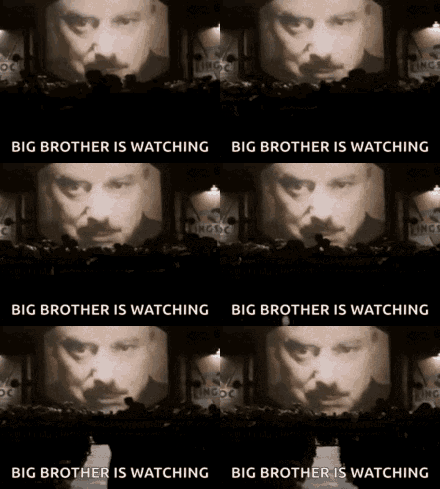
The readings this week did not always alleviate this feeling in me as an instructor. When Duin and Tham state “Academic analytics is the application of these business intelligence tools and strategies as a means to guide decision-making processes related to teaching and learning” (2). Or when they use a series of business buzzwords like “mine the data available to create “actionable intelligence” with the goal of increasing efficiency, effectiveness, and student success” (3). These moments make me cringe because it’s the same language used in factories or business decisions on the value of human workers (hello previous Human Resources work trauma). This makes me wonder what higher education wants to be, and whether it understands student learning (my own institution makes me question this as well).
These feelings are not limited to just one article however, or one rhetorical move in the academy. We as academics are always trying to prove our worth to our institutions, our students, and our field through a wealth of different ways, effective or not. Some of these are through tenure processes, which prioritize research in many places, but in others it may emphasize getting your individual name out with the institutions name attached, therefore proving that the institution is effective. I have a colleague who works at an institution that believes that they need to publish a variety of single authored pieces and the only ones that count as a full publication are ones that are in national publications and have the university identity attached to the piece. There is an array of other requirements that they have as well but the need of requirements like this makes me think about who we are doing this for and because our own employment is as risk is this a statement being made by “big brother” about our worth.
Duin and Tham don’t necessarily ease this tension, however. As the article transitions, they address issues of collecting data and who is using the data. We see statements like “we find no mention made of the broader ‘gaze’ regarding data being collected and mined from these systems…” (4), or “big data analytics will continue to be ‘quite persuasive to higher-level administrators’” (Marc Scott qtd on 4). These (and others) are worrying statements about tech use in the field. I do think that by the end of the article they come up with a good series of needs for the LMS creation and use in the field.
I want to leave with one final though here. Writing instruction and student creation is a hugely messy process (think about student disposition, habitus, learning theories, unlearning processes, etc.) and we cannot “increase efficiency” without damaging these moments of transfer, but LMS systems don’t always allow for this. Neither do algorithms. However, as an instructor, I do understand the need and uses of these tools, and in many instances they are used in the right ways and in effective support of learning. Like with anything it’s the moments when “they go wrong” or are “used inappropriately” that we see the most.
Week 11 (3/21/24)
Reading about pedagogy practices using sound elements is interesting because I am a person who hates to hear my own voice. I really do not like listening to my voice being replayed anywhere (such as leaving phone messages, recording audio or videos for people, etc.). I am not sure where that personal quirk came from (I figure I can blame my parents because Freud would) but it means that I have actively not pursued recording for this class or in my own pedagogy. Some of the readings this week show me that ignoring it, especially in multimodal composition, is probably a bad idea pedagogically.
Reading chapter 18 was especially interesting this week because it really got me thinking about how engagement with design is as important as knowledge in virtual or audio tours. I have done some terrible audio tours in the past but there is one experience that stands out in particular, the USS Midway in San Diego, CA. I went on a tour of the aircraft carrier with my significant other and my best friend when he was visiting (this was about 15 years ago). We had shuffled into the museum (a ship) with a group of people who were all tourists and ended up wandering as a group of about 20 people, all listening to this very droll history (think in the tone of Ben Stein in Ferris Buellers Day Off). Even after one room of the ship you could tell that everyone was bored. Then the tour picked up as everyone took their headphones off.
The headphones came off because my friend started talking about everything he was seeing, did he miss things, probably, but was it more interesting, definitely. He has a knowledge of military aircraft that would rival a military historian (as a son of an Air Force pilot), and a jovial personality. As he began his own tour for the benefit of the 20 people in this group his stories ranged from archival (this is this and that is that) to creative non-fiction narratives (he would talk about what it would be like in particular scenarios in particular rooms). Now mind you, he had never been to the Midway before. He just understood in a moment what the audience needed and made it happen. Without knowing it he followed, in a way, some of virtual tour assignment and audio remediation that Cummings, Kendrick, and Peterson’s assignment designs had. He was responding with intention (understanding what the need was in the moment) and applying knowledge and style elements in different ways to engage what the tour needed. He even reflected with members of the group afterwords, asking if there was anything else that they wanted to know (and talking with one person who happened to be a docent at another museum on the east coast about what he could have done).
While this example may not quite completely fit the need of sound, I think it really shows how the work that students can do in our classes when we give them opportunities can allow them to use their experiences and knowledge, build new knowledge, and find constructive ways to create and share that knowledge (especially in “real world” ways). This also shows capability in those moments when students (and faculty) are not thinking about a grade but about what is best for the world outside.
Now the Midway, in all this time, has improved their tours (and if you are ever in San Diego it is worth a visit). Their new setup shows what is capable in tour design and access (although crafty students could probably make it even better).
https://www.midway.org/360-virtual-tour/
Week 10 (3/14/24)
This week’s readings were really interesting to me as I realize that I am less a digital rhetorician and more of a pedagogy person. This was a really interesting realization on my part because of how much I connected with the Romberger and Rodrigo piece (and to a lesser extent the Fodrey and Mikovits piece). The concepts of a Hacker pedagogy and Scrappy Students put into words much of what I feel about teaching.
When thinking about the idea of Scrappy students I can relate to them on two levels. The first is that I feel like I myself am a scrappy student, I have always been one who has fight through a lot to get through and find value in my educational pursuits. As a working-class student most of my life I had to be scrappy because I did not always have the access or advantages that classmates and friends had (including working throughout my education). I always had to hack my way through assignments, sometimes eschewing specific requirements to make something work with what I had.
As an instructor I view most of my students as scrappy because at UC Merced 70+ percent of our students are first generation, multilingual, and Pell grant eligible. Many of them have jobs to help with school, have a lack of support at home for going to college (or in some cases too much support/demands on college). In conversations that I have with my students many of them also have been let down in some way, shape, or form by the education system, so they really have had to scrap to be where they are. They have such interesting experiences that they bring to the class as well. I treat these as important traits to have in my classroom, apparently leaning into a hacker pedagogy.
My hacking pedagogy is really focused on everyone, including myself, challenging and learning from one another. I don’t have the students try to memorize skills but learn contexts and structures that they will see and experience outside of the classroom.
“In a Hacker Pedagogy, students are encouraged to experiment with technologies and processes; they are expected to collaborate both on learning processes and production; they are explicitly taught to abstract from one technology to the next as well as to consider their assemblage process; and they are encouraged to think of their learning as positioned within a larger, complex system” (92).
I explicitly talk to my students about how their college experiences are part of a complex system of classes, and it is their expectation to (hopefully) find different things from every class that they can “transfer” to other contexts. Having explicit conversations of transfer make reflections on projects and expectations of assignments more focused and creative because students begin looking for how things connect and what they can do with information. This also helps with the metacognitive elements of my class (such as contract grading where students have to audit their work at the end of the semester). In assignments like this they begin looking for key elements that are important to them and explain why they chose to include those in the audit.
I could go on and on as to why this pedagogy connected with me but instead I will include a copy of my contract and audit assignment with you all (and thinking about the Hacker Pedagogy I have thoughts on how to explain it even better now).
Week 8 (2/29/24)
One thing that I want to talk to about two of my readings this week (Chapter 2 and 9) is the way that digital rhetoric and digital theories can change the discussions of “Otherness” through digital spaces and digital research. I have always been interested in these discussions in research because of the issues of power that are involved in the creation of “other,” but it is one thing that I have always had difficulty addressing as a cis gendered, middle class, white male. But if I want to learn I have to be receptive to these moments, the powerful ones and the simple ones (and anything in between).
“Chapter 2: Flipping the Table and Redefining the Dissertation Genre with a Digital Chapter”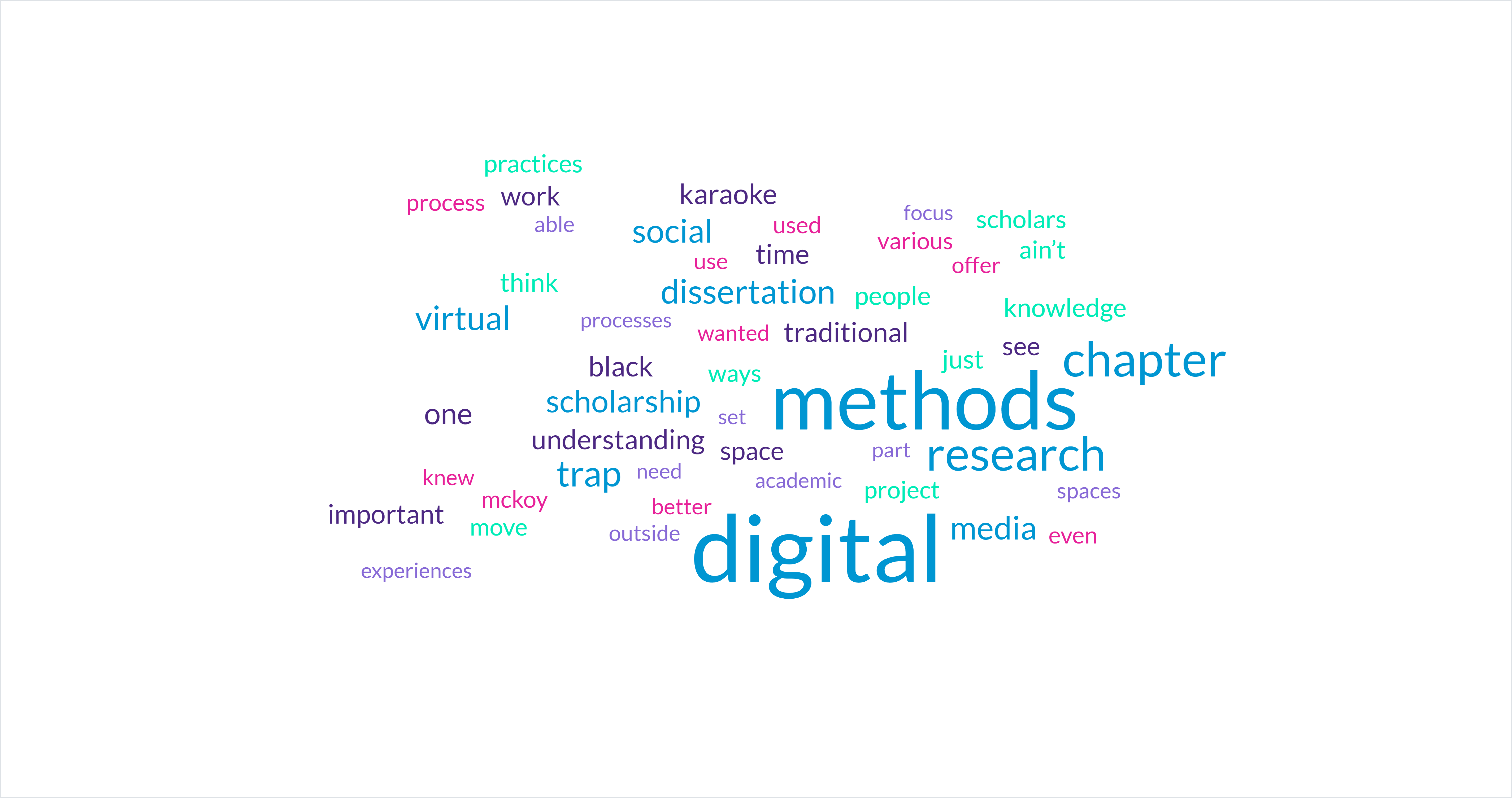
Temptaous Mckoy discusses the need to redesign an entire chapter of the dissertation to a digital chapter. This was because as she says, “I wanted to be sure that the voices of those I interviewed were heard loud and clear” (51). This is important because of her choice to “rhetorically reject Standard American English” and because she didn’t want to misinterpret her people or miss something because of bad transcriptions (51). These are important because of the need to protect the voices of those who are the subject of research, and the academy has not always done that.
Seeing an author who is comfortable enough in themselves to challenge the academy in their dissertation was refreshing. Without digital spaces I cannot imagine what the academy could have changed in this student in the name of doing projects “correctly.” The first paper I ever tried to do anything with as a master’s student (failed brutally at publishing it) I attempted a topic focused on students using their own experiences to better enhance learning and I always hoped to create something as profound as Temptaous does in this chapter (which I was so far off of this). Seeing the knowledge that students have to incorporate their non-academic experiences to connect skills, audiences, and tools is wonderful and they show in their own way how to successfully challenge the norms of the academy through this knowledge. It also shows a level of self-advocacy for this knowledge and “understanding of one’s own knowledge that may have been obtained outside of the academic space” and how it is important for the evolution of academic researchers (and I love it). Because of the traditions of the academy are fraught with traditional power structures, we need more of those who are willing to stand and be counted and say “can’t nobody do what Temp does” (50).
“Chapter 9: Counter, Contradictory, and Contingent Digital-Storytelling through minimal Computing and Community-Praxis”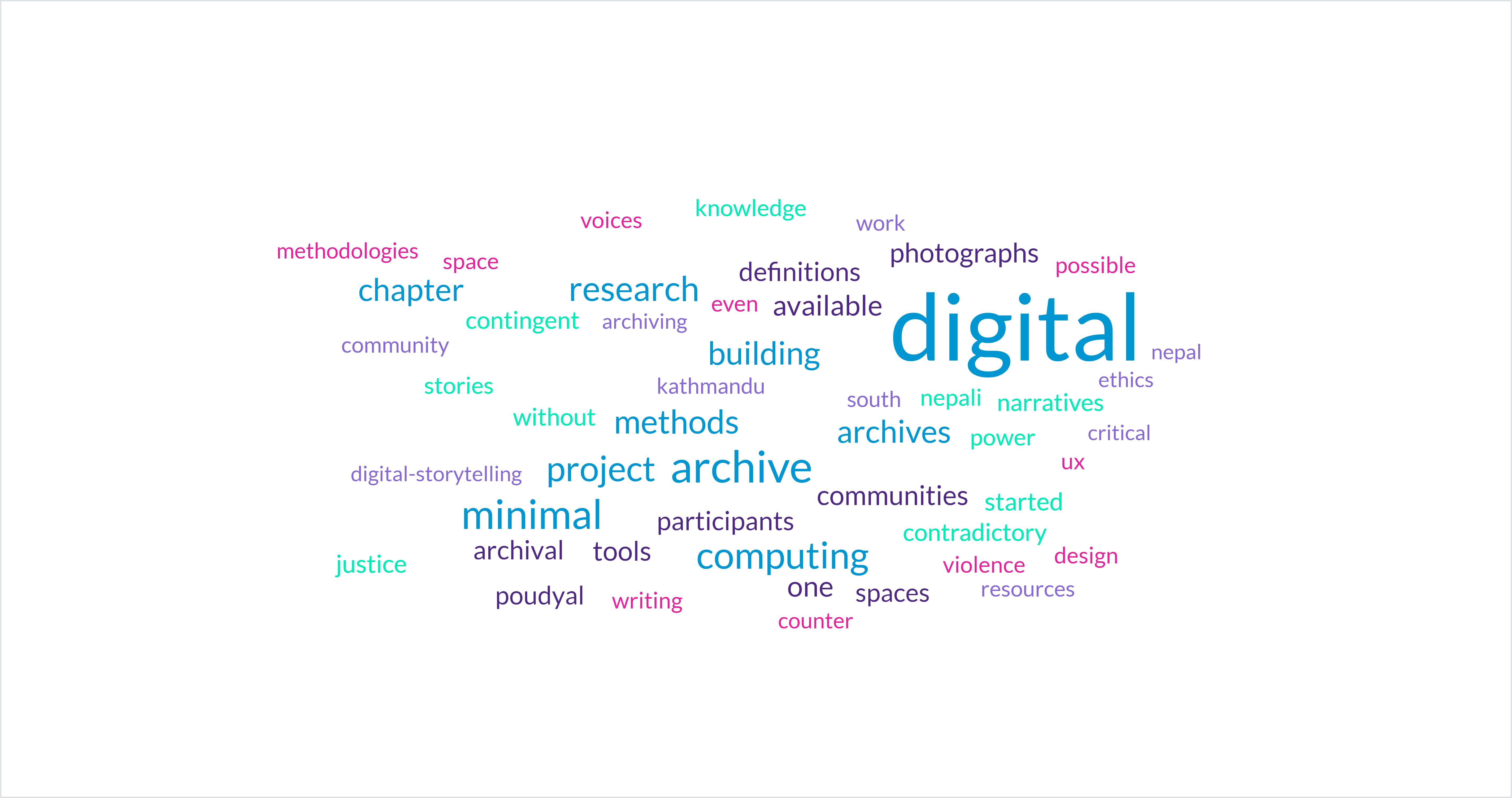
Bibhushana Poudyal shows a bit of an opposite in their work with digital spaces. They chose to show how “many spaces and communities with interest in digital projects lack access to not only resources, capacity, and institutional support for their work but are excluded from the definitions on digitality, digital archives, and digital methods and methodologies” (207). This continues as a parallel to Temptaous’ work when they share “the continuation of these inequities perpetuates the dominance of privileged socio-symbolic order and its law and language and further subalternizes the voices of minoritized and marginalized groups of people” (208). Both of these pieces share a similarity in that they are very focused on those traditionally “Othered” write their stories and the importance of that.
While I love the connections in the paper to things like Bricoleur the most powerful part of the paper is the last three pages. Bibhushana states “’Harmonious archives’ tend to bulldoze over complexities and heterogeneities and end up essentializing diversity” (220). This moment really opened up my thinking, much like when I had a conversation about being an “Ally” to the LGBTQIA+ community and was told about changing the language to “Accomplice.” This person told me that I needed to be more than help on the sidelines of the community and only available when needed. This thinking about diversity hit me in same way. Diversity has become so much of a buzzword that we (and I mean those with power) need to rethink what the terminology means or has evolved. It made me want more and think about how I have found myself using these terms.
Both chapters were very powerful in terms of showing the “other” and ways to incorporate and evolve research for access to everyone. By opening the doors of the ivory tower, we have more powerful discussions by more diverse voices. These voices are ones I am willing to stand, listen, and champion. They make me proud to be an instructor and help me know that I am at the beginning of something special, with special people.
Week 7 (2/22/24)
I was extremely interested in reading Andersen’s piece linking genre and activity theory with digital media because I was hoping that it would help me make sense of digital rhetoric in ways that I have struggled with during the semester. Turns out while an interesting article, it muddied the waters for me more than it helped clear things up. Why?
I have been struggling with the difference between medium and genre, thinking that they were basically the same thing. I had to simplify it immensely (start from the beginning) to make it make sense. Purdue OWL states that “genre and medium are closely related, although a bit different. Genre is the form of your writing (a business letter, memo, report). A medium is the way in which a piece of writing is delivered (email versus a mailed paper copy, for example).” It is in taking this step back and simplifying that I realized that I have been stacking concepts on top of each other and not unpacking them enough to fully get what I needed (Thank you imposter syndrome for kicking in).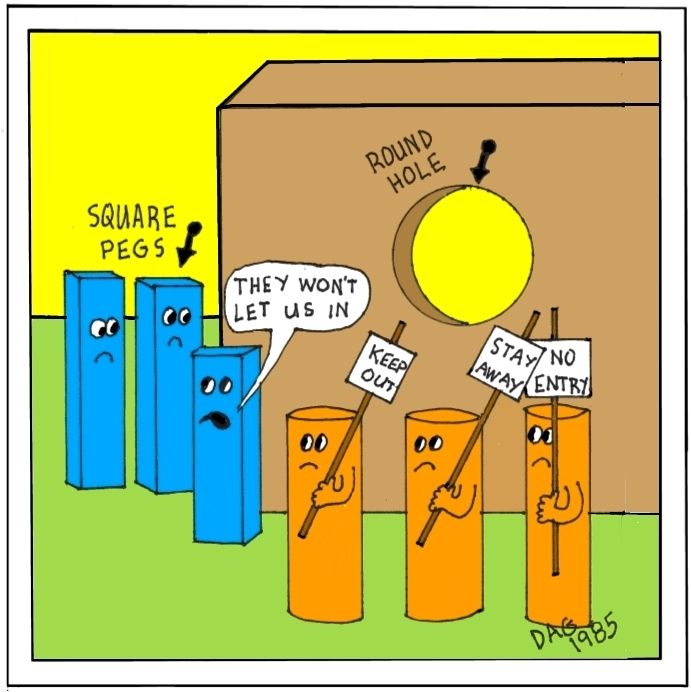
From an activity theory standpoint, I have been continuously trying to place the triangle block into the round hole and hoping it fits. I was reading the idea of hashtags as artifacts or tools rather than genres themselves. It wasn’t until I was talking with my students this week about social media uses (which I am admittedly distanced from. Dare I say Luddite) that I realized that hashtags are not artefacts to them. They are an activity unto themselves because they do more than classify the post, they add and give more information, place a comment within a larger discussion (giving context), and sometimes (to my students) are more informative than a social media post.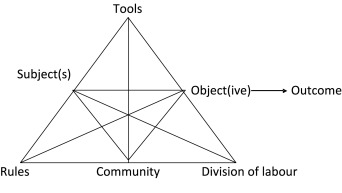
(Image is based on Engstrom’s Activity Theory Framework)
I really love that this week my first year college students were the ones that helped me do two things: take a step back to not overthink and teach me about social media protocols (their words). I felt both cowed by their knowledge and my lack of knowledge, and impressed by how generations make meaning with new technologies (connecting to McMullan’s use of Epochs).
References
Adamides, Emmanuel D. (2023). Activity theory for understanding and managing system innovations. International Journal of Innovation Studies. 7(2). 127-141. doi.org/10.1016/j.ijis.2022.12.001.
Purdue OWL. (2023). Genre and medium. Business writing for administrative and clerical staff. https://owl.purdue.edu/owl/subject_specific_writing/professional_technical_writing/business_writing_for_administrative_and_clerical_staff/genre_and_medium.html#:~:text=Genre%20and%20medium%20are%20closely,determined%20by%20audience%20and%20purpose
Week 6 (2/15/24)
I am fascinated with the idea in Richter’s work on network-emergent rhetorical invention because of the digital elements that he includes as part of the digital environment as rhetorical elements. “Dedicated focus on the specific components converging to enable rhetorical invention on social media, like the online cultures, algorithms, platform designs, and interfaces that play vital roles influencing contemporary online discourse, allows theorists of rhetorical invention to not only identify specific elements at play, but also to trace their convergence and examine how they contribute to the affordances and constraints of social media rhetorical environments” (2). This focus on the environment of social media (and digital spaces in general) as a part of the rhetorical process is one that I find important to the creation in those spaces. Specifically, how these rhetorical choices change personal, social, professional, and civic enterprises for a new generation.
This is an extremely poignant issue of rhetorical invention for me because I just had a conversation with my students this semester and asked them where they get their news and information from. Almost all of the students stated that they get their news from social media sites, claiming TikTok and Instagram as the top two places for news. That is extremely scary thought for me because of the power that algorithms and online cultures play in this collection of news. This goes beyond reputability of sources and digs into the collation of news and information, who is in control of that information, and (in some ways) the game of telephone that is played in social media spaces.
If we as researchers don’t use theories and frameworks that are built to understand these new cycles of information distribution, then how can we understand the rhetorical use of information and the programs that are used to disseminate that information. Maybe, we are headed into uncharted territories with information, much like when new technologies have changed rhetorical stances in the past, or maybe information and technology will (has?) begun moving faster than the rhetorical tools can keep up? I appreciate Richter’s response to these thoughts in stating that, “As rhetorical situations and ecologies evolve, the forms of rhetorical invention they enable evolve as well (and oftentimes lead to further evolutions). Network-emergent rhetorical invention is evolving: while fundamentals of humans, hardware, interfaces, cultures, communities, discourses, code, algorithms, and infrastructures work in generally consistent patterns, their interactions and resulting inventions evolve rapidly, innovate daily, and mutate unpredictably” (13).
*side note: I want to try some of his in class assignments in his conclusions in my classes.
Anytime Rhetoric, Technology, and Power (or corporations) get involved my brain goes to the cyberpunk aesthetic. I wonder if there are rhetoricians in these dystopias and what they talk about. (images from Cyberpunk 2077, Blade Runner, Matrix for a solid list of cyberpunk info https://en.wikipedia.org/wiki/Cyberpunk)
Week 5 (2/8/24)
In part two of Rickert’s Ambient Rhetoric is where I really begin to struggle with his use of Heidegger and that is what underpins my hesitations of the text and the arguments that he makes. Rickert seems to acknowledge and then brush off the issue that his choice of historical works/concepts/frameworks “can appear to resurrect rustic nostalgia, to say no to technological advance, to advocate an odd conservatism” (272). This continues in the paragraph when he states that “this kind of formation, of course, is implicit in the politics of blood and soil, particularly the horrors of fascism” (272). He acknowledges a problematic ideal inherent in the concepts he works with, but he seems unwilling to move beyond them, going so far as to rhetorically push the problem to the side (I felt at least) as he discusses “terrior” and French wineries.
He continues this in his defense of Heidegger later in the chapter. Heidegger, Rickert says, “Lends himself to nostalgic readings, as if his work were a long lament about the uprooting change of modernism and a call to return to a more ‘authentic’ form of being together” (274). He again continues this acknowledgement by addressing Langs critique that “between Heidegger’s writings and his silence both about his affiliation with the Nazis and on Nazi terrors inflicted on Jews (Lang 2, 5-6)” (274). He then counters this again with his use of Scult and “maintaining distance from Heidegger the person” (275). It is here that my hackles are raised because if we read without context (time, place, events, histories, etc.) are we not just perpetrating the issues of rhetoric that Rickert is fighting against? I think if you are going to make rhetoric ambient then those contexts would be more inherent in the spaces, not less so. But maybe I am wrong (I would love to know the answer).
I do not want to make claims here about any of these researchers, I don’t think that I have the knowledge or the right to do so, but I want to address the “elephant in the room” that I feel is there. I wonder about our use of historic western rhetoricians (and other research frameworks) and where that can place our work as researchers when we use them (coming off research methods and thinking about our dissertations here). While I don’t feel any ill intent to these concerns that I am addressing about the conclusion of Ambient Rhetoric, –especially because Rickert does go out of his way to address potential issues–I wonder if our reliance on these frames affects our outcomes in unforeseen ways (this is so big picture it may not matter at all). Rickert’s text left me with tons of questions, but there are a few that I want to address here:
1) For rhetoric to be ambient does the context of space, place, and histories matter?
2) Does the historical context of our frameworks matter, or is maintaining distance important for research?
3) How should we use western frameworks (or any frameworks) that come from troubled times/places in history?
I will leave you all with a little humor to override the stress of graduate school 😊
Week 4 (2/1/24)
Today’s post is maybe more of a “Hot Take” and one that I have been grappling with since my master’s program where one of our instructors was a new materialist (and called out in the interview I mention here). So here it goes…
While I am not against new materialism as a theory, in fact I do believe that there are current issues in how we talk about rhetoric in certain ways (specifically power structures). While reading Rickert, I really struggle to think about how new materialism gives agency to inanimate objects and it reminds me of something I read over Winter Break. Dr. Richards, at the end of the Fall semester, recommended that I read the interview conducted with Bruno Latour by Lynda Walsh. In this interview Bruno Latour critiques the role of rhetoric, and specifically new materialism, as a difficult way to discuss the difficulties and limitations of communication in these spaces. This is where I tend to agree with Latour that rhetoric is not well equipped to talk about the nonhuman because of communication issues (Walsh et al. pg. 415). Following this up in her interview with Latour, Lynda Walsh (a rhetorician of science herself) states “once things come to salience and make themselves available for recruitment as allies or devices in some political action, then we are in the realm of rhetoric” (Walsh et al. pg. 417). It is here where I feel like to give an object its own agency is to limit the intent of the object in the first place.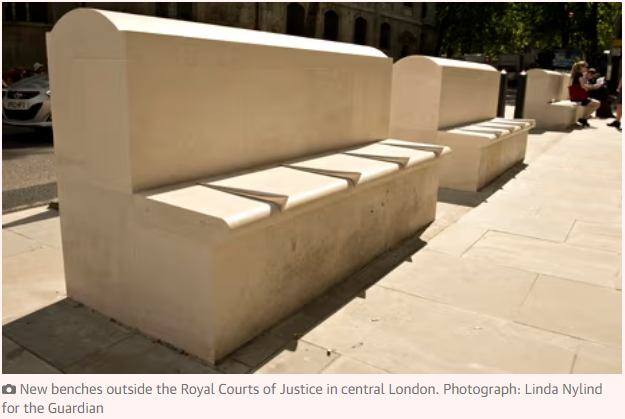
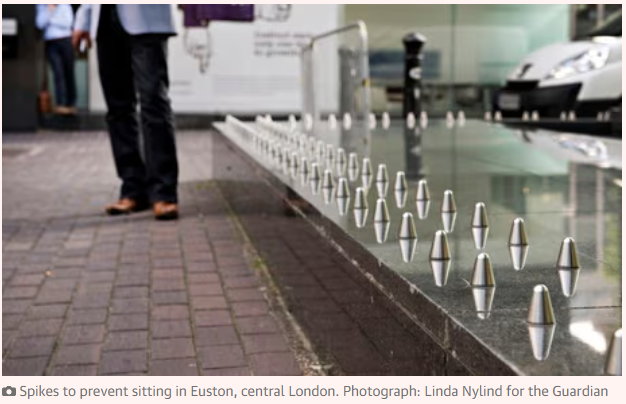 If we were to take a bench in a park or on a street (such as the ones seen in London above), would the creation of the bench have its own rhetoric for stopping skateboarding or homeless from sleeping on it? Does this not remove design choice or intent away from the creators or the city for the planning and placement of these benches? Or is it more like conversations that I have heard from Literature/English colleagues that the author is dead and once the written piece is out in the world the authorial intent doesn’t matter, it is what the audience makes of it? Hostile architecture is a simplified example of this but I struggle to think that this bench had the power to make those agential choices. What do you all think?
Citations
Quinn, B. (2014). Anti-homeless spikes are part of a wider phenomenon of ‘hostile architecture.’ The Guardian. https://www.theguardian.com/artanddesign/2014/jun/13/anti-homeless-spikes-hostile-architecture
Walsh, L., Rivers, N. A., Rice, J., Gries, L. E., Bay, J. L., Rickert, T., & Miller, C. R. (2017). Forum: Bruno Latour on Rhetoric. Rhetoric Society Quarterly, 47(5), 403–462. https://doi.org/10.1080/02773945.2017.1369822
Week 3 (1/25/24)
One thing that this text brought up to me was an idea of power structures and the production of space when talking about new media and digital rhetoric. Thinking about social media outlets and how they use space in creation of media (such as text limits, banning, image use, etc.) brings me to the work of Lefebvre. He states that space “serves as a tool of thought and of action; that in addition to being a means of production it is also a means of control, and hence of domination, of power” (Lefebvre, 26). These online “spaces” are as controlled as physical spaces in many instances, through moderation and other limitations that are set forth by those who run the spaces. A great example of this was the reddit policy controversy last year where reddit tried to better control their spaces.
This brings me to an issue and a question about the use of the canon and other western rhetorical traditions when working with new media and digital spaces. Do these rhetorical traditions enforce the power structures of digital spaces and creation? Do we as researchers, take the western classical methods of rhetoric and knowledge making for granted when we use them and the control that they place on our research in these spaces? And, if we were to step away from solely western models of rhetoric in our analysis of digital spaces, and use indigenous or other rhetorical forms would we see spaces that are more available to everyone, especially those who would historically have been excluded by cultural barriers? Would this be possible where the level of digital literacy (and in some cases of coding, a high level of English and coding language is required) can also be a gatekeeper to specific groups of people or specific spaces?
I know that this is a lot of questions, but the discussions in the Lingua Fracta text had me wondering about how we use the digital and rhetorical tools in the way that we do. I do not necessarily have an answer to any of these questions, they were just ideas that kept popping up in my side notes as I read and compared it to other texts I have recently read (such as Lynda Olman’s new edited collection on global science rhetoric).
Citations
Digital Rhetoric Wordcloud (1/24/2024). Digital rhetoric: A change in community and communication in a modern age. https://digital-rhetoric.weebly.com/
Lefebvre, Henri. (1991). The Production of Space. (D., Nicholson-Smith trans.). Oxford: Basil Blackwell.
Olman, Lynda. (2023). Global Rhetorics of Science. SUNY Press: New York.
WEEK 2 (1/18/24)
This may be a tiny rabbit hole I have gone down for my discussion question, but I am left to wonder what role identity plays in digital rhetoric (as this section only encompassed pgs. 77-80).
As Eyman discusses the idea of identity in digital rhetoric I am left to wonder what role technology has in the advancement of discourse communities and dispositions of individuals in online spaces. When I think about this idea of discourse communities, I am referring to what Gee states as “A Discourse is a sort of ‘identity kit’ which comes complete with the appropriate costume and instructions on how to act, talk, and often write, so to take on a particular role that others will recognize.” When reading the section on identity, I wonder what role the creation and acceptance into a discourse community plays in digital rhetoric as digital spaces are always evolving in both complexity and in possibilities of use (and also thinking about the evolution of AI use in these digital spaces). There becomes a level of expertise that needs to be proven to even identify in these digital spaces and that proves an identity of some sort on the part of the user (as an example I am not an apple product user and would not be accepted into a community of users).
Here I would also like to include the use of Bordieu’s Habitus (and disposition) in the creation and development of the identities in digital spaces. Bordieu states that habitus are “systems of durable, transposable dispositions, … as principles which generate and organize practices and representations that can be objectively adapted to their outcomes without presupposing a conscious aiming at ends or an express mastery of the operations necessary in order to attain them.” This seems to me to be the crux of the development and inclusion into Gee’s discourse communities and something that I wish Eyman would have spent time addressing. So, when I think about digital identities in this way I wonder if digital spaces, as they evolve, are all that different from non-digital spaces when identity is at play? If so, what are the things that make them different? And, does thinking about digital identities in this way open the field of digital rhetoric to a clearer use of both classical and modern rhetorics?
I am including here an interesting video about online and offline selves because I think this is something that we as a field have to grapple with as access, AI, and the roles that we play as instructors (or bosses/employees) evolves.
https://www.youtube.com/watch?v=SZAkZ4TzSEA
Citations
Gee, J.P. (1989) Literacy, discourse, and linguistics: introduction. Journal of education 171.1: 5–15. Print.
Bourdieu, P. (1990). The logic of practice. Stanford, CA: Stanford University Press.
I am not sure that there is that big of a difference between analog and digital. It is just easier to see everyone doing it. I had several carefully curated high school “masks*” for where I was and who I was with. I was looser with people I enjoyed. And certainly, I knew people then who projected a version of themselves who we now know is not who they felt.
My school persona was very different than who I was with my parents or grandparents, and that in turn was different than who I was when I was running the local observatory.
I think the other difference between then and now is how easy it is to access those other or prior personas. However, as several politicians know those blackface photos eventually get out.
* I think that is what we called them then.
Response to week 3:
When you bring up power structures and gatekeeping, I keep thinking about intellectual property, copyright laws, and parody. I’ve seen many examples of this sort of rhetorical digital bullying/policing in online spaces recently.
I’ll give a specific hypothetical. A small YouTuber creates a video essay critiquing a relatively mainstream comedian that happens to also have an online presence. This type of video is not unlike other critiques the YouTuber has made, except for one important detail–it deeply upset the popular comedian. Because I think that YouTube copyright policies are relatively vague (or IP in general is subjective)–and the YouTuber did use various video clips taken from the comedian–the user with more presence controls the rhetoric, and the YouTuber’s video is taken down with a copyright strike issued by the comedian. If the YouTuber had more resources, a larger following, etc. could this have been avoided?
I see this exact hypothetical play out over and over again, so I think your questions are relevant. I don’t know much about IP laws, but I know that the subjectivity of it leads to problems.
Response to Week 3 Questions: Your question about the classical methods of rhetoric and their control on our research made me think about the very word control. You suggest it relates to power, and that is true. I also believe that there is an element of organization underlying control, and I believe that is the way to view the canons. They are tools that allow the creation and transmission of a structured and organized argument that should achieve a desired effect. The rhetor has the power to create using thosee canons, and that power can be applied to the audience to persuade. With digital literacy, that relationship seems to be much more dynamic, and the audience has significant power to influence both the space and time in which the interaction occurs. As a result, the rhetor may be influenced as much as they do the influencing. I think that the canons of rhetoric still apply, but they may not be as one-dimensional or linear as when applied to speaking or written work. And I think this is the point Brooke was making is that the new theories of digital rhetoric can build off of the canons.
I am pretty sure that one of your pictures is an artists take from Rocky IV and is Carl Weathers and Stallone.
I do think it interesting that in the entire book he has not found a single person who he is comfortable just agreeing with.
Response to week 5 (Ambient Rhetoric part 2):
The Batman and Robin meme sums up how Rickert makes me feel. In a way, he’s almost channeling Whitman’s “Very well then I contradict myself. I am large. I contain multitudes.”
Your concerns about historical context are spot on. I like some of what Rickert says in book, but I think he gives Heidegger’s Nazi affiliation a free pass. It makes me think of Lovecraft. I’ve always been a huge fan of his fiction, but he was vehemently racist, even for his time. I would never think that part of himself should just be ignored or glossed over. Those qualities and ideologies must be acknowledged and dealt with. Heidegger is no different, but Rickert definitely brushes it aside.
I also like how you point out Heidegger’s nostalgic need to return to the rustic. That blatantly flies in the face of what Rickert is trying to do with ambient rhetoric. His eye is toward technological advancement and how we need to rethink rhetoric to meet those changes. I even talked about how Rickert is forward-thinking in many ways, especially with his attempt to deconstruct the subject/object binary that rhetoric has maintained since Classical Greece. It opens up new forms of agency; however, we can’t willfully ignore history and what awful things people have done to one another for the sake of turning rhetoric into metaphysical froo-froo.
I am really glad that I was not the only one that felt like I did about the Heidegger issue and I think that Lovecraft is a great example too. As someone who is into TTRPGs, Lovecraft’s influence is inherent (along with Tolkien who was also not a great person) and it makes me question foundations of what we know. Maybe that is too deep and we do need to separate the person from the idea, but if so are we just giving them a pass.
Also, I didn’t say it in my original post but the idea of the return to the rustic (along with some of the other points) made me think of MAGA culture. I don’t think Rickert was going for that but it gave me a chuckle and a Dwayne “the Rock” Johnson level eyebrow raise.
Response to Week 8:
Laura Aull in Chapter 16 also touches on “otherness” via a discussion on linguistic diversity and argues that “it is common to find writing pedagogies that support diversity in theory while maintaining linguistic homogeneity in practice” (134). She posits that teachers often profess the need to include a range of dialects as acceptable written style, including slang, in their classrooms, but those same teachers only offer assessments to be completed in SWAE. She reflects, as you do, on her experiences in the classroom to discover that she, despite her best intentions, was still complicit in advancing the use of only one language in writing, essentially adding to the issue of othering those that are not proficient in that one language. Given what you have written, I think it is very important to reflect quite often on our approaches to teaching, because even if we are trying our best, we may not be seeing our faults that might be visible from a different perspective. Your use of ally vs accomplice seemed to show that we need to think using a different paradigm if we really want to be doing what we talk about doing.
While I haven’t finished all of the readings for the week yet, I had a similar feeling with chapter 10 because of its focus on Black Feminist Rhetoric (which was super interesting). I really liked your connection to intentionality because that really connects to chapter 10 as well. So far the three readings I have finished have covered some area of “othered” communities as either researcher or research area of study. I will definitely add chapter 16 to my list of things to read in my own time (probably between the semester and SDI).
Hi Gus!
I also read Laura Aull’s chapter this week, and I wrote about it for one of my blog posts. I appreciate you pointing out the hypocrisy that Aull points out in her chapter (a hypocrisy I don’t think we talk about enough in academia, which is where “the rubber meets the road” of theory vs. praxis). Aull wisely summarizes: “[L]anguage difference is common ground, but the social value attached to different language use is not” (134). As white instructors, we must always check that inherent, ingrained bias that has been taught to us, probably by other unwitting agents of our white-supremist education system and curriculum in the United States, so that we do not continue to teach it to others, who may continue to teach it – and so on, and so on, and so on. One way to do this, as Aull argues, is to champion “linguistic curiosity” and denounce “linguistic policing” in our classrooms (134).
I love that you bring up the fact that the system has, in many cases, created ingrained bias. I think this is something that we need to acknowledge and be super aware in our roles as instructors and in our own learning process to do everything we can to break the cycle. I think “linguistic curiosity” is important in our classrooms, but I think that we also, as instructors and mentors, also have that “linguistic curiosity” in our own research and never stop learning ourselves, which I think when we become more and more specialized can be something that happens in our field (or at least I have seen it with some faculty at previous institutions). Ultimately it starts with us as you point out.
I LOVE how many responses this thread is getting, Phil! I also read Bibhushana Poudyal’s “Counter, Contradictory, and Contingent Digital-Storytelling through Minimal Computing and Community-Praxis” this week. While I think it’s important to think of marginalized/“othered” voices and how they write and construct meaning, it’s also interesting to think of one’s positionality. Poudyal, for example, acknowledges that she is “building this archive from one of those locations (the US) that produces or has the power to produce such problematic portrayals, disseminate, and amplify them” (2022, p. 210). She lives in America, and it’s this affordance that allows her to use digital archiving as a counterstory. I recently signed a publisher agreement for a book chapter that focuses on the Hudood Ordinances and how these laws affect women in Pakistan. However, I’ve never lived in Pakistan nor can I read or write in Urdu (I can only speak it, since it’s my mother tongue). I wonder: Does my research or ethnic heritage give me the ethos to speak about women in Pakistan? Would I have the affordance to even produce such a chapter if I had spent my entire life in Pakistan versus growing up in sunny California?
Sana, I think you have such a thoughtful response and because you are asking those questions you are a thoughtful researcher. I will say that I think your question about ethos is one about a spectrum where you have a lot more authority to speak on the subject than others but maybe less so than someone “on site” with the same connections (but that may or may not play into the affordances you talk about in your second question). You would definitely have more authority than someone like myself, a white male. And their lies the problem with some of the research history, those who did the research were coming and going from these sites and discussions with the authority of outsiders, making claims about communities with little to no connections, making judgments that they were not qualified (outside of their own belief) to make. As a researcher who is interested in power structures (and breaking them) I am hyper aware of these types of issues and the questions you ask. As an educated, cis gendered, white male am I even allowed to ask these questions? I don’t know but I do know that there are qualified people like you (and others) that bring more to the table than I ever could and that’s important.
***side note: when that chapter comes out please share it with me. I want to read it. It sounds super interesting.
I think it is very important to discuss the credibility a rhetor/author/etc. must have to accomplish the goal of their work. In your case Sana, while you don’t have first hand knowledge of Pakistan, you can speak to some of the aspects having grown up with the cultural aspects many in the USA will never know. It reminds of when MLK’s family members are asked to provide comments or interpret aspects of MLK’s work – they didn’t write it or necessarily even know the foundation of MLK’s particular piece, but they knew the man personally, and that accounts for a lot. The expertise may not necessarily be directly linked, but there is a level of knowledge beyond what most have. I think that we also have the obligation to challenge credentials – I don’t mean in a mean way, but asking for how a person is an expert or very familiar with the knowledge is good academic work to ensure we have a better picture of background, context, etc.
Week 11:
I also hate the sound of my own voice. I think it’s similar to seeing your reflection flipped. It is technically still you, but a version of you that you aren’t used to. It’s only when a recording is so unfamiliar (with static/mic quality being poor enough) that I don’t find this effect to happen, maybe because I don’t even register it as “mine.”
It’s interesting the comparison to the prerecorded vs live audio tour, and how different that experience was. It shows that not only are there unique design elements to engagement through audio but also exemplifies that importance of interactability with something like this.
I don’t know what it is about hearing yourself talk but I am glad that I am not the only one that feels that way. I challenged myself this week to actually try some audio summaries….still hate it and it took me multiple takes because of that.
As for audio tours, I wonder how much interactivity of our technology has changed how we deal with aural information like that. In looking around so many places have virtual tours that are interactive. Also, how is the use of AI going to help define these technologies (and define our history because of it)?
I am not sure that anyone likes hearing their own voice. Other than little kids.
Military tours are so much more fun with veterans, even from the wrong branch. They are just better able to read between the lines and talk about similar experiences. I am glad you got to enjoy it with your friend.
So true about having someone who is a veteran on tours like that, I have done it a bunch. I think you get at the heart of something that I was trying to address about them being able to read between the lines. I think that the issue with a lot of work without context (or as I hear a bunch at my institution, inform and prepare students) is that people can be creative but without context (or timing in some cases) the information and creativity is lost.
It is also like having someone with a science background with you at the Exploratorium or California Academy of Sciences.
I took my kids to the Exploratorium this week (son’s spring break) and after I would explain things to him, he would start explaining it to the next person (usually someone older). I was proud, but tried to explain that sometimes strangers want to figure things out themselves.
Phillip,
Your reflections on the discomforts of hearing your own voice resonates with many — myself included. It seems to be a common sentiment. Nick’s consideration of audio acting similarly to the unease of seeing your flipped reflection adds a curious point. For me, it highlights the disruption between what we expect to hear/see and the reality of it, or maybe I’m not explaining that well enough. Nevertheless, it is neat how poor audio quality could mitigate this discomfort — maybe by making the recording seem less recognizable? Like a photo filter! Does adding a level of distortion add a layer of interest? Something different, anyway.
The comparison between prerecorded and live audio tours is an important consideration in the role of interactivity in shaping user experiences. It emphasizes the significance of responsiveness and adaptability in educational and informational contexts, especially as technology evolves. Integrating AI in defining these technologies and shaping our historical narratives is an intriguing prospect that warrants further exploration.
Also, John, I could see how military tours would be more engaging if they were veteran-led! Their ability to provide context and share personal experiences enriches the tour experience, — noting the importance of understanding and interpreting information within its broader context. The story of your best friend taking the lead and explaining things to others during the tour reflects the power of knowledge-sharing and peer learning!
This discussion helps me to better understand the complexities of audio perception, the role of context in interpretation, and the dynamics of knowledge-sharing in educational settings. So, thank you! I enjoyed the conversation 🙂