Top Artifact 3:
In the Module 12 Archive, I was given a series of situational statements and asked to indicate which ones I felt believed best represented the concept of aggression. Out of the 25 options, I chose items 5, 7, 10, 11, 12, 13, 14, 17 and 24. I picked this artifact to post because the topic of aggression interested me more than the others topics from Modules 11-14. Also, I had a few of my friends do the questionnaire while I did and it was a lively discussion interpreting our different views on what can be considered aggression.
Number 5 provided the example of a juvenile gang attacking members of another gang. To me this represents aggression because it seems like a random act of violence due to in-group vs. out-group rivalry. Similarly, number 13, An enraged boy tries with all his might to inflict injury on his antagonist, a bigger boy, but is not successful in doing so. His efforts simply amuse the bigger boy. This also represents conflict between two people which may stem from in-group vs. out-group rivalry.
Number 7 provided an example of a man viciously kicking a cat, and number 17 a hunter kills an animal and mounts it as a trophy. To me these seem like a no-brainer and I’m sure anyone would think it as being completely aggressive in nature. A man is a much bigger creature and had no need to kick something so much smaller than he is. Likewise, if he is not hunting for food, and only intends to kill the animal to use as trophy, it is nothing more than an act of cruelty. Number 10 provided an example of Mr. X, a notorious gossip, speaks disparagingly of many people of his acquaintance. While not an outward form of aggression, gossip can lead to many negative outcomes and unnecessary conflicts.
Numbers 11, which provided an example of a man mentally rehearsing a murder he is about to commit, number 12, an angry son purposely fails to write to his mother, who is expecting a letter and will be hurt if none arrives, and number 14, a man daydreams of harming his antagonist, but he has no hope of doing so are all perfect examples of premediated acts of aggression. No act of aggression can begin without first the thought of committing the act and with this potential, these examples are therefore aggressive in nature.
Lastly, number 24, in which a person commits suicide, I feel this is an act of aggression because this is still murder, though done onto the self rather than another individual. For several other items, I did not consider them as being aggressive due to the fact that they seemed to be conditional in nature. For example, number 19, a physician gives a flu shot to a screaming child, is not necessarily an act of aggression because is it for the child’s benefit. Likewise, number 22, a bank robber is shot in the back while trying to escape cannot necessarily be considered an act of aggression because the robber is breaking the law and brought that outcome upon himself.
After completing this artifact, I have to say that I discovered that aggression is not as clear cut as it may seem from the onset. For example, me and my friends not only had differing opinions on what we considered to be aggression but we also had different opinions on why the acts could be committed. Basically, we all considered, for most of the 25 items, a different context for different examples. It is a fascinating study to think about what counts as aggressive when the meaning behind it is actually considered. This is a good example of “Never judge a book by its cover” as well as “Things are not always as they seem”.
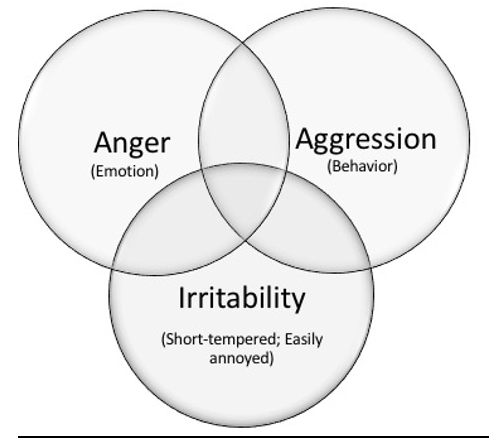
For a representative image to follow this post, I chose one which represents that aggression alone is not to blame for what we perceive as aggressive behavior. Three separate factors play into this: irritability is an emotional state, which leads to harsh reactions, anger is an intense emotion affecting our current perception, and aggression is a behavior which is an outward expression of anger. Together these all overlap and affect our decisions to act in ways which can be emotionally charged, stem from being annoyed or through expressing our current behavior.
Top Artifact 2:
After reviewing all the potential artifacts to archive, I ultimately chose the one from module 7 to use and unload to my site. This one spoke to me because of how it addressed the concept of cognitive dissonance. The attitude survey was very easy and I answered all the questions with a quick and decisive 4 for “agree” completely. However, for the behavior survey, my previously selected answers, of which I thought to be certain, were tested when I realized that my attitude towards many of the subjects did not match my actual behavior.
This shocked me because as the textbook noted, it is quite uncomfortable to know how inconsistent we can be despite holding our own attitudes, and preceding behavior as concrete, predictable and something to be absolutely sure of. I learned after completing this artifact that no one can escape cognitive dissonance because I previously believed that I was somehow immune to this concept. For example, while I always wear a seatbelt, donate to charities for the homeless, and would assign a designated a sober driver where alcohol is concerned, I did not engage in activities such as proper weekly exercise, habitually recycling or always reading the assigned material before class starts each week. I could answer the attitude section almost instantly but my behavior did not necessarily coincide with my previously held convictions about myself.
Having experienced cognitive dissonance for myself in this manner has certainly expanded upon my existing knowledge of the concept. I thought it was interesting, but nothing more until I experienced it for myself and I now know how easy it is to fall into this kind of mental trap.
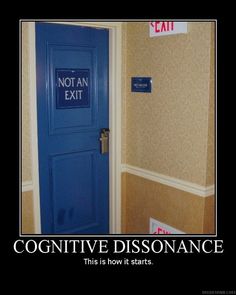
The representative visual image I picked for this post helps to illustrate cognitive dissonance and how it addresses the idea behind the perception of contradictory information. We don’t like it when we are faced with inconsistencies and this meme shows a perfect example. The signs say “EXIT” while the door reads, “NOT AN EXIT”. Even though it is humorous, it masterfully represents how we would interpret this type of situation when information is contradictive to how we would normally perceive some aspect of natural world. We laugh at this because it is a contradiction, one that we can recognize instantly, yet we can often fail to see them in our own lives and in ourselves on an ongoing basis.
Top Artifact 1:
After completing all artifact assignments for Modules 3-6, the one which stood out to me the most is from Module 4: Social Cognition. This artifact dealt with the topic of heuristics. Even though the focus of assignment 1 was also based on the use of heuristics, I found the concept incredibility interesting so I was pleased to see that an artifact also incorporated them and this is why I chose to select this particular artifact to be documented on my ePortfolio.
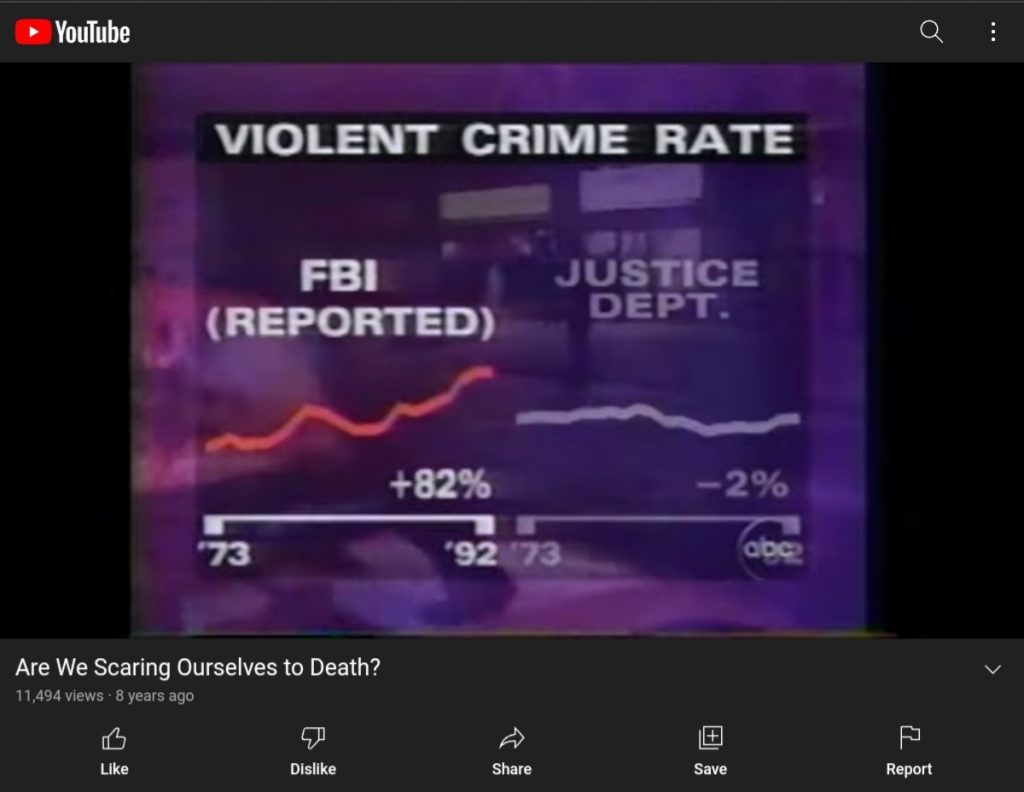
From completing this artifact assignment, I was able to expand upon my knowledge of how heuristics are used in everyday life and learn about their effects when used by the mainstream media. For example, I wrote about how, according to the provided video “Are We Scaring Ourselves to Death?”, the media selectively shows data regarding American crime rates to the public at large. Displayed in the video was an analysis by the FBI which showed an increase of 82% in the violence crime rate in America from 1973 to 1992. This was compared to one conducted by the Department of Justice which displayed an increase of only 2%. What fails to be explained by the media is the fact that the FBI data was based on the increase of documented reports about crimes committed and not necessarily the crimes themselves. It could be surmised that crime rates were no different in the almost 20-year time gap but simply that reports were just more likely to occur by then.
I used this information to make connections regarding the media’s oversaturation of heuristics. In this case, I cited the use of the availability heuristic which describes our tendency to use information that quickly comes to mind and is easily recalled when making decisions about the future. If someone watched the news and the kind of reporting that states American crime rates have increased 82% in the last 19 years, this knowledge would certainly be remembered, easily recalled and perhaps even dictate choices. Given how startling this information is, it effectively controls people and as the title of the video implies, it is scaring people to death. People will be too scared to even go outside because of how easily the information about crime rates is recalled and put front and center in their mind.
Additionally, the media clips were very selective in which cities were portrayed and how. B-roll was taken from dark lit shots of crime scenes in U.S. cities such Detroit, Chicago, St. Louis and Baltimore were prominent. These are of course infamous places associated with high crime which bring to mind instant feelings of fear adding to the depth of the message they are trying to convey. This brought to mind the representativeness heuristic which is used to access how likely a certain event is, and that often dictates our decisions by assessing how similar it is to an existing mental prototype. And the prototype being established by media coverage is that living in a commonly known violent area entails that some crime will happen to anyone in said cities. From the media’s portrayal, the more violent a city, the more likely a crime will occur to any given person despite the fact that crime rates in those cities were significant lower during the time in which this news report was done.
Prior to completing this artifact, I had written about heuristics only in hypothetical situations but doing this assignment allowed me to see them use in a prominent real-world setting. This offered me a chance to see what effects can come from their use and what to possibly avoid myself when I inevitably see them in use again by the mainstream media as it is largely how they operate. Because it stuck me as such a powerful and attention demanding image, I decided to include a YouTube screenshot from the video as my visual representation which displays the FBI and DOJ statistics about American crime rates from 1973-1992 mentioned earlier. This image more than others in the video got me thinking about heuristics and their consequences, reinforcing what I had previously learned.