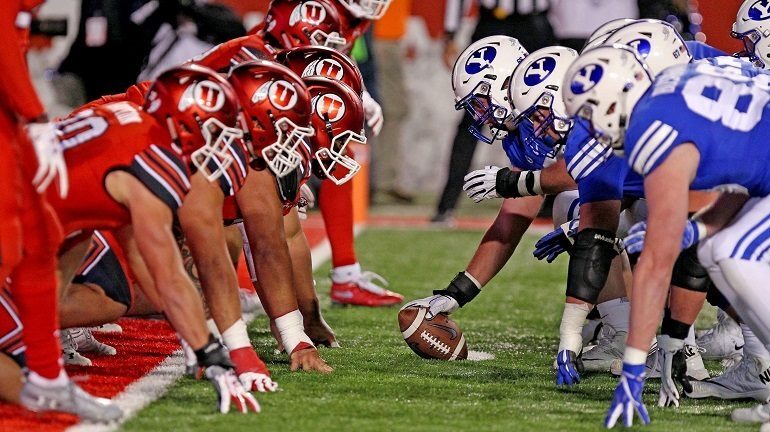
The moment the game kicks off, everything else in Utah stops. It doesn’t matter where you’re from, what city you live in, or if you even went to either school, if you live in Utah, you’re either Utah or BYU. There’s no in-between. This isn’t just a game. It’s a state-wide obsession. It’s the Holy War.
The Utah vs. BYU football rivalry is one of the most intense in the country, and for people who grew up here, it’s personal. The rivalry dates all the way back to 1896 and has carried on for more than a hundred years. But it’s not just the age of the rivalry that makes it so intense it’s the culture behind it. BYU represents a school owned by The Church of Jesus Christ of Latter-day Saints. Utah, on the other hand, is the state’s flagship public university. When these two meet, it’s not just about touchdowns. It’s tradition, pride, identity, and sometimes, it even feels like life or death.
As a diehard Utah fan, this game means everything to me. It’s more than just wanting my team to win. It’s a feeling that hits different. Growing up, the Holy War was always the most important game of the season. I remember sitting in classrooms with kids arguing over who was better. There was constant trash talk, before, during, and after the game. It wasn’t just about the score. It was about bragging rights for the entire year.
I’ll never forget going to the 2019 game at LaVell Edwards Stadium with a bunch of my best friends. We were wearing Utah gear, loud and proud. The second we walked in, we got looks. Throughout the game, people were yelling at us from all directions, and I even had popcorn and doughnuts thrown at me. I’m not exaggerating. BYU fans were literally throwing food. And even though it was wild and kind of hostile, it honestly made the rivalry feel even more real. That’s how serious this game is. It’s that deep. Felt great talking trash the moment we won the game though.
Another moment I’ll always remember is the game when BYU’s Taysom Hill, now QB for the Saints, threw a pick-six to start the game. It first play, and Rice-Eccles Stadium absolutely exploded. I mean, I’ve never heard a stadium that loud in my life. You couldn’t even hear yourself think. That one moment set the tone and made it feel like Utah was in complete control, and the whole crowd fed off it.
But this rivalry has had its share of back-and-forth moments, too. Like in 2021, when BYU finally snapped a nine-game losing streak against Utah. That win meant everything to Cougar fans. The field at LaVell Edwards Stadium filled with students, players, and fans who had waited over a decade to finally beat Utah again. It was emotional. You could see it in the way people celebrated, this wasn’t just any regular-season win. This was history.
And speaking of history, there’s so much of it. From Utah’s undefeated season in 2004 that ended with a Fiesta Bowl invite, to crazy endings and iconic soundbites. One of the most unforgettable was in 2008, when BYU quarterback Max Hall said in a press conference, “I hate Utah.” He didn’t stop there. He called Utah fans “classless” and said he “couldn’t stand them.” That quote became fuel for Utah fans for years. Then, years later, Utah quarterback Cam Rising got his chance to fire back. When asked how he felt about BYU, he simply said, “I hate BYU.” No hesitation. Just raw rivalry. And we can’t forget Tyler Huntley’s iconic postgame quote after beating BYU: “They so poo poo.” It was short, funny, and instantly legendary. These moments don’t happen in regular games. They happen in the Holy War.
Even when the rivalry took a short break after Utah moved to the Pac-12, the energy didn’t go anywhere. If anything, it got stronger. Now, with BYU in the Big 12 and Utah joining in 2024, the Holy War is officially back on the schedule, and it’s going to matter more than ever.
Players feel it too. A lot of them grew up in Utah, surrounded by this rivalry their entire lives. When they put on the jersey, they aren’t just playing for themselves or even their team, they’re playing for their families, their schools, their cities. It’s emotional. The stakes feel higher. Whether it’s a freshman getting their first taste of the rivalry or a senior trying to go out on top, the intensity is unmatched.
The thing about the Holy War is that it’s not just one Saturday in the fall. It’s all year long. It lives in the conversations, the arguments, the memes, and the memories. It splits households and brings out the loudest, most passionate version of every fan. And the best part? It’s not going away.
In a world where college football rivalries sometimes fade or get watered down, the Holy War stays real. It stays raw. Because here in Utah, football isn’t just a sport, it’s really is a part of who we are. And when it’s Utah vs. BYU, you can bet the whole state will be watching.
Leave a Reply