Exploring Culture
Spanish 101 has allowed to me to become more engaged and have a better understanding of Spanish culture. Through this class, we have engaged in understand holiday traditions, greetings, and culture differences. These practices have assisted me in creating a more diverse perspective and view on the world.
I find exploring others culture is an important aspect of learning a language. It helps us understand on a greater impact on why certain traditions are there and not here. For example, the traditional “kiss” greeting as seen very often is a bit different than what we have seen. This greeting is about creating a closer friendship and connection with those we know and not every does it. Additionally, Spanish festivals are so vivid and full of life. The Marzo fesita Semana Santa Sevilla is a holiday that is a lead up to easter. This holiday helped demonstrate how religion is connected to their culture. I have always tried to keep an open mind when speaking on other cultures as I believe that we can celebrate and show value in other’s traditions by having a greater understanding.
Engaging in Communities
To be able to engage with a greater community outside your own circle create a space for togetherness. The ability to engage with a community helps us cave way to a better understanding of the views and opinions of others. In this class, we often interacted with one another through discussion boards. These boards help us not only understand the individual person but also grasp an understanding on what they value. These values helped me create a more open understanding. However, engaging in your community is larger than talks on a discussion board. Engaging in your own community helps you bring forth change and improvement to our environment. Everyone has a unique skill set that can be used to improve others lives and if we brought those skills together we could create a better world.
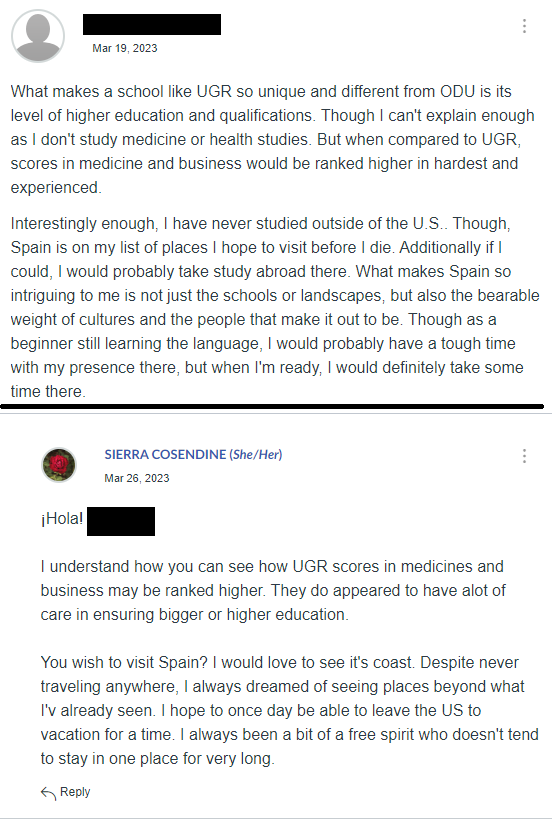
The online world and the fact that many peoples lives now mean staying in doors provided a difficult opportunity when it came to engaging with communities. I think the most effective way I had the chance to do was through the discuss boards. These discuss boards provides not only personal, but culture topics to help us engage with a larger community. In the discussion board listed below, the class was tasked with looking into how schools in Spain differ from ODU. I believe this was an important exercise as I helped us show some light of how other schools interact with a larger community.
Interpersonal Communication
I had done various readings and writings within class to help improve on my Spanish skills. To further expand on the idea of discussion boards, the provided the opportunity to work on more communication skills. A conversation with another Student allowed me to not only see how others were doing, but noticed the flaws in my own writings.
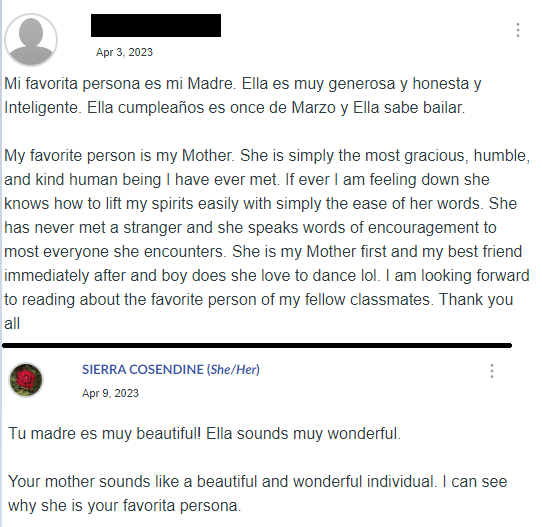
I have blurred out names for those individual’s privacy, we had an assignment labeled DB 5: Mi persona favorita in these discussion boards. In this discussion board, we were instructed to write about our favorite person in Spanish and respond to others in Spanish. It was rather difficult making sure to stay accurate in not only grammar, but spelling. I think these exercise were important in our communication skills. The ability to properly communicate with others in a different language is crucial for crossing a language gap. I think even if I didn’t type out words as proper as I should, the ability to get my point across in a way people can still understand is a step in the right direction.
Presentational Speaking
Within the class I had not only met with my professor for speaking activities, but also I interacted with other students in Flipgrid post. These post helped me show and practice my Spanish speaking skills and allowed me to interact with other classmates.
In keeping with the idea and theme of togetherness and collaboration, I have attached a media file speaking from one of our Flipgrid post, speaking about my friend, Layla in Spanish and why I admire her.
This exercise provided us an opportunity to talk about someone other than ourselves and why they were important to us. Additionally, it showed us other peoples view points and how they admire them.
I had many speaking opportunities throughout the class that allowed us to expand my vocabulary. There are some areas where I certainly struggled in such as I had issues with understanding what the individual is saying, but I couldn’t put it properly into words. This challenge can be overcome with practice and keeping a more open mind. Another challenge I found when speaking (and writing) is knowing what a word means in english, but being unable to find the word in Spanish.
Regardless of the challenge I feel each one provided an opportunity for improvement. The way I look at Spanish can only improve from here as long as I remember my mistakes and work to try and improve.
Presentational Writing
Some of our writing work outside of discussion boards was through Lingolearning. Through there, we had to write and review information. I selected a particular activity that required us to research information in Spanish and give feedback on our results. Learning to properly research written material and understand it is an important part of the writing process.
Below we had to research the most popular social networks in a given Spanish speaking country. For this particular assignment, I selected Bolvia. In the assignment we were instructed to write about the differences between search results when researching in English vs Spanish. I believe this assignment helped me in my writing capacities as it allowed me to work on typing in Spanish various information and how different words created different results. This will late prove useful in reading as well.
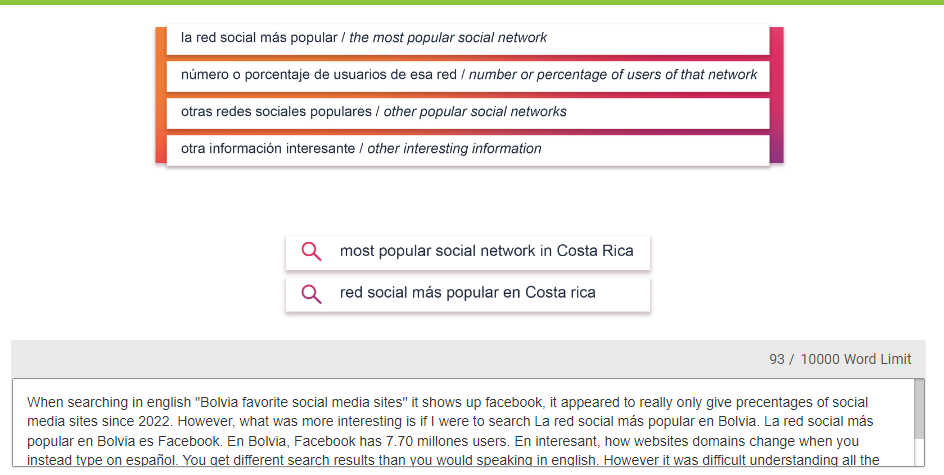
A sample of a writing exercise
Interpretive Listening
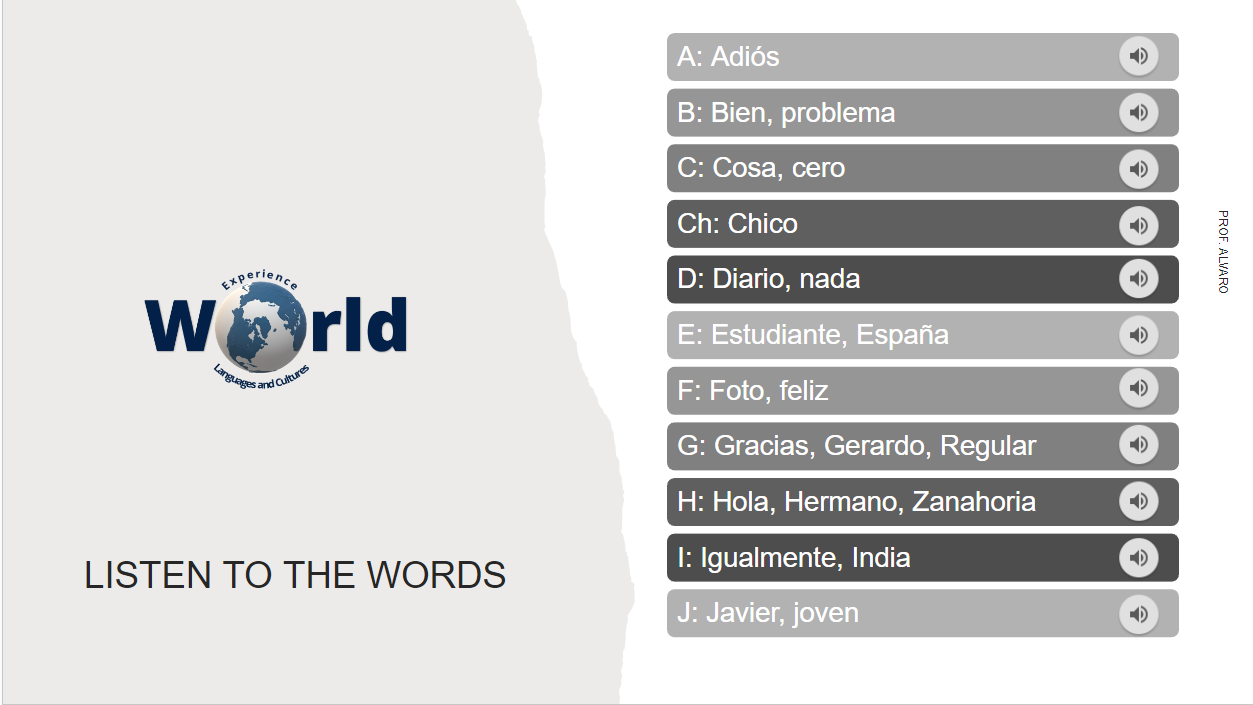
Listening is an important part of learning Spanish as it is required in order to learn how to properly pronounce words. I was provided with many opportunities to listen to Spanish speakers. However, I believe one of the best assignments that assisted me during my time in this class was an assignment on how to pronounce certain letters.
In this assignment, we had to listen to how certain letters are pronounced and then listen to the words being said. We later had to then record ourselves repeating the words and pronouncing them correctly. I believe this assignment set up the foundations to properly understanding how Spanish words are spoken and sound. Without this, I believe I may have struggled further in how to practice pronouncing certain words. I for certain struggled on pronouncing “r” sounds, however through practice. I believe listening, writing, speaking, and reading go hand in hand. The ability to properly listen, helped me learn the steps to properly speak especially tricky words in Spanish.
Interpretive Reading
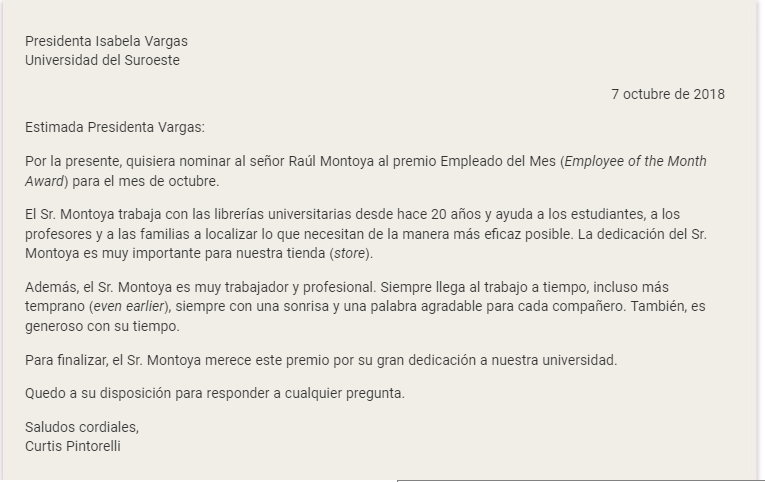
Throughout the semester we had to learn how to read large blocks of text and understand what was being said. Part of the tricky issue with these is sometimes I may have not known all the words that were being said. I had to reliant on context clues and using the knowledge of how to use a Spanish dictionary in learning how to read these words. These readings were often done through articles, emails, videos, and communicating with peers.
In Lingolearning, we often had large emails like the ones below that we had to read. In these emails, we had to determine what was being spoke, what formality it is, and the context of the letters. These proved rather challenging especially when trying to determine sometimes if this was a more formal or informal letter. I felt these letters provided a nice way to see how someone might write professional and casual letters in Spanish. This allowed me to try and think of how I may format letters in Spanish in the future.