Interpretive, Interpersonal, and Presentational Modes of Communication
Introduction
My name is Justin Saldivar, I am 18 years old at Old Dominion University and looking to pursue a degree in Cybersecurity, I picked up Spanish as It could be useful in the field I’m majoring towards. In this document, I will showcase my current progress in understanding and speaking Spanish.
SPAN 101
Exploring Culture
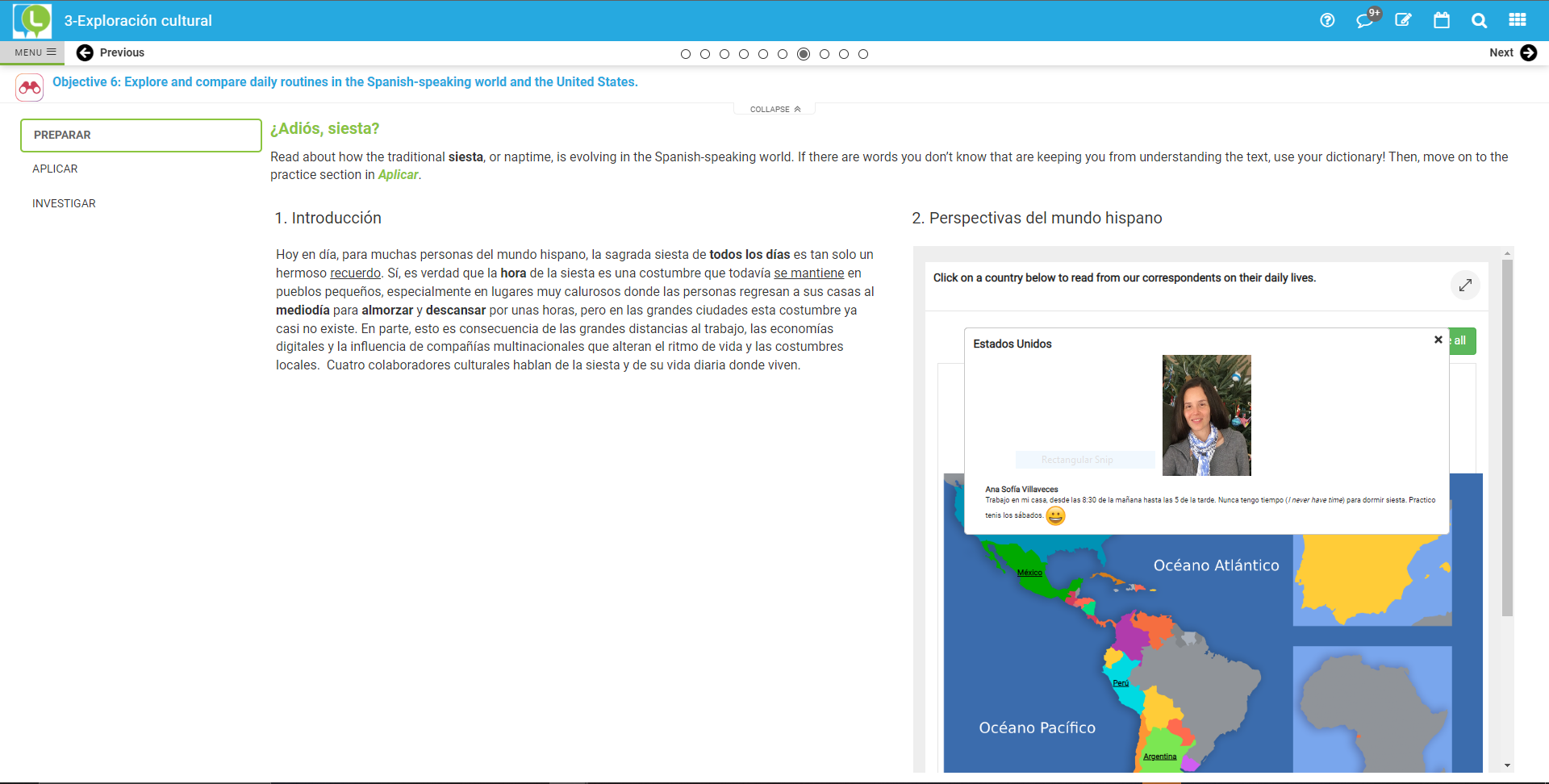
Before 3.6’s assignment, I had heard of the word Siesta, but had little clue of its meaning or its origins. The assignment gave me great insight into a practice that makes sense in the more hot climates of South America and any primarily Spanish-speaking place that practices it.
"Today, for many people in the Hispanic world, the sacred siesta every day is just a beautiful memory. Yes, it is true that siesta time is a custom that is still maintained in small towns, especially in very hot places where people return home at noon to have lunch and rest for a few hours, but in big cities this custom it almost doesn't exist anymore. In part, this is a consequence of long distances to work, digital economies and the influence of multinational companies that disrupt the pace of life and local customs. Four cultural collaborators talk about the siesta and their daily life where they live."
Above shown is the translated text of 3.6’s assignment. Although the assignment itself was relatively simple, being a review of which nations of South America hold Siestas for the workweek. It was an enlightening experience on a practice that had stood the tests of time. However, It did also show me the conflict between the traditional practice and the needs of the modern world as a whole. In addition, the interviews of the cultural collaborators really struck home the fact that people doing mundane activities is common in all cultures no matter the distance.
Engaging in Communities
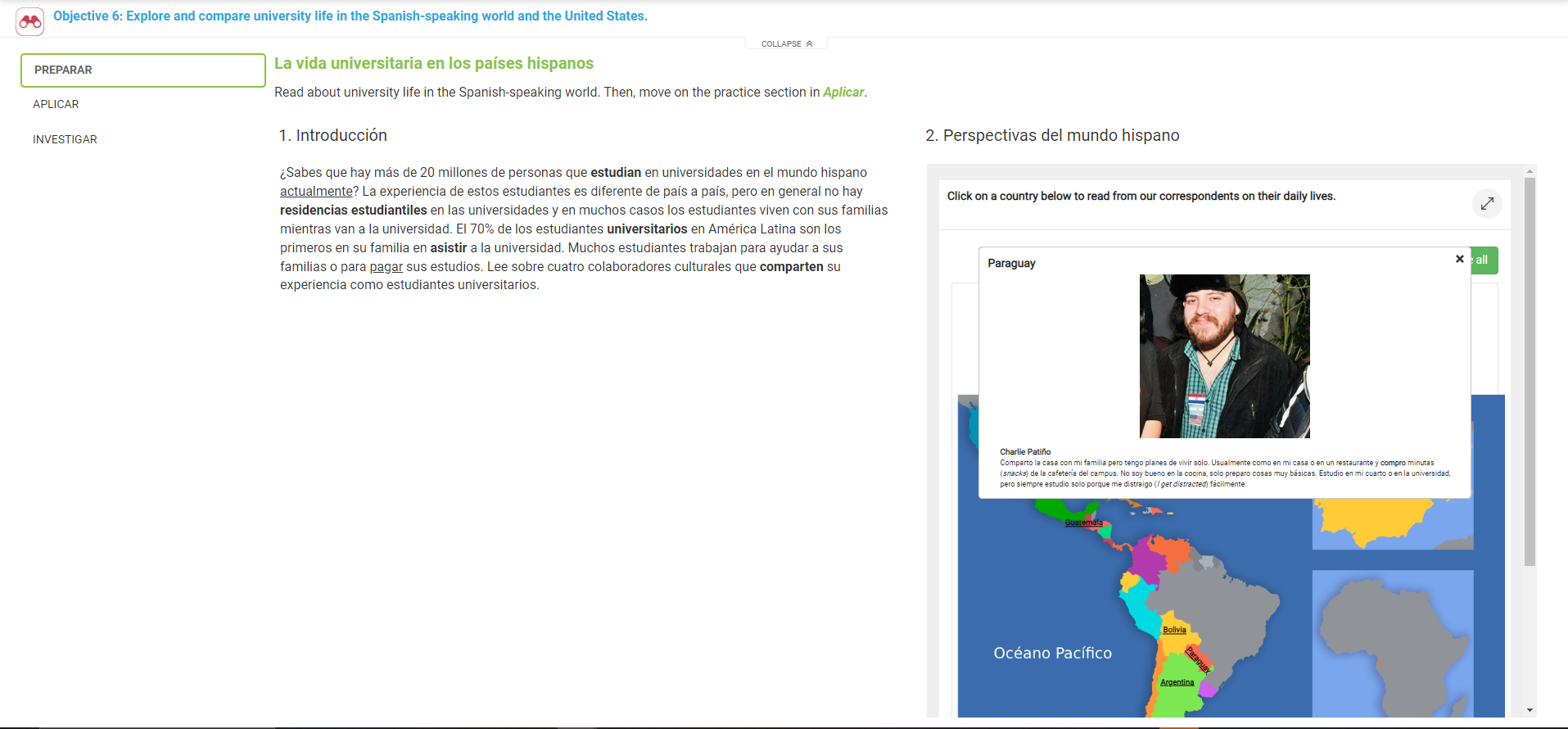
I believe that even the most basic of interactions with a community can go a long way in fostering goodwill, small acts such as opening the door for someone or letting someone get ahead of you on the highway can improve someone’s day even for a little. Although we did not speak to cultural collaborator’s from around the world, we did many activities that took transcripts from cultural collaborators from South America. Examples such as asking if they live at home or at campus come to mind.
Interpersonal Communication
During the semester, we were to produce a 2 minute video with a classmate. The idea was to ask them questions about their life and in return they do the same.
My main struggle was trying to find anyone that was eligible for an interview for the project. As it had to be someone in the class that was also learning Spanish. Despite the difficulties, I managed to finish the assignment with a proper score. Next time, I will try my best to secure a interview as fast as possible. Down below is a small clip from the interview.
Presentational Speaking
During the semester, we were to produce a 2 minute video to showcase several locations across the university campus. In addition, we had to describe the location in detail and list characteristics.
My main struggle was not only finding good places to record, but also how I would describe each location. The locations I chose were Monarch Hall, Batten Arts and Letters, and the Physical Sciences building. In total, they were 2 minutes with each video being 30-40 seconds long. I had to physically travel to each location and record me talking about each building, the project helped me improve on my writing and speech skills in general.
Presentational Writing
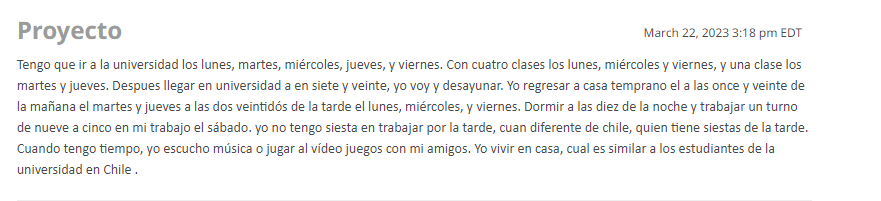
On our third project, we had to write down what our regular weekly schedule was in Spanish. We described what days of the week we did something and specified what times we did those things.
The main challenge with the project was the fact that I couldn’t put all of my daily deeds into the calendar and write it all out in a quick and efficient manner. In addition, most details after the afternoon on the calendar were quite empty in comparison to the rest of the times of the week. However, the times before the afternoon were easy to write out as that is when I am the most busy with school and other matters.
Interpretive Listening
During the semester, our learning in class primarily consisted of listening to short 5 minute videos that demonstrated concepts and speech in Spanish. These also included additional side notes which further delved into what the video was talking about.
In the videos, the speakers tended to talk about a subject that was the main focus of that module and thus were quite varied, examples included how to properly used gendered endings in most forms of speech, how to describe the time of day, and how cultural differences can affect mannerisms in speech in the Spanish world. I would say that the initial struggle doesn’t come from understanding the notes themselves. Rather its remembering all of it for assignment’s, projects, and 1 on 1 interviews. Besides that however, the videos were of great help in making me understand the basic fundamentals of Spanish as a whole, below is an example of a video that is similarly structured to Lingro’s videos.
Interpretive Reading
During the entire semester, our assignments were online and came from a site called Lingrolearning. Not only did it have a wide variety of lessons including extensive sections where we could practice what we learned, but there were informative videos and notes along the way to point us in the right direction.
Like most things, the start was the most challenging. Not only was I actually learning a new language with its quirks and different alphabet, but also that having to learn a new website and assignments took a while to get used to. However, with time. I began to understand both the website and the basics of Spanish, I found that the notes themselves were the most interesting part of the website thanks to their short but informative length of 5 minutes typically. In addition, the 4 projects we had to do the semester were a great help in advancing my understanding of Spanish to new heights as a whole.