Why This Skill Matters
Technical security and threat analysis is the heart of cybersecurity work. It is the skill of watching systems, spotting threats, and responding before damage spreads. Every entry-level cybersecurity job ad I have looked at lists this skill at the top. SOC Analyst roles want people who can monitor alerts. Cybersecurity Analyst roles want people who understand how attackers move. Both want people who can use real tools like Wireshark, SIEM platforms, and packet analyzers.
I built this skill in two ways. The first was through coursework that pushed me into deep technical territory. The second was through real work as a SOC Analyst at Allied Universal Security, where I monitor live systems every shift. Together, these experiences taught me how to think like a defender. They also taught me how to stay calm under pressure when alarms go off.
The three artifacts below show how I built this skill. They cover technical research, reflective learning, and real-world threat detection.
1. Artifact Title
Privacy-Preserving Machine Learning Using Fully Homomorphic Encryption
Course
CS 463: Cryptography for Cybersecurity (Fall 2025)
What It Is
A research paper that reviews how Fully Homomorphic Encryption protects sensitive data during computation. The paper covers the history of FHE, its math foundations, and how it supports privacy in machine learning systems.
Why This Artifact Shows the Skill
This paper pushed me into deep technical territory. I had to study lattice math, ciphertext operations, and encryption schemes like CKKS and BFV. I also had to understand how libraries like Microsoft SEAL and OpenFHE make this technology usable in real systems.
The skill of technical security is not just about using tools. It is about understanding how the math behind those tools actually works. Writing this paper taught me to read cryptography research and pull out the parts that matter for real defenders. It also gave me confidence that I can hold my own in technical conversations.
2. Artifact Title
CIQ Journal Module 6: Reflecting on Cryptography Learning
Course
CS 463: Cryptography for Cybersecurity (Fall 2025)
What It Is
A short reflective journal entry from Module 6 of my cryptography course. In it, I shared where I felt engaged, where I felt confused, what surprised me, and what I had figured out so far.
Why This Artifact Shows the Skill
At first glance, a journal entry may not look like a technical security artifact. But it is. Cybersecurity is a field that changes fast. The professionals who keep growing are the ones who can reflect on their own learning. Schön’s idea of the reflective practitioner says that real skill comes from thinking about your work as you do it.
In the journal, I admitted I felt confused about private keys. I noted I was surprised by how much math the course required. I also wrote that I had pushed through and understood the Euclidean algorithm. This kind of honest self-review is what separates good analysts from great ones. A SOC Analyst who hides confusion misses learning chances. A SOC Analyst who reflects openly grows fast.
1. I feel the most engaged when I am on Overleaf and I do the assignments due to it being tedious.
2. I would say I feel the most confused when we were learning about the private keys.
3. I was surprised by how much math is in this course.
4. I do not really have any assumptions about the module.
5. I know how to do the Euclidean algorithm but it took some time to understand. I have a pretty good understanding now.
3. Artifact Title
SOC Analyst Daily Workflow at Allied Universal Security
Role
SOC Analyst | Allied Universal Security | Manassas, VA | July 2025 to Present
What It Is
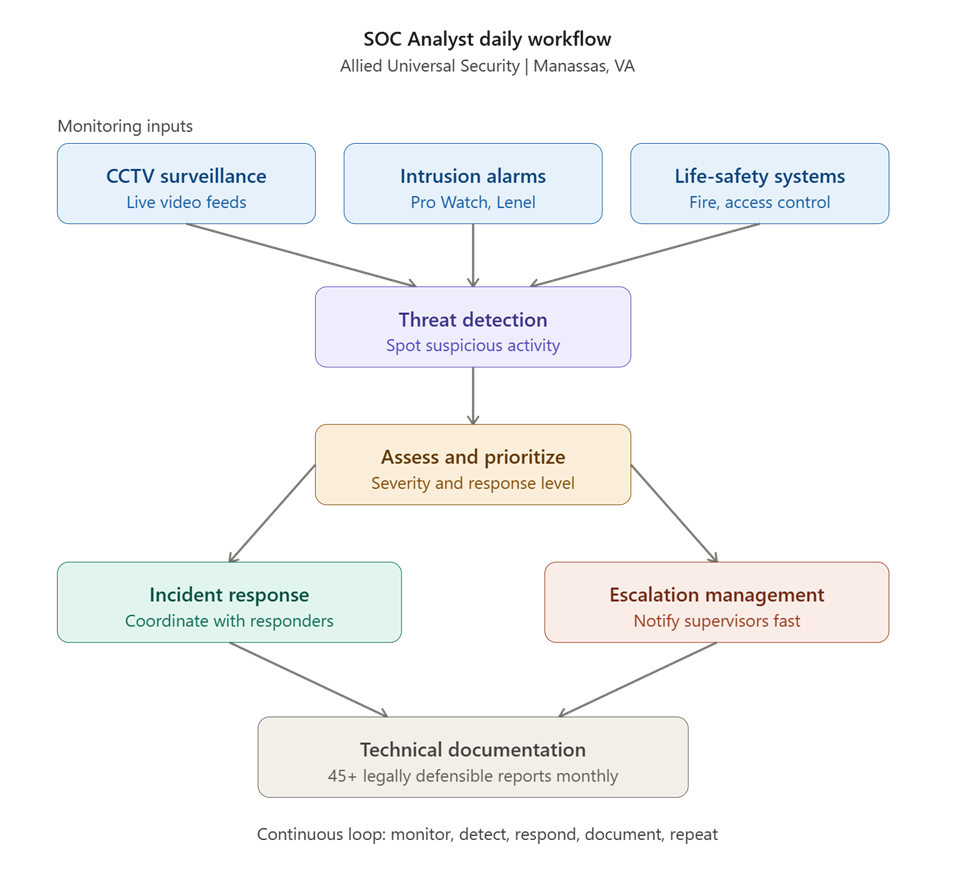
A visual breakdown of my real-world work as a SOC Analyst. The diagram shows how I move through a full security cycle every shift. From monitoring live inputs, to detecting threats, to coordinating response, to documenting outcomes. This is not a textbook example. It is what I do every day on the job.
Why This Artifact Shows the Skill
Classroom learning teaches you the theory of threat detection. Real shift work teaches you how to do it under pressure. My role at Allied Universal pulls together everything I have studied. I watch CCTV feeds. I respond to intrusion alarms. I work with Pro Watch, Lenel, and Skidata to manage access control. I write more than 45 legally defensible incident reports each month.
The NIST National Initiative for Cybersecurity Education framework lists threat detection and incident response as two core work roles for SOC professionals. The diagram below shows how my daily work hits both. It also shows how each step connects to the next. Real security is a continuous loop. You never stop monitoring. You never stop documenting. You never stop learning from what just happened.