Immunology
Paper 1
Rituximab (mAB)
Verneshia Heidelberg
Biomedical Science
Immunology BIOL302_34645
June 23, 2025
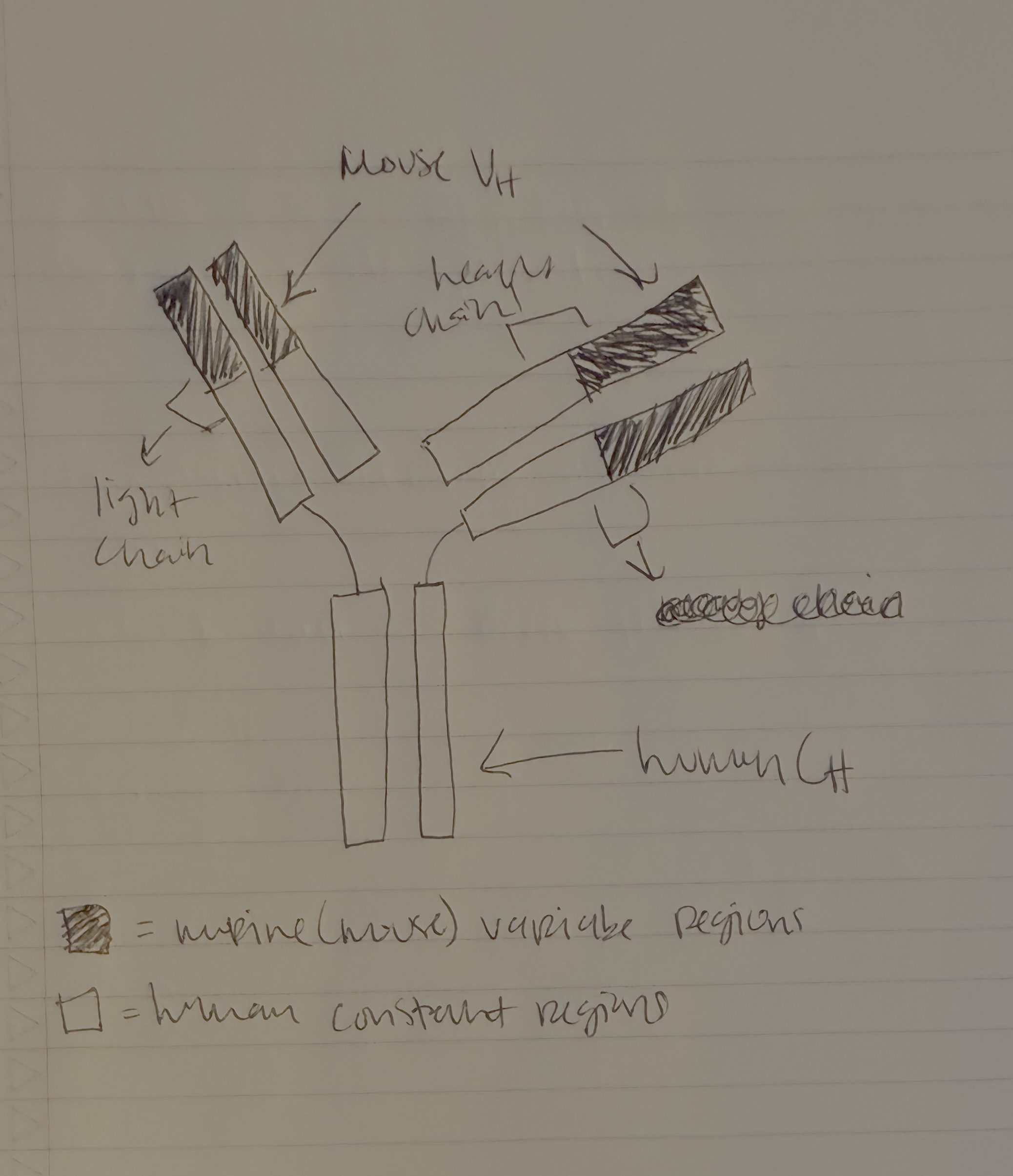
Rituximab, also known as Rituxan, is a chimeric monoclonal antibody. Manufactured by Genetech and Biogen, it was FDA approved in 1997 by the NHL and RA approved in 2006 (1). It is used to treat cancer as well as several autoimmune diseases. Known for its treatment specifically of lymphoma and chronic lymphocytic leukemia, as well as for people who have autoimmune diseases like multiple sclerosis and Rheumatoid arthritis, because of their conditions with immune dysregulation or abnormal B-cell proliferation (3). The dosage for cancer is 375 mg/m IV that is given once a week for 4-8 weeks or 1000 mg IV on days 1 and 15 for Rheumatoid arthritis that is repeated every 6 months (1). The mechanisms of actions, or how rituximab works, is that it binds to the CD20 antigen (2). The CD20 antigen is a protein that is superficially on the surface of not only pre-B lymphocytes, but mature B lymphocytes as well. It does this by way of Complement-Dependent Cytotoxicity (CDC), Antibody-Dependent Cellular Cytotoxicity (ADCC), and induction of apoptosis. CDS is the activation of the complement system to lyse B-cells (2). ADCC is the recruitment of immune cells to destroy B-cells, and induction of apoptosis directly triggers cell death in CD20+ B cells. Rituximab reduces abnormal immune responses in autoimmune diseases by depleting B-cells (3). This is also how it can destroy cancerous B-cells in lymphoma and leukemia cancers. Rituximab is what is called a chimeric IgG1 kappa monoclonal antibody. It combines human constant regions in the gene segment with mouse variable regions (2). This is what makes it effective in engaging immune effector functions. Some side effects of this drug are fever, chills, and hypotension, which are common with the first dosage. Other side effects are infections, low white blood cells, and arrhythmias (1).
References:
- Hanif, N., & Anwer, F. (2024). Rituximab. In StatPearls. StatPearls Publishing.
- Cerny, T., Borisch, B., Introna, M., Johnson, P., & Rose, A. L. (2002). Mechanism of action of rituximab. Anti-cancer drugs, 13 Suppl 2, S3–S10.
- Edwards, J. C., Szczepanski, L., Szechinski, J., Filipowicz-Sosnowska, A., Emery, P., Close, D. R., Stevens, R. M., & Shaw, T. (2004). Efficacy of B-cell-targeted therapy with rituximab in patients with rheumatoid arthritis. The New England journal of medicine, 350(25), 2572–2581. https://doi.org/10.1056/NEJMoa03253
Paper 2
T Cell Response in Covid-19 Vaccine
Verneshia Heidelberg
Biomedical Sciences
Immunology BIOL302
June 23, 2025
The COVID-19 pandemic and the SARS-CoV-2 variants that emerged with it highlighted just how important it is that we understand immune protection and in more advanced ways than just understanding of antibodies. In the article given to read, Wherry and Barouch discuss the underappreciated role of T cells, specifically in response to our immune systems when encountering the COVID-19 vaccines (1). We know that earlier vaccine studies largely centered on neutralizing antibodies as the benchmark for how well a vaccine performed. Antibodies work by blocking the infection, which in turn prevents the virus from entering cells. This however is short lived. Antibody levels decline within months of vaccination. The SARS-CoV-2 variants showed us the ability of how to partially escape antibody recognition. The article discusses the four main goals of vaccination in regards to SARS-CoV-2. They are protection from acquisition of infection, prevention of transmission, protection from severe disease, and prevention of Long Covid (1).
In one of the first figures of the paper, it shows how neutralizing antibodies (NAbs) are induced by vaccines (1). When the Nab titers wane or the virus evades the antibody recognition, it is the T cell that responds by blocking progression of the infection from the upper respiratory track to the lower respiratory tract (1). T cell immunity is more stable and tends to be more resilient. CD4+ helper and CD8+ cytotoxic T cells play a critical role in clearing and controlling viral infections (1). We learned this in our lectures. In our lecture when discussing B-cell and T-cell receptors, we also discussed how CD4 and CD8 are T-cell coreceptors that define subsets of T-cell function. They are the only two accessory molecules that have direct involvement in antigen recognition. Antibodies bind only to specific parts of the virus, while T cells can recognize a wider array of viral components. Some of those components are ones that are unchanged across variants, which makes them less susceptible to viral mutations (1). This means they are more reliable to give longer protection. The article set out to prove that while antibodies are important for preventing infection, T cells are critical for long-term protection and disease mitigation.
During Covid, we were administered mRNA vaccines, Pfizer and Moderna as examples. They are effective in triggering T cell responses. Some studies showed that while antibody levels declined, T cells generated by the vaccines persisted and continued to respond against viral epitopes (1). Booster shots increased antibody titers, but they also re-engaged memory T cells (1). This boosted the overall immunity. The article highlights this because while preventing infection is ideal, vaccinations are mainly meant to prevent hospitalization and the extreme of death (1). Our T cells are central to this when they attack infected cells and produce cytokines. This helps limit viral spread and helps to reduce the disease severity. The authors argue for broader evaluation criteria in the development of vaccines. T cells need to be included more in vaccine for maximum effectiveness. Viruses mutate, so this is especially important for that reason alone.
The authors showcased that going forward, T cells are indispensable in long-term COVID-19 immunity. T cells response lasts longer than antibody levels post-vaccination, they have variant resilience, and strong T cell responses correlate with reduced risk of hospitalization or even death despite infection (1). The research also shows that mRNA vaccines induce CD4+ and CD8+ T cell responses (1). Boosters reawaken the T cells and strengthen memory responses. This all proves that T cells are not just an accessory to antibodies. They are foundational to long-term defenses against COVID-19 specifically. More T cell metrics need to be included in vaccine trials and our public health policies moving forward.
Reference:
1. Wherry, E.J. and D.H. Barouch, T cell immunity to COVID-19 vaccines. Science, 2022. 377(6608): p. 821-822.
Reflections
Something I learned in this class was just how intertwined our cells are. They all work together, and they adjust to complications throughout our entire body. Taking Microbiology and Immunology together has showcased just that. It explained some things I learned in Neuroanatomy, which before I studied immunology in depth, I sincerely believed our brain was honestly on an island of its own. Being able to connect the dots has been so helpful to me, and it is something I plan to look for in my future classes. The question of, “how does this affect other aspects of the body” is a mandatory question in every diagnosis, in my opinion. This class taught me that.