Synopsis:
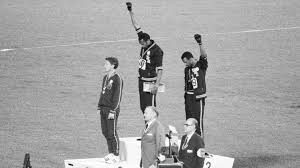
During the 1968 medal ceremony for the 200 – meter race were two iconic activism figures named Tommie Smith and John Carlos. Both of which raised a black gloved fist while the U.S. national anthem played. In history/society this action is named the black Power salute that was intended to bring global attention to racial injustices and inequality within the United States. Both smith and Carlos were also barefoot which represents poverty, wore breads to represent the lynching of the victims and bowing their heads during the national anthem.
The instant effect that this event had on sport and society was powerful and momentum shifting. While many viewed the protest as a heroic stand for human rights, others viewed it as unfit or inappropriate for an Olympic setting. The international Olympic Committee, led at the time by Avery Bundage, immediately banned both Smith and Carlos from the games. In this time Smith and Carlos were receiving death threats, being booed by the public, and even their teammates viewed them as a disgrace to the olympic games. The reaction displayed a broader struggle to interlock politics with sports, despite the protest by itself outlined issues that reached beyond athletics.
Media coverage has played a major role in prescribing the public perception of the event. Many of the media coverage outlets describe the two as unpatriotic or attention seeking. Simply focusing more on the controversy that the event holds rather than the message that is being pushed. Newspapers, television stations, and broadcasts stayed away from deep discussions pertaining to systematic racism, instead focusing on the violations committed against the Olympic Games. Being that social media was not available during this time, the conception of the message was controlled by mainstream channels. Thus limiting how the athletes were able to express their intention behind their actions to the public.
Despite this both Smith and Carlos tried to form their own narrative for their actions. Both athletes were a part of the Olympic Project for human rights, a protest that strived to use sport as a platform to promote social change. However, without some of the platforms we have today such as instagram and twitter, their voices were misconstrued by reporters and editors. Which did not allow Smith and Carlos’s perspective.
In the near future, the media has progressively suppressed the full impact of their messages by keying out the controversy impact rather than context. However, over time perceptions and perspectives have shifted. In today’s time the moment is viewed as a signal for the silent discriminations against systematic racism, human rights abuses, and racial injustices. Smith and Carlos are widely recognized as frontrunners in history who used their platform to demand justice.
The 1968 olympic protest shows how media and the public perception can frame the understanding of activism. Even though the public has suppressed or muted their message, history has changed the public perception of the Black Power Salute. Which has proved that the power acts of protests can have a continuing impact beyond the original perception.