Scholarship on People, Place, Stewardship, and Democracy
Research associated with the Center for Civic Lands and Democratic Stewardship examines what happens when people take responsibility for places they share.
Our publications explore volunteerism, stewardship, public institutions, civic engagement, and democratic life. They connect scholarly research with questions faced by public-land professionals, volunteers, communities, and citizens.
Featured Book
Volunteers in the Parks: Tensions, Challenges and Opportunities in the National Park Service
Thomas Andrew Bryer | Springer Nature | 2026
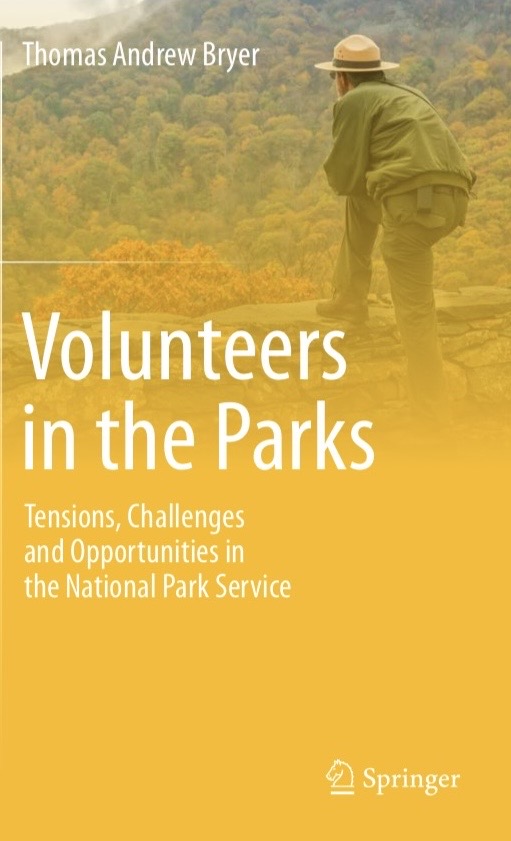
What happens when citizens become active stewards of America’s national parks?
Volunteers in the Parks provides an in-depth study of volunteerism within the National Park Service’s Volunteers-In-Parks program. Drawing on embedded volunteer service and interviews with more than 200 volunteers and National Park Service employees, the book examines why people volunteer, the roles they perform, the impact of their service, and the opportunities and tensions involved in managing volunteers within a public institution.
The book develops a multidimensional understanding of volunteer impact. Volunteers create value for themselves, for visitors and other beneficiaries, for the National Park Service, and—at the broadest level—for democratic society. At the same time, the research examines an important tension: public institutions can benefit greatly from volunteers while needing to ensure that volunteers supplement rather than replace the professional workforce.
The book provides the empirical and conceptual foundation for much of the Center’s work on volunteerism, civic lands, and democratic stewardship.
Learn more about Volunteers in the Parks at Springer Nature
Research Articles
Volunteers and Law Enforcement in the National Parks: A Typology of Roles and Functions
Thomas Andrew Bryer | Criminal Justice Policy Review | 2026
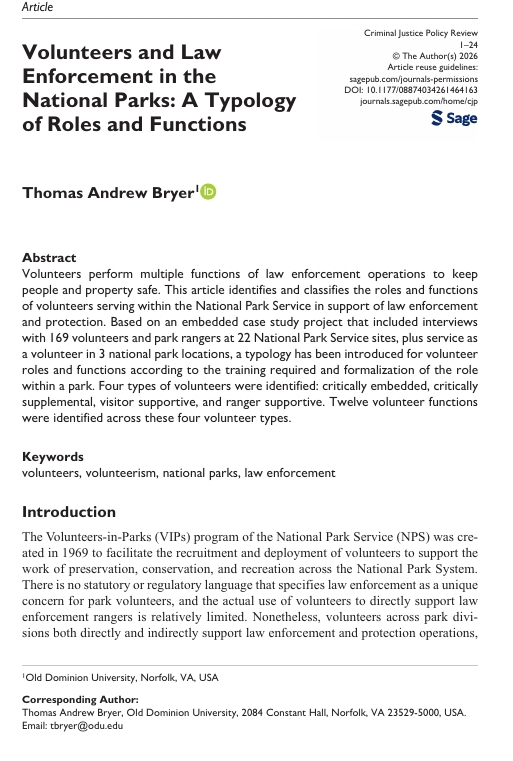 Volunteers in national parks do more than greet visitors, maintain trails, and assist with interpretation. In some parks, their work also contributes—directly and indirectly—to keeping people and property safe.
This study examines the roles volunteers perform in support of law enforcement and protection within the National Park Service. Drawing on an embedded case-study project that included interviews with 169 volunteers and park rangers at 22 National Park Service sites, as well as volunteer service at three national park locations, the research identifies 12 volunteer functions and organizes volunteer roles according to the training they require and the degree to which the roles are formalized within a park.
The resulting typology identifies four kinds of volunteer involvement: critically embedded, critically supplemental, visitor supportive, and ranger supportive. Together, they reveal a wider range of volunteer contributions to public safety than may be immediately apparent.
The research raises important questions for public-land management about training, responsibility, organizational capacity, appropriate boundaries, and the relationship between professional employees and citizen volunteers. It also demonstrates why understanding volunteerism requires looking beyond volunteer-hour totals to examine what volunteers actually do and how their service contributes to public purposes.
Read the article at Sage Journals
Essays & Public Scholarship
National Park Service Volunteers as Courageous Citizens: Keeping the Flame of Democracy Lit
Thomas Andrew Bryer | Courageous Citizenship Papers | 2026
 What does volunteering in a national park have to do with democracy?
This essay considers National Park Service volunteers not simply as a source of organizational capacity, but as citizens engaged in acts of democratic stewardship.
Written for the Braver Angels Citizen Scholars Council’s inaugural symposium on courageous citizenship, the paper draws on research with National Park Service volunteers and employees to explore how service in parks can connect everyday acts of stewardship to larger democratic values.
The essay examines five dimensions of democratic impact emerging from the experiences of volunteers and rangers: connection across difference, shared ownership, civic learning, preservation and stewardship, and service to future generations. Through these experiences, volunteers help sustain places that belong not to any one person, organization, or generation, but to a broader public.
The paper advances an idea central to the work of the Center for Civic Lands and Democratic Stewardship: public lands can be places where citizenship is practiced. Caring for shared landscapes, helping visitors encounter their histories, working alongside people with different backgrounds and perspectives, and preserving places for people one may never meet can all be expressions of democratic responsibility.
Read “National Park Service Volunteers as Courageous Citizens”
Explore the Courageous Citizenship Papers collection
Research Briefs
National Park Service Volunteers as Courageous Citizens: Keeping the Flame of Democracy Lit
Thomas Andrew Bryer | 2026
A shorter version of the full-length essay. Center research briefs provide a synopsis of longer written material not to replace but to whet the appetite for deeper reading.
From Research to Practice
These publications reflect a larger goal of the Center: to produce scholarship that travels beyond the university.
Research matters not only when it contributes to scholarly knowledge, but when it helps public institutions, practitioners, volunteers, communities, and citizens better understand the places and responsibilities they share.
The Center therefore seeks to connect research with dialogue, education, professional practice, public scholarship, and opportunities for action.