Artifact #5: Altruism and Selfishness
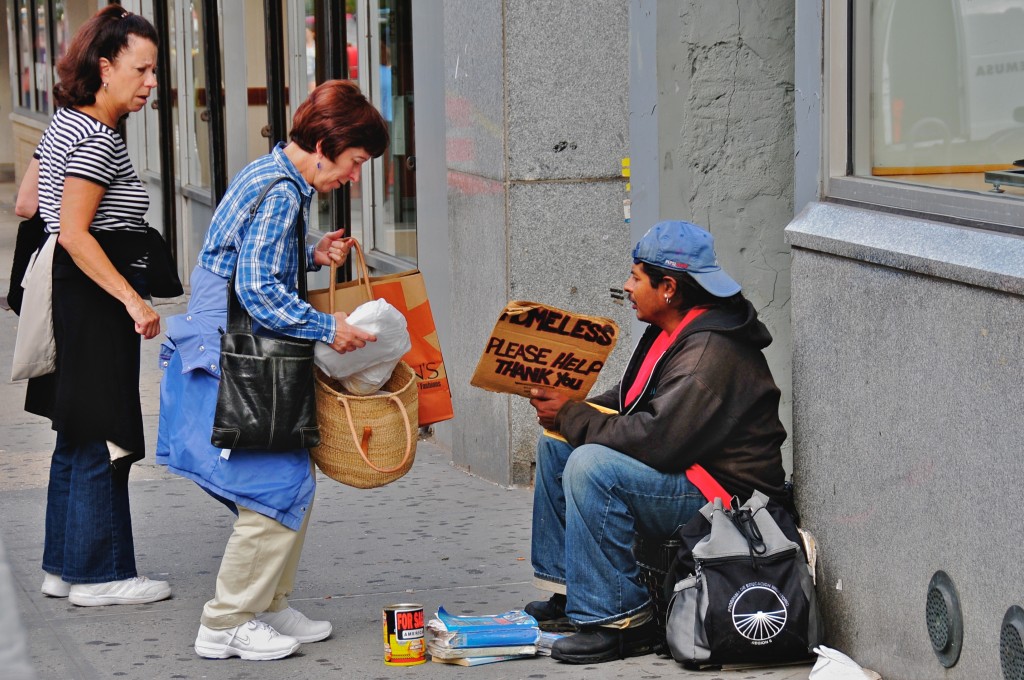
A common act of altruism that many people have participated in is helping the homeless. This simple act of brightening someone’s day who may be less fortunate can leave one feeling better about themselves. This photo is a prime example of people easily helping others and subconsciously helping themselves as well.
https://www.pbs.org/newshour/nation/homelessness-now-crime-cities-throughout-u-s
Most of the people who I am the closest to in my life are not selfish people. When attempting to think of people who are selfish, my mind did not go to those with who I am personally familiar. Instead, it went to more famous people who have considerable amounts of wealth. For example, Jeff Bezos, who has a net worth of $177.9 billion. While he should not be forced to distribute his income, if he wanted to, he could solve a considerable amount of people’s problems for those who cannot afford to. Therefore, when thinking of people in my life who are selfish, and relating it to their level of happiness, I do not think that my personal sample size is very accurate. This is because I did not have personal results with a correlation between happiness and selfishness. I did not consider anyone in my personal life selfish and instead judged their happiness based on their history with depression, and their demeanor.
I believe that happiness and selfishness are rarely perceived together because happy people are thought of as selfless. This is because their happiness tends to not only impact them but impact those around them as well. People who are truly happy will try to spread their feeling of bliss to those around them. This is also known as empathy-altruism, as it brings satisfaction to us when we help others. This feeling of joy can also relieve us of negative feelings. However, this is a tricky question due to the fact that people who may be considered selfish (Bezos, for example), are perceived as happy due to their wealth. This outward perception of happiness may not be correct, as money does not always bring happiness, and can leave individuals feeling emotionally unsatisfied. Personally, I believe that happiness comes from within, and while outer factors such as money can impact this, they will not provide happiness of their own (in this video, rapper Cardi B discusses this). I chose a photo of a woman helping a homeless lady as this simple act of altruism is one that often brings happiness to both individuals. I learned that I should help more people out in my daily life not only because it fulfills me subconsciously, especially since I am in the financial position to do so.
Artifact #4: Happiness
One of the times that I have felt pure bliss and happiness was during my vacation to Italy’s Amalfi Coast. I value relaxation and self-care, as I know how overwhelming feelings of stress can eat at the mind and the soul.

As I get older, I am beginning to face more responsibilities and increasing stressors as I am faced with the duties of life. As someone who has been diagnosed with anxiety disorders, I understand how important it is to find happiness in my life, and how important it is to take steps back from life and enjoy the world. While a lot of my stress has come from my anxiety and school-related factors, I have also encountered social stress, from toxic relationships and emotionally overwhelming situations. Freeing myself from these types of situations has really benefited my mental state. Some of the psychologically proven tactics such as working out and adjusting my perception of my life and life events have greatly helped my attitude, which in turn improved my mental health. Especially viewing things from multiple perspectives, which has allowed me to see the benefits in initially stressful and saddening situations. From this, I have learned to balance my life to promote the best mental health that I can.
Fostering happiness in my life is something that I am continually working on. Since the Coronavirus pandemic and the heightened racial tensions in America, I have been feeling slightly overwhelmed as life has drastically changed. From spending more time alone to marching for those whose voices can no longer be heard, I have had a lot of time to reflect and integrate new things into my life that can be a source of happiness. During these times, this has mostly been spending time with family, discovering new music, and spending time outside. Seeking therapy in the past has also been a way for me to foster happiness, as I can explain how I am feeling to someone who can understand. I chose this picture of me in Italy on the Amalfi Coast to represent happiness for me. Personally, I am the happiest when I can travel, specifically to places with beaches, as I love the breeze and relaxation that the ocean gives me. During this trans-European trip, I was able to see many new parts of the world which was a beautiful and enlightening experience. I have always felt joy when learning about new cultures and experiencing them firsthand. Something about traveling is exhilarating and especially eye-opening for me. I felt at peace when I could relax on a beach watching the sunset at the end of a busy day in the sun.
Artifact #3: Attitudes
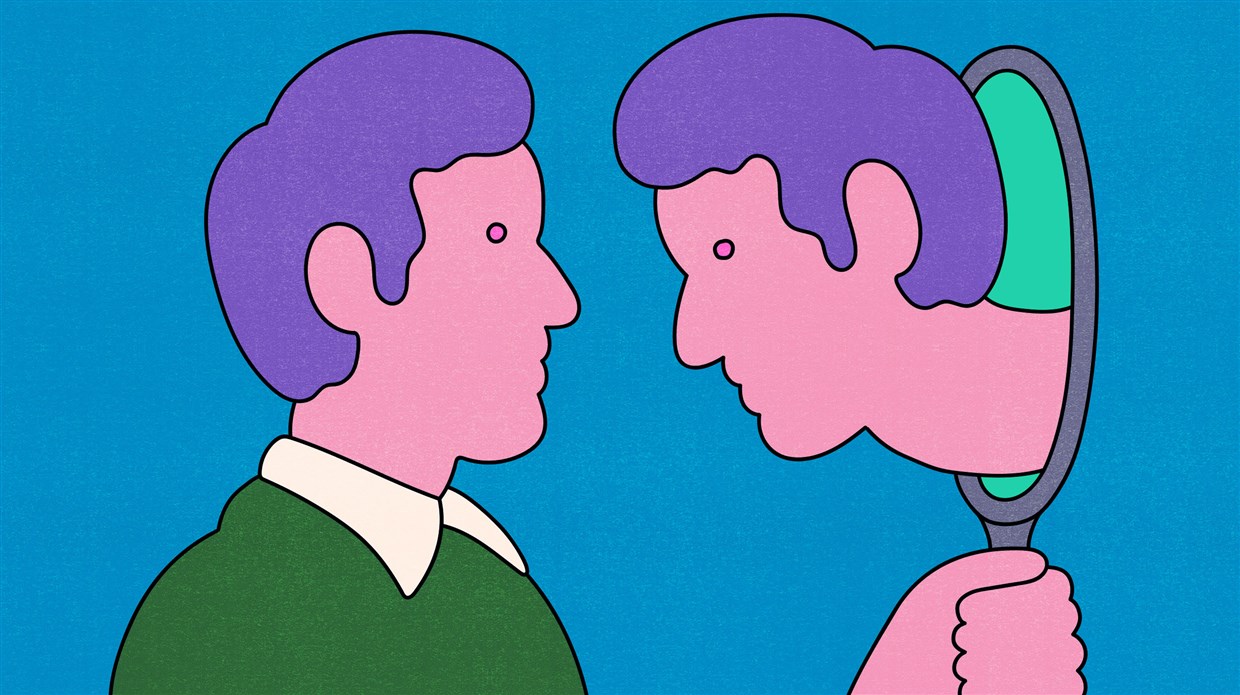
One of the best ways to eliminate the negative feelings associated with cognitive dissonance is to change your attitude or change your behavior. This involves analyzing your actions and thoughts critically. This picture demonstrates that in a literal sense.
https://www.nbcnews.com/better/lifestyle/what-self-awareness-how-can-you-cultivate-it-ncna1067721
I chose this picture to represent the module titled “Attitude”, as I believe that this photo can represent the feeling of cognitive dissonance and dealing with contradictory feelings. I feel like it explains how people often try to limit the feelings of dissonance by reflecting on their actions and attempting to alter these actions to align with expectations and preconceptions of what is expected of them. Inconsistencies between our attitudes of the world and our behaviors within the world often make us feel dishonest and uncomfortable when reflecting on them. Therefore, this process of self-reflection and realization is important in regards to aligning our behaviors with our attitudes.
In navigating the world, I often realize that some people struggle with cognitive dissonance and logically examining their strongly or long-held beliefs. For example, in artifact one, where I compared anti-maskers belief of “my body, my choice” when it comes to masks, but not when it comes to abortion policy. This is especially difficult to deal with when I debate people, as those with schemas that are strongly resistant to change are close-minded, and are unwilling to consider other points of view because they refuse to be incorrect. Due to this, I try my best to avoid contradictory viewpoints. As the photo depicts, I also often examine my own beliefs critically and wonder if my attitudes towards certain things are valid. As I get older, I am learning to grow in reflecting on my attitudes and beliefs to better myself as a social, educated, and logical person.
Artifact #2: Impacts of Media Inaccuracy
,
An unfair media representation, explaining the supposed rise in violent crimes in the years 1973-1922. This is an example of media fear-mongering and bias, relaying information that is missing key supportive facts. (Video cited below)
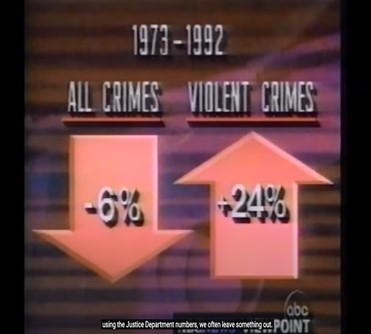
This screenshot from an ABC special, “Are We Scaring Ourselves to Death”, represents the media’s tendency to promote unnecessary panic and use fear-mongering. News channels are successful at this due to the representative heuristic and availability heuristic that viewers rely on to judge the information. When the media puts out information that highlights the tragedy or mishaps of the world, people are more likely to feel as if these unfortunate events are probable. In this example, the data misrepresents the crime rate as the statistic fails to address the increase in population. This is important because violent crime will usually increase with the population. However, without this additional data, citizens will file this information into their brains and use the representative or availability bias when recalling information about crime and maybe even about certain races. Therefore, their future judgments might be incorrect or irrational.
News like this, absent of critical background information, can also be damaging to minority groups in America whose violent crime is often pinned on. The stereotype that there is more danger around minority groups is also a result of media biases and is carried out through heuristics. These harmful stereotypes have been shown to be extremely damaging to the well-being of minority groups in the United States of America, such as African-Americans and Latino Americans. When people constantly view news that paints these groups in a negative light, they are more prone to subscribe to the notion that these groups are inherently dangerous, and adopt these ideas. This is shown in subtle microaggressions, such as clutching your purse or locking your door when a Black person walks past you. This artifact helped me learn why people hold some of the biases and unfair attitudes that they do. As a Black person whose racial group is often stereotyped and demonized I hope for more acceptance and racial education in America.
Artifact #1: Anti-Maskers and Norms
An adverse reaction to the nationwide mask mandates that have been put in place to protect Americans. This is a prime example of violating a norm that is explicit at this time in many countries worldwide.

During this time of political tension due to the pandemic and subsequent mask mandates, many people are defiant to this new and temporary adjustment to our daily lives. When the mask mandates went into effect, many people refused to comply with the reasoning ranging from masks being infringements on their rights, to masks being mind control devices that are useless. While these claims are not rooted in fact, large movements and pushes have been made to avoid the use of masks in public spaces. This is an example of a violation of an explicit norm — a norm that has been formally written. Some anti-maskers violate the implicit norm of personal space which is especially alarming during a pandemic. This norm violation has sparked conversation regarding political belief and simple consideration for others’ well-being. Personally, I understand where anti-maskers are coming from in the sense that I realize that defiance is natural, and can feel even more justified when people from your group (republicans, for example), also hold the same beliefs that you do. However, the issue is that their views do not change in the face of contradictory, scientific information. Anti-maskers are an issue because they simply ignore the scientifically proven benefit of wearing masks, and are unwilling to potentially protect those around them. This is the issue that I have with strong anti-mask rhetoric — ignorance towards scientific information and the spread of misinformation. The insight that I have gained from this countermovement has opened up my mind to a whole new breed of people. Not “republicans” or “southerners”, as generalizing is inaccurate. More accurately, people who are comfortable with being willfully ignorant. Violating this norm displays their non-conformity, which can be potentially dangerous and is the antithesis of progress concerning this pandemic in the United States of America. I also believe that there is a level of cognitive dissonance as well. Most people that have been promoting themselves as anti-maskers are often republicans who are also pro-life, or against abortion and allowing for women to decide what happens within their bodies. Their reasoning for being pro-life often revolves around their belief that abortion is the killing of innocent life. If this is the case, then it would follow logically that they would be for masks, considering that they can save innocent lives. Therefore, I find this quite interesting and almost humorous. It was interesting to connect people’s refusal to comply with actual psychological reasons behind their thought process. This is one of the many scenarios of the violation of explicit norms, non-conformity, social influence, and cognitive dissonance in the real world.
This is my favorite artifact from this semester because, to me, it has the most personal and worldly relevance at the moment. This topic addresses one of the most polarizing and separating times in recent U.S. history, which has so far left over 200,000 Americans dead, which could have been prevented.