Interpretive, Interpersonal, and Presentational Modes of Communication
Exploring Culture
I’ve learned several things about Hispanic culture from culture related lessons we’ve had. For some of them, we read the opinions of native Spanish speakers about various topics, including sexism in sports, comfort foods, and same-sex marriage. In other assignments, we listened to native Spanish speakers describe things like their family, their country, and the school they go to.
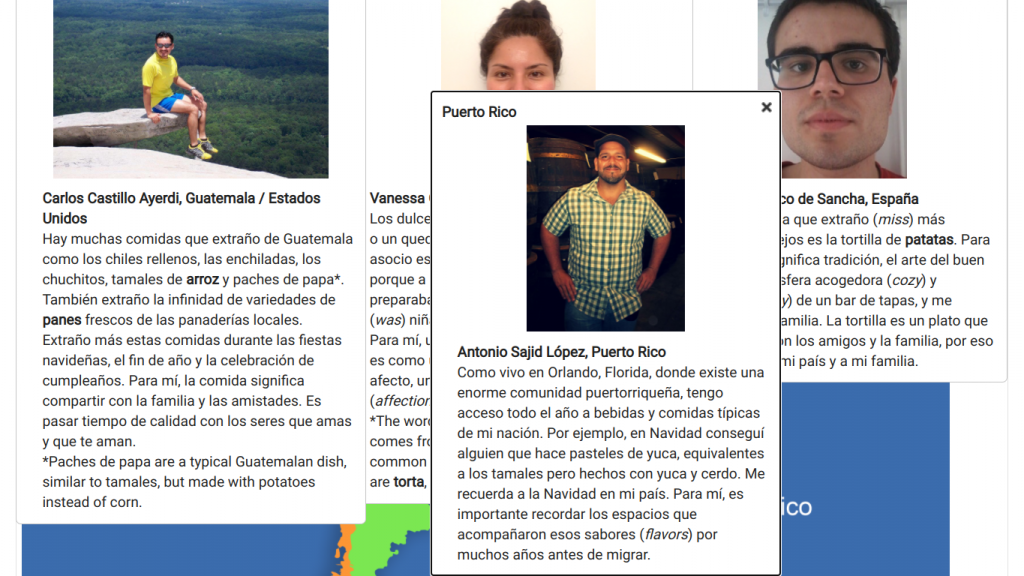
I realized in these assignments that people in Spanish-speaking countries have similar ideals to most Americans. I see that both value equality, self-expression, and family. I also noticed that everyone has their own foods they associate with good memories and home, but they’re different in Spanish-speaking countries. As it appears, people tend to feel comfort or nostalgia when they eat foods usually reserved for holidays, special occasions, or when with family. Some comfort foods I found include tamales, various types of bread, Spanish tortillas, and tres leches cake.
Engaging in Communities
I am not engaged in my community.
Interpersonal Communication
This semester, I’ve completed two conversations on TalkAbroad, a site that allows language learners to talk to native speakers in their target language. We discussed simple topics like family members and life styles, but we also touched challenging topics, like sexism.
In addition to TalkAbroad conversations, we’ve had numerous in class conversations in which we discussed topics that we were learning and practiced new phrases.
These conversations were a bit challening, however. I felt that I needed to write everything out before saying it so that my thoughts wouldn’t contort themselves from meaningful words to incoherent mumbles. However, with each activity, I gained more confidence, and I realized it was fine to make occasional mistakes. The most difficult part for me was feeling comfortable socializing because I’ve always been a bit shy and insecure, but being required to talk to others helped me gain experience and extend my comfort zone out a bit more.
Instructions-for-Conversation-on-ConectadosI unfortunately was unable to include the audio of the conversation that I had with my partner, but these are the instructions for the assignment U3-18 Entre compañeros: Una foto (Use it!) that we did in the book Conectados from Mind Tap in Cengage.
Presentational Speaking
In class this semester, we’ve given several presentations. One of our presentations was about our family, another was about a poster we made to advertise an imaginary sports club or activity, and another was to explain a dish that we have prepared.
For the family presentation, it was a bit difficult finding the right words to describe my family members accurately in Spanish. I tried to combat this problem by looking for different ways to say what I thought. For the poster, I struggled find a good way to format it, so I left it simple but polished and organized. Lastly, it was a bit of a challenge to explain myself for the cooking assignment because there were a lot of specific phrases that I wanted to say in Spanish that I wasn’t familiar with. Like for the family presentation, I tried to find creative ways to voice my thoughts in Spanish, but I did have to use a dictionary to translate a couple specific words. Despite my challenges, I excelled at using proper grammar and sounding natural.
23605_2020-11-06-132714_735Presentational Writing
I’ve done a poster on a sports activity that I had to present, and a paper that put together an outfit recommendation.
The poster was easy enough, but the paper took a bit more effort because it involved a topic I’m not very familiar with: clothing. While completing the assignment, I learned some new vocabulary terms about outfits, including the difference between a suit coat and a blazer, and it became easier to describe the clothes people wear. It was also a bit challenging to come up with a recommendation based on a person’s unique situation because there was a lot of information to go by, but I just slowed down to understand it all and formed a reasonable outfit.
Conjunto-Para-Steve-PrestlyInterpretive Listening
In Spanish 121, we have listening activities to train our ears to Spanish. I remember two: a video on a food delivery service and a video on a scarf named Billy.
I couldn’t understand all the language in the video of the food delivery service at first because there were a couple unfamiliar phrases. However, context and rewatching the video helped me understand. As for the scarf video, it was fairly straightforward and fun. I had no trouble with it, but it was still good pratice. The more I hear Spanish, the more readily I’ll be able to understand it.
Interpretive Reading
This semester, we completed an interpretive reading activity on a site for various sports clubs, another on a service that recommends and sends outfits to its subscribers, and multiple readings on Hispanic culture.
As with the other assignments, I had a bit of difficulty learning new vocab terms and phrases, but it didn’t take long at all. It was all straightforward reading, and most unfamiliar words had their English equivalents next to them.
Untitled-documentThis is from an assignment in the book Contraseña on the site LingroLearning in Unit 11, Texto.