Interpretive, Interpersonal, and Presentational Modes of Communication
Exploring Culture
This semester, we had various conversations on the cultural aspects of the topics we were learning to discuss in Spanish, and we also read some comments from native speakers. Here is one of those “Exploraciones Culturales.”
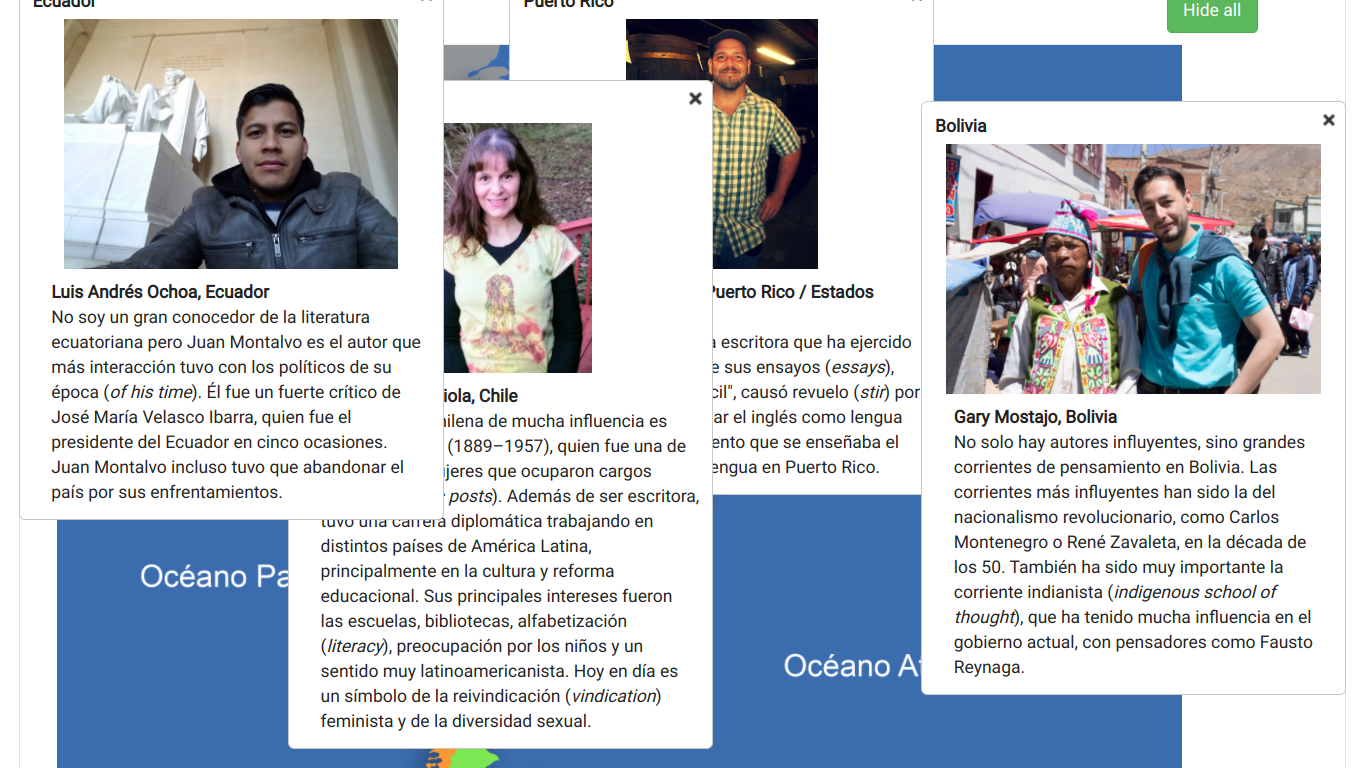
These activities shed light on some common beliefs and practices in Spanish-speaking communities. For one, they’ve shown the great appreciation that Spanish speakers have for the family. One of the collaborators for the exploraciones culturales said that he talks to his parents every day and the rest of his family members weekly. For someone who hasn’t spoken to their father in weeks and hardly knows any relatives outside of his household, this was very surprising to me. Other collaborators made similar remarks. Additionally, I have learned that people from Spanish-speaking countries often believe that learning English opens up many opportunities for them. One collaborator commented that he was raised to believe that Spanish was inherited by the family, but English was necessary to advance in the world. Lastly, I have learned that Spanish speakers are very proud of their culture. Many collaborators mention what an “orgullo” it is to be part of their culture.
Engaging in Communities
It’s important to engage in your immediate community to understand and help with any problems in your area. It can also help to form and build friendships. Neighbors can often depend on each in times of need, and socializing can often bring up one’s spirits. On a global level, it’s important to engage in the community for the benefit of everyone. Every country depends on others for resources, whether they be primary resources, manufactured goods, or cultural resources. For the betterment of everyone, it is necessary to be up to date and involved with our larger community.
I didn’t participate in the community much this semester, especially due to the pandemic. However, I think I’ve played my part as a good citizen by following guidelines and being respectful, and I am waiting until there are appointments available for the Covid vaccine that don’t conflict with my schedule.
Interpersonal Communication
This semester, we had 3 conversations on TalkAbroad. This site allows users to talk with native speakers of Spanish. Also, we had numerous conversations in class from the site LingroLearning.
This video is an example of a project we completed that involved a conversation. The assignment was to create a conversation that could cause a misunderstanding and show how it would unravel through text and in person. As the video shows, the character played by me becomes offended in the text conversation because he believes that his friend is genuinely trying to insult him, so the two become angry with each other and decide not to go sky diving. However, the conversation face to face shows that the friend is just joking, and they decide to go sky diving in the end.
Each of the assignments had its own challenges, but the TalkAbroad assignments were especially challenging because they involved direct contact with a real native speaker, and we weren’t allowed to use any English. Whereas we usually would have at least a few minutes to collect our thoughts and speak, the conversations through TalkAbroad required immediate responses. I think that they have been the best at preparing me for a real conversation in Spanish in the future because they helped me become more confident with my speaking and they were as close to a real conversation as possible, minus the preparation that we did before the conversations. As for the other conversations we had in class, they’ve helped me become aware of some of my shortcomings in the language and have helped make me better at keeping a conversation in Spanish. My biggest challenge with them was just forming an opinion, and I hope that my opinions will develop naturally with time but that I will remain open-minded.
Presentational Speaking
This semeseter we’ve completed various presentational speaking activities. The following video was for an assignment that involved inventing a story for how a person used their college education to start their career. In this istance, I discuss becoming a biostatistican and what I would do if I were a biostatistician.
I also did a presentation on timeline for the Prado Museum in Madrid, Spain and a presentation on visiting Machu Picchu. The project on becoming a biostatistician was challenging because I had to imagine a task I would do if I were a biostatistician, but the rest was as easy as explaining myself in Spanish. As for the presentation on the Prado Museum, I had to do a lot of research for the assignment, but the Spanish aspect of the project gave me no problems. Lastly, the project on Machu Picchu, similar to the project on the museum, was difficult in that it required a bit of creativity, since I’ve never actually visited Machu Picchu. All of my problems were solved by simply doing some additional research, so I would say that these assignments were great Spanish practice.
Presentational Writing
The following project was supposed to demonstrate how historical events can be reinterpreted. It’s a short story about a boy who believes that the Coronavirus regulations are oppressive and purposeless. After his family is faced with a tragedy, he realizes that the rules have meaningful purposes.
 Loading…

 Reload document
  Open in new tab
 I also created an infographic on obesity. The most challenging part of both assignments was finding an idea, but the rest came naturally after that. The infographic was also a bit challenging to format because I wanted to make sure it looked nice. Although it took a while, the end result was nice, and I learned some graphic design techniques that will make similar projects easier in the future. The problems I ran into while writing the short story were writing dialogue in Spanish and shortening the story to its most vital points. The language used in casual conversation is very different from the Spanish that we’d been studying, which was a bit more formal and essay-like. To make it sound natural, I had to use some new words, and I had to simplify the grammar a bit. I’ll hopefully be able to write dialogue more readily if I tried to again. As for reducing the story to its key events, I had a picture of what would happen in my head, but I needed to use as few words as I could to explain myself. Whether in English or Spanish, it wasn’t easy to do, but it was a good exercise.
Interpretive Listening
We’ve had various videos and audios to listen to this semester to test comprehension. First, we listened to people explain what they studied in college and what career they currently have. Then, we listened to a podcast about tourist attractions in Mexico. Next, we watched a video on the Museum of Modern Art in Buenos Aires, Argentina. We also watched a video on how means of communication can alter understanding. Lastly, we listened to a performance of a poem. The following video is the video on how means of communication can change how we understand each other. It shows how the same conversation can have two different outcomes when done through text messages and in person.
There were a few things that were challenging to understand in some of the listening activities, especially the activity on the museum and the activity above. The video on the Museum of Modern Art included fast-talking native speakers with Argentinian accents, and some of the voices weren’t very clear. Additionally, it used some unfamiliar vocabulary terms. I tried to get a better understanding by watching the video several times, but there were still some words that I couldn’t quite hear. The same is true of the video above: the people talk fast, and it’s hard to follow their conversation. It helped a bit that the first part is in text and the second part just repeats the text but out loud, but I still had to listen several times to make sure I could hear each word.
Interpretive Reading
We read an infographic on the flu and one on mental health, we read a graphic novel on identity and immigration, we read the following short story on Mayan civilizations, and we read an article about stereotypes in Mexico. The following short story demonstrates how advanced the Mayan culture was, and it shows how little Europeans thought of the Mayans.
Loading…
Monterroso, Augusto. El Eclipse. https://www.ingenieria.unam.mx/dcsyhfi/material_didactico/Literatura_Hispanoamericana_Contemporanea/Autores_M/MONTERROSO/Eclipse.pdf
In general, the interpretive reading was fairly easy. I did come across the occasional unfamiliar word or phrase, but reading at least allows me to move at my own pace, and I never have the problem of mishearing a word like I would when listening to an audio. It’s also convenient that the word is right there and I can look it up if I need to. I think the reading assignments have taught me that no matter how much Spanish I learn, there will always be some words that I don’t know, and that fine. I can always consult a dictionary if necessary. It’s the same as running into an unfamiliar word in English, and I’m proud to have gotten to the point where I know exactly how to handle this situation when reading in Spanish.