Jonee Grant
ARTG 495
02/04/2026
Weekly Response #1
Koch’s central argument is that Michelangelo’s Bacchus functions as an act of self‑formation. She outlines three major claims. First, she argues that Bacchus, created at a pivotal moment in Michelangelo’s early career, demonstrates how “the artist formed himself morally and intellectually in the carving of the work whilst also challenging spectators to engage in self‑formation.” Second, she suggests that the sculpture allowed Michelangelo to express his own metamorphosis by drawing on the “poetic‑artistic aspects of self‑formation.” Finally, she maintains that Bacchus played a crucial role in shaping how Michelangelo would continue to develop during his Roman period (pg. 2–4). The sculpture Bacchus, a 203‑cm marble statue carved between 1496 and 1497was commissioned by Cardinal Raffaele Riario in Rome.
One of the first indicators that Bacchus reflects Michelangelo’s self‑formation is the statue’s unusual design. Unlike most sculptures of the period, which were intended to be viewed frontally, Bacchus is meant to be seen in the round. Important visual elements appear on the sides and back, suggesting that Michelangelo deliberately crafted a Multiview sculpture intended for close, continuous observation. This approach aligns with his later masterpiece, David, sculpted in Florence 1501-1504, and the two works are frequently compared. This Multiview composition suggests that the statue was intended for placement in a courtyard or garden, where viewers could walk around it. Donatello’s life‑sized bronze David, displayed in the Medici palace courtyard, offers a precedent for this type of viewing and was likely a source of inspiration for Michelangelo along with it being admired by his patron.
Because Bacchus departs from traditional frontal composition while still drawing on classical iconography, Koch argues that Michelangelo was studying a wide range of artistic and literary sources. Writers such as Plato and Ovid contributed themes of metamorphosis; Pliny’s Natural History preserved descriptions of Praxiteles’ lost bronze; and Callistratus wrote about the sculptor’s “power of transformation.” Michelangelo also incorporated Christian ideas particularly sin, good and evil and the hierarchy of creation from stones and minerals being the lowest order to plants being a step above them to be succeeded by animals then man adding his. Also, own interpretive signature of the dry wood stump which is used in two more of his later works.
Koch frequently compares Bacchus with David. Michelangelo carved David between 1501 and 1504 from a single massive block of Carrara marble. Standing seventeen feet tall, the statue depicts the biblical hero at a moment of poised tension. Koch describes David as the “best‑known instance of Michelangelo’s self‑identification,” arguing that Michelangelo equated himself with David and the marble with Goliath. Just as David conquered the giant with his sling, Michelangelo conquered the resistant stone with his tools, demonstrating his power to transform the physical world. In contrast, Bacchus shows Michelangelo transforming not only stone but also ideas adapting concepts from literature, poetry, and mythology into sculptural form. If David represents mastery over the physical, Bacchus represents mastery over the intellectual.
It is also significant that the statue is missing its phallus. Praxiteles, renowned for naturalizing the gods and making them appear more human, created works such as Hermes with the Infant Dionysus (c. 340 BCE), which features a pose similar to Michelangelo’s Bacchus. Scholarship on The Venus Pudica uncovering art histories “hidden agendas” and pernicious pedigrees explores Greek nudity, highlighting stark differences between male and female representations. By omitting Bacchus’s phallus, Michelangelo imitates classical iconography while simultaneously inventing something new.
Although Koch interprets Bacchus as a tool of self‑formation, I disagree. Instead, the sculpture demonstrates Michelangelo’s ability to reveal a different facet of himself one that expands beyond what he had already proven. Koch cites Charles Seymour’s analysis of David, which describes the work as both a public symbol of civic freedom and a personal expression of the sculptor’s artistic challenge (p. 24, line 71). This suggests that Michelangelo had already established his reputation. Bacchus, then, becomes a debut of another side of his talent a deeper mode of expression that connects the viewer to the work, the iconography, and the patron in new ways. Just as Bacchus embodies duality, Michelangelo was showcasing his own duality in skill and artistic identity. The sculpture did allow Michelangelo to show his own growth and metamorphosis; it also shaped how he developed as he carried over tropes such as the wood stump into other works.
This essay exposed me to Michelangelo’s Bacchus. It was interesting and informative. Bacchus standing as a marble sculpture but also carrying weight in intellectual realm is the definition of duality. I am left with a myriad of questions and thoughts on how the sculpture could be understood. The deity and the satyr are connected by the grapes between them Bacchus holding them and the satyr eating them, if the two figures symbolize the ascending order of elements does it also represent the Chrisitan path to righteousness?. As humans we are below God and like the satyr sin, or a lower from is a part of us all, yet we have a chance to be close to God and be more like him if we turn away from sin and live on the word of God which would be the grapes in a form of communion as Baccuhs’ body is filled with the wine. The god is the higher state and the satyr the lowest state, but they are connected suggesting a flow between the states. A reminder that transformation is always possible.
- Koch, Linda A. “Michelangelo’s Bacchus and the Art of Self‑Formation.” The Art Bulletin 76, no. 4 (1994): 649–668.
- Salomon, Nanette. “The Venus Pudica: Uncovering Art History’s ‘Hidden Agendas’ and Pernicious Pedigrees.” The Art Bulletin 74, no. 2 (1992): 311–327.
Reading 2
VIRTUS PERFICITUR – by Robert Williams
Robert Williams’s essay “Virtus Perficitur: On the Meaning of Donatello’s Bronze David” argues that Donatello’s bronze David one of the artist’s most famous works has been misunderstood because it is too often interpreted from a single, dominant viewpoint: the homoerotic reading. This perspective has shaped and limits how viewers understand the sculpture, leading many to assume that Donatello intentionally crafted David as a fetishized, homoerotic figure. Williams does not deny that erotic elements exist, but he challenges the idea that this is not the sculpture’s primary meaning. Instead, he highlights an overlooked dimension: the biblical and moral significance of David as a heroic figure who defeats a powerful enemy through divine assistance.
Visually, the statue does suggest eroticism or does it? The figure is nude, youthful, and androgynous. The dramatic hip placement often described as “effeminate,” and the soft expression have contributed to the homoerotic interpretation. Critics have noted that the face does not convey the emotional intensity one might expect from a young boy who has just triumphed in battle.
The sculpture was commissioned by the Medici family, though the exact patron remains uncertain either Cosimo de’ Medici in the 1430s or his son Piero. By 1469, the bronze David stood in the courtyard of the Medici palace above an inscription reading: “The victor is the defender of the fatherland. God crushes the wrath of an enormous foe. Behold, a boy overcame a great tyrant. Triumph, O citizens!” Given the Medici’s political influence and public visibility, it is unlikely they intended the statue to project homoeroticism. A deeper meaning must have been at play.
Biblically, David is said to have removed his armor before fighting Goliath, which could be interpreted as a form of symbolic nakedness. Donatello may have drawn on this detail to justify the nude figure. David also prayed to God before entering battle, acknowledging that victory would come through divine aid. Jill Burke, in The Italian Renaissance Nude, explains that Renaissance viewers understood nudity in multiple ways: athletes competed nude, the male body was not sexualized in the same way it is today, and nudity often signified a godlike or ideal form. She notes that “the nudity of humans was taken as evidence of God’s special care for those made in his own image and likeness.” She also emphasizes that prepubescent boys typically age seven to fourteen were viewed as innocent. Donatello’s David aligns closely with this ideology. The Medici family identified with David as a symbol of the weak overcoming the strong through faith and virtue. This interpretation also carried political weight. Another Donatello sculpture in the Medici collection, Judith and Holofernes, was displayed near David and similarly depicted the triumph of the weak over the powerful. Together, the two works reinforced a message that owed their power and position to God’s grace and not their own accord.
The bronze David is adorned with laurel leaves, traditionally awarded to victors in athletic competitions. He wears a laurel wreath and stands upon another, reinforcing the theme of triumph. Both of Donatello’s works emphasize the idea that God helps the weak prevail over the strong a reading that dramatically shifts the sculpture’s meaning away from purely erotic interpretations.
Williams supports his thesis well, using biblical passages to support his idea along with context from the Medici inscriptions. Secondary sources are Adrian W. B. Randolph Engaging Symbols: Gender, Politics, and Public Art in Fifteenth‑Century Florence Williams directly critiques Randolph’s arguments about gender ambiguity, pose, and erotic display. Also sited was Horst W. Jason his writing in The Sculpture of Donatello (1957) both authors lent to the homoerotic understanding of the sculpture.
Before reading Williams’s essay, I had never considered the bronze David in a biblical context, even though the work is familiar to me. The homoerotic implications may reflect the viewer’s own desires or discomfort, and perhaps that tension is part of Donatello’s intention. The sculpture invites us to confront our assumptions, revealing how personal interpretation can overshadow deeper symbolic meaning. If the bronze David is erotic, we should ask whether eroticism lies in the sculpture or in the gaze that insists on seeing an androgynous, prepubescent nude as erotic. And when we with prayer ask the lord conquer our own erotic desire, are we not reenacting the triumph of the weak over the powerful within ourselves?
- Robert Williams, “Virtus Perficitur: On the Meaning of Donatello’s Bronze David,” Mitteilungen des Kunsthistorischen Institutes in Florenz 53, no. 2/3 (2009): 217–28, http://www.jstor.org/stable/41229900.
- Burke, Jill. The Italian Renaissance Nude. New Haven, CT: Yale University Press, 2018.
Jonee Grant
ARTH 495
2/13/2026
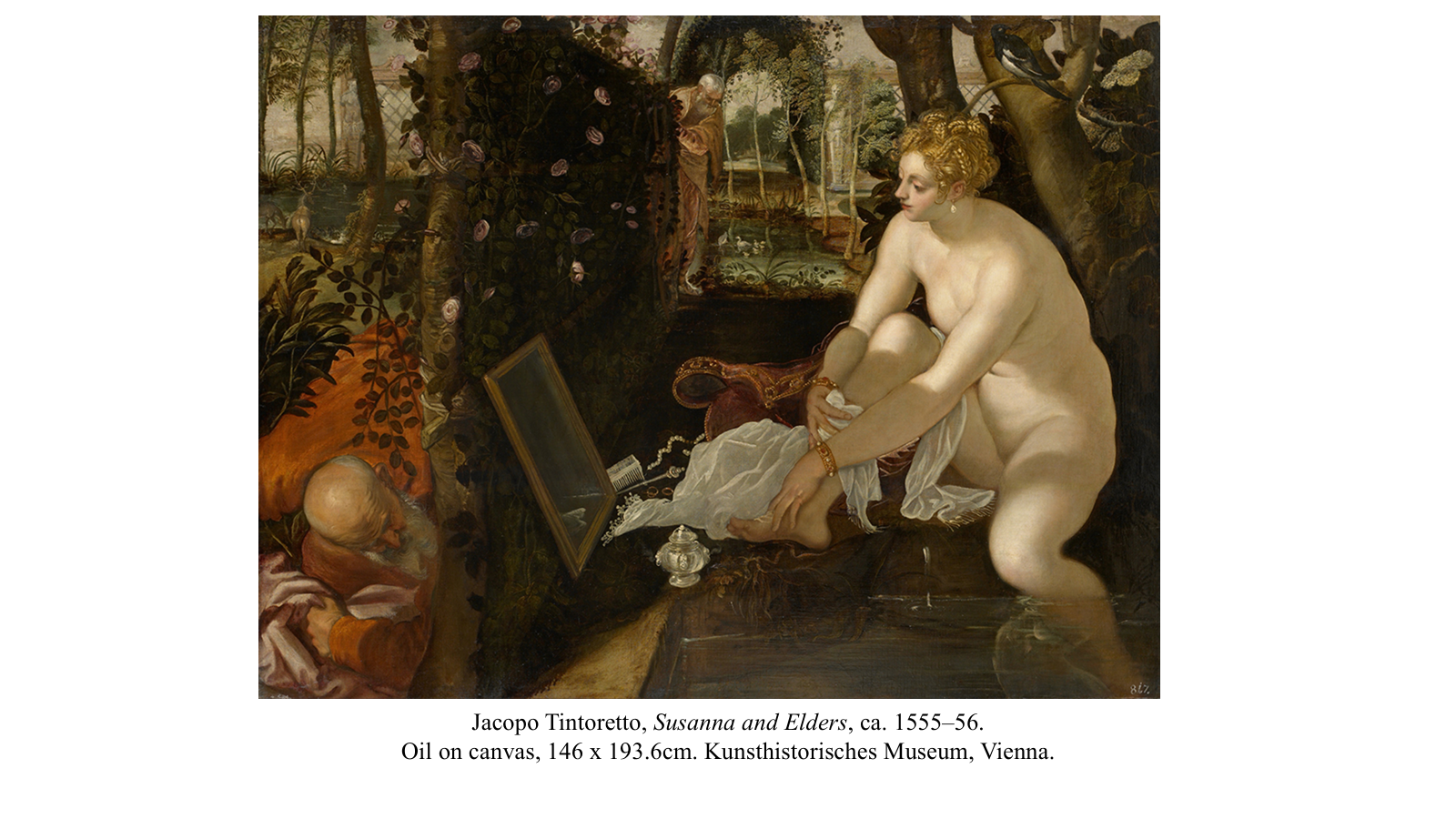
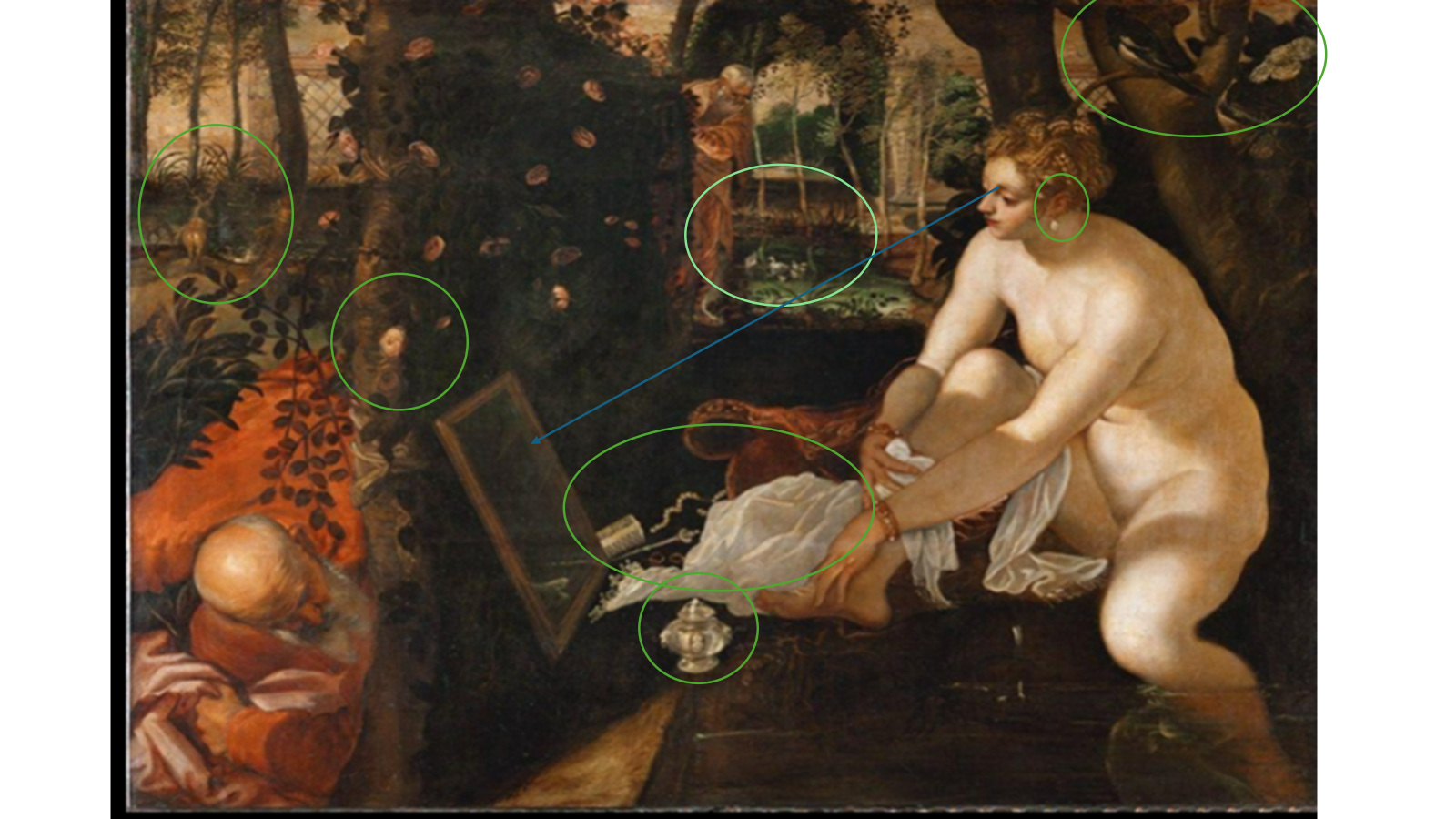
The artwork I have chosen to examine in my research paper is Susanna and the Elders by Jacopo Tintoretto, painted around 1555–56 and currently located in Vienna’s Kunsthistorisches Museum. I selected this piece specifically because I knew little about it beforehand. The painting originates from a time when politics and religion in Venice were linked. My objective is to study the work both thoughtfully and academically, aiming to understand how Tintoretto incorporates these political and religious tensions into his narrative, as well as what role he intended for the viewer within that context. Renowned for his vigorous brushwork, striking lighting, and dynamic compositions, Tintoretto offers a unique approach to this biblical subject. I am especially interested in exploring how his distinct style elements come together to create an engaging story.
Assignment #1–Annotated Bibliography on Work of Art and Initial Ideas
Anonymous. The Holy Bible: Translated from the Latin Vulgate; Diligently Compared with the Hebrew, Greek, and Other Editions in Divers Languages. Douay–Rheims Version, 1609, 1582. Internet Archive, scanned May 6, 2019
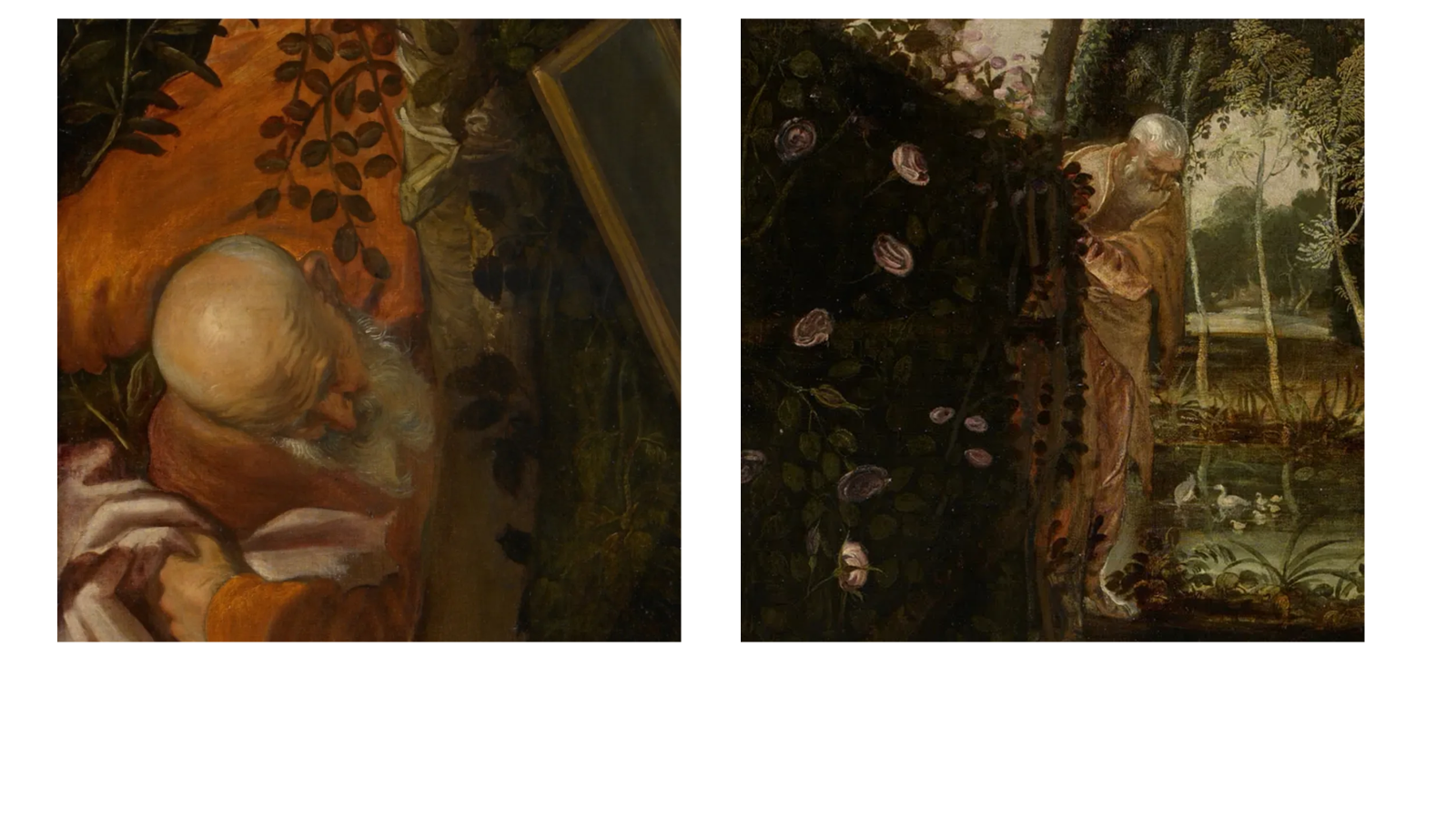
The Latin Vulgate is the Bible translated into Latin. The old testament was translated from Hebrew. It was used by the Catholic church during the time of the painting. The story takes place in the book of David chapter 13. The scripture talks about the story of a Jewish woman named Susanna and her interaction with two elders in her garden. Susanna a virtuous woman is set upon by two elders who have been being peeping toms, while she bathes in her garden. when she refuses them they lie and say she has been with a man other than her husband. She is put on trial and convicted and sentenced to death. A young boy, David speaks out for her, and with his wisdom unravels the pervy elders’ story and they are sentenced to death. Tintoretto’s painting is of the scene of the unaware Susanna being watched by the men in her garden.
My thoughts: To form an opinion about the painting, I need to understand what inspired its concept. Knowing the artist’s ideas or motivations can help decode its symbolism. Like all compelling art, Susanna and the Elders is not simply a depiction of a scene, it is filled with symbolic imagery and connected to the social or political climate of the Scuola di San Marco at that time. The Vulgate, a religious text, will be important; Daniel chapter 13 will certainly feature in my final paper as it sets the scene for these events.
DiPalma, Jessica. “Jacopo Tintoretto: Artist Overview and Analysis.” Edited and revised by Molly Enholm. TheArtStory.org. First published July 16, 2019. Updated regularly. Accessed February 12, 2026
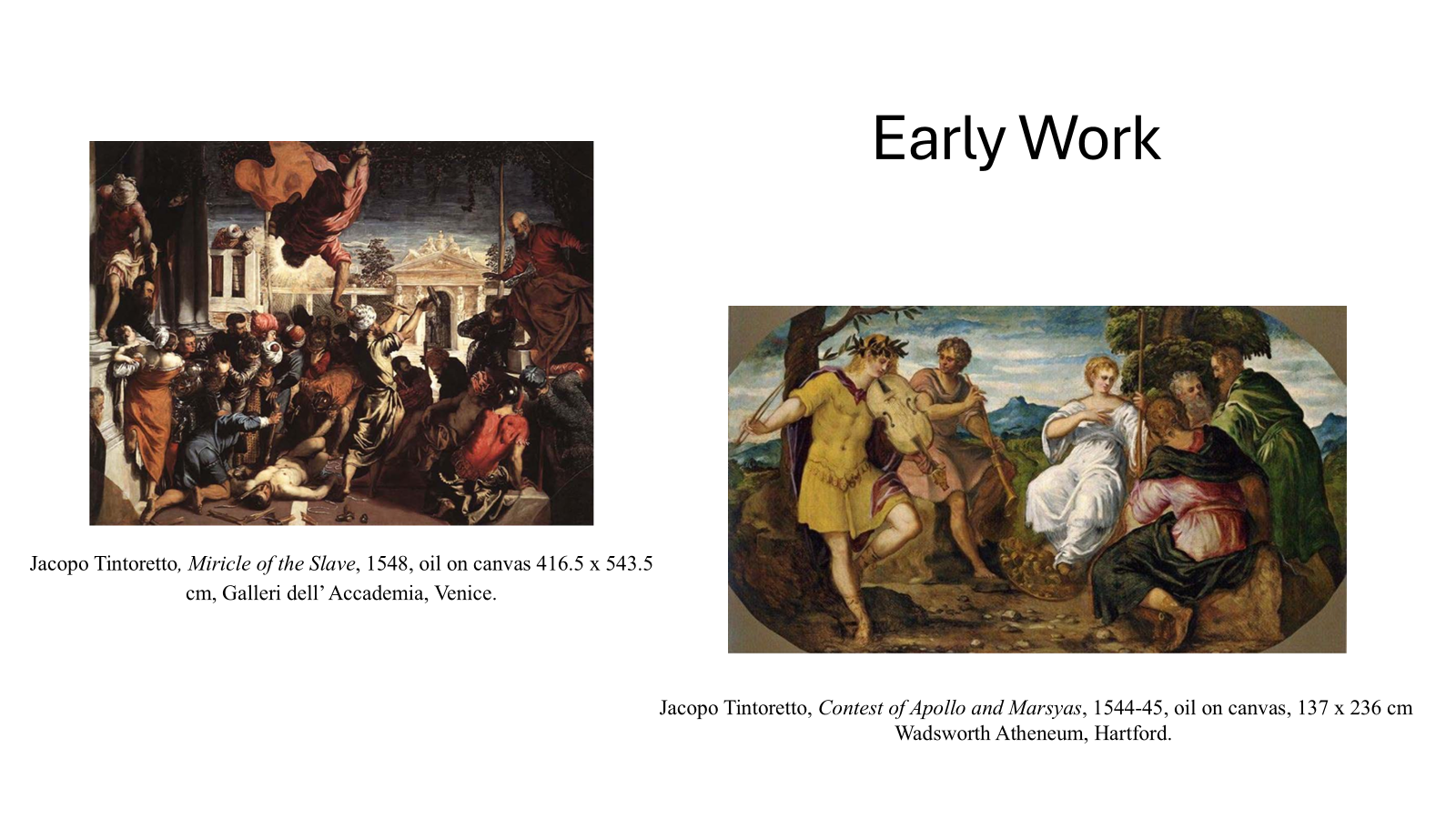
This article documents the life and works of the artist Jacopo Tintoretto. Tintoretto was one of the most dynamic and innovative painters of the Venetian Renaissance. He was set apart by his explosive energy, dramatic lighting, and daring manipulation of space. At Birth he was given the name Jacopo Robusti, he earned the nickname Tintoretto “the little dyer” from his father’s profession. He briefly trained in Titian’s workshop; however, it was not long before he forged his own style . A style that mimicked Michelangelo’s sculptural drawing with the rich color pallet he learned in the Venetian school. His signature style became his rapid, expressive brushwork and the theatrical elements of his compositions thus, this combination gave his work as never before seen intensity. Throughout his career he produced portraits, religious works, and mythological scenes for the Scuola Grande di San Rocco.
My thoughts: Understanding an artist’s background and their mentors provides valuable insight into the symbolic elements present in their work. Artists often pay tribute to those who have influenced them or occasionally demonstrate their progression beyond such influences. I am particularly interested in observing how he incorporates aspects of Titian and Michelangelo’s styles, and which facets of their influence are integrated into this piece.
Grillo, Jennie. “Showing Seeing in Susanna: The Virtue of the Text.” Prooftexts 35, no. 2–3 (2015): 250–70
This article focuses on viewers seeing “rightly” and their ethical perception. Grillo argues her thesis that that in the biblical text Susanna story was not meant as an erotized cautionary tale. She goes on to say that the story puts emphasis on the elders distorted vision and Daniel’s intervention through diving wisdom and sight. Grillo suggests that the Greek additions to the book of Daniel have been misunderstood by scholars who are not using the period eye thus only seeing the story through a Voyeuristic lens. According to her the Biblical or Greek text does not invite to shar in the elders twisted view. Instead, the narrative is structured to draw a moral contrast between a righteous and a corrupt way of viewing or seeing. She continues to add that Susannas nudeness like many renaissance nudes where not meant to be erotic but serve as deeper symbols. Most of her supporting arguments for the thesis is derived from the comparison of the Theodotion and old Greek additions to the book of Daniel. In the Theodotion version Grillo states that the scene is presented in such a way that the viewers could not easily agree with the elder’s lustful perspective thus putting emphasis on Susannas integrity and on the elder’s vlogger gaze and Daniel’s righteous and discerning gaze. Her thesis is that the story centers around ethical vision and how seeing can be corrupted by lust and desire or made Prue by justice
My thoughts: I concur that morality and personal judgments can obscure perception, thereby creating a distorted sense of reality for the observer. However, I disagree with the assertion that this is the sole central focus of the work. During the Renaissance era, nudity was not inherently associated with eroticism; rather, it could symbolize purity and a connection to virtue. Additionally, the perspective of the viewer warrants consideration since we are distanced from the scene yet able to observe all. Is the artist suggesting that each viewer projects their own desires onto what they perceive? If everyone is projecting their desires on what they are seeing, whose perspective is right?
Hahn, Robert. “Caught in the Act: Looking at Tintoretto’s Susanna.” The Massachusetts Review 45, no. 4 (2004): 633–47
Robert Hahn makes the claim that Tintoretto is deliberate in his placement of the subjects in the scene to blur the boundaries of morality. with Susanna gazing at her reflection while the elders spy and by positioning the painting so the views is also out of Susannas sight it puts the views closer to the viewpoint of the elder’s lustful gaze and not Susannas self-inflection. Hahn argues that he paintings central meaning focuses on “visual desire, complicity and the ethics of spectatorship.” Hahn emphasizes the contrast between Susanna’s innocent moment of self-reflection and her being unaware of the predatory gaze. The viewer’s viewpoint is between the elders and Susanna In a morally gray area. His thesis focusses on the ethical component of the work of how spectators could easily become predators. The painting becomes about desire and innocents being seen and seeing oneself, rather than the biblical story.
My Thoughts: I do believe that Tintoretto was strategic in placing the viewpoint between the subjects of the painting. However, the question of morality is just the surface. Does the viewer have a choice? We are where he put us. Mybe the viewpoint is that of Gods where we are sing what is unseen, we are seeing the elders see her and seeing her not see them only seeing herself. This point ties it back to being biblical though the morality theme is throughout.
Marx, Dalia. “The Prayer of Susanna (Daniel 13).” In Ancient Jewish Prayers and Emotions: Emotions Associated with Jewish Prayer in and around the Second Temple Period, edited by Stefan C. Reif and Renate Egger-Wenzel, 1st ed., 221–38. De Gruyter, 2015.
The direction Marx takes is in the biblical context or Lense. Susanna says a prayer when she is walking to be executed pleading to the lord to prove her innocents. It is her appeal to the lord that shifts the narrative from voyeurism to righteous resistance and divine judgment. Marx takes a deeper look at the prayer referring to the scripture itself, Daniel chapter 13. The prayer is argued to be the central narrative of the painting, giving it an emotional and theological meaning instead of focusing on the sexual aspects. Susanna could be viewed as a victim or stand as a symbol for purity of all sexual angles. By diving into the prayer and making that her focus Marx shapes Susanna as a religious practicing patron who has an active relationship with God. In her prayer, Susanna appeals to God, who “knows the secrets of hearts,” requesting divine judgment considering her wrongful and false conviction by others. Her prayer serves both as a plea for assistance and a call for justice.
My Thoughts: Marx made compelling arguments that supported her thesis. While I cannot completely disregard the sexual symbolism I strongly believe that the work does function as a religious work if the viewer knows the back story. There is also the stigma behind nudes in religious works. Michelangelo was a pioneer or showcasing duality in his sculptures could, it makes me wonder if that is also the case here. Are sexuality, religion and politics being showcased at the same time?
I have not chosen a direction for my paper. Because I have yet to form an original viewpoint of the piece that is not speculative. I am leaning into it being a religious and political theme, but I will need a variety of sources on each to really build support for my argument and it has been tough to find scholarship about this work within a 10-year range. I am interested in the three-point perspectives of the painting being the elders, Susannas and the viewers we all see different things both physically and spiritually. The elders perceive Susanna as a sexual object, while Susanna herself remains oblivious to their intentions, focusing solely on her own perspective. We, as observers, witness everything, yet remain hidden both from the subjects and from ourselves, since there is no viewpoint within the scene that offers a reflection, like Susanna’s mirror or the pool, where we might see ourselves.
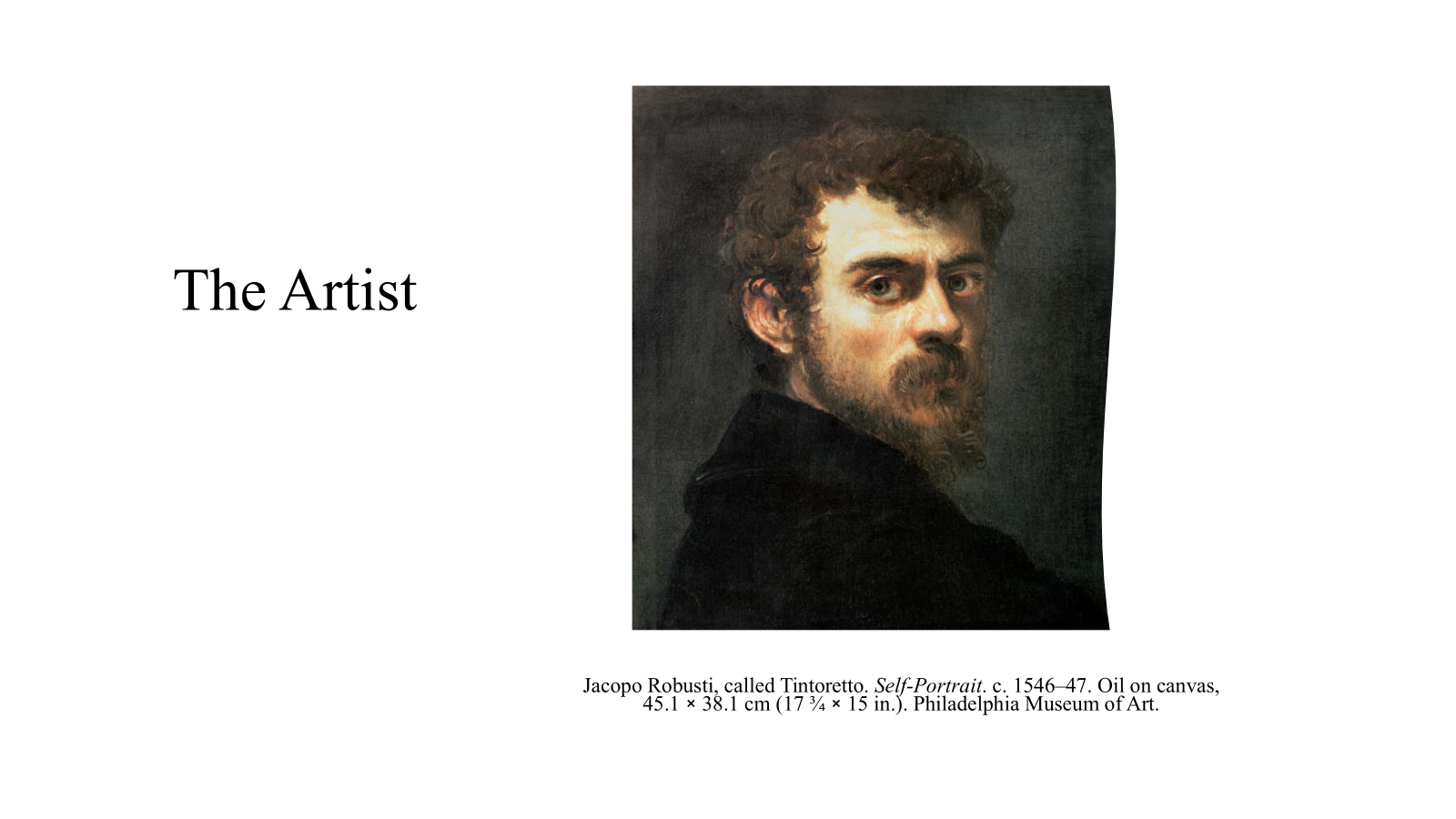
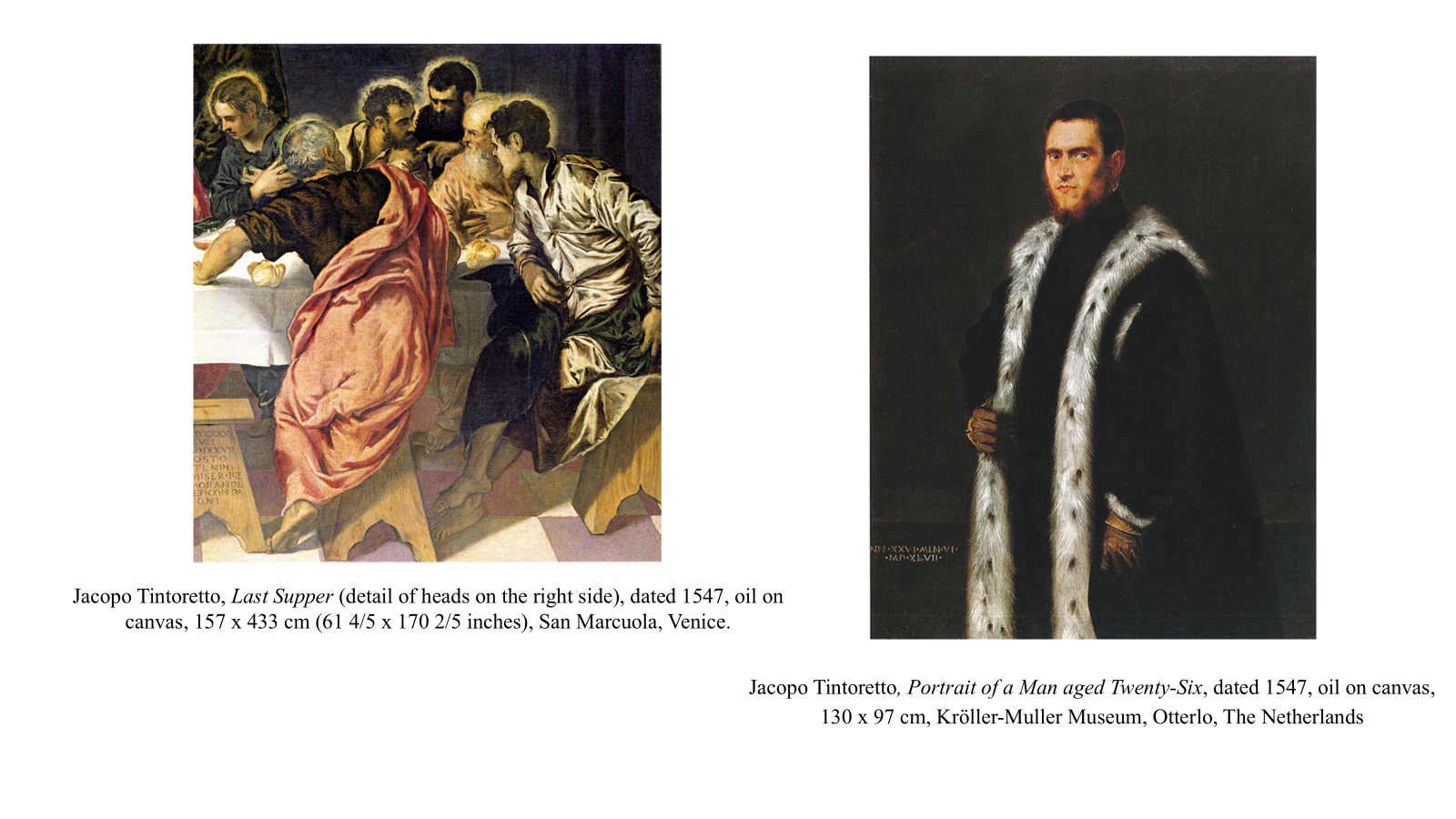
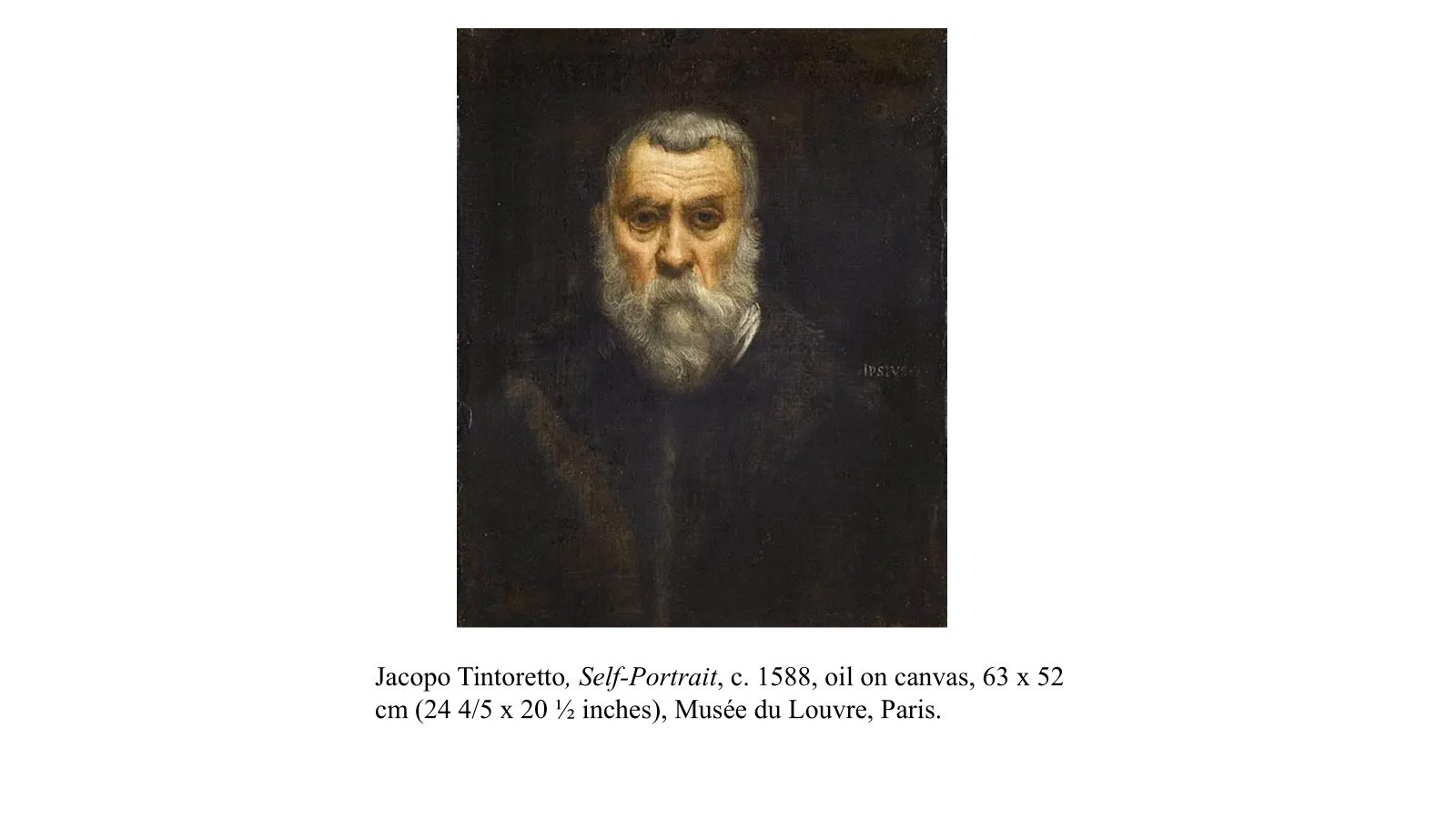
Tintoretto was one of the most dynamic and innovative painters of the Venetian Renaissance. He was set apart by his explosive energy, dramatic lighting, and daring manipulation of space. At Birth he was given the name Jacopo Robusti, he earned the nickname Tintoretto “the little dyer” from his father’s profession. He briefly trained in Titian’s workshop; however, it was not long before he forged his own style . A style that mimicked Michelangelo’s sculptural drawing with the rich color pallet he learned in the Venetian school. His signature style became his rapid, expressive brushwork and the theatrical elements of his compositions thus, this combination gave his work as never before seen intensity. Throughout his career he produced portraits, religious works, and mythological scenes. He often produced religious works without a patron.
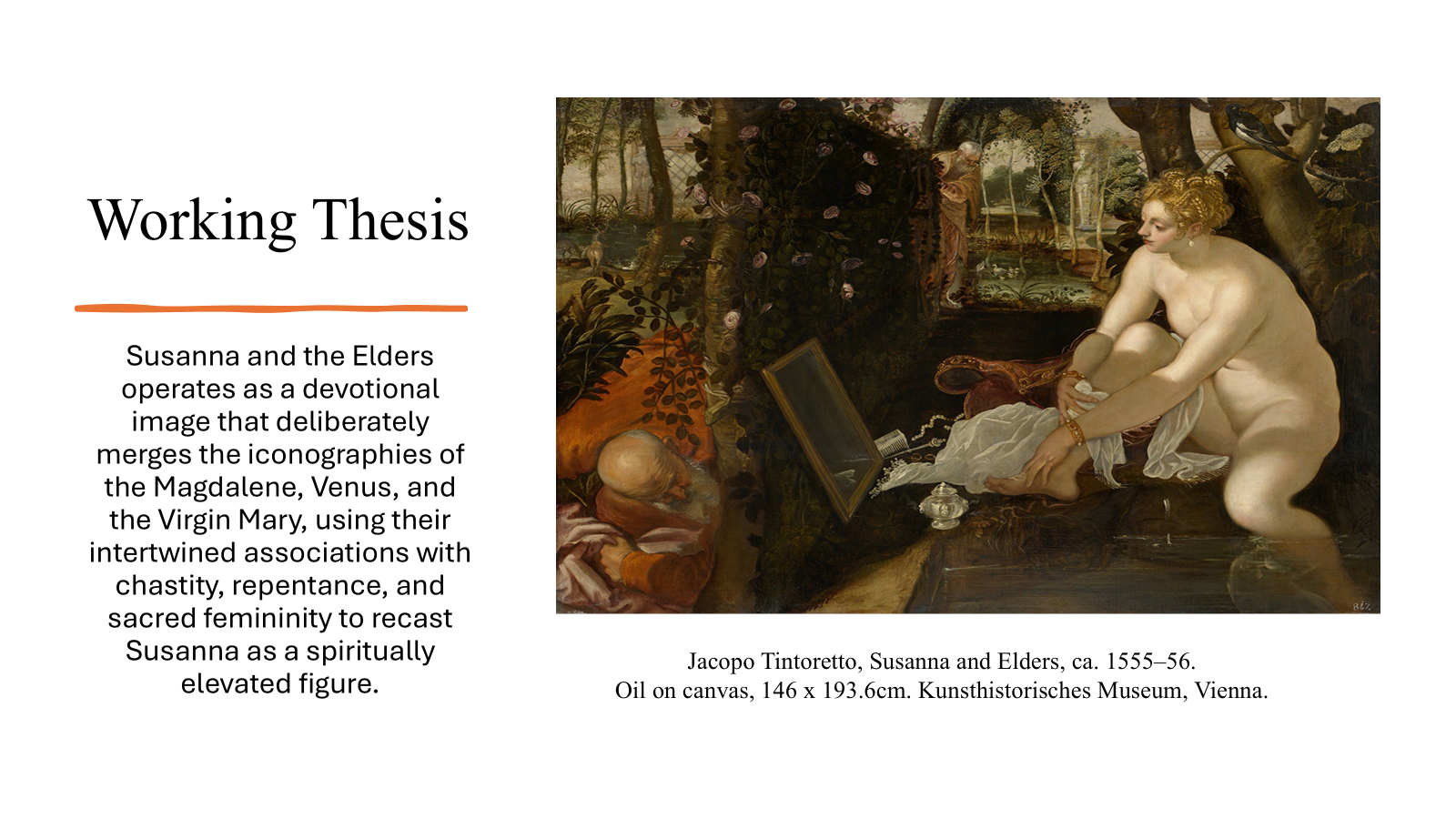
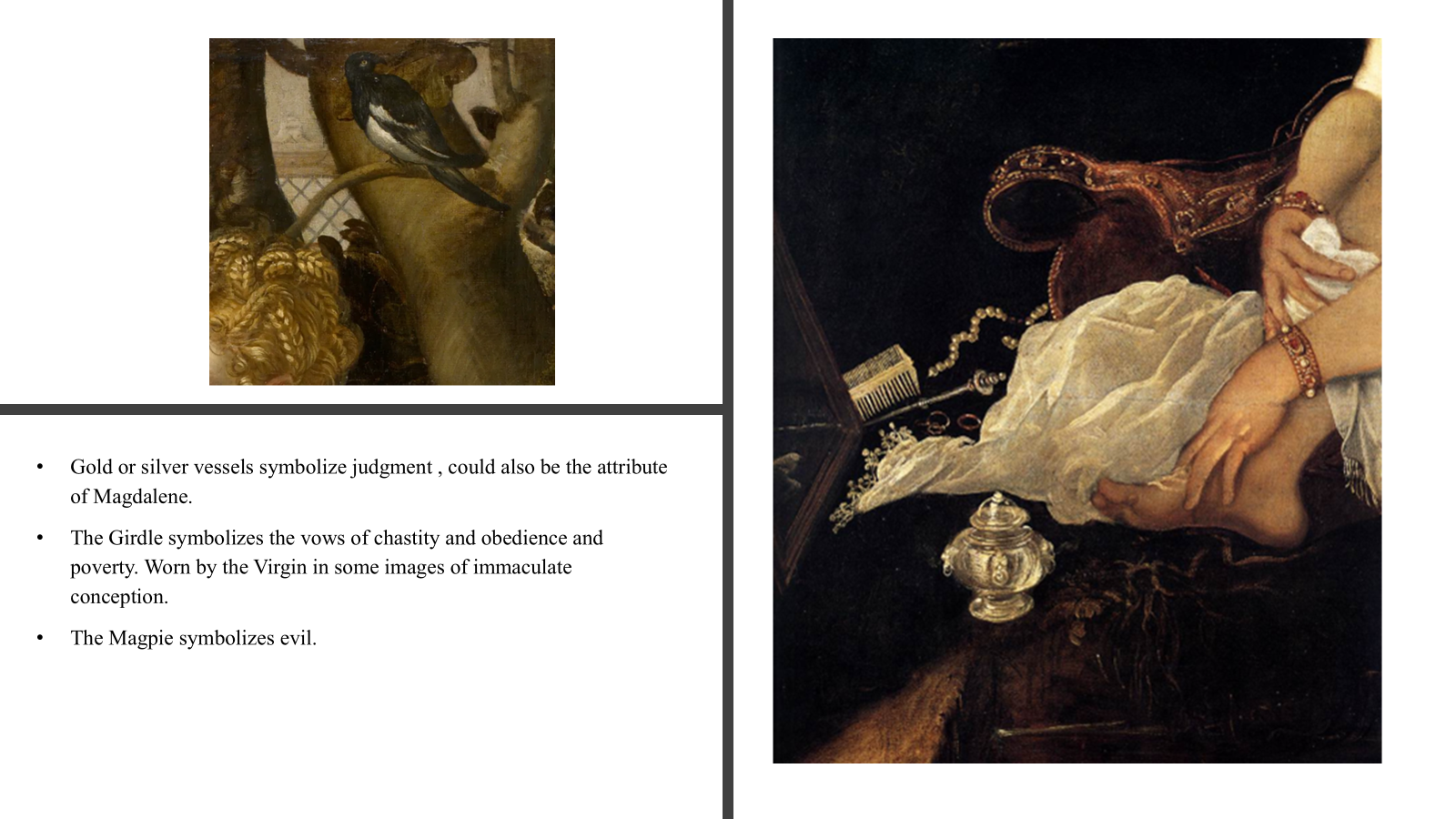
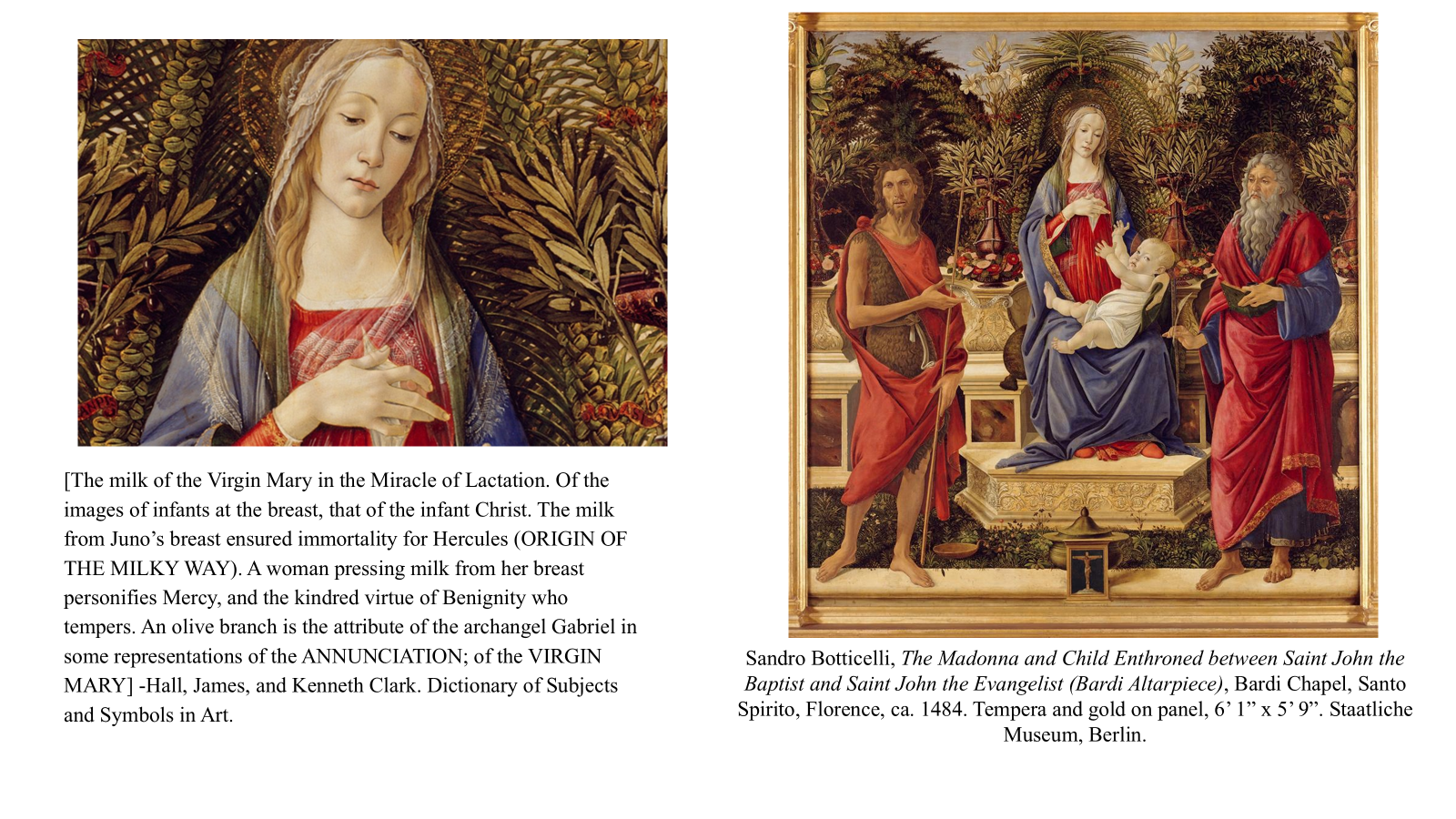
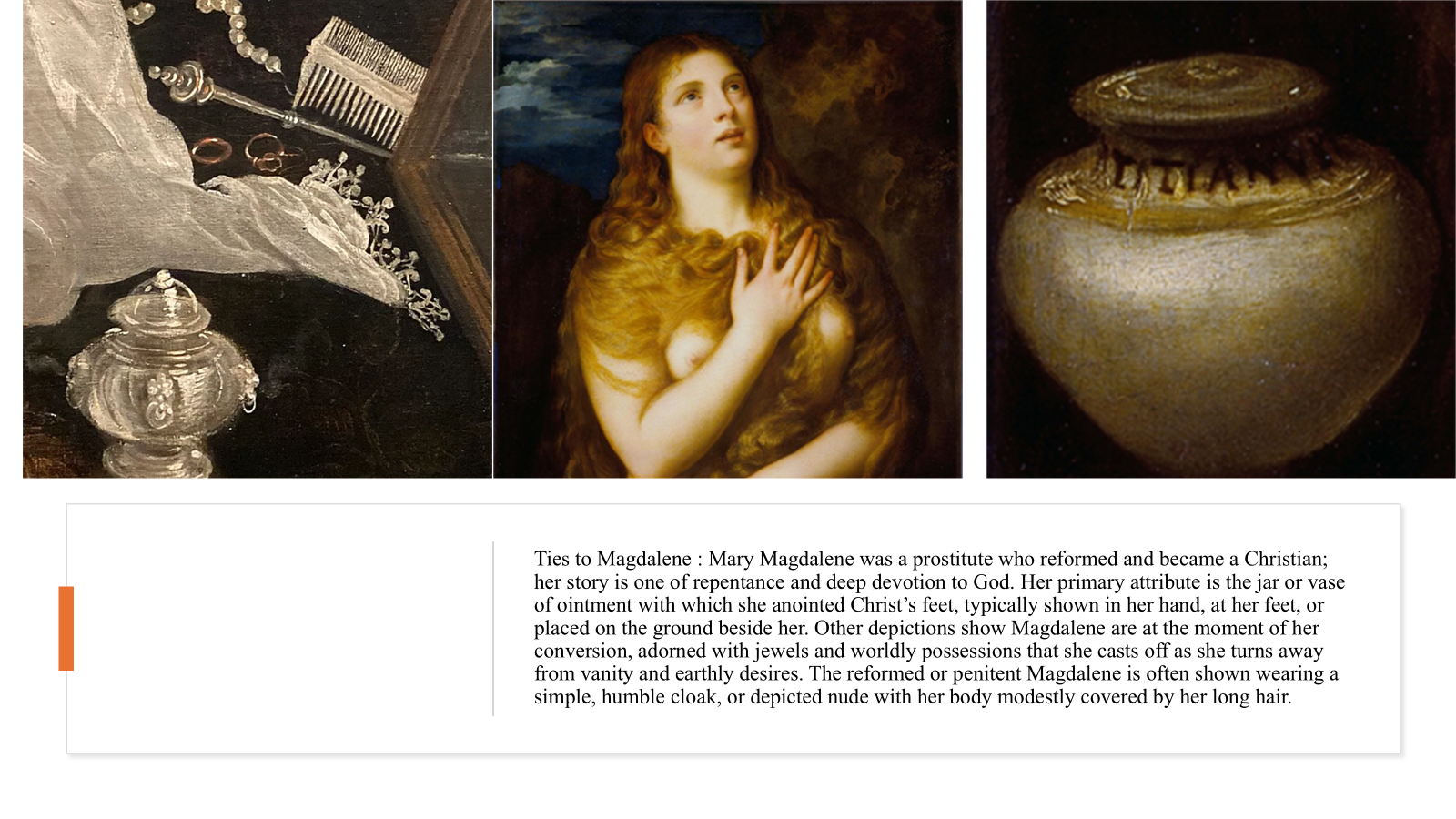
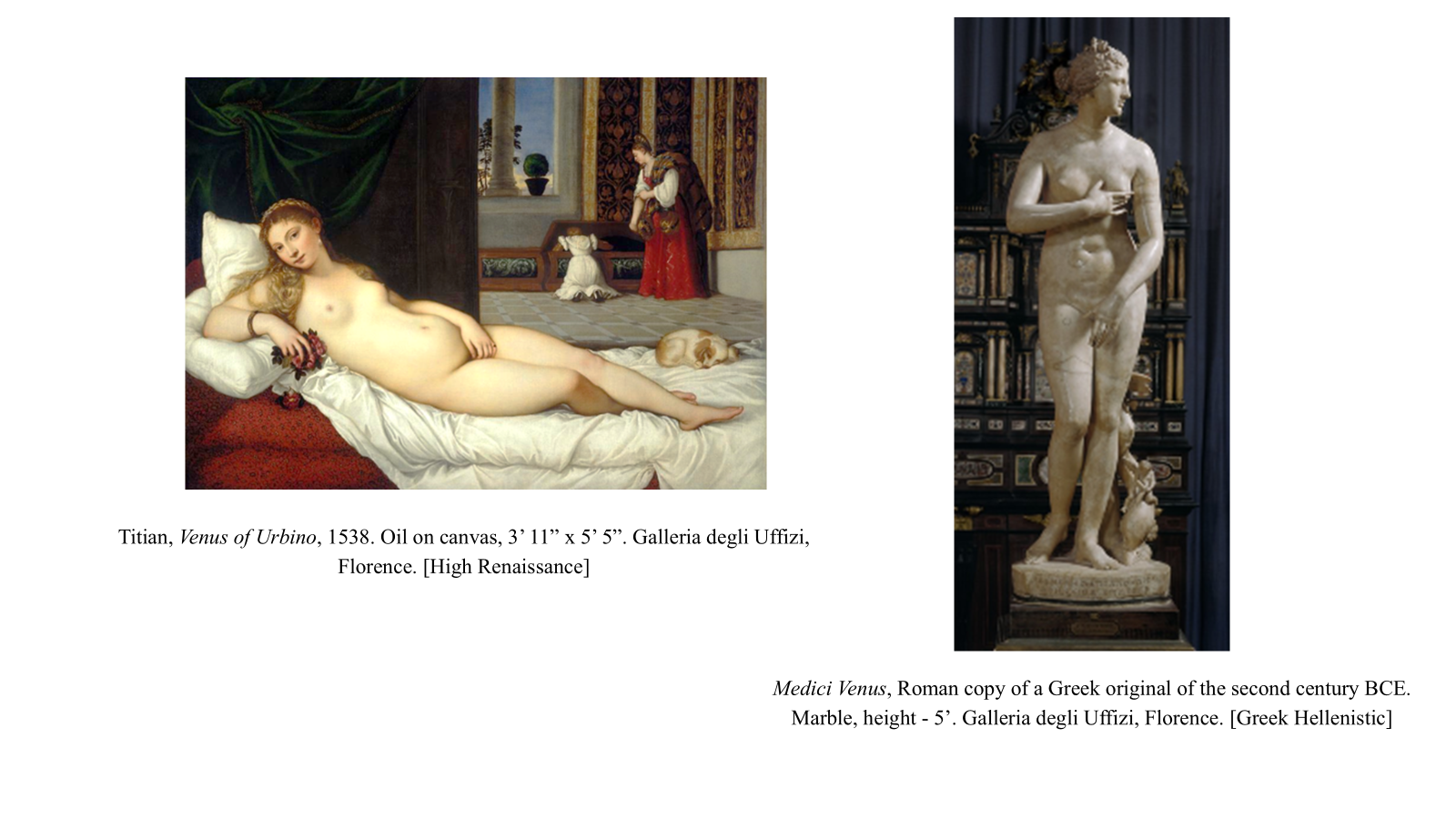
The painting takes on a Marian inflection, placing the viewer in a continual inner dialogue about themselves and the state of their own faith. The scene contains iconographical evidence that supports the idea of Susanna functioning as a version of the Virgin Mary. Symbolic references also point to Mary Magdalene, who represents repentance and spiritual reformed to the goddess Venus, with whom the Virgin Mary was sometimes visually associated. As the Catholic Church elevated Mary to a near‑divine status, she accumulated titles such as “New Eve,” “Seat of Wisdom,” “Immaculate Virgin,” and Stella Maris (“Star of the Sea”). Iconography present in the painting ties Susanna to all three figures: the Virgin, the Magdalene, and Venus. During this era, the Virgin Mary was frequently depicted as a breastfeeding mother or shown with her breast exposed as she nursed the infant Christ. She is also associated with a thin white or sheer veil, roses and lilies, and symbolic trees such as olive, cedar, palm, and evergreen. Several of these symbols appear in the enclosed garden another Marian symbol where Susanna bathes. Mary Magdalene, once a prostitute who reformed and devoted herself to God, also has attributes present in the garden. Venus, the goddess of fertility, love, and beauty, was born from the sea and rose from a scalloped shell; her myth begins with an immaculate conception, paralleling Mary’s divine conception. Some of Venus’s symbols also appear in the painting. By 1555, when this work was created, Tintoretto was known for his self‑portraits and religious subjects, and his connections to Michelangelo and Titian are visible in elements of the composition. Evident in the painting’s sculptural forms.
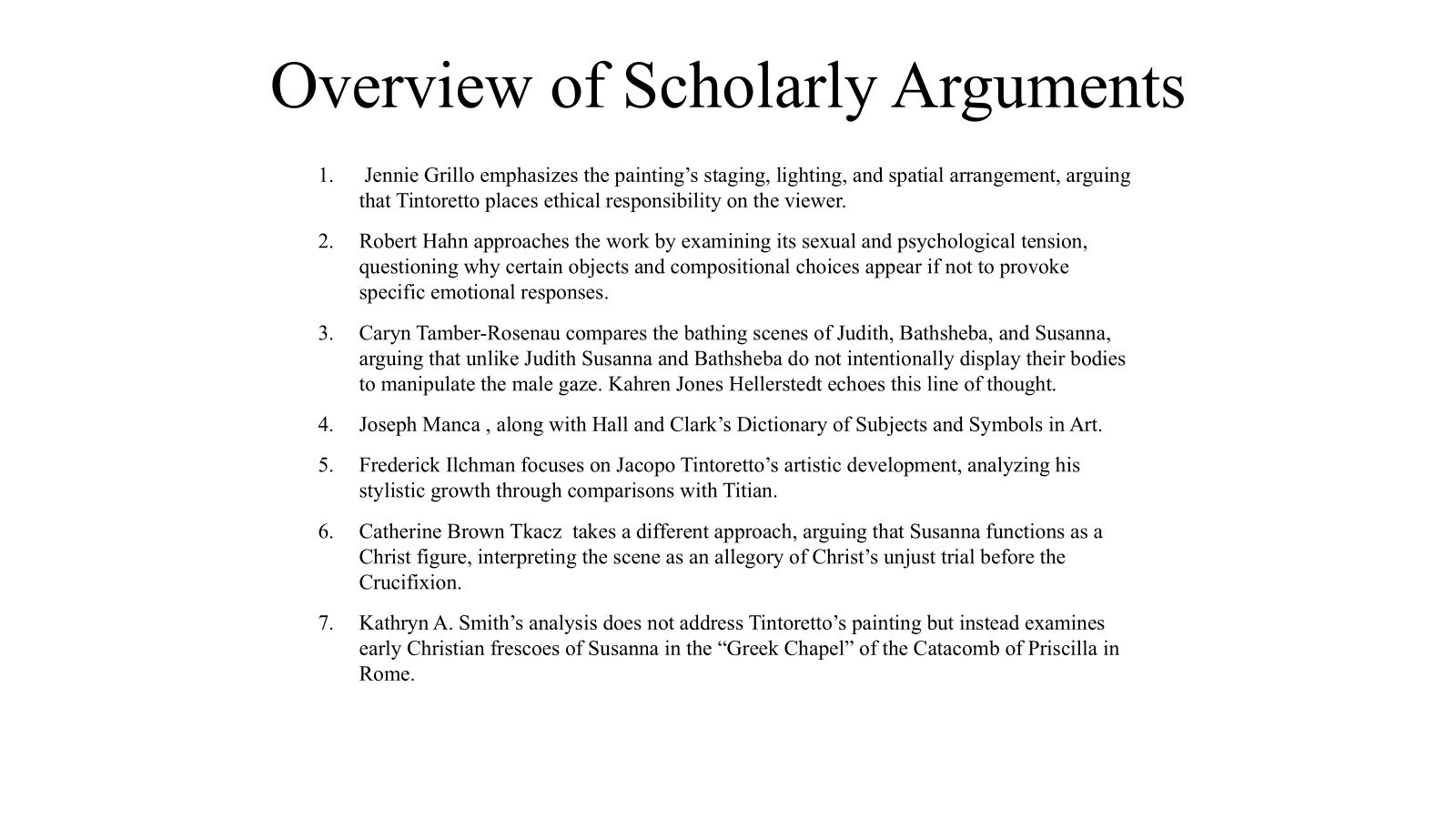
The sources I have gathered present these main lines of interpretation. Several scholars read Susanna and the Elders through a theatrical and moral lens, sexual/voyeuristic. New ideas explore Susanna as Christ, the importance of chastity/virginity over marriage, and common attributes between Magdalene, The Virgin, and Venus. Introduces other bathing scenes.
1. The theatrical placement of figures and the manipulation of light intensify the voyeuristic dynamic, reinforcing questions about the morality of “seeing” and “looking.” These elements support, rather than define, the painting’s meaning. Grillo also notes that the Renaissance nude in this context was not intended to be sexualized.
2. Like Grillo, he argues that the viewer is placed in a morally ambiguous position, though he suggests that this ambiguity extends beyond the simple act of witnessing Susanna’s vulnerability.
3. While Susanna and Bathsheba are victims, this contrast highlights Judith’s agency and control. in her analysis of Rembrandt, Hellerstedt, Kahren Jones suggests that his Susanna functions as a representation of Bathsheba.
4. They not directly address Tintoretto’s Susanna, but their discussions of iconographic symbolism provide strong support for linking Susanna to Mary, Mary Magdalene, and Venus. They offer multiple iterations of symbols such as evergreens, enclosed gardens, mirrors, and flowers that reinforce my thesis of Susanna as a Marian type.
5. Ilchman’s work provides essential context for understanding Tintoretto’s artistic climate in the mid‑1500s and the painterly decisions that shape Susanna and the Elders.
6. Tkacz’s perspective foregrounds the judicial and political dimensions of the narrative.
7. She argues that early Christian art presents virginity as spiritually superior to marriage and incorporates biblical and Jewish cultural traditions. While the fresco cycle unfolds the story across multiple scenes, Tintoretto condenses the narrative into a single moment without sacrificing depth or meaning.
8. David Rosand develops this parallel, arguing that Tintoretto constructs a visual trap in which the viewer becomes entangled in the same dynamics of desire, reflection, and moral uncertainty that structure both scenes.
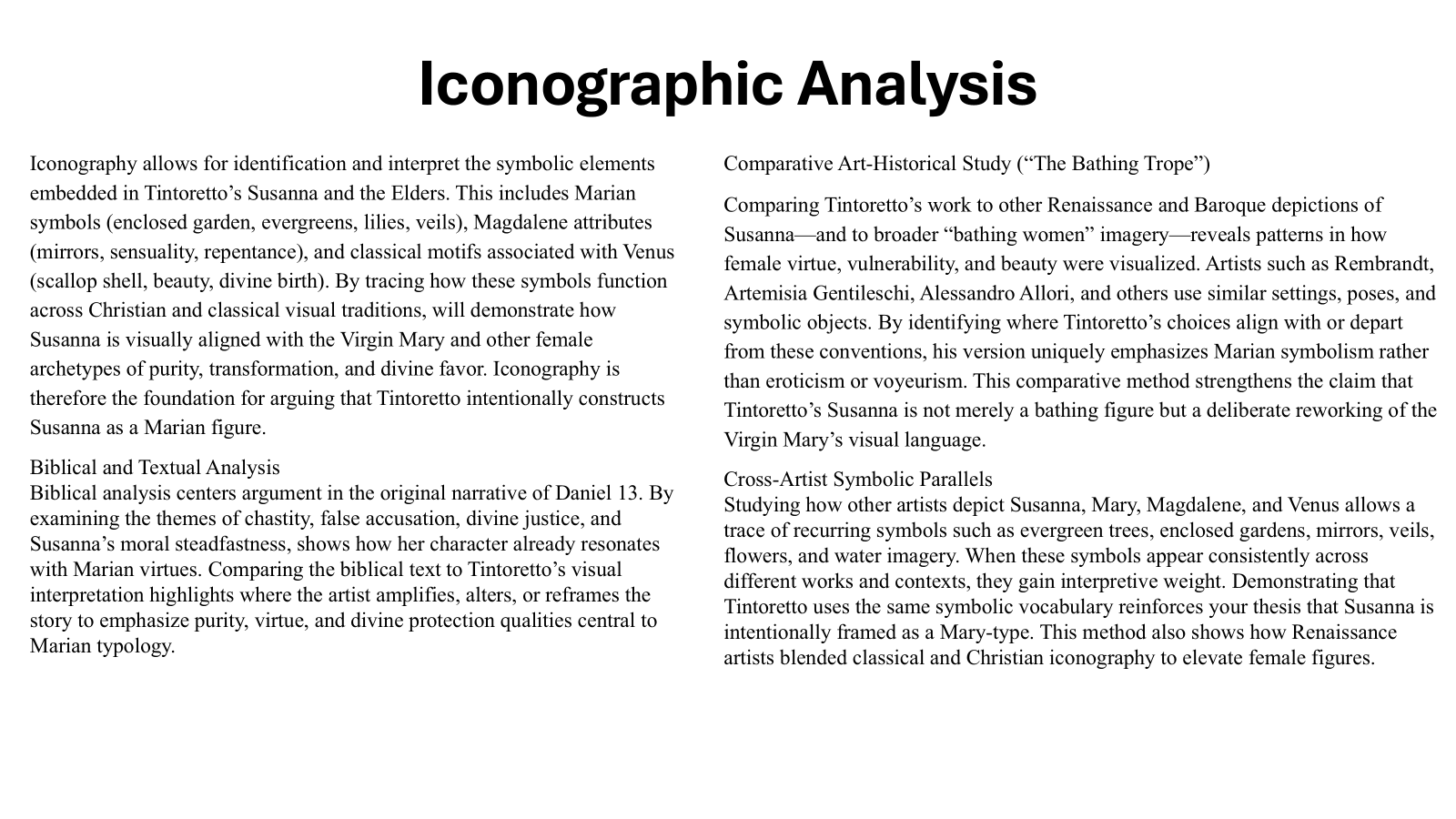
Deceit (or Fraud; Lat. Fraus). A vice that is personified in one of the earliest examples of Christian allegorical literature Dante (Inf. 17:1–27) described a monster inhabiting the Circle of Fraud,having a human face that of a just man.