Jonee Grant
Arth History 495
May 6th, 2026
Research paper
Jacopo Tintoretto, born Jacopo Robusti, was born in Venice, around 1518-1519. Known
for completing large works of art in the city of Venice, Tintoretto made a name for himself
through his expressive painterly brushwork and theatrical elements combined with his use of
asymmetrical arrangements and muscular figures in motion in his compositions. He indicated his
reluctance toward the traditional system of how artistic commissions were awarded and routinely
exhibited readymade paintings on the Venetian streets or installed unsolicited paintings on
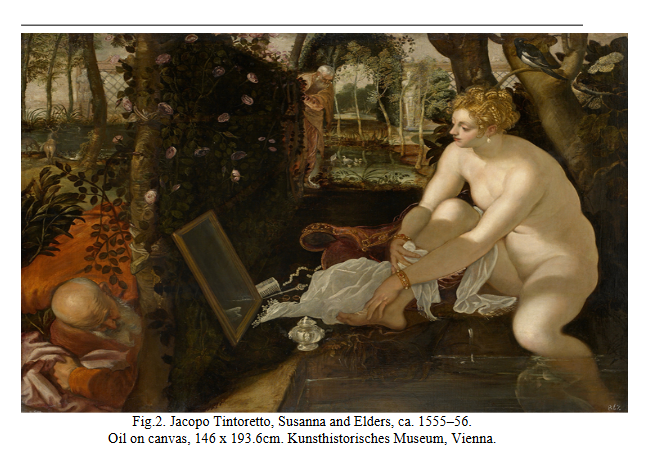
buildings.i One of his compositions that notably blends the mythological and religious is
Susanna and the Elders (fig.2.) (ca. 1555–56). It is a large oil on canvas painting measuring
146.5 x 193.6 cm. Narratives involving Susanna were popular in Venice for private collectors
because they combined moral instruction, sensual beauty, and biblical narrative. It also was an
opportunity for artists to display the female nude. Scholars have debated Tintoretto’s unusual
treatment of the biblical scene pointing to the blend of sensuality alongside the Venetian
religious culture and classical mythology. In his article, “Caught in the Act: Looking at
Tintoretto’s Susanna,” Robert Hahn makes the claim that Tintoretto is deliberate in his
placement of the subjects in the scene to blur the boundaries of morality by having Susanna gaze
at her reflection while the elders spy on her, and all the while by positioning the painting so the
viewer is also out of Susanna’s sight. This puts the viewers closer to the viewpoint of the elders’
lustful gaze and not Susanna’s self-inflection.ii Tom Nichols, in his book Tintoretto: Tradition
and Identity, notes that an apocryphal theme, a theme rooted in doubtful or legendary stories, is
carried over from Tintoretto’s mythical scenes into his biblical subject of Susanna and the
Elders.iii Nichols compares two versions of Tintoretto’s Susanna and the Elders referring to them
as erotic mythologies with an underlining tone of sexual deceit.iv Kathleen P. McClain’s article,
“Inventing Marital Chastity: The Iconography of Susanna and the Elders in Early Christian Art,”
notes that although Tintoretto’s image directly engages the viewer, his portrayal of Susanna
emphasizes her beauty more than the moral weight of the biblical narrative.vShe claims the scene
lacks clarity and a strong narrative.vi In Robert Echols’ and Frederick Ilchman’s edited exhibition
catalogue, Tintoretto: Artist of Renaissance Venice, they describe Tintoretto’s painting as being
entirely mythical with the potential to be a moralizing lesson and a parable for righteousness.
They claim that Tintoretto is merely an artist taking advantage of the opportunity to display a
female nude.viiIn Myths of Venice: The Figuration of a State, David Rosand argues that Venice
deliberately fashioned its political identity through a sophisticated visual and symbolic language
using Marian purity, Venusian maritime birth, and Astraean justice to construct a hybrid female
allegory that embodied the Republic’s claims to divine favor, moral authority, and harmonious
governance.viii Jacopo Tintoretto’s Susanna and the Elders contains rich iconographical evidence
that supports the idea of Susanna as a visual analogue to the Virgin Mary, Mary Magdalene and
the goddess Venus; figures whose associations were deeply embedded in sixteenth century
devotional Venetian culture.ix This paper argues that through his hybrid strategy, Tintoretto
intentionally merges the iconographies of Susanna, the Virgin Mary, Mary Magdalene, and
Venus to fashion Susanna as a composite emblem of sacred femininity, a personification of the
four heroines whose virtues are moral ideals for the viewer to aspire to. When Tintoretto’s
biography is considered alongside the painting’s formal and iconographic dialogue with the
Virgin Mary, Mary Magdalene, and Venus, figures central to Venice’s devotional and
mythological imagination it becomes apparent that Susanna and the Elders present Susanna as a
composite ideal, synthesizing the virtues associated with four exemplary women.
Jacopo Tintoretto’s father was a cloth dyer (tintore) which is how he earned the nickname
Tintoretto “the little dyer.”x He was known to have a flair for business and a love of theatre. He
was also a contemporary of William Shakespeare, contributing to the same vibrant cultural
landscape that defined the late sixteenth century.xi Tintoretto is traditionally said to have trained
briefly in Titian’s workshop in the early 1530s, however, it was not long before he became an
independent painter, forged his own style, and started to refer to himself as “Master Giacomo
painter in the campo di S Cassiano.”xii With his expressive painterly brushwork, theatrical
compositional effects, asymmetrical arrangements, and muscular figures in motion, Tintoretto
developed a dynamic visual language through which he produced portraits, religious narratives,
and mythological scenes throughout his career. Throughout his career he produced portraits,
religious works, and mythological scenes.xiii In 1540, he painted The Virgin and Child with the
Infant John the Baptist and Saints Joseph, Elizabeth, Zacharious, Catherine and Francis. He
signed this work “Iachobus” that closely resembles a stylized symbol of a wheel; a reference to
the drying process of cloth and thus, a nod to his father.xiv Tintoretto completed many minor
commissions such as frescos and furniture paintings and an altarpiece for the Venetian
fishmongers in 1541-1544.xv His most notable works from this period are the large scale-laterals
of the Conversion of Saint Paul and the Christ among Doctors. A set of sixteen octagonal
paintings for a young Venetian patrician, Vettore Pasani, for his room in his palace at San
Paternian are considered among his most prestigious commissions.xvi In 1545-1546 he was
commissioned by a famous Tuscan writer, Pietro Aretino, for two ceiling paintings for the
bedroom of his house on the Grand Canal.xvii In 1547 he completed Miracle of the Slave for the
Scuola Grande di San Marco. This painting was returned due to it being deemed controversial. In
a letter, Aretino acknowledges the realism but criticized the hasty execution.xviii Tintoretto
married Faustina the daughter of Marco Episcopi around 1549-1553. Tintoretto not only secured
financial stability but effectively established himself as a painter of city-wide importance, whose
work was central to Venice’s most powerful confraternal institution by fulfilling his first
commission for the Scuola Grand di San Rocco. While living in the San Marzial district in 1554,
Marietta his oldest daughter is born. He completes two more paintings for the church of San
Rocco, along with portraits for various patrons.xix By 1574, Tintoretto had eight children and
they moved to a house on Fondamenta dei Mori in the parish of San Marziale. While living there
Tintoretto received commissions from the French monarch Henri III.xx In 1557, he completes the
ceiling painting for the Sala Superior of the Meeting House of the Scuola Grand di San Rocco
church. Tintoretto proposed to the Scuola Grande di San Rocco that he would produce one large
painting each year for the rest of his life in exchange for a lifelong annual stipend of 100 ducats,
an arrangement that ultimately resulted in his creating more than sixty works for the
confraternity between 1564 and 1587. During this time, he also wins a commission from foreign
patron.xxi Tintoretto goes to Mantua to oversee the installation of his work The Gonzaga Family
Adoring the Trinity (also known as The Trinity with the Gonzaga Family). Commissioned by
Duke Guglielmo Gonzaga for the Ducal Palace, the painting was one of Tintoretto’s most
prestigious non-Venetian commissions.xxiiThis is the only time he has left Venice.xxiii 1579 is
considered Tintoretto’s busiest year, when he had some of his children Domenico, Marco, and
Marietta working in his workshop. Tintoretto dies of a fever on May 31st, 1594, and he is buried
in the tomb of his father-in-law in the church of Madonna dell’ Orto.xxiv There is no surviving
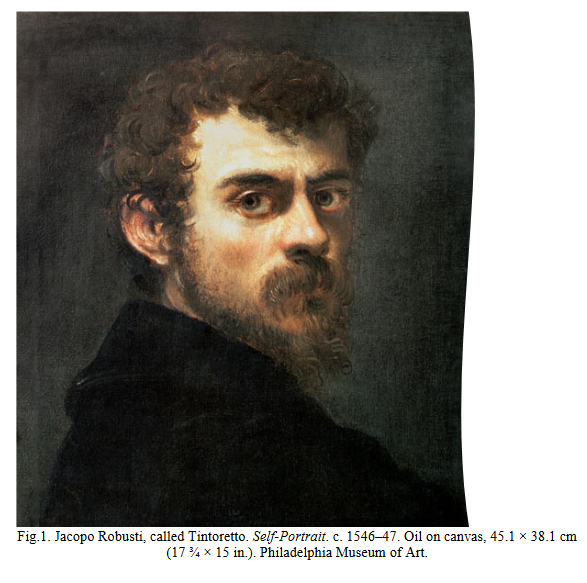
document that identifies a specific patron for Susanna and the Elders.xxv Fig. 1.Tintoretto.
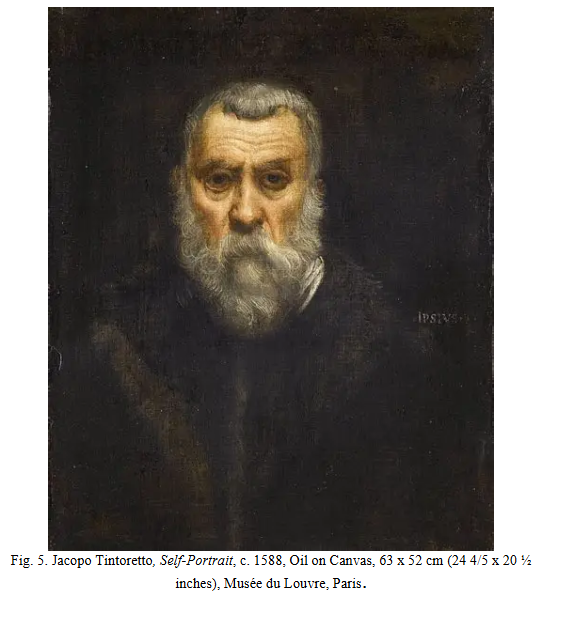
Self-Portrait. c.1546–1548. Oil on canvas. Philadelphia Museum of Art. Fig. 5.Jacopo
Tintoretto, Self-Portrait, c. 1588, oïl on Canvas, 63 x 52 cm (24 4/5 x 20 ½ inches), Musée du
Louvre, Paris.
The story in Daniel chapter 13 unfolds in Babylon and centers on Susanna, the virtuous
daughter of Hilkiah and wife of the wealthy Joachim, whose garden served as a gathering place
for the Jewish community in exile. Two elders’ judges appointed to preside over legal matters
begin to frequent Joachim’s house and, over time, become inflamed with desire for Susanna.
Hiding themselves in the garden, they wait until she enters to bathe, having sent her attendants
away to fetch oil and ointments. When she is alone, the elders emerge from their hiding place
and threaten her: she must submit to them, or they will accuse her of committing adultery with a
young man. Susanna refuses, declaring that it is better to fall innocent into the hands of God than
to sin, and she cries out for help. The elders then shouted as well, claiming they witnessed her
with a lover who escaped. Because adultery was punishable by death under Jewish law, Susanna
is brought before the assembly. The elders, whose status gives their testimony great weight,
repeat their fabricated story, and the people condemn her. As she is led away to execution,
Susanna prays to God, who “stirred up the holy spirit of a young boy named Daniel.” Daniel
interrupts the proceedings and rebukes the crowd: “Are you so foolish, you children of Israel,
that without examination or knowledge of the truth you have condemned a daughter of Israel?”
He demands that the elders be questioned separately. When Daniel asks the first elder under
which tree he saw Susanna with the alleged young man, the elder answers, “Under a mastic
tree.” Questioned alone, the second elder claims it was “under an evergreen oak.” Their
contradictory testimonies expose the lie. The assembly recognizes the truth, praises God, and
condemns the elders to the same punishment they sought for Susanna. She is vindicated, her life
is spared, and justice is restored.
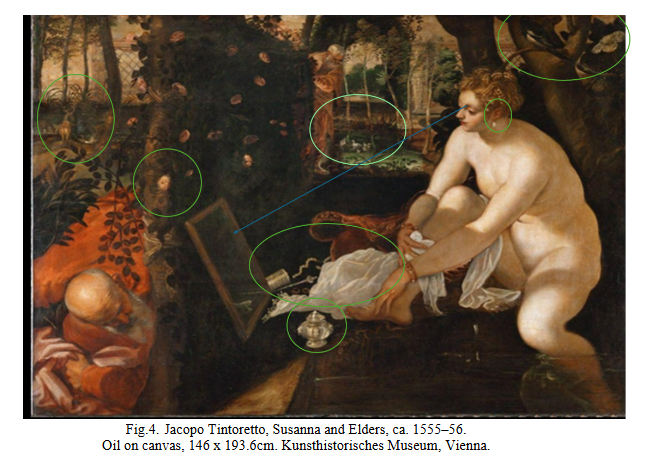
The painting (fig.4.)Susanna and Elders, ca. 1555–56. Oil on canvas, 146 x 193.6cm.,
now in the permanent collection of the Kunsthistorisches Museum in Vienna. The composition
presents a nude Susanna seated in a garden beside a pool, leaning against a tree and facing a
dense rose trellis against which a simple mirror is propped. She gazes into the mirror, absorbed
in her own reflection. Scattered around her are a white silk shawl, pearls, jewelry, a comb, and
pieces of silverware, forming a carefully arranged still life. At either end of the trellis, two
elderly men peer around the lattice to watch her, while Susanna remains unaware of their
presence. Susanna’s body is rendered with a pale, luminous complexion. She is positioned
between the rose trellis before her, the pool of water to her right where her right leg is submerged
to the knee and the large tree and shrubs behind her. Her proportions are intentionally
exaggerated: her voluptuous body contrasts with a noticeably smaller head, giving her a
sculpturesque presence and suggesting that the painting may have been intended to be viewed
from below. Her face is stylized, with no single emotion dominating; her lips are red, her cheeks
softly flushed, and her golden hair is braided and pinned up away from her neck and shoulders.
A single pearl earring hangs from her right ear. Both arms wrap around her bent knee, each wrist
adorned with a jeweled bracelet. Her left breast is exposed while her right is covered by her
elongated arm. Her hands reach toward the foot that rests on the pool’s edge, while her pubic
area remains uncovered despite a delicate white cloth draped over her knee and gathered at her
foot. At her feet lie a silver urn, the mirror she gazes into, an open book, her discarded clothing,
and additional jewels. Behind her rises a large tree, where a magpie perches on a branch above
her head. She sits parallel to the garden’s opening, which lies only a few feet away. Between her
and this opening stand one of the elders, gray-haired and fully clothed in tan drapery. Beyond
him is another pool with ducks swimming, bordered by six slender trees that form a gate-like
barrier. A wall spans the far background from left to right. To the left of the elder is yet another
pool, where a doe lowers its head to drink and a buck stands nearby; the trellis and the elder’s
body obscure whether these pools connect into a single body of water. In the foreground,
crouched behind the trellis, is the second elder. He is also gray-haired, with a long beard, and
wears robes in red and pink tones. His brow is deeply furrowed as he watches Susanna. The
dominant color scheme of the painting consists of varied greens, accented by touches of pink,
red, and gold, with smaller highlights of silver, white, and tan. The pools in the background are
greenish in tone, while the pool at Susanna’s feet is rendered with transparent clarity.
In Susanna and the Elders, Tintoretto demonstrates his mastery of combining sculptural
figuration with controlled, deliberate lighting. Susanna’s luminous skin immediately draws the
viewer’s attention, even though one of the elders in the foreground is painted in striking reds and
pinks. As the eye moves across the canvas, the composition reveals increasing detail while
maintaining consistently fine brushwork, even in distant elements. Every figure and object is
rendered with clarity. The placement of Susanna and the two elders form a triangular
arrangement, with each figure’s surrounding environment contributing to the narrative. Susanna
is unmistakably the focal point: her glowing complexion echoes the radiance found in
Tintoretto’s religious works, suggesting divinity and purity, a stylistic choice common among
Venetian painters. Although the composition is filled with lush flora and fauna, the dominant
greens function as a harmonious backdrop rather than overwhelming the scene. They provide a
tonal foundation upon which the pinks, reds, golds, and pale flesh tones build, creating a
balanced and visually cohesive whole.
Tintoretto’s bold hybridization in Susanna and the Elders is not accidental but
characteristic of the artist whom Tom Nichols describes as a “formidable maverick,” one who
routinely pursued ambitious pictorial ideas even without a commission. This independence
allowed Tintoretto to merge sacred, penitential, and mythological identities within a single figure
an approach that aligns directly with the visual logic David Rosand identifies as central to
Venice’s self-mythologizing culture. Venice fashioned its civic identity through overlapping
female archetypes Marian purity, Magdalen penitence, and Venetian-Venusian beauty creating a
symbolic system in which hybrid femininity expressed the state’s spiritual and political ideals.xxvi
This cultural framework clarifies why Tintoretto’s Susanna is constructed through precisely
these identities. Highlighting Marian symbolism at a moment when the Catholic Church was
elevating the Virgin to near-divine status was a strategic choice in Tintoretto’s religious imagery.
In Venice, the Virgin functioned as a moral and spiritual model for wives, her perpetual virginity
serving as the ultimate emblem of purity; invoking her iconography therefore made a painting
especially appealing as a gift a husband might commission for his bride. Marian symbols such as
veils, evergreens, roses, an exposed breast and above all the enclosed garden appear prominently
in the composition. The garden, which forms the setting for the entire scene, is one of the most
potent Marian emblems because it evokes the Annunciation, the moment when the angel Gabriel
declared that Mary would conceive Jesus. This episode affirmed Mary’s purity, divine
protection, and sacred enclosure, visually reinforcing her role as the immaculate vessel chosen
by God. This connects Susanna to Mary, while also tying them both to Venice itself. Venice’s
claim that the city was founded on the Feast of the Annunciation, March 25, 421 provides a
crucial ideological backdrop for understanding why Tintoretto would infuse Susanna and the
Elders with Marian imagery. Venice built its entire civic mythology on the belief that the
Republic was born under the sign of the Virgin Mary, miraculously conceived and divinely
protected from its very origin. Annunciation imagery saturated the city’s churches, bridges, and
state buildings, reinforcing the idea that Venice’s purity, justice, and political stability derived
from Mary’s intercession.
A Venetian viewer would therefore read any figure marked by Marian attributes
luminosity, purity, contemplative interiority as participating in this foundational myth.
Tintoretto’s Susanna, shown in a secluded garden at a moment of moral testing, echoes the
Annunciation’s themes of divine presence, feminine virtue, and miraculous protection. The
Annunciation’s significance in Venice also shaped the expectations placed upon brides, making
it central to the city’s dowry culture and the ideal of the casta sposa (the chaste bride). Because
Venice claimed its foundation on the Feast of the Annunciation, the Virgin Mary became the
ultimate model of purity, obedience, and divine protection qualities explicitly expected of
Venetian brides entering marriage. Dowry objects such as cassoni panels, spalliere, and domestic
paintings often depicted exemplary women whose virtues aligned with Marian ideals, reinforcing
the bride’s moral identity within the household. In this context, Tintoretto’s Susanna and the
Elders become an especially potent marital image. Susanna’s Marian purity, Magdalen
introspection, and Venusian beauty would have offered a bride a complex but culturally legible
model of sacred femininity one that balanced chastity with beauty, virtue with desirability, and
moral steadfastness with divine favor. Her resistance to corruption and the divine punishment of
her aggressors would have been read as assurances of protection within the marriage, echoing the
Annunciation’s promise of divine guardianship. By embedding Annunciation-inflected purity
into a narrative of testing and vindication, Tintoretto creates an image perfectly suited to dowry
culture: a visual embodiment of the casta sposa ideal that aligns the bride’s identity with the very
mythic day on which Venice believed itself to have been born.
Alongside these Marian associations, Tintoretto weaves a second visual thread: the
unmistakable iconography of Venus, whose symbols water, mirrors, nudity, and the secluded
garden further shape Susanna’s identity within the painting. A single pearl earring hangs from
Susanna’s right ear, and her right foot is submerged to the knee in a clear pool of water, invoking
Venus’s own miraculous birth from the sea. Even Susanna’s sculptural, pale body, which
dominates the right side of the composition, alludes to her goddess-like stature. Rosand notes,
Venice embraced Venus as its mythic ancestor, born from the sea foam just as the city itself rose
from the waters of the lagoon.xxvii Venice claims to have been founded on March 25, the Feast of
the Annunciation, aligning the Republic’s very birth with the Virgin Mary’s purity, divine
election, and miraculous conception. At the same time, these two origin stories, Mary’s spiritual
conception and Venus’s maritime birth, were not contradictory in Venetian thought but mutually
reinforcing symbols of divine favor, beauty, and civic harmony. Tintoretto’s Susanna embodies
this dual lineage: her luminous, Marian purity and contemplative pose evoke the Annunciation,
while her sensual beauty, reflective pool, and garden setting recall Venus’s aquatic birth and
generative power. For a Venetian viewer, Susanna’s hybrid identity would therefore resonate as
an echo of Venice’s own miraculous origins, uniting sacred conception and mythical origins into
a single visual language. Tintoretto’s fusion of Mary and Venus in Susanna is thus not merely
aesthetic it is a deeply Venetian articulation of the city’s spiritual and mythological
self-understanding.
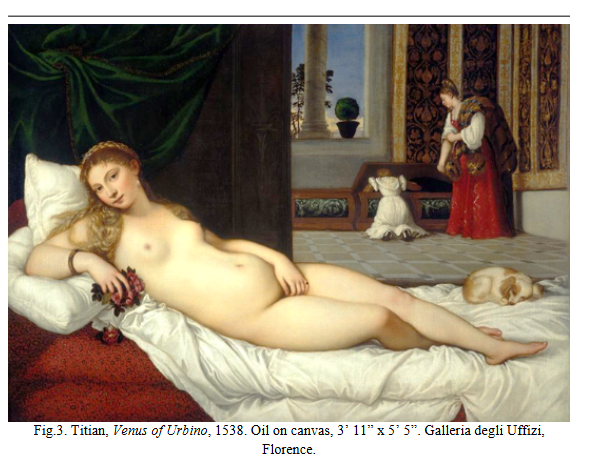
At the same time, Tintoretto would have known (fig. 3.)Titian’s Venus of Urbino,1538.
Oil on canvas, 3’ 11” x 5’ 5”. Galleria degli Uffizi, Florence, a work that blends Venusian
sensuality with Marian and Magdalen associations and may even function as a portrait of a wife.
It would establish a precedent for using the female nude to articulate ideals of marital virtue,
beauty, and domestic identity. But where Titian keeps the biblical and mythological registers
external to the narrative space. Tintoretto integrates them seamlessly into the narrative itself,
transforming Susanna into a distinctly Venetian emblem of virtue, beauty, and divine protection.
This Further sharpens Tintoretto’s originality. This fusion more seamless and conceptually
daring than Titian’s aligns with Tintoretto’s reputation for audacity and supports the reading of
Susanna and the Elders as a work that anchors its heroine within the cultural and spiritual
identity of Venice itself.. Tintoretto paints Susanna this way because it allowed him to fuse
personal innovation with the most powerful symbolic structures of his city.
In addition to Marian and Venusian symbolism, Tintoretto incorporates elements linked
to Mary Magdalene. A figure deeply venerated in Venice for her penitence and spiritual renewal.
Completing this triad of feminine archetypes, he draws on Magdalen iconography whose
associations with repentance and contemplative devotion further complicate Susanna’s identity.
Mary Magdalene was a prostitute who reformed and became a Christian, and her story is one of
repentance and deep devotion to God. Her primary attribute is the jar or vase of ointment with
which she anointed Christ’s feet, typically shown in her hand, at her feet, or placed on the ground
beside her. She is also depicted at the moment of her conversion, adorned with jewels and
worldly possessions that she cast off as she turns away from vanity and earthly desires. In
Tintoretto’s painting the ointment jar and scattered jewels lay at her feet along with her
garments. Tintoretto’s decision to infuse Susanna with Magdalen attributes becomes even more
intelligible when viewed through the devotional culture of Venetian confraternities, where Mary
Magdalene was revered not only as the “patron saint of prostitutes” but as a model of profound
penitence, emotional spirituality, and inner reform. Venetian scuole especially the Scuola di
Santa Maria Maddalena and confraternities dedicated to penitential devotion promoted
Magdalene as a figure whose tears, prayer, and moral steadfastness offered a powerful template
for lay piety. Her followers were widespread, respected, and deeply integrated into the city’s
religious life. For Venetian women, Magdalene represented not sexual transgression but the
possibility of spiritual depth, moral resilience, and intimate connection with the divine. By
aligning Susanna with Magdalene, Tintoretto taps into this confraternal understanding of the
saint as a model of interior virtue, complementing Susanna’s Marian purity, and Venusian
beauty. This fusion would have been especially meaningful in a domestic or dowry context: a
bride encountering Susanna in her new household would see not a figure tainted by sin but a
spiritually fortified woman whose devotion and moral clarity echoed the confraternal ideals
shaping Venetian lay spirituality. In this way, Tintoretto’s hybrid Susanna reflects the devotional
practices of Venice itself, where Mary, Magdalene, and Venus were not contradictory but formed
a culturally coherent spectrum of feminine virtue, beauty, and spiritual authority. Tintoretto spent
over two decades producing more than sixty paintings for the Scuola, immersing himself in a
confraternal environment where Magdalene’s tearful devotion and moral steadfastness were
celebrated as exemplary forms of lay piety. In this context, Tintoretto’s decision to infuse
Susanna with Magdalen attributes is not an anomaly but a natural extension of the spiritual
values he absorbed through his most important patrons. For Venetian viewers familiar with San
Rocco’s cycles, Susanna’s introspective pose, moral testing, and luminous purity would have
echoed the penitential ethos embodied by Magdalene. By aligning Susanna with the saint revered
in confraternal devotion, Tintoretto elevates her from a biblical heroine to a figure of interior
virtue whose moral clarity resonates with the spiritual ideals that shaped his own artistic identity.
The Scuola Grande di San Rocco was the wealthiest and most prestigious of the Scuole Grandi
by the mid-16th century, its wealth allowed it to commission Tintoretto’s massive cycles its
political visibility rivaled that of state institution.xxviii.
Tintoretto’s Susanna and the Elders also resonate deeply with Venice’s political
mythology of justice and state power. As David Rosand shows, Venice imagined itself as a
divinely protected republic whose authority rested on the virtue of Justice often personified as a
serene, beautiful woman enthroned above the waters, merging Marian purity, Venusian beauty,
and the moral authority of Astraeaxxix. This visual and ideological fusion created a civic language
in which female figures embodied the Republic’s claim to fairness, incorruptibility, and divine
sanction. A Venetian viewer would have recognized Susanna as participating in this same
symbolic system. Her innocence under threat, her steadfast refusal of corruption, and the divine
punishment ultimately delivered to her aggressors mirror the Republic’s self-image as a state that
protects the virtuous and punishes the unjust. The reflective pool, the enclosed garden, and
Susanna’s luminous, Marian-like purity align her with the visual vocabulary of Venetian Justice,
while the elders’ voyeurism echoes the very abuses of power Venice claimed to transcend. In this
sense, Tintoretto transforms the biblical episode into a distinctly Venetian allegory: Susanna
becomes a figure of civic virtue whose moral clarity reflects the Republic’s own mythic
commitment to justice, while the elders embody the threats of corruption and tyranny that Venice
defined itself against. The painting thus participates not only in domestic and marital symbolism
but also in the broader political rhetoric through which Venice articulated its authority and moral
supremacy.
Understanding why Tintoretto would load Susanna and the Elders with Marian,
Magdalen, and Venusian imagery and with echoes of Venetian justice and state mythology
requires seeing him as both a product of and a challenger within Venetian visual culture. He was
an artist who often worked without commission and pursued ideas that exceeded conventional
expectations. This independence made him unusually receptive to the layered symbolic systems
that Rosand identifies as central to Venice’s self-definition: the Republic imagined itself through
hybrid female figures who embodied purity, penitence, beauty, and justice all at once.xxx By
painting Susanna through these same identities, Tintoretto was not merely illustrating a biblical
story he was engaging directly with the ideological language of his city. The Ducal Palace’s
imagery of Justice, where a radiant female figure embodies the Republic’s incorruptibility and
divine sanction, provides a political analogue for Susanna’s steadfast virtue under threat.
A sixteenth-century Venetian viewer would have immediately recognized the layered
identities Tintoretto embeds in Susanna, because the city’s visual culture trained its citizens to
read female figures through precisely the kinds of hybrid associations Rosand describes. In
Venice, Marian purity, Magdalen penitence, and Venusian beauty were not contradictory
categories but interlocking symbolic registers that shaped the Republic’s civic mythology.xxxi
Annunciation imagery saturated the city, reinforcing ideals of chastity and divine favor;
depictions of Mary Magdalene emphasized repentance, interiority, and moral resilience; and
Venus reimagined as a benign, civicizing force embodied beauty, harmony, and the generative
power of the sea. A Venetian viewer encountering Tintoretto’s Susanna would therefore not see
a simple biblical heroine but a figure whose identity resonated with the city’s own
self-understanding. Susanna’s luminous skin and reflective pose would evoke Marian purity; her
solitary contemplation and moral testing would recall the Magdalene; and her sensual beauty,
garden setting, and connection to water would signal Venusian associations deeply tied to
Venice’s mythic origins. In a domestic setting, especially within a marriage chamber or studilo,
these layered identities would have been read as both aspirational and protective: Susanna
becomes a model of sacred femininity, a moral exemplar for the household, and a visual
affirmation of the justice and divine guardianship Venice claimed for itself. For a Venetian
audience, xxxiiTintoretto’s hybrid Susanna was not an interpretive puzzle but a culturally fluent
image that aligned personal virtue, marital identity, and civic mythology into a single,
compelling figure.
Tintoretto’s Susanna and the Elders stands as a compelling example of how
sixteenth-century Venetian artists could merge biblical narrative, classical mythology, and
devotional symbolism into a single, multilayered image. While scholars continue to debate
whether Tintoretto’s treatment of Susanna prioritizes sensuality, moral ambiguity, or
mythological allusion over the biblical context, the painting’s complexity reveals a deliberate
iconographic strategy. By drawing simultaneously on the visual languages of the Virgin Mary,
Mary Magdalene, and Venus, Tintoretto anchors Susanna within the cultural and spiritual
identity of Venice itself. Although no surviving document identifies the original patron, the
painting’s scale, subject matter, and intimate iconography strongly suggest a private Venetian
commission. Its luxurious garden setting, emphasis on beauty, and moral undertones align with
artworks intended for domestic spaces such as bedchambers, studioli, or small reception rooms
places where devotional reflection and aesthetic pleasure coexisted. In such a context, Susanna
and the Elders could function not only as a display of artistic sophistication but also as a moral
emblem within the household. Paintings were sometimes given as marriage or engagement gifts,
and Tintoretto’s hybrid iconography would have resonated in that setting. A Venetian bride
might have understood the image as both an honor and a charge: the associations with the Virgin
Mary, Mary Magdalene, and Venus would elevate her to an idealized model of sacred
femininity, while Susanna’s steadfast virtue and the divine punishment of her aggressors could
be read as assurances of protection and justice within the marriage. In this way, the painting
becomes more than a biblical episode it becomes a culturally meaningful expression of marital
identity, virtue, and honor. Recognizing this layered function enriches our understanding of
Tintoretto’s intentions and contributes to the broader discourse on Renaissance visual culture.
Rather than viewing Susanna and the Elders solely as an eroticized biblical scene or a
moralizing tale, this interpretation situates the work within a complex network of devotional,
mythological, and domestic meanings. Tintoretto’s Susanna emerges not as a passive object of
the elders’ gaze, but as a constructed ideal whose virtues chastity, introspection, beauty, and
moral resilience were meant to inspire, instruct, and protect those who lived with the painting.
This hybrid iconographic strategy reveals Tintoretto’s sophisticated engagement with Venetian
identity using female imagery to express moral and civic virtues of purity, beauty, and justice.
Together those virtues create sacred femininity and underscores the painting’s enduring
significance within Venetian art and culture.
Endnotes
i Tom Nichols, Tintoretto: Tradition and Identity (London: Reaktion Books Ltd.,1999), 144
pages,10-17
ii Robert Hahn, “Caught in the Act: Looking at Tintoretto’s Susanna.” The Massachusetts Review
45, no. 4(2004): 633–47
iii Nichols, Tom, Tintoretto: Tradition and identity. London Uk,1999
iv Nichols, Tintoretto: Tradition and Identity, page 7
v Kathleen P. McClain, Seeing Beyond the Traditional Image of Susanna and the Elders (MA
thesis, University of Alabama at Birmingham, 2000).
vi Kathryn A. Smith, “Inventing Marital Chastity: The Iconography of Susanna and the Elders in
Early Christian Art,” Oxford Art Journal 16, no. 1 (1993): 3–24.
viii David Rosand, Myths of Venice: The Figuration of a State (Chapel Hill: University of North
Carolina Press, 2001),
ix Miguel Falomir, “Mythologies,” in Tintoretto: Artist of Renaissance Venice, ed. Robert Echols
and Frederick Ilchman, exh. cat. (New Haven and Washington, DC: Yale University Press
in association with the National Gallery of Art, 2018), 198–200.
x Nichols, Tintoretto: Tradition and Identity, page 8
xi Nichols, Tintoretto: Tradition and Identity, need page 9
xii Nichols, Tintoretto: Tradition and Identity, page 10
xiii Nichols, 1Tintoretto: Tradition and Identity, page 10
xiv Nichols, Tintoretto: Tradition and Identity, page 10
xv Nichols, Tintoretto: Tradition and Identity, page 10
xvi Nichols, Tintoretto: Tradition and Identity, page 10
xvii Nichols, Tintoretto: Tradition and Identity, page 11
xviii Nichols, Tintoretto: Tradition and Identity, page 11
xix Nichols, Tintoretto: Tradition and Identity, page 11
xx Nichols, Tintoretto: Tradition and Identity, page 12
xxi Nichols, Tintoretto: Tradition and Identity, page 12
xxii Nichols, Tintoretto: Tradition and Identity, page 12
xxiii Nichols, Tintoretto: Tradition and Identity, page 12
xxiv Nichols, Tintoretto: Tradition and Identity, page 13
xxv Nichols, Tintoretto: Tradition and Identity, page 13
xxvii Rosand, Myths of Venice: The Figuration of a State
xxviii Patricia Fortini Brown, Private Lives in Renaissance Venice: Art, Architecture, and the
Family (New Haven and London: Yale University Press, 2004), 161–165.
xxix Rosand, Myths of Venice: The Figuration of a State
xxx Rosand., Myths of Venice: The Figuration of a State
xxxi Rosand., Myths of Venice: The Figuration of a State
xxxii Nichols, Tintoretto: Tradition and Identity, page 17
Bibliography
Brown, Patricia Fortini. Private Lives in Renaissance Venice: Art, Architecture, and the Family.
New Haven and London: Yale University Press, 2004.
Dalla Costa, Thomas, Robert Echols, and Frederick Ilchman, eds. Tintoretto in Venice: A Guide.
Exhibition catalogue, Scuola Grande di San Marco, Venice, 6 September 2018–6 January
- Venice: Marsilio Editors S.p.A., 2018.
Susannah Rutherglen, “Façade, Ceiling, and Furniture Paintings,” in Tintoretto: Artist of
Renaissance Venice, ed. Robert Echols and Frederick Ilchman, exh. cat. (New Haven and
Washington, DC: Yale University Press in association with the National Gallery of Art,
2018), 93–102.
Miguel Falomir, “Mythologies,” in Tintoretto: Artist of Renaissance Venice, ed. Robert Echols
and Frederick Ilchman, exh. cat. (New Haven and Washington, DC: Yale University
Press in association with the National Gallery of Art, 2018), 198–200.
Falomir, Miguel. “Mythologies.” In Tintoretto: Artist of Renaissance Venice, edited by Robert
Echols and Frederick Ilchman, 198–200. Exh. cat. New Haven and Washington, DC:
Yale University Press in association with the National Gallery of Art, 2018.
Hahn, Robert. “Caught in the Act: Looking at Tintoretto’s Susanna.” The Massachusetts Review
45, no. 4 (2004): 667–685.
Manca, Joseph. “Mary versus the Open Door: Moral Antithesis in Images of the Annunciation.”
Source: Notes in the History of Art 10, no. 3 (1991): 1–8.
McClain, Kathleen P. “Seeing Beyond the Traditional Image of Susanna and the Elders.” MA
thesis, University of Alabama at Birmingham, 2000.
Nichols, Tom. Tintoretto: Tradition and Identity. London: Reaktion Books Ltd., 1999.
Olszewski, Edward J. “Expanding the Litany for Susanna and the Elders.” Source: Notes in the
History of Art 26, no. 3 (2007): 28–36.
Rutherglen, Susannah. “Façade, Ceiling, and Furniture Paintings.” In Tintoretto: Artist of
Renaissance Venice, edited by Robert Echols and Frederick Ilchman, 93–102. Exh. cat.
New Haven and Washington, DC: Yale University Press in association with the National
Gallery of Art, 2018.
Smith, Kathryn A. “Inventing Marital Chastity: The Iconography of Susanna and the Elders in
Early Christian Art.” Oxford Art Journal 16, no. 1 (1993): 3–24.
Rosand, David. Myths of Venice: The Figuration of a State. Chapel Hill: University of North
Carolina Press, (2001). 217 pages
Images
Fig.1. Jacopo Robusti, called Tintoretto. Self-Portrait. c. 1546–47. Oil on canvas, 45.1 × 38.1 cm
(17 ¾ × 15 in.). Philadelphia Museum of Art.
Fig.2. Jacopo Tintoretto, Susanna and Elders, ca. 1555–56.
Oil on canvas, 146 x 193.6cm. Kunsthistorisches Museum, Vienna.
Fig.3. Titian, Venus of Urbino, 1538. Oil on canvas, 3’ 11” x 5’ 5”. Galleria degli Uffizi,
Florence.
Fig.4. Jacopo Tintoretto, Susanna and Elders, ca. 1555–56.
Oil on canvas, 146 x 193.6cm. Kunsthistorisches Museum, Vienna.
Fig. 5. Jacopo Tintoretto, Self-Portrait, c. 1588, Oil on Canvas, 63 x 52 cm (24 4/5 x 20 ½
inches), Musée du Louvre, Paris.