
CYSE 201
Cybersecurity and Social Sciences (In Progress)
The course demonstrates to me that cybersecurity exists as a separate field from technical work because I acquired new ways to think about it. Before the course I saw cybersecurity as a technical field which dealt with system and network security and protection tools. The class content shows me that human behavior and social systems and legal regulations and political systems together with economic factors create the foundation of cybersecurity.
The current research shows how psychologists and sociologists and political scientists and criminologists and economists create different models to understand cybersecurity threats. I acquire abilities to analyze theoretical frameworks through strengths and weaknesses assessments for practical cybersecurity application.
The course helps me develop understanding of cybercrime and cyber law and cyber policy and cyber risk and digital forensics and cyber warfare through social and institutional forces which shape these concepts. The researchers at this institute use specific data collection methods which they analyze to investigate cybersecurity through social science research techniques. The lesson shows me how different groups of people encounter security issues which leads to better understanding of how people protect themselves from online dangers.
The course has helped me create a complete understanding of cybersecurity which shows that system protection depends on understanding human behavior. This viewpoint will help me during my studies and professional progress in cybersecurity.
By the end of this course, students will be able to:
- Apply psychological, sociological, criminological, political, economic, and legal theories to explain cybersecurity threats and evaluate their strengths and limitations in understanding human behavior.
- Define and apply key concepts such as cybersecurity, cybercrime, cyber law, digital forensics, human factors, cyber policy, cyber risk, cyber threats, and cyber warfare in real-world contexts.
- Analyze how social science research in cybersecurity is conducted, including the development of research questions, hypotheses, and the collection and analysis of data.
- Examine how cybersecurity impacts diverse and marginalized communities and explain how social science theories and research contribute to understanding cybersecurity at the societal level.
This image displays the psychological aspects which connect to cybersecurity protection. The study demonstrates how people choose their actions while their cognitive biases and emotional states influence the security results. Understanding these behavioral factors is critical in preventing cyber incidents that stem from human error rather than technical failure.
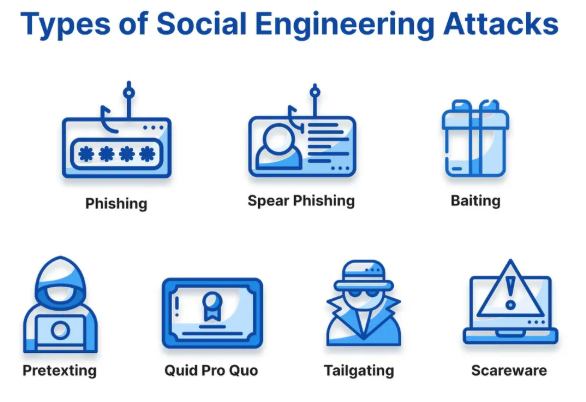
This diagram shows different social engineering techniques which include phishing and baiting and pretexting. The attacks depend on three elements which include manipulation and trust and social interaction to show that cybersecurity threats emerge from human behavior and social connections instead of technical security flaws.
Source: What Is Social Engineering in Cybersecurity? [Examples & Tips] | Hideez
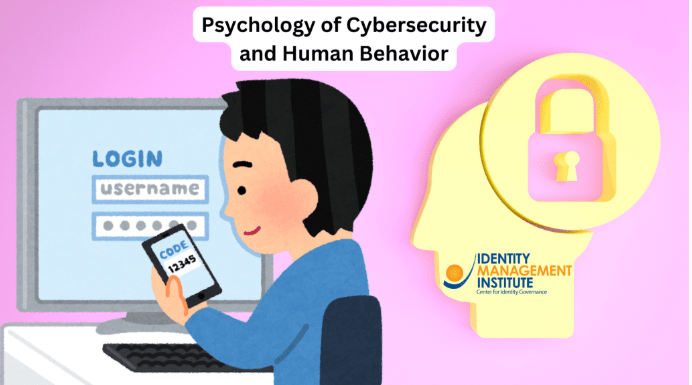
This image shows how cybersecurity relates to social science fields by demonstrating its links to psychology and sociology. The study of human behavior together with risk perception and group dynamics enables professionals to forecast and prevent cyber threats.
Source: Psychology of Cybersecurity and Human Behavior – Identity Management Institute®