Interpretive, Interpersonal, and Presentational Modes of Communication
Spanish is a beautiful language, with a rich history and culture. I feel that it is incredibly important these days to have an understanding of Spanish. For the average person, the ability to connect with someone who does not know your language can be very powerful. It shows that you are an open minded person, who is willing to learn things that are truly unfamiliar. In my line of work, construction, this logic of mine has paid dividends when it comes to asking my co workers to do something. I have been able to get my crews to work harder, and more efficiently, just by simply speaking to them in their language.

Reflecting on Spanish 102
In Spanish 101, I learned the very basis of what the Spanish language is. It gave me the tools that I needed to build a higher level of fluency in the language. Spanish 102 is what helped really bring me up to a conversational level. In the beginning of Spanish 102, I found myself being able to speak a lot better than I could understand. Working with primarily Spanish speaking people, it was very important to me that I could not only talk to them, but also understand what they were telling me.
This comes with challenges of all of its own. If a word is said to me in English that I do not know, I can use context clues to assume its meaning. When dealing with a language that feels like it is spoken at a faster pace, those context clues are often lost in the conversation on my end. That was my main focus this semester, to really be able to speed my brain up to be able to analyze what specific words are being said. Every day at work, I would pick apart what words were being said, sometimes asking my coworkers to repeat the same thing 2 or 3 more times. Eventually, I got better and better, having to ask for repeats less and less. That was, and probably still is my biggest weakness when it comes to Spanish, the ability to understand. But through repetition and practice, it is improving.
Spanish 102 did quite a few things for me this semester. First, it helped build my vocabulary. There are many new words that I have knowledge of now, that I did not in the beginning. Learning new words naturally expanded my conversations I have in real life. Learning new tenses also allowed me to speak more accuratley. I have a five year old daughter, and as she is learning to talk conversationally, I find myself correcting her in similar ways that I find myself correcting my own work in Spanish. Same goes for the conjugations that attach to the words. My coworkers seem to notice the same, and will begin conversations with me as opposed to me always starting the conversations. I think that this has to do with the fact that they can understand me better, and I have a lot more subjects that I can talk with them about!
Artifacts
Below is an attachment of a quiz we had where we needed to read a whole article about siestas. I was extremely proud of this assignment, because we not only needed to read an entire page of information, but also come up with our own conclusions about it. I could best equate it as a child knowing the word mom, but not understanding that it only applies to the female parent. When they understand that fact, it shows another level of understanding and literacy. In Spanish 1, I may have been able to read the words, but I would not be able to come to my own conclusions about the article due to a limited level of understanding.
Exploring Culture
When thinking of hispanic culture, the first thing that comes to my mind is food. American foods tend to be very plain and basic when it comes to flavor. The main things that Americans really enjoy is portion size, and texture. Hispanic foods tend to focus more on flavors, and appearnce, presenting a variety of colors and flavors.
I believe that the food is of such importance is because it is understood how well food brings people together. From my understanding, when a meal is served, the whole family comes to the table to eat. This helps bring everyone closer together. I think that because everyone is set around the food, it is important to a lot of people that the food itself looks nice. As to the flavors, they tend to the spicier side of the scale. I would like to know if this is because spices that are hotter grow better there, and are native to South America? If not, when did the food transition to a spicier variety, and what events led to this cultural shift.
Engaging in Communities
It is extremely important to engage with everyone in your community! A good community is one that takes care of itself, feeding a cycle of helping each other. If we fail to do that, then we do not grow as people. The ability to connect with people through language is extrememly important when building a close knit community.
Often, if someone speaks only Spanish, they will only stick around other native speakers. I do not know if it has to do with a lack of confidence, or fear of being discriminated against. I have had the same concerns when approaching someone who does not speak English, who I do not know, and attempt to speak to them in Spanish. I have learned, that through doing this though, it breaks down that barrier, and people open up. I also think that it is inspiring to everyone in the community. People who do not know Spanish will be inspired to learn it too, and because the barrier is broken down, the non English speakers may feel comfortable trying to speak in English, or at least be inspired to learn it. At my work, since leaning Spanish, there are several of my co workers who have begun practicing English!

Interpersonal Communication
TalkAbroad intimidated the heck out of me. Although I had a good idea of what to expect, the pressure of preforming was real. I would equate it to being in a hispanic country and you need to ask for directions. You know what to say, and how to say it but when someone is in front of you, and asking specific questions, you can get flustered. I really like the discussion boards, because I really enjoy the culture.
Talk Abroad was 2 way communication, and was extremely spontaneous. Almost to an uncomfortable degree. When I have the same form of communication with a co worker, I know their personality, what they like and don’t like, and how they just are as a person. I believe that many people would have a similar awkward experience meeting a stranger and having to talk to them in their own language. Our entrevistas is another form of 2 way communication, but is also intertwined with a one way communication in a presentational mode. There is a conversation that is happening, but it is relatively planned out. The discussion boards are also one way, but it is an interpretive mode. We are to study, and think about a certain subject, usually regarding to culture,
Presentational Speaking
The primary presentational activities that we preformed were the enntrevistas, and the voice threads. We would record ourselves talking in Spanish, non-conversationally.
The most challenged I was with these was using the voice threads. I feel that there was a lot of pressure to get the answers spot on perfect. The problem is, with a lot of my Spanish, is I think that I have picked up a lot of bad habits from conversations with my co workers. I also have a hard time remembering if what I am trying to say is something that we have learned yet. So when doing these presentations, I need to talk perfect, but the way that I feel most natural and comfortable speaking is often the incorrect way. I know that the way that class has taught us is the right form, but when I think about it so much, it causes me to stumble and stutter. I think that I most exceled at the entravistas, I don’t know what it was, but I felt really comfortable working with, and talking to my partner. Maybe it is because we just worked to each others strengths, and the conversations would flow, but we both did extremely well at it. Plus, it was a great chance to let my creativity to flow.
Presentational Writing
The presentational writing was mainly worked through was compositions. We would be given a sceniro, and have to write about it accordingly.
Compositional writing was always a fun/engaging assignment. This would again allow me to be creative and really get into what I was writing. The hard part about these was first, grammar and spelling. My confience for my spelling is really low, which is why I much prefer to speak. To me, it feels a lot less stressful. Luckily, the spanish alphabet is very phonetic, and most words can be spelled out exatcly how theyre said. Grammar at this point in the course, is something that I think that most people will struggle with when writing. Especially if there is no base of spanish from outside sources.
The main problem of mine, is that I can think out what I want to say, for example, the assignment is pretend you’re writing for your school paper, and talk about ten activities for students to do around campus. I can come up with a really good and in depth story about how I get black coffee in the winter time before class, and people watch while waiting for class. But sometimes, the story that I create does not work with the vocabulary that I know, and I often either get things completely wrong, or I revert back to the way that I speak to people in person which is very loose and disorganized.
Interpretive Listening
We would have segments on VHL, our tests, and quizzes where a story is told, without any words to read to follow. They were fun, challanging, and met my goals for the semester
Most of the Spanish that I listened to this semester was at work, as I spend at least an hour a day communicating in Spanish. For school however, the VHL recorded segments were the most difficult to do. Primarily the true or false. In the beginning of the semester I would have to read the question first, and then listen to the recording for the answer. As I mentioned, my listening skills were my main goal to improve this semester. By the end of the semester, I could more or less listen first, and recall bits of the information that was said. I may be able to answer a few questions per listen of the recording, a huge improvement from the beginning of the semester. I think that I overcame this issue by simply learning to identify the nouns and verbs in each sentence said, and not focus as much on the other parts of the sentence such as por, la, el etc. Essentially, I learned to digest large amounts of information, and condense it into memoizable bits of information.
Then, write a short reflection paragraph that includes the different things you listened to/heard this semester inside and outside of class or in the Language Learning Center or its website. Find a recording and add to this section; be sure to cite it. What was unclear or challenging for you? How did you overcome this difficulty? What did you find most interesting or compelling? What was your takeaway from the listening experience? How have you grown with each activity?
Interpretive Reading
We read a lot from the text book. One in particular was reading a informative article about siestas stands out to me.
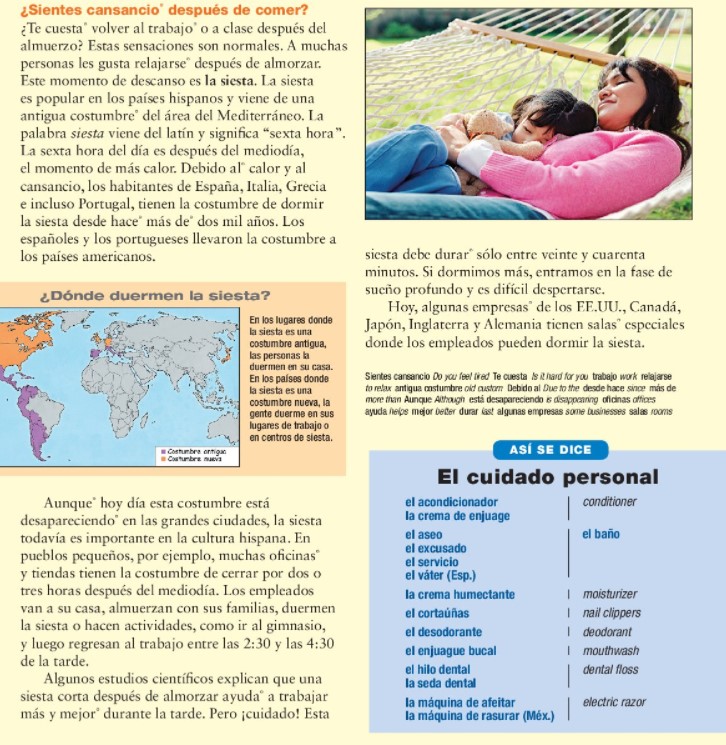
This whole article is about the siesta, and its importance to hispanic culture. I find this bit of insight into what life is like for them very interesting. I think that it is important for everyone to be able to read and understand what other cultures do. Reason being, we can learn a lot. If we see a society that is, for example, happier than ours is as a whole, and we wish to emulate that, we need to study what they do differently. This way, we can learn from their culture and work to change ours for the better with the influence and help from others cultures. The particular assignment was not exteremly challanging, because you needed to recall what was read in the article. However, A couple of the questions were more conseptual. So the article needed to be read and understood to a degree that your own concl;usions could be drawn. My main take away was the idea that yes, we need to understand what it is that we are reading, but more importantly, as a sign of mastering the language, we need to be able to understand it to a deeper level to come up with our wn unique thoughts and feelings about the subject we are reading. Reading is very enjoyable to me as opposed to listening because I can take my own time, and get a 100% understanding of the subject at hand. As opposed to a 50% understanding, and having to piece together the context.