

Work Samples
(L)eadership
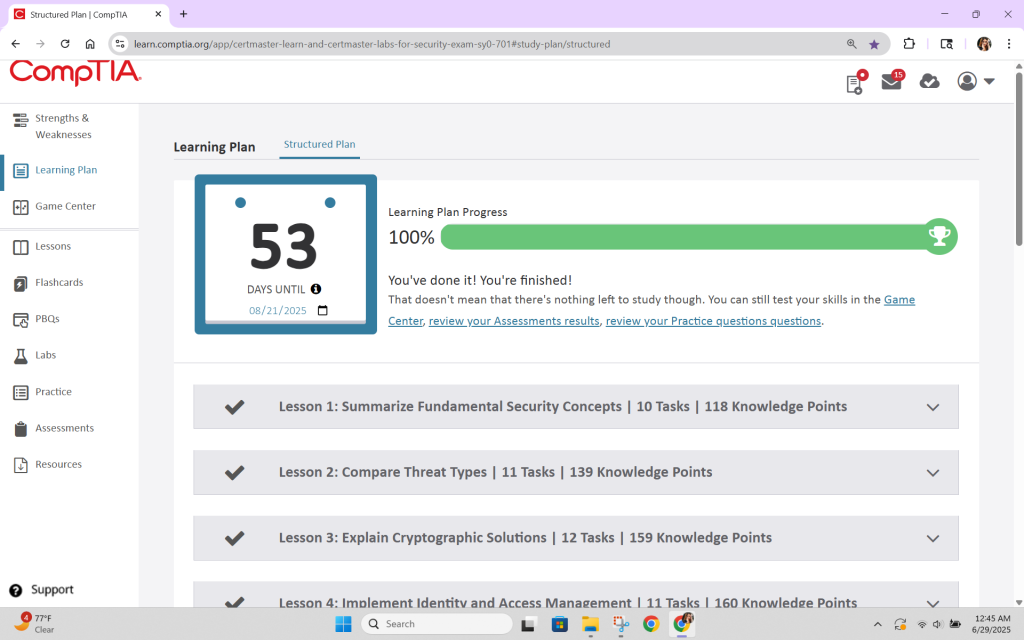
For my (L)eadership Course CPD 395 TCPS: CompTIA Security+, I completed an industry-recognized certification course focused on foundational and intermediate cybersecurity concepts. Although I no longer have direct access to my original coursework materials due to the course being hosted externally through CompTIA, the completion of this program required demonstrated understanding of key security principles, risk management, and real-world application of cybersecurity practices.
Throughout the course, I engaged with modules covering topics such as network security, threat identification, cryptography, identity management, and secure system design. One of the most impactful components of the course was learning how to assess vulnerabilities and implement appropriate mitigation strategies. For example, I developed the ability to evaluate different types of cyber threats, such as phishing attacks, malware, and social engineering, and determine how organizations can proactively defend against them through layered security approaches.
Additionally, the course emphasized leadership within cybersecurity environments, particularly in decision-making and responsibility when handling sensitive data and organizational risk. I learned how security professionals must not only understand technical systems but also communicate risks effectively and enforce policies that protect both users and infrastructure.
While I am unable to provide a traditional assignment or project sample, the successful completion of the CompTIA Security+ course itself serves as evidence of my competency in cybersecurity fundamentals. This experience strengthened my analytical thinking, attention to detail, and ability to apply security concepts in practical scenarios, all of which are essential skills in both leadership and technology-focused roles.
(e)lective
In my (e)lective course Online Deviance (CRJS 395), I completed several projects that focused on online investigations and digital research methods. This course was especially interesting because it introduced practical techniques used to investigate information on the internet. Through these assignments, I developed a stronger understanding of how digital footprints are created, how online information can spread across platforms, and how investigators are able to trace and analyze publicly available data.
One of the most impactful assignments in my (e)lective course involved conducting a self-investigation using the OSINT Framework. In the video for this project, I examined my own online presence using a variety of Open Source Intelligence (OSINT) tools. These tools allowed me to locate and analyze publicly available information, demonstrating how investigators can collect and connect data from multiple online sources. The goal of the assignment was to better understand how information that individuals share online can be discovered, linked together, and used in the context of an investigation.
This project helped strengthen my research, investigative, and critical thinking skills. It also provided valuable insight into how OSINT tools and techniques are used in real-world fields such as cybersecurity, digital forensics, and criminal investigations. Completing this assignment made the learning experience more engaging because it applied investigative methods in a hands-on way. Overall, my (e)lective course further developed my interest in online investigations and digital intelligence gathering.
https://drive.google.com/file/d/11Hstl2Za7Pe_bRIfVzrBRxhBjwLqN5yc/view?usp=sharing
(A)cademic Internship
Access the link below that will direct you to my CYSE 368 Cybersecurity Internship.
(E)ntrepreneurship
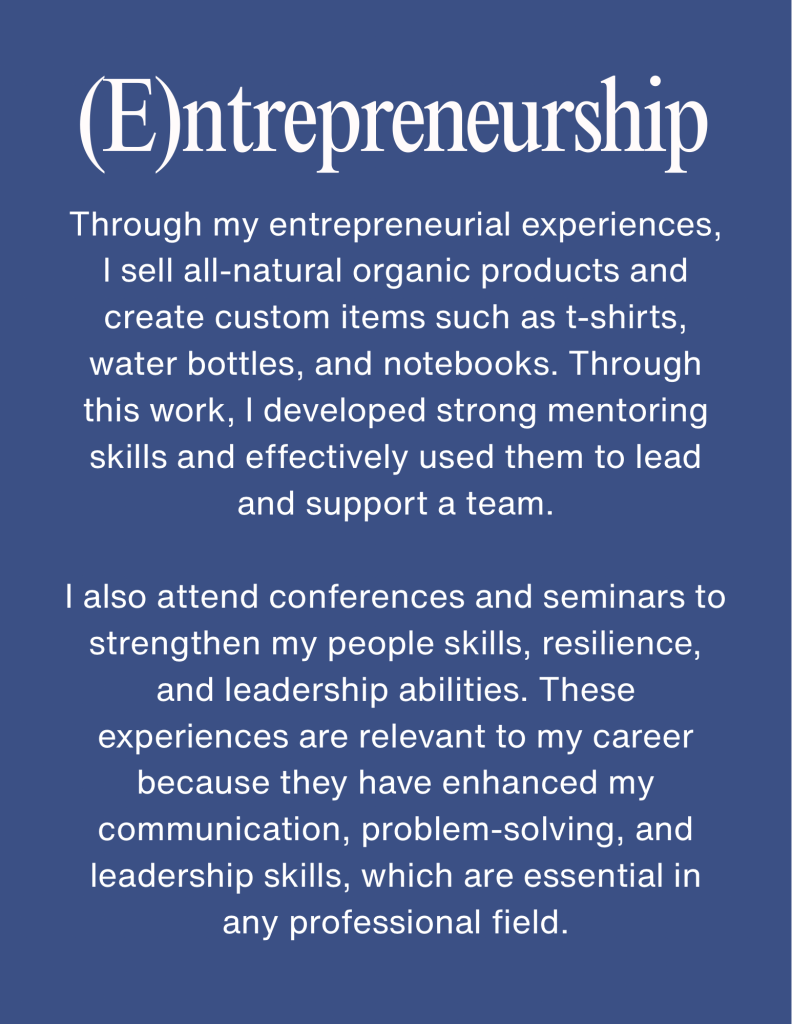
For my (E)ntrepreneurship work sample, I gained hands-on experience by selling all-natural organic products and creating custom items such as t-shirts, water bottles, and notebooks. Through this business, I developed skills in product development, marketing, customer service, and overall business management.
I also strengthened my leadership abilities by mentoring and supporting my team, helping them stay motivated and improve their performance. In addition, attending conferences and seminars allowed me to build my communication skills, resilience, and professional mindset.
Overall, these entrepreneurial experiences have helped me grow in communication, problem-solving, and leadership, which are essential skills that I will continue to use in my future career.Below you will see picture of products I’ve created including my clothing brand, custom notebooks, and a business conference I attended with over 15,000 people.

My Clothing Brand

Business Conference
^Link to my business page on Instagram
(R)esearch
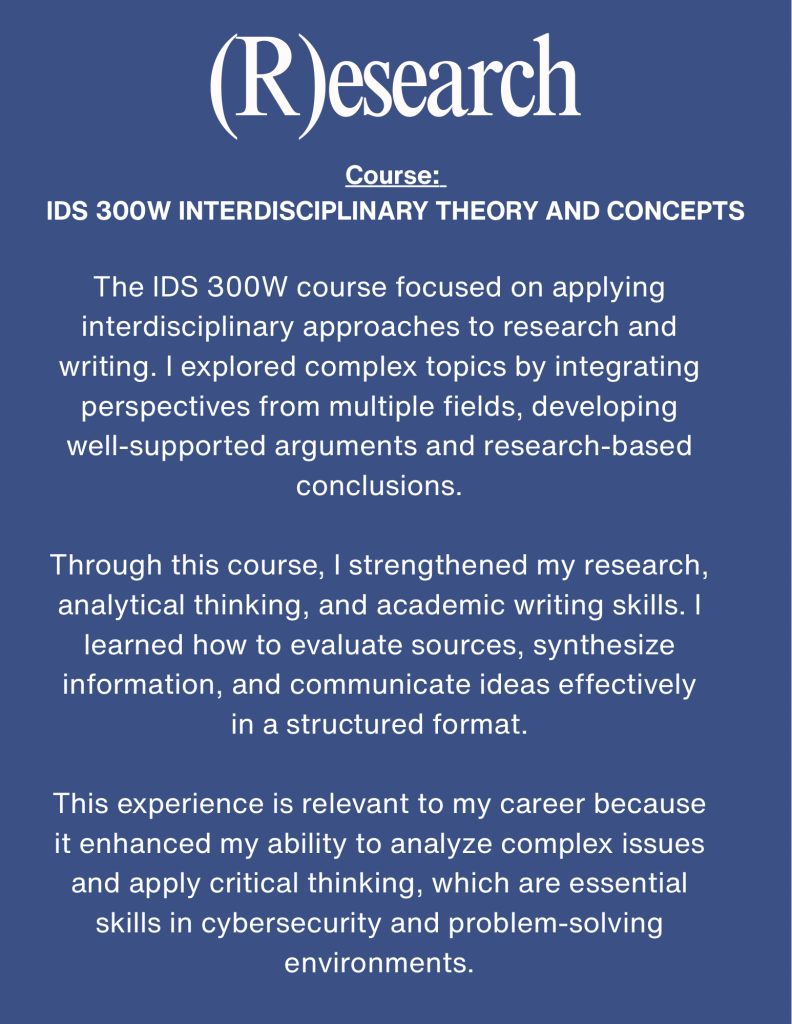
For my (R)esearch work sample in IDS 300W Interdisciplinary Theory and Concepts, I am highlighting my paper titled “Interdisciplinary Research: A Multi-Perspective Approach to Computer Science, Law, and Psychology.” This paper explores how cybersecurity and digital forensics can be better understood by combining the disciplines of Computer Science, Law, and Psychology to examine digital evidence, investigative procedures, and human behavior in cybercrime cases.
As a senior Cybersecurity major with a minor in Cybercrime at Old Dominion University, this research allowed me to apply an interdisciplinary approach using Repko and Szostak’s 10 step method to demonstrate how technical systems, legal frameworks, and psychological behavior work together in modern digital investigations.
(W)riting
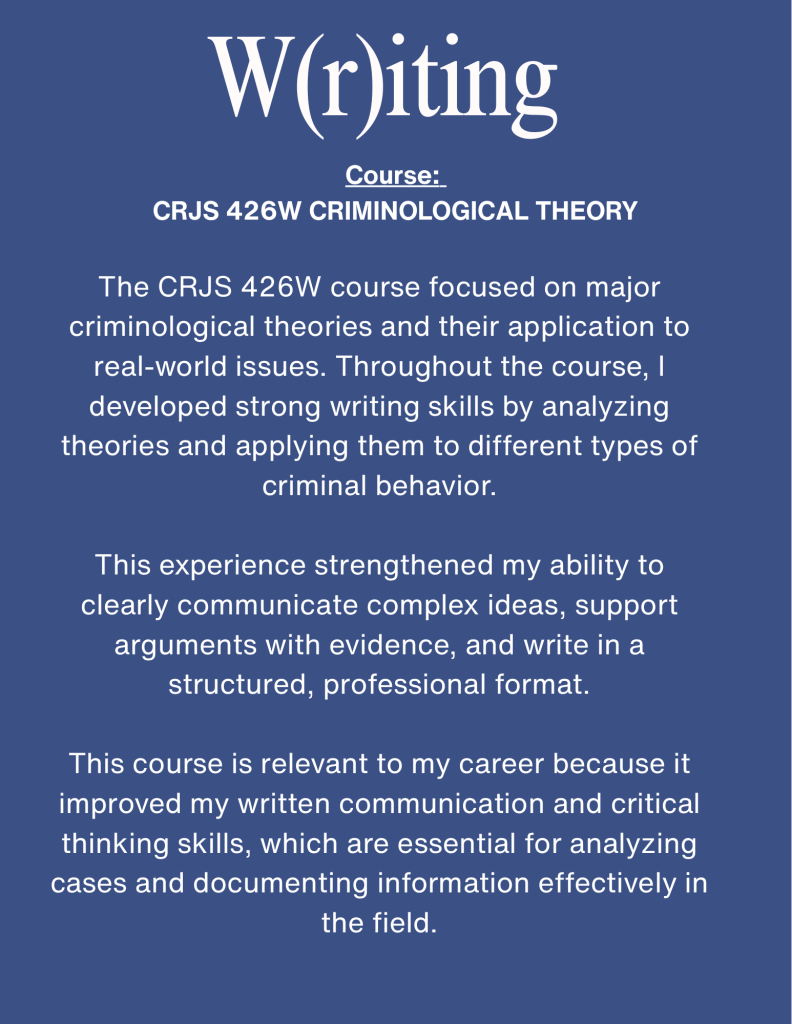
For my (W)riting work sample in CRJS 426W Criminological Theory, I studied major criminological theories and applied them to real-world criminal justice issues. This course helped me strengthen my ability to analyze theories, use evidence to support arguments, and communicate ideas in a clear and organized way.
The work sample I selected is a Current Policy Summary on Mandatory Arrest in Domestic Violence Cases. This paper examines how mandatory arrest laws developed, their impact on policing domestic violence, and their effectiveness based on research findings.
Overall, this assignment improved my writing, critical thinking, and ability to clearly communicate complex criminal justice concepts, which are important skills for my future career.