Exploring Culture
LingroLearning provides students with the opportunity to learn about other cultures through the Exploración Cultural activities. They consist of a section of general information about Spanish speaking countries and provide examples of how people in these other countries live.
La vida universitaria en los países hispanos, Exploración 4-1 ¿Quién?
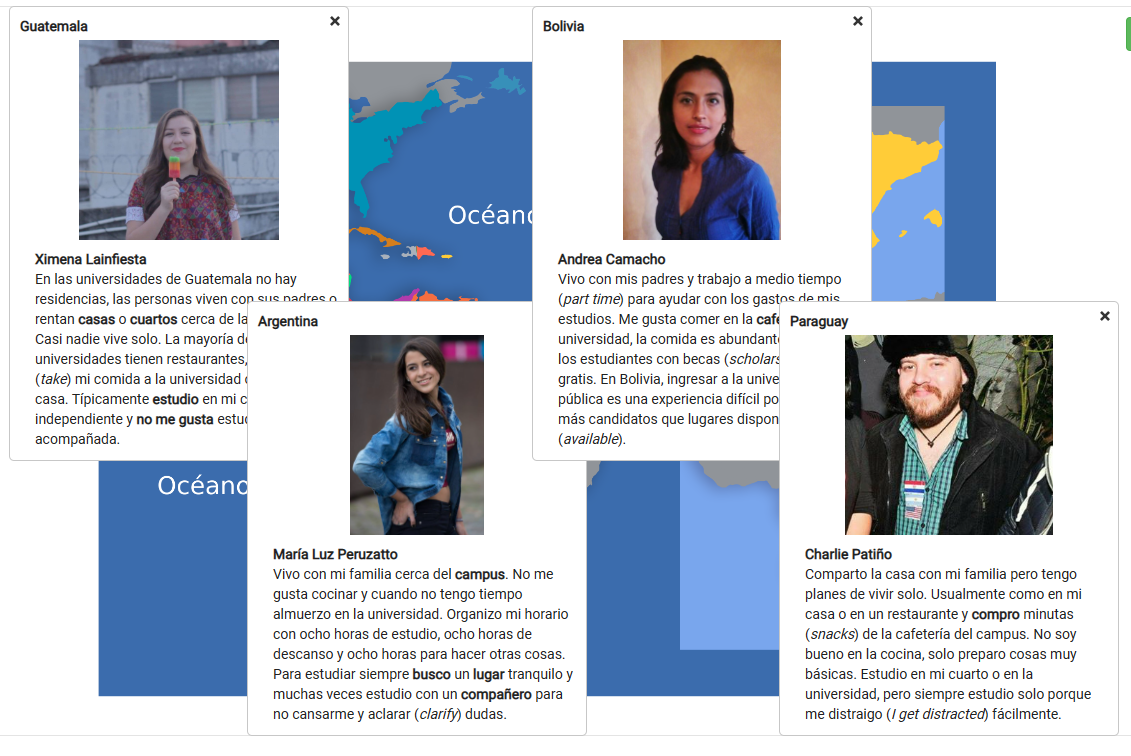
¿Sabes que hay más de 20 millones de personas que estudian en universidades en el mundo hispano actualmente? La experiencia de estos estudiantes es diferente de país a país, pero en general no hay residencias estudiantiles en las universidades y en muchos casos los estudiantes viven con sus familias mientras van a la universidad. El 70% de los estudiantes universitarios en América Latina son los primeros en su familia en asistir a la universidad. Muchos estudiantes trabajan para ayudar a sus familias o para pagar sus estudios. Lee sobre cuatro colaboradores culturales que comparten su experiencia como estudiantes universitarios.
These sections were helpful for me to compare how I live with other countries, as well as compare other Spanish speaking countries to each other. There are many Spanish speaking countries, all with their own rich and unique culture, so it is important to learn the distinctions between them.
Engaging in Communities
Engaging in your local community is important for personal development, as well as the development of communal ties. I like to practice Spanish with my daughter, and she enjoys reading Spanish stories from The Fable Cottage with me. She likes to practice what she has learned with her Latinx classmates at school and that helps create a cultural connection between them. I’m also an assistant Girl Scout troop leader and enjoy sharing The Fable Cottage videos with my troop. As a mother I believe it’s important to pass on knowledge, like languages, to the younger generation and cultivate a love for other cultures early in life.
Interpersonal Communication
LingroHub has Conversar activities which act as a forum in each section that allow for students to interact with each other and compare information. These usually consist of a student creating a post and other students reacting and sharing their opinion, similar to social media.
Conversar-4-25-Foro-de-conversacion_-¿Como-es-la-universidad_-1Although these are not always the most effective exercises because they don’t allow for a lot of face-to-face conversational Spanish, they do encourage the spontaneous drafting of sentences and analyzing information in Spanish. This activity was helpful because it gave us a platform to discuss our university and what we like about it.
Presentational Speaking
For the Proyecto for unit 4, I made a video of my favorite places: the university orchid conservatory, the art student lounge and my home office. I enjoyed this project because it allowed me to be creative and expand my vocabulary to words that were relevant to my daily life.
The LingroLearning program is, understandably, geared towards what the average college student would want to speak about. However, because my life doesn’t reflect that of an average college student, this project allowed me to learn vocabulary that is more suited to my daily life. Part of what made this project enjoyable is also what made it challenging. I had difficulty knowing which word was most appropriate for my project in some cases. For example, there are many words that can be used for an orchid greenhouse, such as invernadero, vivero, jardín botánico, or jardín de orquídeas.
Presentational Writing
For LingroLearning, I created a project to show my schedule and reflect on my daily life. This included a completed calendar and short composition on how I spend my average week.
Proyecto3It was helpful for learning new vocabulary to put my schedule in Spanish into a calendar. The familiar calendar format made it easier to see vocabulary and recognize what that word was based on what time slot it was in. I enjoy having my schedule in Spanish and hope that I can continue with the practice. The most difficult part of this project was narrowing down what is the most important information to include in the synopsis of my weekly schedule. I had to reflect on what was the most relevant and important to me to include.
Interpretive Listening
LingroLearning’s Contresaña: Texto for each unit provides students with examples on what their project needs to look like. It also gives students the opportunity to read and listen to Spanish speakers in contexts that make sense.
This activity gave me the opportunity to hear other Spanish speakers. I struggle to understand spoken Spanish so this was especially helpful for understanding the vocabulary for this section. It also provided context and examples on how I wanted my project to be.
Interpretive Reading
The Exploración Cultural section in LingroLearning helped develop my skills for investigating other cultures in Spanish. These activities encourage you to do “wildcard” internet searches in Spanish to stretch your understanding of the language.
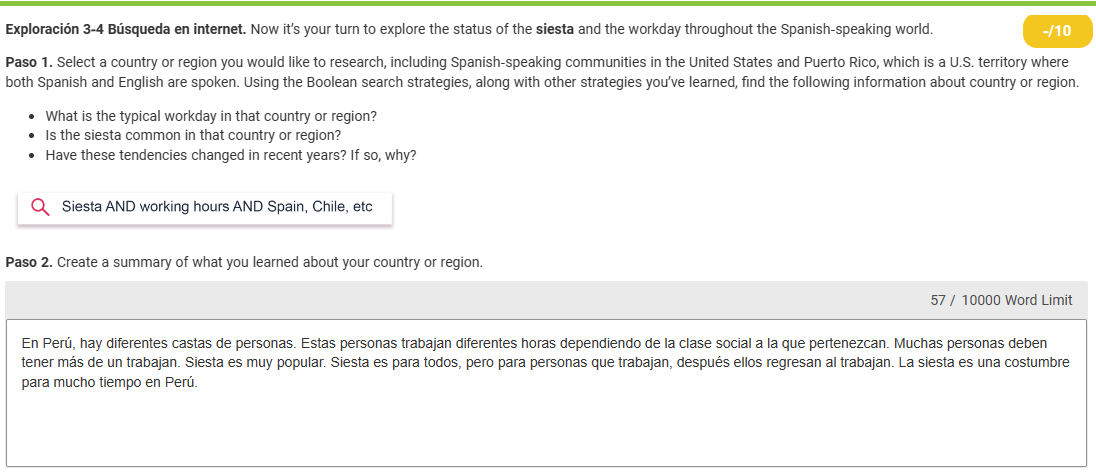
These activities encouraged me to practice my Spanish outside of the curriculum as well as investigate how other cultures live their daily lives. The Exploración Cultural sections in the curriculum allowed me to learn how people in Spanish speaking countries interact with technology, what their college life is like and how the typical workday is structured. These are common points of interest in many cultures, so knowing how to communicate about them makes it easier to make connections with other people in those countries. It was interesting to learn that dormir la siesta is still a valued tradition in Peru. It was sad to learn that even in these countries that practice la siesta there are still people who much work so hard that they still do not have time to partake in the tradition. This is particularly tragic in hot countries who practice la siesta as a way to rest during the hottest part of the day.