Interpretive, Interpersonal, and Presentational Modes of Communication
Exploring Culture
In the class, we discussed many topics that helped me understand cultural perspectives. These topics include stereotypes, traditions or customs, and cultural identity. For each of these topics, I identified how they were present in my own life and compared them to how they were present in Hispanic cultures. This helped me learn about stereotypes that other cultures have about the United States, the traditions and customs that other Hispanic cultures have, and the cultural identity that Latinx people in the United States. Cultural identity was shared through readings, videos, and poems. Stereotypes were shared through videos and class discussions. Traditions and customs were shared through readings as well.
The readings and poems helped me understand the values of Hispanic culture by teaching me what Hispanic cultures find important about their identity and traditions. The in-class discussions and projects helped me understand the values of my culture because I reflected on the traditions, stereotypes, and cultural identities that my culture has and why. I made a video and wrote an essay on stereotypes from where my hometown. I also made a video and wrote a paper on the Mexican tradition, Epifanía. These challenged my worldview because I was reminded that other cultures have stereotypes about the United States like we have stereotypes about them. I also learned about different holidays that we don’t celebrate in the United States. I found it a little challenging on reflecting whether or not the stereotypes were true because the United States is such a large country with a lot of different types of people that the stereotypes would be true in some places and false in other places. I did have to work through some misconceptions about Mexico. The media displays the people of Mexico as poor, and they talk about how many of them want to come to the United States, but in reality, a lot of Mexicans are proud of their culture and heritage.
Engaging in Communities
Reflect on your experience and participation in these communities. Include artifacts such as photos, audio/video clips, etc.
It is important to engage in our immediate community because we should know as much about our community as possible. Engagement will help us better know our community members, which will make the community stronger. There is power in numbers, so the more we know our community and work with the people in it, the better we can make our surroundings. It is also important to know about the global community. This will allow us to be more considerate of other communities, so we can share the world and its resources. It is especially important today because we can talk to anyone through the internet. Knowing more about these communities and being engaged in the global community will allow us to know about problems and events that are bigger than our own.
In class we engaged in global communities through our TalkAbroad assignments. Talking to native Spanish speakers from different countries allowed us to learn more about other communities in the world. I learned a lot about stereotypes and influencers in Spanish speaking countries. I engaged with my immediate community everyday in class when we would talk to each other and share our opinions and experiences. I learned about many of my classmates and what they enjoy doing. We talked about a variety of topics including hobbies, family, food, memories, and more.
Interpersonal Communication
Then, in a short paragraph or two, write a reflection that includes each type of the interpersonal (spontaneous, unplanned) communication activities: telecollaborative (TalkAbroad) conversations, discussion board posts, and any other interpersonal exchange. Explain how you’ve grown with each assignment/activity. What was difficult and how did you overcome that difficulty? What did you excel at and why/how? What/how did you learn from it and would you do differently next time?
This semester I did two fifteen minute TalkAbroad sessions. For these I talked to a native Spanish speaker about various topics. The first TalkAbroad I did in early October, and we talked about stereotypes. I did the second TalkAbroad in the middle of November, and we discussed influencers. I also had conversations with my classmates in class and commented on their projects.
The TalkAbroads helped me form my thoughts and communicate them on the spot in a smoother way. I am good at writing down sentences and phrases in Spanish, and catching my mistakes, but I need to work on doing that while speaking. I think the TalkAbroad allowed me to do this while discussing relevant topics. The first TalkAbroad I was a little under prepared because I filled out the parts of the workbook that I was supposed to before the conversation, but I never went back to them. For the second TalkAbroad I reviewed those sections multiple times before my conversation.
When I would comment on my classmates projects and videos I would have to think of something to say. I tried not to have the same response everytime, and in order to make it personal I would have to really pay attention to what they were discussing in their videos. This helped me become a better listener. It was difficult to think of things to say in the comments, but I tried to find my favorite part and say how I liked it. I also talked to my classmates during the class time. The hardest part of this was finding a partner to talk to. Sometimes I would look at someone to try to talk to them, but they wouldn’t look back at me. Eventually, I started inserting myself into groups of three or moving to talk to someone. I think this really helped my speaking because it helped my speech get smoother and less hesitant.
Presentational Speaking
The main presentational speaking we did was our videos for our projects at the end of the units. They were on a variety of topics and usually lasted 2-3 minutes. Then we would watch each other’s videos and leave comments.
My first presentation was on stereotypes. This one was pretty easy because I was talking about stereotypes people have of where I’m from. The hardest part was reaching the time minimum. The next presentation was also on the easier side because it was reading a poem aloud. The most difficult part was adding expression to certain parts of the poem to make it more interesting. The next presentation was on something that transformed my life. The hardest part was thinking of something that changed my life, but once I thought of something it was less challenging. The last presentation I did was a description of a Hispanic custom or tradition. The hardest part of this one was filling the time requirements, but other than that I chose a tradition I found interesting, so it was fun to make.
https://drive.google.com/drive/u/1/folders/1gCe6Scg3azJt5S4I6Lay4MTTSy2ea0p1
Presentational Writing
In class we would write about 250 words for each project. I did this for stereotypes of where I’m from, analyzing a poem, a summary of a text, and a story about a Hispanic tradition. I made a rough draft in class, and edited it to make a final copy later at home.
For the first time I knew what I wanted to write about, but my grammar was a little rusty because I hadn’t written a peice of text in Spanish for two years. The feedback on the rough draft really helped me with this. I think I did well communicating my overall thoughts. For the second one the hardest part was remembering my thoughts about the poem. I read it the night before and thought about what I was going to write, but it didn’t stick with me well through the night. To overcome this I just took my time and really thought about the poem when I was writing my rough draft. For the third writing, I had a hard time remembering the details of the story. We were not provided the story, so I had to trust my memory. For the last one, the hardest part was incorporating the vocabulary from that unit. I knew what I wanted to write about, so I was able to do the rest pretty well.
Interpretive Listening
Every unit we would have a text. Sometimes the text was a reading or a poem, but sometimes the text was a video. We would listen to the videos, and have to answer questions about them for the homework. Two examples are there was one about influencers and another that was a TED Talk about food.
The video about an influencer was fin to watch because it was an influencer that I had never heard of. It was hard to know what he was talking about all of the time because he used vocabulary that I had not heard yet. I thought it was really interesting how proud he was of being Romani because until I watched that video I had never heard or learned about someone who was Romani. A takeaway I got from the video was that influencers jobs are just as hard as other jobs, but in different ways. The video expanded my knowledge about influencers, and culture. The TED Talk was difficult to understand because Gastón Acurio speaks pretty fast. I had to watch some parts multiple times to understand it. I thought it was interesting how invested he is in food. He thinks he can do anything with food. I tookaway that change starts with one person. I learned about food and culture from this video.
Interpretive Reading
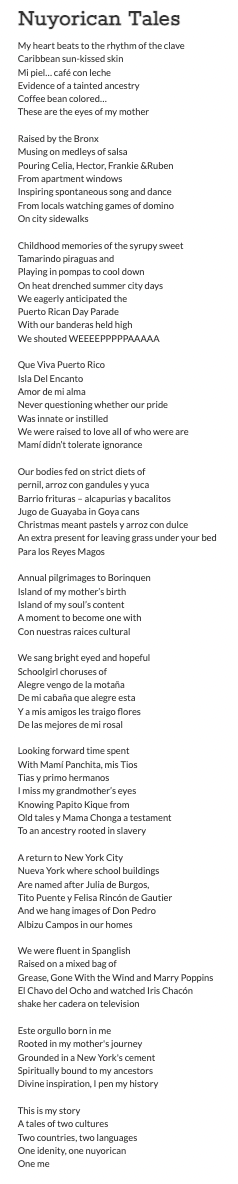
In class we had multiple readings including an article on Mexican culture, stories about a first generation college student and yerba mate, and a poem. We analyzed all of these and looked at their cultural significance.
For the article, it was challenging to read just because it was my first reading of Spanish for eighteen months. To overcome this I took my time and made sure I was understanding everything I was reading. I took away that stereotypes can be negative or positive, but it really depends on the person not the group if it is true. This helped me understand my culture and Hispanic cultures better. For both of the stories the hardest part was learning the new vocabulary. To overcome this I had the unit vocabulary open while I read the stories. I took away that life altering situations can be scary for everyone, and traditions are really important to cultures.This helped me learn more about what other people do in their lives. The hardest part of the poem was understanding Spanish poetry. I overcame this by reading it multiple times and looking at it like I would a poem in English. One take away is that many people are proud of their heritage even if it is complex. This taught me that people can have more than one way of identifying themselves.
https://centropr-archive.hunter.cuny.edu/centrovoices/letras/nuyorican-tales