Romanov Assignment Part A
Part I: History
1. Who were the Romanov’s (in Russian history)? The Romanovs ruled the country of Russia for 300 years. In 1917, the last ruling Russian Tsar, Nicholas II, abdicated his crown in favor of his brother Grand Duke Michael. He and his wife, the Tsarina Alexandra, and their five children: Olga, Tatiana, Maria, Anastasia, and the Tsarevich (Crown Prince) Alexis were held in exile in Yekaterinburg, Russia. The Romanov family was later executed on July 17, 1918, by the Ural Soviets.
2. Briefly outline the Romanov lineage. The accession of the first Romanov tsar Michael I began in 1613. Michael I’s grandson Peter I, also known as Peter the Great, assumed the position of Tzar and used it to expand Russia’s land and wealth. After Peter the Great’s death in 1725, Catherine II, Peter’s granddaughter, took the position and ruled until 1796. She was known as Catherine the Great during her rule over Russia. After her rule ended, Catherine the Great’s throne was taken up by Paul I in 1796. The years and title of tsar went on until Tzar Nicholas II accession to the throne in 1894. In 1917, the Romanov lineage ended with the Bolsheviks rising to power in the Russian Revolution where they killed Czar Nicholas II along with his entire family.
3. Nicholas II was the last Romanov to hold power in Russia. What was his title? Nicholas II’s official title was “Emperor and Autocrat of All the Russias.” His kingly title was “Tsar.”
4. What happened to Nicholas II? Why (from a geopolitical view)? Who then took control? Nicholas II abdicated from the throne, and he and his family were killed on July 17, 1918. It is speculated that Nicholas II was executed because of his poor leadership and poor economic and political policies. After his death, the Bolsheviks rose to power and Vladimir Lenin took over the throne.
5. Describe the family of Nicholas II. What happened to them? Nicholas II married his wife, the Tsarina Alexandra, and had five children: Olga, Tatiana, Maria, Anastasia, and the Tsarevich (Crown Prince) Alexis. Alexandra was a carrier for hemophilia and her only son, Alexis received the hemophilia gene. Nicholas II and his family were led to the cellar of the Ipatiev House where they were held and executed on July 17, 1918.
Part II: Hemophilia
6. How was Nicholas II wife, Alix, related to Queen Victoria of England? Alix was Queen Victoria’s granddaughter. Alix’s parents were Alice and Louis IV. Alice was Queen Victoria and Prince Albert’s daughter. Both Queen Victoria and Alix are designated as carriers for hemophilia.
7. In a couple of sentences, describe the disease hemophilia. Hemophilia is usually an inherited bleeding disorder in which the blood does not clot properly. This disease can lead to spontaneous bleeding as well as bleeding following injuries or surgery. Blood contains many proteins called clotting factors that can help to stop bleeding. Without these clotting factors, it is more likely that bleeding will occur which can lead to serious health problems. Hemophilia is caused by a mutation that provides instructions for making the clotting factor proteins needed to form a blood clot. These genes are located on the X chromosome. Males are more likely to have a disease like hemophilia if they inherit an affected X chromosome. Females are more likely to be carriers of this disease if they have one affected X chromosome.
8. What type of hemophilia (A or B) is (probably) represented in the pedigree chart? Hemophilia Type B is represented in the pedigree chart.
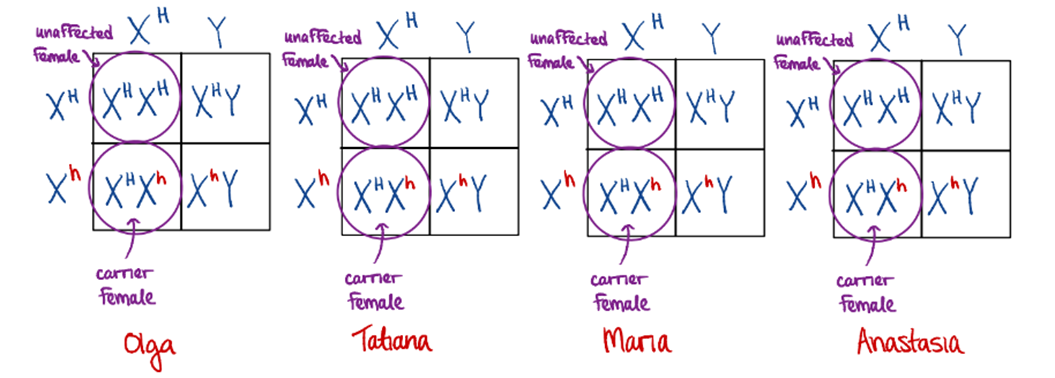
9. The Romanov’s son, Alexis, had hemophilia. Describe how Alexis genetically acquired hemophilia. (Use a Punnett square. You can either draw a table or line up the genotypes.) Alexei genetically acquired hemophilia from his mother, Alix who was a carrier of the hemophilia disease. He received the hemophilia gene through his mother’s recessive or affected X chromosome.
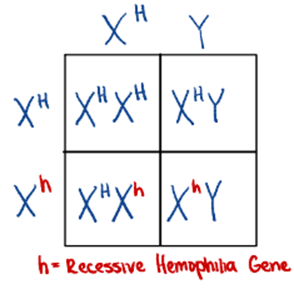
10. Using a Punnett square (again, draw a table or line up the genotypes), explain why only males in the pedigree chart have hemophilia. Only males can have the hemophilia disorder because they have only a single X chromosome; therefore, there is a 50% chance of them receiving the disorder. Men only have one X and one Y chromosome. Women have two X chromosomes. As a result, if a woman has the recessive Hemophilia X chromosome, they can only become a carrier with the other non-affected X chromosome that they have.
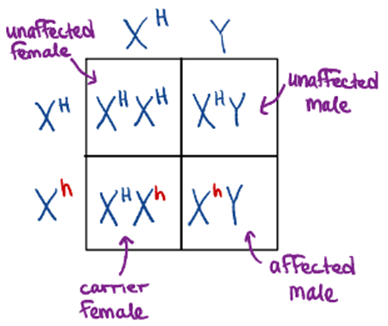
11. Is it possible for a female to inherit hemophilia, and, if so, how? It is possible for a female to inherit hemophilia. A female can inherit hemophilia if she inherits hemophilia alleles from both of her parents or if she inherits one hemophilia allele and her other X chromosomes is missing or does not work properly.
12. None of Alexis’ sisters are shown to have hemophilia. Using only the tools available at the time they lived, how could it have been determined whether they were carriers like their mother. If Alexis was suffering from hemophilia that means his mother was a carrier for the hemophilia gene which is X linked. His mother could have been exhibiting symptoms of hemophilia even if she was a carrier and her daughters could have had the same effects as she did if they were carriers as well.
13. Using a Punnett square (again, draw a table or line up the genotypes), what is the probability the daughter of a mother who is a carrier and a father who does not have the disease, will be a carrier? There is a 50% chance that the daughter of a mother who is a carrier and a father who does not have the disease will be a carrier.
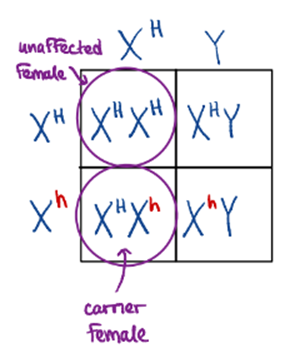
14. Using a Punnett square (again, draw a table or line up the genotypes), what is the probability that 4 daughters of a mother who is a carrier and a father who does not have the disease, will be a carrier? There is a 50% chance that the 4 daughters of a mother who is a carrier and a father who doe not have the disease will be carriers.
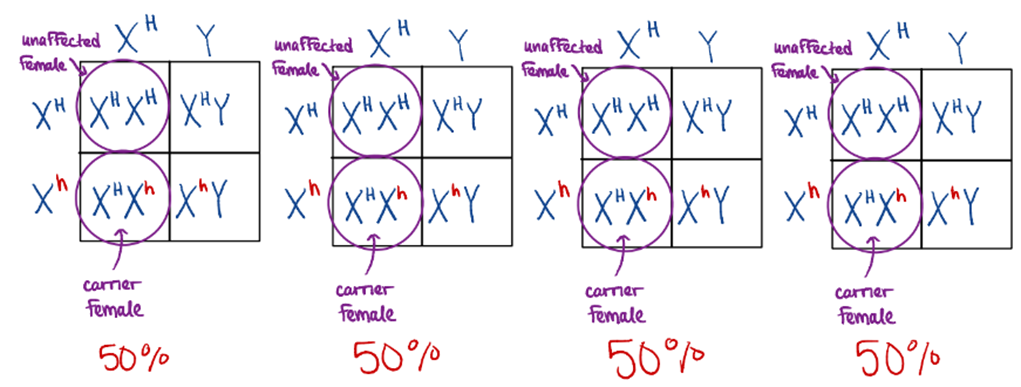
15. Using a Punnett square (again, draw a table or line up the genotypes), explain why none of Alexi’s sisters had hemophilia. None of Alexis’s sisters had hemophilia because their mother’s recessive X chromosome and their father’s nonaffected X chromosome allowed them to not inherit or become carriers of hemophilia.
16. Some historians speculate that Alexis’ hemophilia condition could have led to the Russian Revolution. Explain. You probably want to look up the faith healer Rasputin. Rasputin won the favor of Czar Nicholas II and Czarina Alexandra through his ability to stop the bleeding of their hemophiliac son, Alexis. Rasputin exerted an influence on the ruling family of Russia which made the public question those in power. This fed into the public’s resentment of the Russian monarchy which could have led to the Russian Revolution.
References
A&E Television Networks. (2009, November 16). Rasputin is murdered. History.com. Retrieved January 30, 2023, from https://www.history.com/this-day-in-history/rasputin-is-murdered
BBC. (n.d.). Political problems – reasons for the February Revolution, 1917 – higher history revision – BBC bitesize. BBC News. Retrieved January 30, 2023, from https://www.bbc.co.uk/bitesize/guides/ztyk87h/revision/2
Centers for Disease Control and Prevention. (2022, August 1). What is hemophilia. Centers for Disease Control and Prevention. Retrieved January 30, 2023, from https://www.cdc.gov/ncbddd/hemophilia/facts.html#:~:text=What%20is%20Hemophilia%3F,-Espa%C3%B1ol%20(Spanish)&text=Hemophilia%20is%20usually%20an%20inherited,can%20help%20to%20stop%20bleeding.
Centers for Disease Control and Prevention. (2022, August 1). How hemophilia is inherited. Centers for Disease Control and Prevention. Retrieved January 30, 2023, from https://www.cdc.gov/ncbddd/hemophilia/inheritance-pattern.html#:~:text=A%20female%20can%20also%20have,or%20does%20not%20work%20properly.
Nicholas II of Russia. British Library. (n.d.). Retrieved January 30, 2023, from https://www.bl.uk/people/nicholas-ii-of-russia#:~:text=Nicholas%20II%20was%20the%20last,Autocrat%20of%20All%20the%20Russias’.
Romanov Family Tree. The Museum of Russian Art. (2015, November 29). Retrieved January 30, 2023, from https://tmora.org/online-exhibitions/dinner-with-the-tsars-russian-imperial-porcelain/introduction/romanov-family-tree/#jp-carousel-1498